South Africa’s very suspect plan for vendor-financed nuclear power
 A nuclear tale that sounds too good to be true Business Day BY CAROL PATON, 15 SEPTEMBER 2014, BUILD now, pay much later. That is the good news story about nuclear energy being told to SA’s decision-makers. In this model, a nuclear vendor and a financier — usually the government of the country of the vendor or a state-owned enterprise or bank — come as a package. The loan from the financier is repaid from the electricity tariff over the long term, 15 to 20 years, and repayments begin when electricity is produced.
The vendor-financed option has made the scary R1-trillion price tag, wielded by Department of Energy and Treasury officials as a warning to their political principals, disappear in a puff of smoke. The nuclear option appears even more attractive when vendors move onto the next part of the story: as operating costs for nuclear energy are low, and the expense lies in construction, once the loan is repaid, energy becomes a virtual “cash cow” for the operator, and any private investors, for up to 30 years………
The clear frontrunners in this are French company Areva and Russian state-owned enterprise Rosatom. Both offer technology and finance in one package, with some differences. At the heart of both is a power purchase agreement in which the operator of the grid, Eskom, would make an irrevocable commitment to purchase the electricity at an agreed tariff………
An important part of the financing package for vendors interested in SA is the government’s commitment in the nuclear policy of 2008 to a fleet approach. Vendors are able to offer better prices if a fleet of reactors is procured as they get better at building them. Some vendors will not consider SA at all without a fleet procurement.
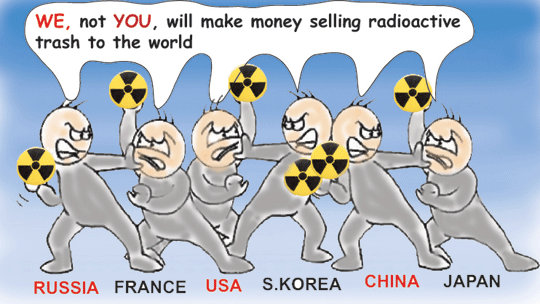
This is what lies behind SA’s curious decision in the IRP 2010, SA’s electricity plan, to include 9,600MW of nuclear power in the energy mix. This would amount to a fleet of six Areva reactors (or more, if other vendors with smaller reactors are selected). As electricity demand is far from certain, and has not grown as expected over the past two years or more, overbuilding capacity is a risk.
Independent analysts, such as Prof Harald Winkler of the University of Cape Town, argue that even a nuclear fleet would be more expensive than other options and would lock SA into even higher electricity prices with negative effects on the economy.
Costs such as insurance in the event of a nuclear accident, dealing with the waste, and decommissioning the plant, are not built into the construction prices.
The conclusion of all of this is that the magnitude of the government guarantees required in a R400bn-R800bn nuclear plant building exercise remain very difficult to estimate. Whatever the size of the guarantee and its purpose — for construction or as a guarantee to purchase the power — it would have to find its way onto SA’s contingent liabilities……..
Despite the good “build now, pay later” message being punted by nuclear vendors, the probability is that it will be business and consumers that not only pay later, but pay much more. http://www.bdlive.co.za/business/energy/2014/09/15/news-analysis-a-nuclear-tale-that-sounds-too-good-to-be-true
No comments yet.
1 This Month
5 January -Webinar-What is Trump’s Golden Dome?
REGISTER AT Massachusetts Peace Action Education

New book – https://www.amazon.com/dp/1923372157?utm_source=substack&utm_medium=email
Now until to February 10, 2026 Radioactive waste storage in France: the debate is finally open! How to participate?
-
Archives
- January 2026 (51)
- December 2025 (358)
- November 2025 (359)
- October 2025 (377)
- September 2025 (258)
- August 2025 (319)
- July 2025 (230)
- June 2025 (348)
- May 2025 (261)
- April 2025 (305)
- March 2025 (319)
- February 2025 (234)
-
Categories
- 1
- 1 NUCLEAR ISSUES
- business and costs
- climate change
- culture and arts
- ENERGY
- environment
- health
- history
- indigenous issues
- Legal
- marketing of nuclear
- media
- opposition to nuclear
- PERSONAL STORIES
- politics
- politics international
- Religion and ethics
- safety
- secrets,lies and civil liberties
- spinbuster
- technology
- Uranium
- wastes
- weapons and war
- Women
- 2 WORLD
- ACTION
- AFRICA
- Atrocities
- AUSTRALIA
- Christina's notes
- Christina's themes
- culture and arts
- Events
- Fuk 2022
- Fuk 2023
- Fukushima 2017
- Fukushima 2018
- fukushima 2019
- Fukushima 2020
- Fukushima 2021
- general
- global warming
- Humour (God we need it)
- Nuclear
- RARE EARTHS
- Reference
- resources – print
- Resources -audiovicual
- Weekly Newsletter
- World
- World Nuclear
- YouTube
-
RSS
Entries RSS
Comments RSS
 nuclear-news
Leave a comment