An insight onto the nuclear industry’s manipulations to shift their cost burdens
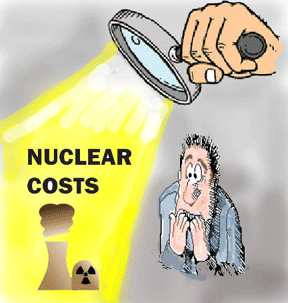 Vendors adapt to financing role World Nuclear News, 5 September 2014 Nuclear power reactor vendors have been forced to adapt to the fact that governments are no longer willing to assume the financial risks associated with nuclear new build projects, Jerry Hopwood, vice president of product development at Candu Energy, said on 12 September….
Private sector models are difficult to execute for nuclear projects due to first-of-a-kind issues, their large capital requirement, long construction timescales and investor return expectations. But they can work within a positive framework of incentives – for example the UK’s contract for difference model, he said..
Several emerging markets are still developing state-owned models, but are incorporating mechanisms where risks are placed with the appropriate parties, such as nuclear initial public offerings and build-own-operate-transfer.
“Public-private partnership seems to be where the sector is going,” he said.
Public-private partnerships
This combination means a project is financed by both the government and a private investor, with the public share able to attract export credit. Such a model requires a power purchase agreement matched to debt obligations and the project risks are allocated between government agencies and private companies.
Regulatory and technology risks are “two separate sides to the same coin,” he said. Other risks include engineering, supply and project management; technical services; skilled labour and availability and rates; training and commissioning, and lifetime operational support.
Government sponsored financial incentives encourage private sector companies to take increased financial responsibility for nuclear new build projects.
These include contracts for difference and power purchase agreements, loan guarantees, export credits, carbon credits, and cost and schedule overruns.
“Vendors play a critical role in the success of the public-private partnership model by focusing on key areas, which are project risk reduction and regulatory feedback. No matter how the risks are allocated, if they are too high, you won’t get the financing,” he said…….
Collaboration
“Working closely with regulators, vendors can ensure that reactor designs meet safety and environmental standards before project deployment,” he said. “A vendor pre-project design review of a new nuclear power plant allows the regulatory body an opportunity to assess a design prior to any licensing activities and to identify potential issues that would require resolution.”
Further co-ordination between regulators, either bilaterally or through multi-lateral forums, such as MDEP [Multinational Design Evaluation Program], can help to harmonize views and mitigate risks. In that way a design qualified in the home country can be used elsewhere. We need regulatory cooperation across the world,” he said.
The success of future new build projects is “imperative” to ensure the long-term sustainability and growth of the industry, he said. “Failure is not an option.“……
Vendor-led financing is not sustainable in the long term, Hopwood said.
“I think it’s a sort of kick starting mechanism, a way to get projects going so that we start to have a track record,” he told World Nuclear News. “Whether it be in a big way or a small way, it’s showing vendor commitment and it’s getting some projects on the books and going and creating a track record and that’s the value of it and necessarily it must lead to more.”
“If we picture a world with many nuclear projects going ahead – there are 71 nuclear units under construction at the moment – the financing requirement is far more than any vendor or even any individual utility can finance, so financing has to come from aggregating from many sectors in order to have a flourishing nuclear industry. The demand for money is going to be so great that it will necessarily require us to seek out all sorts of funding, all kinds of capital formations,” he said. http://www.world-nuclear-news.org/NN-Vendors-adapt-to-financing-role-1509201401.html
No comments yet.
1 This Month
5 January -Webinar-What is Trump’s Golden Dome?
REGISTER AT Massachusetts Peace Action Education

New book – https://www.amazon.com/dp/1923372157?utm_source=substack&utm_medium=email
Now until to February 10, 2026 Radioactive waste storage in France: the debate is finally open! How to participate?
-
Archives
- January 2026 (51)
- December 2025 (358)
- November 2025 (359)
- October 2025 (377)
- September 2025 (258)
- August 2025 (319)
- July 2025 (230)
- June 2025 (348)
- May 2025 (261)
- April 2025 (305)
- March 2025 (319)
- February 2025 (234)
-
Categories
- 1
- 1 NUCLEAR ISSUES
- business and costs
- climate change
- culture and arts
- ENERGY
- environment
- health
- history
- indigenous issues
- Legal
- marketing of nuclear
- media
- opposition to nuclear
- PERSONAL STORIES
- politics
- politics international
- Religion and ethics
- safety
- secrets,lies and civil liberties
- spinbuster
- technology
- Uranium
- wastes
- weapons and war
- Women
- 2 WORLD
- ACTION
- AFRICA
- Atrocities
- AUSTRALIA
- Christina's notes
- Christina's themes
- culture and arts
- Events
- Fuk 2022
- Fuk 2023
- Fukushima 2017
- Fukushima 2018
- fukushima 2019
- Fukushima 2020
- Fukushima 2021
- general
- global warming
- Humour (God we need it)
- Nuclear
- RARE EARTHS
- Reference
- resources – print
- Resources -audiovicual
- Weekly Newsletter
- World
- World Nuclear
- YouTube
-
RSS
Entries RSS
Comments RSS
 nuclear-news
Leave a comment