Why did Canadian government stop testing seafoods for radioactive contamination?
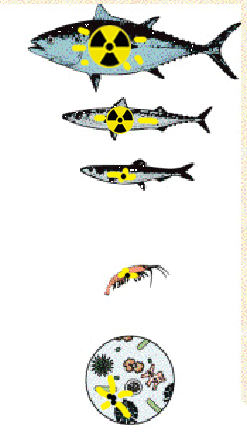
 School Science Project Reveals High Levels Of Fukushima Nuclear Radiation in Grocery Store Seafood Investment Watch By Michael Snyder March 27th, 2014 A Canadian high school student named Bronwyn Delacruz never imagined that her school science project would make headlines all over the world. But that is precisely what has happened. Using a $600 Geiger counter purchased by her father, Delacruz measured seafood bought at local grocery stores for radioactive contamination. What she discovered was absolutely stunning. Much of the seafood, particularly the products that were made in China, tested very high for radiation. So is this being caused by nuclear radiation from Fukushima? Is the seafood that we are eating going to give us cancer and other diseases? The American people deserve the truth, but as you will see below, the U.S. and Canadian governments are not even testing imported seafood for radiation. To say that this is deeply troubling would be a massive understatement.
In fact, what prompted Bronwyn Delacruz to conduct her science project was the fact that the Canadian government stopped testing imported seafood for radiation in 2012…
Alberta high-school student Bronwyn Delacruz loves sushi, but became concerned last summer after learning how little food inspection actually takes place on some of its key ingredients.
The Grade 10 student from Grande Prairie said she was shocked to discover that, in the wake of the 2011 Fukushima nuclear disaster in Japan, the Canadian Food Inspection Agency (CFIA)stopped testing imported foods for radiation in 2012.
And what should be a major red flag for authorities is the fact that the seafood with the highest radiation is coming from China… Armed with a $600 Geiger counter bought by her dad, Delacruz studied a variety of seafoods – particularly seaweeds – as part of an award-winning science project that she will take to a national fair next month.
“Some of the kelp that I found was higher than what the International Atomic Energy Agency sets as radioactive contamination, which is 1,450 counts over a 10-minute period,” she said. “Some of my samples came up as 1,700 or 1,800.”
Delacruz said the samples that “lit up” the most were products from China that she bought in local grocery stores.
It is inexcusable that the Canadian government is not testing this seafood. It isn’t as if they don’t know that it is radioactive. Back in 2012, the Vancouver Sun reported that cesium-137 was being found in a very high percentage of the fish that Japan was selling to Canada…
• 73 percent of the mackerel
• 91 percent of the halibut
• 92 percent of the sardines
• 93 percent of the tuna and eel
• 94 percent of the cod and anchovies
• 100 percent of the carp, seaweed, shark and monkfish
So why was radiation testing for seafood shut down in Canada in 2012?
Someone out there needs to answer some very hard questions……..http://investmentwatchblog.com/school-science-project-reveals-high-levels-of-fukushima-nuclear-radiation-in-grocery-store-seafood/
No comments yet.
1 This Month


Tell the Ukrainian Government to Drop Prosecution of Peace Activist Yurii Sheliazhenko

Petition to revoke the licensing of the Near Surface Nuclear Disposal Facility (NSDF) at Chalk River. https://www.ourcommons.ca/petitions/en/Petition/Details?Petition=e-7247


of the week – STOP SMALL MODULAR REACTORS IN CANADA
To see nuclear-related stories in greater depth and intensity – go to https://nuclearinformation.wordpress.com
-
Archives
- March 2026 (193)
- February 2026 (268)
- January 2026 (308)
- December 2025 (358)
- November 2025 (359)
- October 2025 (376)
- September 2025 (258)
- August 2025 (319)
- July 2025 (230)
- June 2025 (348)
- May 2025 (261)
- April 2025 (305)
-
Categories
- 1
- 1 NUCLEAR ISSUES
- business and costs
- climate change
- culture and arts
- ENERGY
- environment
- health
- history
- indigenous issues
- Legal
- marketing of nuclear
- media
- opposition to nuclear
- PERSONAL STORIES
- politics
- politics international
- Religion and ethics
- safety
- secrets,lies and civil liberties
- spinbuster
- technology
- Uranium
- wastes
- weapons and war
- Women
- 2 WORLD
- ACTION
- AFRICA
- Atrocities
- AUSTRALIA
- Christina's notes
- Christina's themes
- culture and arts
- Events
- Fuk 2022
- Fuk 2023
- Fukushima 2017
- Fukushima 2018
- fukushima 2019
- Fukushima 2020
- Fukushima 2021
- general
- global warming
- Humour (God we need it)
- Nuclear
- RARE EARTHS
- Reference
- resources – print
- Resources -audiovicual
- Weekly Newsletter
- World
- World Nuclear
- YouTube
-
RSS
Entries RSS
Comments RSS
 nuclear-news
Leave a comment