The surreal problem of Chernobyl’s forests not decaying properly
 The Woods Around Chernobyl Aren’t Decaying GEOFF MANAUGH http://www.gizmodo.com.au/2014/03/the-woods-around-chernobyl-arent-
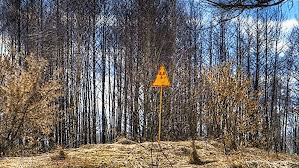
 decaying/ 19 Mar 14, Like a landscape of the undead, the woods outside Chernobyl are having trouble decomposing. The catastrophic meltdown and ensuing radiation blast of April 1986 has had long-term effects on the very soil and ground cover of the forested region, essentially leaving the dead trees and leaf litter unable to decompose. The result is a forest full of “petrified-looking pine trees” that no longer seem capable of rotting. Indeed, Smithsonian reports, “decomposers — organisms such as microbes, fungi and some types of insects that drive the process of decay — have also suffered from the contamination. These creatures are responsible for an essential component of any ecosystem: recycling organic matter back into the soil.”
All of that now has been slowed way down, as explored in a new study led by University of South Carolina biologist Timothy Mousseau, just published in Oecologica.Mouseeau and his colleagues explain that they would normally expect to see between 70 per cent and 90 per cent loss of dead plant matter over the course of a year as the discarded leaves and branches are consumed by local microbes; however, at the various test points they established throughout the Chernobyl forested region, the sampled vegetation had lost less than 40 per cent over the same time frame.
This means the woods are decaying approximately twice as slowly, stretching out their  period of decay for years, if not decades, and, in the process, piling up fuel for future forest fires.
As Smithsonian also mentions, this is perhaps the most worrisome aspect of all of this, and all the more reason to be concerned about the radioactive side-effects of such a fire: “Other studies have found that the Chernobyl area is at risk of fire, and 27 years’ worth of leaf litter, Mousseau and his colleagues think, would likely make a good fuel source for such a forest fire. This poses a more worrying problem than just environmental destruction: Fires can potentially redistribute radioactive contaminants to places outside of the exclusion zone, Mousseau says. ‘There is growing concern that there could be a catastrophic fire in the coming years,’ he says.”
Either way, there is something immensely surreal in this dream-like vision of a dead forest that simply cannot decay, its branches lifeless yet ever-present, petrified or fossilized in place, its carpet of leaves always growing deeper and seeming to never go away.
No comments yet.
1 This Month

of the week – Shut Down Drone Warfare!


Tell the Ukrainian Government to Drop Prosecution of Peace Activist Yurii Sheliazhenko

Petition to revoke the licensing of the Near Surface Nuclear Disposal Facility (NSDF) at Chalk River. https://www.ourcommons.ca/petitions/en/Petition/Details?Petition=e-7247
To see nuclear-related stories in greater depth and intensity – go to https://nuclearinformation.wordpress.com
-
Archives
- March 2026 (251)
- February 2026 (268)
- January 2026 (308)
- December 2025 (358)
- November 2025 (359)
- October 2025 (376)
- September 2025 (257)
- August 2025 (319)
- July 2025 (230)
- June 2025 (348)
- May 2025 (261)
- April 2025 (305)
-
Categories
- 1
- 1 NUCLEAR ISSUES
- business and costs
- climate change
- culture and arts
- ENERGY
- environment
- health
- history
- indigenous issues
- Legal
- marketing of nuclear
- media
- opposition to nuclear
- PERSONAL STORIES
- politics
- politics international
- Religion and ethics
- safety
- secrets,lies and civil liberties
- spinbuster
- technology
- Uranium
- wastes
- weapons and war
- Women
- 2 WORLD
- ACTION
- AFRICA
- Atrocities
- AUSTRALIA
- Christina's notes
- Christina's themes
- culture and arts
- Events
- Fuk 2022
- Fuk 2023
- Fukushima 2017
- Fukushima 2018
- fukushima 2019
- Fukushima 2020
- Fukushima 2021
- general
- global warming
- Humour (God we need it)
- Nuclear
- RARE EARTHS
- Reference
- resources – print
- Resources -audiovicual
- Weekly Newsletter
- World
- World Nuclear
- YouTube
-
RSS
Entries RSS
Comments RSS
 nuclear-news
Leave a comment