TODAY. Saint Rafael Grossi on the road to Damascus.

On the road to Damascus is where you get an epiphany. Well, Saint Paul did, anyway. He was on his way to Damascus to do punishing stuff to Christians, when he had a divine revelation and was transformed into an apostle, all aglow with Christian love.
Well, I don’t know that Rafael Grossi had any such revelation, in going to Damascus. But it seems clear that he decided that the proliferation of nuclear weapons is really nothing to worry about, certainly not when compared with the mission of the International Atomic Energy Agency, which is to promote the nuclear industry.
We always knew that countries that get nuclear weapons first get a “civil” nuclear industry. Except for the USA, which started the whole thing off the other way around, with the atrocity of the bombs for Hiroshima and Nagasaki. They then launched enthusiastically into the hypocrisy of the “peaceful nuke.
Britain’s leader Rishi Sunak, and France’s Emmanuel Macron have both publicly made it clear that “commercial” nuclear power is essential for their nuclear weapons industry. (So it doesn’t matter if commercial nuclear is a financial catastrophe.) The USA and Russia don’t seem to care, as long as they can sell all kinds of nuclear technology to anybody, really.
The new “advanced” small nuclear reactors make the problem worse, as they use enriched uranium, and reprocessing technologies that provide a great cover for making weapons grade fuel .
Rafael Grossi is well known for his earnest and pious statements about nuclear safety. Indeed, didn’t we all think that this is his job, to ensure the safety and non-weapons-proliferation of the world’s reactors?
But when did Rafael’s epiphany happen? When did he realise that safety and non-weapons proliferation did not matter now?
Rafael doesn’t seem to understand that all nuclear facilities become a target for terrorism, and a target in war-time. He has said a few cautionary words about the Zaporizhzhia Nuclear Power Station in Ukraine, but he’s quite OK with Ukraine setting up new nuclear power stations.
Rafael has expressed worthy worries about Saudi Arabia and nuclear weapons, but nevertheless “expressed his delight and admiration for Saudi Arabia’s nuclear capabilities” – and promoted them .
Syria is a place, and with a leader, prone to military disruptions, and , like Saudi Arabia, to human rights abuses, but that doesn’t seem to worry Grossi, over there to arrange for a Syrian nuclear industry.
An epiphany? Or did Rafael know all the time that his job is to be a nuclear salesman ?
Blatant hypocrisy
Unstable nuclear-waste dams threaten fertile Central Asia heartland
- Summary
- Dams unstable following a landslide in 2017
- 22-25 million euros needed to move the waste to safer areas
- 16 million could be displaced from region in event of disaster
MAILUU-SUU, Kyrgyzstan, April 23 (Reuters) – Dams holding vast amounts of uranium mine tailings above the fertile Fergana valley in Central Asia are unstable, threatening a possible Chernobyl-scale nuclear disaster if they collapse that would make the region uninhabitable, studies have revealed.
Dams holding some 700,000 cubic meters (185 million gallons) of uranium mine tailings in Kyrgyzstan have become unreliable following a 2017 landslide. A further landslide or earthquake could send their contents into a river system used to irrigate Kyrgyz, Uzbek and Tajik farmlands, the studies at the Soviet-era radioactive waste disposal facility showed. That event would possibly displace millions in those three countries.
The studies, part of a project by the European Commission and the European Bank for Reconstruction and Development to reinforce the facilities, show that the type of waste involved cannot be safely contained in their current locations and needs to be moved away from the banks of the Mailuu-Suu river.
The Fergana valley, where the contaminated water would go, is the most densely populated area in Central Asia with 16 million people, many of whom are involved in the cultivation of cotton, rice, grains, fruit and vegetables.
“If a landslide causes the river to burst, the waste from two mine dumps will enter the water,” says Gulshair Abdullayeva, a manager of the Mailuu-Suu radiology lab.
“The environmental disaster would almost be comparable with Chernobyl.”
Studies have shown that the waste in those dumps is liquid, making it more hazardous, and it could flow into the river in the event of a strong earthquake, says Sebastian Hess, an engineer with German firm G.E.O.S. contracted by the Kyrgyz government.
“That would be a horrible catastrophe,” he said. “This water is used to irrigate fields which means agricultural produce would be contaminated.”
The dams’ foundations were weakened by water during a 2017 landslide which raised the river’s water level, bring it closer to the tailings, engineers have said.
The Bishkek government and G.E.O.S. estimate that 22-25 million euros would be needed to move the waste from the two unsafe locations to one further away from the river.
The area near the town of the Mailuu-Suu, one of the world’s biggest uranium ore dumps, was developed by the Soviet Union between the 1940s and 1960s. A factory in the town also processed uranium ore from other nearby mines.
Biden signs $95bn aid bill to be sent ‘right away’ – for wars in Ukraine, Israel, and provocations in Taiwan

SOTT – Signs of the Times, BBC, Wed, 24 Apr 2024
US President Joe Biden has signed a $95bn (£76bn) package of aid for Ukraine, Israel and Taiwan.
“It’s going to make America safer, it’s going to make the world safer,” he said after signing the bill into law.
The president said the US would “right away” send fresh weapons and equipment to Ukraine to help Kyiv fend off Russian advances.
Comment: The West has depleted much of its weapon stocks, so much of the money is to go to US weapons manufacturers to actually make the weapons, first.
He spoke a day after the US Senate approved the aid package following months of congressional gridlock.
Ukraine has recently stepped up its calls for Western assistance as Russia makes steady gains in its invasion.
Included in the package is $61bn in military aid for Ukraine. It passed the Senate in a bipartisan vote of 79-18.
Tuesday evening’s approval came after the measurepassed the US House of Representativeson Saturday.
Democratic Senate Majority Leader Chuck Schumer said: “After more than six months of hard work and many twists and turns in the road, America sends a message to the entire world: we will not turn our back on you.”
Comment: They will, however, turn their backs on their own citizens.
Reacting to the vote, Ukrainian President Volodymyr Zelensky said it “reinforces America’s role as a beacon of democracy and leader of the free world”.
The Senate passed a similar aid package in February, but a group of conservatives who oppose new Ukraine support had prevented it from coming to a vote in the House of Representatives.
Last week, Democrats and Republicans in the lower chamber joined together to bypass this opposition.
They ultimately agreed to a package bill that included the foreign aid as well as legislation to confiscate Russian assets held by Western banks; new sanctions on Russia, Iran and China; and a provision that will force the Chinese company ByteDance to sell the popular social media service TikTok.
Comment: The theft of Russian assets will backfire, both with Russia’s retaliation, and global investors who will be reluctant to operate in the US; as will the sanctions; and the control of TikTok only further serves as proof of America as a surveillance state
In the House on Saturday, a majority of Republicans in the chamber voted against the foreign aid package.
The bill also faced resistance among a handful of Senate Republicans who opposed any new aid to Ukraine.
Fifteen voted with two Democrats – as well as independent Senator Bernie Sanders who objected to providing new offensive weapons to Israel – against the bill.
“Pouring more money into Ukraine’s coffers will only prolong the conflict and lead to more loss of life,” Republican Senator Tommy Tuberville said in remarks on Tuesday.
“No-one at the White House, the Pentagon, or the state department can articulate what victory looks like in this fight.”
The aid package is expected to provide a significant boost to Ukraine’s forces, which have suffered from a shortage of ammunition and air defence systems in recent months.
On Tuesday, Ukraine’s second city, Kharkiv, faced the latest in a series of recent drone and missile strikes, with authorities saying two people in a residential neighbourhood were injured.
The commander of Ukraine’s National Guard, Oleksandr Pivnenko, said he was expecting an attempt by Russian forces to advance on the city, which is near the Russian border.
Between February 2022 and January 2024, the US gave Ukraine more than $40bn in military aid, according to German research organisation, the Kiel Institute.
Comment: The EU has allocated 50 Billion euros of taxpayers money.
Aid for Israel and Taiwan
The foreign aid package passed on Tuesday also allocates $17bn to Israel, as well as $9bn for civilians suffering in conflict zones around the world, including Palestinians in Gaza.
Comment: So $17 billion to wage genocide, less than a few billion for those suffering from it?
Israeli Foreign Minister Israel Katz reacted to the vote by thanking congressional leaders for their “unwavering commitment to Israel’s security”.
“Israel and the United States stand together in the fight against terrorism, defending democracy and our shared values,” he said.
The US already provides Israel with $3.8bn in military aid each year.
Over in Asia, a Chinese government spokeswoman called the military aid for Taiwan a “serious violation of the one-China principle” that would “send the wrong signal to the pro-independence separatist forces” in Taiwan.
“We urge the US to take practical actions to fulfil its commitment not to support Taiwan independence by not arming Taiwan in any way,” she said.
Taiwan’s incoming President William Lai said the aid package would “strengthen deterrence against authoritarianism”.
Taiwan is a self-governing island and considers itself distinct from China, but Beijing views it as a breakaway province and hopes to bring it back under its own control.
TikTok ban
The national security package also includes a provision that could lead to a nationwide ban on TikTok………………….. more https://www.sott.net/article/490878-Biden-signs-95bn-aid-bill-to-be-sent-right-away-for-wars-in-Ukraine-Israel-and-provocations-in-Taiwan
Scottish National Party and UK Government in row over cost of nuclear dumping grounds
The SNP has claimed that Scotland could be saddled with a bill of over £22 billion as part of Westminster’s cleanup of nuclear dumping grounds.
By Andrew Quinn, Westminster Reporter, 23 Apr 24, https://www.dailyrecord.co.uk/news/politics/snp-uk-government-row-over-32644089
A row has broken out between the SNP and the UK Government over how much Scotland will pay on radioactive waste.
The SNP has claimed that Scotland could be saddled with a bill of over £22 billion as part of Westminster’s cleanup of nuclear dumping grounds.
But the UK Government has said that the figure is actually much lower.
Radioactive waste is an issue which is devolved to the Scottish Parliament.
The party said this would mean Scotland could be made to pay £22,618,000,000 in total as it contributes 8.6 per cent of the UK’s tax revenue.
This would work out to £22,000,000 every year for a century.
But the UK Government has dismissed these claims, saying that the Nuclear Decommissioning Authority’s annual statement from last year put future costs at £124bn across the UK.
It also said that calculating the amount that Scotland would pay by its tax share was wrong.
Scotland has three nuclear power stations which are currently being decommissioned. England and Wales have 14 sites.
SNP MP Martin Docherty-Hughes said the money should be spent on public services.
He said: “Westminster’s obsession with nuclear energy and weapons neither benefits nor helps ordinary Scots, and yet they’re expected to fork out tens of millions every year for a century to pay for the cleanup of radioactive materials.
“While the Tories have lined up funding for the cleanup of material that shouldn’t have been used anyway, public services have been decimated, and a cost of living crisis that has seen energy bills go through the roof has hammered households.
“Conventional military spending has been recklessly slashed as global tensions rise, with the Tories instead focussing obscene amounts of cash on disposing of nuclear materials from weapons of mass destruction we should never, and will never, use.
“And in prioritising expensive nuclear energy they’ve even refused to support efforts to save jobs and future proof Scotland’s already established and thriving energy sector by matching the SNP Scottish Government’s £500 million funding for a Just Transition.
“The list of projects and causes Scotland’s £22 billion could be better spent on is endless, but as ever Westminster’s spending priorities are askew and based around making Scotland pay for things Scots neither want nor need.
“Hospitals, doctors, nurses, teachers, police officers, members of the armed forces – none of this is a priority for Westminster who’d rather spend billions on unnecessary nuclear projects. Scotland could do far better with independence and focus spending on areas that would actually benefit the people who live and work here. Only a vote for the SNP can secure representatives who will fight Scotland’s corner and stand up for our unique needs and interests.”
The UK Government was approached for comment
Scotland could be hit ‘with £22bn nuclear clean-up bill’
SCOTLAND could be saddled with a bill of more than £22 billion as part of
Westminster’s clean up of nuclear dumping grounds over the next century,
the SNP have said. Official estimates published by the UK Government last
November estimated total clean-up costs for sites which contained disposed
nuclear material from weapons programmes and energy generation could come
to £263bn over the next 100 years.
This means Scotland, which contributes
8.6% of the UK’s tax revenue, could be made to pay £22,618,000,000 in
total, working out to £22m every year for a century. The SNP’s defence
spokesperson Martin Docherty-Hughes criticised how conventional military
spending had been “recklessly slashed” while the Tories focus cash on
disposing nuclear materials from weapons of mass destruction.
The National 23rd April 2024
https://www.thenational.scot/news/24272520.scotland-hit-with-22bn-nuclear-clean-up-bill
Nuclear: In Flamanville, the EPR farce continues
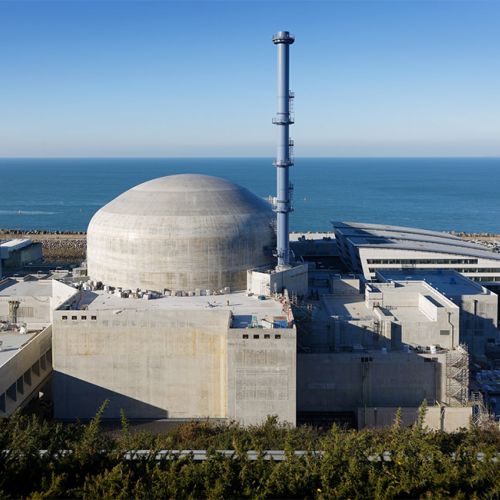
During a meeting of the local information commission on April 12, the Nuclear Safety Authority (ASN) assured that it could give the green light to the start-up of the reactor by the beginning of May. However, not all technical problems are resolved. And now a new one – of vibrations – appeared at the end of last year on the primary circuit. Revelations.
Blast, Thierry Gadault , 22 Apr 24
A few kilometers from the Flamanville nuclear power plant, Les Pieux (Manche) is typical of the many nuclear communities that we cross along the Rhône and Loire valleys: stone facades scrubbed with a toothbrush, paved sidewalks shiny as a new penny, innumerable municipal facilities that a town of some 3,500 inhabitants could never hope to afford, even in its wildest dreams, if it were not for the millions poured every year by EDF into the Department………………………..
Dialogue of the deaf in the basement
Behind the town hall, an old mansion which dominates the village, is the Pieux proximity center. In the basement of the building, which houses part of the municipal services, an auditorium with around fifty seats hosts the meetings of the Local Information Commission (CLI), a consultative body bringing together EDF, the Nuclear Safety Authority (ASN), local elected officials, the State and association representatives.
April 12, 2024, there was a crowd for the extraordinary meeting of the CLI. The menu was potentially copious: it was a question of taking stock of the EPR, before the ASN gave the green light to EDF to install the nuclear fuel in the vessel. While the independent authority was in full public consultation (it ended on April 17), an essential prerequisite for its decision-making, the associations had obtained this appointment in the form of a last-chance meeting, to try to derail the process.
But neither the ASN representative, Gaëtan Lafforge, the head of the Caen division, nor that of EDF, Alain Morvan, the director of the Flamanville EPR project, had the intention of revealing the reality of the numerous problems which still affect the reactor. And it was a dialogue of the deaf that the participants engaged in.
On the ASN and EDF side, the speech can easily be summarized: officially, everything is in order and the objective is now to gradually bring the reactor to operate at full power, at the end of the year. The authority also specified that the green light will be given by the beginning of May. Alain Morvan, with slides reduced to the strict minimum, simply outlined the process of starting up the new reactor.
On April 12, questioned on this subject by Yannick Rousselet, nuclear safety consultant at Greenpeace, the ASN representative had the greatest difficulty in answering the question clearly. “I can’t tell you that there won’t be anything left, there could be possible deviations during the tests,” stammered Gaëtan Lafforge. This then led to a short lunar exchange with the anti-nuclear activist, which triggered laughter from the audience.
On the anti-nuclear activist side, the troops left after two hours with their questions. In particular, lo and behold, a new vibration problem on the primary circuit detected last year.
The information was given to Blast by Julien Collet, the deputy director general of ASN, during the authority’s annual press conference organized at the end of last January. The DGA then told us that EDF was in the process of investigating this umpteenth glitch on the EPR.
On April 12, questioned on this subject by Yannick Rousselet, nuclear safety consultant at Greenpeace, the ASN representative had the greatest difficulty in answering the question clearly. “I can’t tell you that there won’t be anything left, there could be possible deviations during the tests,” stammered Gaëtan Lafforge. This then led to a short lunar exchange with the anti-nuclear activist, which triggered laughter from the audience.
Strangely, Alain Morvan, who could have provided technical details, remained silent. And no one thought to give him the floor. Especially since the president of the CLI, perhaps impatient to go to lunch, hastened to close the session. Questioned by Blast after the meeting, the director of the EPR project, cornered by a member of EDF communications, refused to answer us.
Hardly any more luck with the Parisian communications department, a few moments later. “The vibrational issues have been dealt with and technical solutions put in place,” she simply responded in the usual wooden language. In short, move around, there is nothing to see.
Yes, but here it is: questioned by a journalist from Presse de la Manche, the local daily which covered the event, EDF gave another answer : “There is no new vibration subject,” said the electrician. to our colleague. Um… we should know: has the subject been covered or does it not exist?
It’s not me, it’s him !
To try to see things clearly, Blast turned to the Institute of Radiation Protection and Nuclear Safety (IRSN), the public research establishment which provides technical advice to the ASN.
Perhaps concerned about its future – following the merger with the ASN imposed by the government and ratified by the National Assembly and the Senate – the establishment informed us through its press manager that the subject was not his responsibility. And to send us back to the ASN…
Unfortunately, ASN did not answer our questions. As Martine Aubry, the mayor of Lille and former candidate defeated in the 2011 socialist primary, said about François Hollande, “when it’s vague, there’s a wolf…”
The lid saga
This new problem… sorry “subject” vibration is therefore added to the numerous unresolved technical files that EDF has decided to leave as is, with the agreement of the ASN, to provide a response only after the commissioning of the reactor – it is unusual, we will agree. Starting obviously with the lid of the tank, weakened by a manufacturing defect (positive carbon segregation also present in the bottom of the tank). When the authority finally authorized the use of the tank and its lid in 2018, when it was no longer possible to exclude the risk of rupture but only to prevent it (which does not have the same meaning), she had asked EDF to change the cover no later than December 2024.
……………………………………..Questioned by activists to know why the company was not waiting for this new cover, Alain Morvan got confused in his explanations. He first suggested that it was not finished, and that it would therefore not be installed before the summer of 2025, before contradicting himself to finally assure that it would be delivered to the nuclear power plant at the end of the year…
In fact, the public group has nothing to do with it: in 2023, Framatome obtained from the ASN to postpone the replacement of the cover by one year, without giving any justification for such a postponement. According to the order issued by the authority last year, it must now be replaced during the first full inspection of the installation, after its start-up.
While it was possible to change this part in complete safety for the health of workers, if the new one had been installed before start-up, this postponement changes everything. The current cover will be irradiated and it will in fact become nuclear waste. In other words, an object that cannot be handled like that.
Apart from the fact that this unnecessarily exposes workers to taking doses during operations to replace it, this poses another problem. This question has not been resolved to date by EDF: that of the storage of this contaminated part, when it is removed. ASN asked the EDF group to construct a building for this purpose which would allow it to be stored safely on the power plant site. Which still doesn’t seem to be done…
Radioactivity, haphazardly
Emblematic, the tank cover file is not the only one which demonstrates EDF’s lack of consideration for nuclear employees, whether they are in-house agents or subcontracting employees. A second major project, also planned after the start-up of the reactor, will expose those involved to radioactive risks. Here again, this intervention could have been carried out in complete safety before the installation was started: the modification of the cooling system of the reactor auxiliary networks (RRI) and rescued raw water (SEC). Essential elements, particularly during reactor shutdown…………………………………………………………………………………………………………………….
Later, again
Still in the same logic, EDF has postponed the modification of the tank internals until later, more precisely the lower plenum which directs the distribution of the hydraulic flow in the tank. Since the incident that occurred on one of the two EPRs at Taishan in China, in 2021, we have had some feedback: it has been established that this equipment generates poor distribution of hydraulic flow which causes greater fluctuations. greater than expected in the neutron flux, which could lead to difficulties in controlling the nuclear reaction. Although ASN asked EDF to modify the lower plenum, the studies are still in progress………………………………………………………….
In China, to avoid major problems while waiting for the modification of the lower plenum, the power of the reactors (officially 1,750 MW) would have been limited to 1,500 MW. Will this also be the case for the Flamanville EPR? Questioned during the CLI meeting on April 12 by Yannick Rousselet, neither ASN nor EDF deigned to respond.
Let’s cross our fingers, hoping that there will be no runaway nuclear reaction in the Flamanville EPR tank. Especially since Libération revealed in July 2022, two systems of probes and sensors essential for operating the reactor, installed either in the tank or outside, are malfunctioning.
The EPR, political totem
“It would have been smarter to do all this work before the reactor was started,” exasperates Gilles Reynaud, the president of Ma Zone Contrôlée , which brings together nuclear subcontracting employees. But EDF wants to put the EPR into production to say: “that’s it, it works.” Doing all this work afterwards, I don’t find it very respectful for the workers and the population. »
No matter the cost
“We are starting at all costs for purely political reasons,” judge Yannick Rousselet, interviewed by Blast at the end of the CLI on April 12. As President Macron announced the relaunch of nuclear power with the construction of new EPRs, they want to send the message that we are out of the rut. » For Rousselet, this is a very short-term vision: “Even if this reactor shuts down in a few months for a long period, no one cares. We must be able to say: “That’s it, the Flamanville EPR is loaded. He started.” This is what is most dangerous. We don’t try to solve the problems first. »
The secrets of an engineer
And then, potentially, there is another problem in the medium term. Recently, an engineer, Thierry C, contacted Blast to tell us about his short experience in nuclear power.
………………………………. “When I took the file, I quickly realized that most of the valves that had to be installed could not meet the temperature and pressure conditions planned during these requalification tests,” he explains to Blast. Of the approximately 650 pipes equipped with valves, there were approximately 450 that had to be cut to remove the equipment and replace it with a temporary device to block the pipes. » A not really reassuring observation. “I spoke about it to my superiors who asked me to keep quiet and not talk to EDF about it. »
The documents and plans consulted by Blast seem to confirm these remarks. Which poses a problem: the requalification tests must be carried out with the valves to be validated. However, this analysis work was carried out in 2008-2009, when the EPR construction site, which had just started, was still in the civil engineering stage. Thierry C. left the group shortly after carrying out this study. What has happened since then? Has the error made by Alstom on the technical characteristics of the valves been corrected? Impossible to know: neither EDF, nor ASN, nor IRSN wanted to answer us.
Overall, given these unresolved problems and the lack of transparency from EDF and ASN regarding the technical setbacks of the installation, within the Flamanville CLI but also vis-à-vis the press, the long nightmare of the EPR construction site may not be over. This bad dream led to its bill exploding – which reached some 19.1 billion euros . A farce that could end up boring and no longer make anyone laugh. https://www.blast-info.fr/articles/2024/nucleaire-a-flamanville-la-farce-de-lepr-se-poursuit-G9PeKawaRwmShmxp6sJL3g
UN report demolishes Israeli propaganda campaign against UNRWA
Israel has waged a multi-year campaign against the UN aid group for Palestinian refugees in hopes of eradicating the right of return
The Cradle, News Desk, APR 22, 2024
Israel has failed to provide any evidence of its claims that employees of the UN Relief and Works Agency (UNRWA) are members of “terrorist organizations,” according to an independent review led by former French foreign minister Catherine Colonna.
In January, Israel claimed without evidence that some UNRWA staff – until then the primary conduit of humanitarian aid into the besieged and bombed Gaza Strip – were members of Hamas and Palestinian Islamic Jihad (PIJ) and had participated in the Hamas-led attack on Israeli military bases and settlements on 7 October, known as Operation Al-Aqsa Flood.
The Israeli allegations promptly caused the US and other western nations to cut funding to UNRWA. This came amid reports from rights groups that Israel was using starvation as a weapon against the 2.3 million Palestinians in Gaza.
The Guardian reported on 22 April that the “Colonna report,” which was commissioned by the UN in the wake of Israeli allegations, found that UNRWA had regularly supplied Israel with lists of its employees for vetting, and that “the Israeli government has not informed UNRWA of any concerns relating to any UNRWA staff based on these staff lists since 2011.”
The Guardian added that most donor nations have resumed their funding in recent weeks. However, UK ministers had said they would wait for the Colonna report to decide whether to resume funding. The US Congress has since banned any future financial support of UNRWA.
The Colonna review was drafted with the help of three Nordic research institutes and will be published later on Monday.
It confirms that Israel has yet to provide any evidence of its claims………………………………………………..
more https://thecradle.co/articles/un-report-demolishes-israeli-propaganda-campaign-against-unrwa
Former Sellafield consultant claims the nuclear complex tampered with evidence
Whistleblower Alison McDermott claims former employer Sellafield tampered with metadata in letters used in evidence during an employment tribunal.
Tommy Greene, Bill Goodwin, Computer Weekly, 22 Apr 24
A former consultant at Sellafield has claimed that metadata in letters used against her in a tribunal hearing by the nuclear facility has been interfered with.
A tribunal has heard that three letters produced by managers at the vast nuclear complex and submitted as evidence in the employment dispute were “fabricated” and “tampered with”.
Alison McDermott lost a whistleblowing claim against the Cumbrian nuclear facility and is now fighting a demand to pay £40,000 costs.
The former Sellafield consultant said the metadata for one of the three letters was “wiped” by legal representatives for Sellafield.
She formally withdrew the allegations in her first employment tribunal claim against the nuclear complex.
The 2021 tribunal judgment determined that the letters were not “fabrications”.
“These letters are not fabrications, as had previously been asserted by the Claimant,” it found.
However, the ex-contractor raised her claims about the letters’ production and of alleged tampering during last week’s tribunal when defending herself from allegations she had acted “unreasonably” in the legal action with Sellafield and a regulatory body.
Sellafield maintains that McDermott’s allegations are “untrue”.
McDermott, a human resources (HR) consultant, signed a two-day-a-week contract with Sellafield worth £1,500 per day and was tasked in 2018 with looking at an employee’s sexual harassment allegations.
But within days of submitting a report that found the HR team was viewed as “broken and dysfunctional” by some staff, her contract was ended.
She has contested cost awards as a litigant-in-person during a one-day hearing in Leeds.
Summarising her arguments, tribunal judge Stuart Robertson said McDermott had suggested that the three letters used against her by Sellafield during the employment case over the termination of her contract were “fabricated and not genuine”.
Deshpal Panesar KC, who represented Sellafield at the tribunal, accused McDermott of “making baseless claims of the most damaging sort – representing an existential threat to the careers of multiple public servants”.
Panesar said McDermott had accused Sellafield and its regulatory body, the Nuclear Decommissioning Authority (NDA), of “illicit conduct, fabrication of evidence and false representations” when making her case.
McDermott sought to challenge cost awards made against her, amounting to £40,000, in a previous tribunal decision.
The employment tribunal claim she brought against Sellafield in 2021 was unsuccessful. But an appeal judge found aspects of her case “troubling” and she was subsequently recognised as a whistleblower under UK employment law.
Robertson, a new tribunal judge, is now considering whether McDermott’s claims and conduct have been “unreasonable”.
McDermott claims she suffered a number of detriments when her contract was terminated. She has since spoken out publicly against Sellafield, branding its workplace culture as “toxic”.
Sellafield and the NDA have contested the claims robustly, initially arguing McDermott’s work was ended for “financial reasons” and later as a result of her “poor” performance.
Suspicious of the letters
The three letters have been a central point of contention in McDermott’s court battle.
The Information Commissioner’s Office ruled in early 2021 that Sellafield had acted unlawfully, having broken data laws and committed security breaches for, among other things, failing to supply McDermott with the letters after she had made a data subject access request.
Sellafield subsequently used the critical letters against McDermott in the employment tribunal case she brought over the termination of her contract.
McDermott told Thursday’s tribunal that the letters had caused her “significant detriment”………………………………………………………………………………………………………………………………………… more https://www.computerweekly.com/news/366581793/Former-Sellafield-consultant-claims-the-nuclear-complex-tampered-with-evidence
Problems delay OL3 reactor restart by 6 days
Olkiluoto 3 was taken offline at the beginning of last month for annual maintenance.
The outage of Olkiluoto 3, Finland’s newest nuclear reactor which is
currently offline for maintenance, is being extended by six days due to
technical problems, operator Teollisuuden Voima (TVO) announced on Sunday.
The facility was shut down for its first round of annual maintenance on 2
March, according to the firm, which added that around 1,100 professionals
were involved in the effort. The firm’s other two reactors, Olkiluoto 1 and
2, were generating electricity at normal levels of approximately 1,780MW,
the company said. Maintenance on OL3 is now scheduled to be completed on 4
May.
The reactor was put into service just over a year ago, following
construction delays of 14 years. The scheduled break was originally due to
end on 8 April.
YLE News 21st April 2024
Japan halts nuclear wastewater discharge from Fukushima power plant
Japan has halted the discharge of nuclear-contaminated wastewater from the
Fukushima Daiichi Nuclear Power Plant due to a power glitch, local media
reported on Wednesday.
CGTN 24th April 2024
https://news.cgtn.com/news/2024-04-24/news-1t3zLN4TLri/p.html
New civil nuclear programmes crossing over into military nuclear programmes

New Nuclear Dual-Use Risk: Beating Swords into Ploughshares? By Dr. Paul Dorfman, https://nct-cbnw.com/new-nuclear-dual-use-risk-beating-swords-into-ploughshares/ 24 Apr 24.
Dr. Paul Dorfman discusses whether new civil nuclear programs could cross over into military nuclear programs, and what this means for global non-proliferation efforts.
According to key global finance advisory and asset management firm Lazard, new nuclear power systems perform poorly compared to renewables’ storage, energy efficiency, cost, roll-out speed, and management. So why invest in new nuclear?
Prof. Andy Stirling and Dr. Phil Johnstone, from the University of Sussex Science Policy Research Unit (SPRU), argue that the answer lies in the clear and present link between civil and military nuclear infrastructure. This is because civil nuclear energy maintains the skills and supply chains also needed for military nuclear programs, without which the costs of nuclear military capabilities could become politically unsupportable.
As they point out, the U.K. Government’s ‘Civil Nuclear: Roadmap to 2050’ report includes sets of statements on civil and military nuclear ambitions in order to “identify opportunities to align the two across government”, strengthening existing interconnections between civil and military industries’ research and development, and thereby minimizing costs for both the weapons and power sectors.
More recently, in March 2024, U.K. Prime Minister Rishi Sunak explicitly linked military nuclear weapons production capability with civil nuclear power generation development. French President Emmanuel Macron has gone further, saying that “without civil nuclear power, no military nuclear power, without military nuclear, no civil nuclear”. And the fact is that 90% of all new nuclear construction projects worldwide involve corporations controlled by states with nuclear weapons
New Nuclear, New Proliferation Risk
The increasingly tense geopolitical environment makes nuclear a controversial issue, with nation states concerned that neighbors might use notionally civilian nuclear programs for military ends. In this sense, there are unique challenges and perceived opportunities when it comes to new civil nuclear ambitions.
Choice of offensive or defensive doctrine affects the way other states evaluate their respective security and, in turn, influences the probability of cross-over between civil and military nuclear capacity. Indeed, current movements in military doctrines share the common denominator of adopting more offensive postures.
Meanwhile, according to the U.K. Royal Society, all forms of nuclear production pose weapons development risks, as “there is no proliferation proof nuclear fuel cycle – the dual use risk of nuclear materials and technology and in civil and military applications cannot be eliminated.”
Unhelpfully, Small Modular Nuclear Reactors (SMRs), which are the best new hope for fissile fuel, could make the weapons proliferation problem even worse as any potential SMR roll-out to either developed or developing countries is likely to increase nuclear proliferation and security risks. This is especially so if any of those states prove politically unstable or have relatively limited resources to support a robust nuclear security and regulatory infrastructure.
Nuclear Cross-over in an Increasingly Unstable World
Unless uranium enrichment and reprocessing technologies are effectively regulated against the diversion of civil materials for military purposes, the reality is that new nuclear plants can provide the cover to develop and make nuclear weapons. Whether that capability is turned into actual weapons depends largely on political inclination.
Saudi officials have made it clear on more than one occasion that there’s another reason for their interest in civil nuclear energy technology which was not captured by the royal decree on the Saudi nuclear program – the relationship of the civil program to nuclear weapons. More recently, Saudi Arabia is pushing for the right to produce nuclear fuel, a move that poses further significant proliferation risk. The International Atomic Energy Agency (IAEA) has voiced concerns about Saudi intentions and safeguards.

Unfortunately, the IAEA’s support for Saudi’s civil nuclear clashes with their position on the Kingdom’s military ambition. This is not the first time that the UN nuclear regulator has been caught in this uncomfortably dualist situation.
More worryingly, the Director General of the IAEA, Rafael Grossi, has just met with Syrian President Bashar al-Assad in Damascus to “agree on a new engagement between Syria and IAEA with a view to providing confidence in the peaceful uses of nuclear energy for the benefit of its people”. Given the deeply problematic military and human rights history of al-Assad’s regime, the IAEA’s actions seem profoundly concerning, and bring the IAEA’s role in the global nuclear arena into sharp focus.
Thinking this through, an important question springs to mind. Due to the apparent potential for civil-military nuclear cross-over, could the IAEA’s mission – to work for “the safe, secure and peaceful application of nuclear science and technology” – inevitably result in weapons proliferation by default?
Irrational Paradoxes
Back in Eastern Europe, although Ukraine runs a substantive civil nuclear power program, it’s no longer a nuclear weapons state. Ukraine, once briefly the third-largest nuclear power in the world, made the decision to give up nuclear weapons on the basis that the U.S., U.K., and Russia would guarantee Ukraine’s security via the Budapest Memorandum.
In this sense, both Putin’s invasion of an independent state and subsequent nuclear weapons threats highlight the very real practical distinction between unilateral and multilateral nuclear weapons disarmament in an increasingly unstable world.
And then there’s Zaporizhzhia, where a civil nuclear power plant has become a target of war at the very same time that Russia’s role as a major player in the global civil nuclear power sector continues to expand via Moscow-backed international nuclear new-build projects and technology, uranium supply and enrichment, and spent nuclear fuel management.
Direction of Travel
While it appears reasonably clear that civil and military nuclear can enmesh, one must ask whether one inevitably leads to the other. While the usual concern is that civil nuclear infrastructure leads to military development, according to former Australian Prime Minister Scott Morrison, Australia is bucking the trend: “Let me be clear: Australia is not seeking to establish […] a civil nuclear capability […] a civil nuclear energy industry is not a requirement for us to go through the submarine program.”
In other words, despite the new nuclear submarine AUKUS deal, the current Australian government has no plans to develop new civil nuclear infrastructure.
So, does that start to negate the civil-military nexus hypothesis? Well, it’s not that nuclear military interests are the sole drivers of support for civil nuclear power, but for some states dual-use technology may comprise a significant complementary factor.
In the end, it’s the direction of travel that counts. While all key energy institutes and research organizations agree that renewables will do the heavy-lifting for the net-zero energy transition, it’s worth considering the implications of U.S. Energy Secretary Jennifer Granholm’s speech to Australia’s Energy Forum: “No country has ever been held hostage for access to the sun. No country has ever been held hostage for access to the wind. They have not ever been weaponized, nor will they be.”
Dr. Paul Dorfman is the Chair of the Nuclear Consulting Group, a Visiting Fellow at the Science Policy Research Unit (SPRU) of the University of Sussex, U.K., a Member of the Irish Government’s Radiation Protection Advisory Committee, and a Former Advisor to the U.K. Ministry of Defence Nuclear Submarine Dismantling Project.
U.S. Senate Passes $95 Billion Foreign Military Aid Bill
The bill passed in a vote of 79-18
by Dave DeCamp April 23, 2024, AntiWar.com
On Tuesday night, the Senate passed a $95 billion spending bill that includes military aid for Ukraine, Israel, and Taiwan in a vote of 79-18. The bill has already passed through the House and now heads to President Biden’s desk for his signature.
Earlier in the day, the Senate rejected an effort by some senators to add amendments to the legislation in a vote of 48-50. The legislation, which also includes a provision that could ban TikTok, was passed through the House as four separate bills but was combined into one in the Senate.
The legislation includes $61 billion for the proxy war in Ukraine, much of which will go to US weapons makers to replenish US stockpiles. It includes over $9 billion in economic aid in the form of repayable loans, but Ukraine is not actually expected to pay it back. Another provision will authorize the US to sell off frozen Russian assets, which could be used to pay the loans. CNN previously reported that the Biden administration will also be able to cancel the debt.
The bill also includes $26 billion to support Israel. About $9 billion will go toward humanitarian aid in Gaza and other places, while the remaining $17 billion will go toward military aid to support the slaughter of Palestinians in Gaza and replenish Israeli air defenses. The aid is on top of the $3.8 billion in military assistance that Israel receives from the US each year.
Another $8 billion will go toward military aid for Taiwan and other spending in the Indo-Pacific region to prepare for a future war with China. It includes $1.9 billion to replenish weapons sent to Taiwan and regional countries and $2 billion in Foreign Military Financing, a State Department program that gives foreign governments money to purchase US weapons. Over $3.3 billion will go toward submarine infrastructure in the region.
The massive spending on foreign military aid was put forward by House Speaker Mike Johnson (R-LA), who previously killed a deal that would have included similar foreign aid spending and billions for border security and changes to migrant policies………….. more https://news.antiwar.com/2024/04/23/senate-passes-95-billion-foreign-military-aid-bill/
Russia, US clash at UN over nuclear weapons in space

By Michelle Nichols, April 25, 2024
UNITED NATIONS, April 24 (Reuters) – Russia on Wednesday vetoed a U.S.-drafted United Nations Security Council resolution that called on countries to prevent an arms race in outer space, a move that prompted the United States to question if Moscow was hiding something.
The vote came after Washington accused Moscow of developing a anti-satellite nuclear weapon to put in space, an allegation that Russia has denied. Russian President Vladimir Putin has said that Moscow was against putting nuclear weapons in space.
“Today’s veto begs the question: Why? Why if you are following the rules would you not support a resolution that reaffirms them? What could you possibly be hiding?” U.S. Ambassador to the U.N. Linda Thomas-Greenfield told the council after the vote. “It’s baffling and it’s a shame.”
Russia’s U.N. Ambassador Vassily Nebenzia accused Washington of trying to tarnish Moscow and said Russia would shortly begin negotiations with council members on its own draft resolution aimed at keeping space peaceful.
“We want a ban on the placement of weapons of any kind in outer space, not just (weapons of mass destruction). But you don’t want that … Let me ask you that very same question: Why?” Nebenzia asked Thomas-Greenfield in the council.
The draft resolution was put to a vote by the U.S. and Japan after nearly six weeks of negotiations. It received 13 votes in favor, while China abstained and Russia cast a veto.
The U.N. text would have affirmed an obligation to comply with the Outer Space Treaty and called on states “to contribute actively to the objective of the peaceful use of outer space and of the prevention of an arms race in outer space.”
The 1967 Outer Space Treaty bars signatories – including Russia and the United States – from placing “in orbit around the Earth any objects carrying nuclear weapons or any other kinds of weapons of mass destruction.
Before the council voted on the U.S. draft text, Russia and China had proposed it be amended to include a call on all states “to prevent for all time the placement of weapons in outer space and the threat or use of force in outer space, from space against Earth and from Earth against objects in outer space.”
The council voted on the proposed amendment, but it failed to pass. It received seven votes in favor, seven against and one abstention……………………………………. https://www.miragenews.com/indian-nuclear-sites-impact-south-tibetan-1222069/
Price tag for Poland’s first nuclear plant may reach $37bn

Global Construction Review, David Rogers, 22.04.24
Poland first nuclear power plant could cost as much as $37bn, according to Jan Chadam, the acting head of Polskie Elektrownie Jadrowe (PEJ), the agency set up by the government to oversee its nuclear plans.
According to finance news agency PAP, Chadam told the 39th Europower conference in Warsaw: “We don’t have the final value of this project, but one can imagine that it will probably be around PLN150bn [$37bn].”
The plant is due to be built by US engineers Westinghouse and Bechtel. It will be sited in Pomerania on the Baltic Coast, with work beginning in 2026 and completing in 2033. Two additional units are expected to follow within the next three years.
However, Chadam said schedule was unlikely to be met, which he said added to the uncertainty over the cost.
In 2020, when the plan to build a fleet of nuclear power stations was first outlined, the price for the multiple units was tentatively put at $40bn.
The details of the finance are still being worked out. PEJ is seeking assistance from financial advisers on ways to attract investors.
Chadam added that Poland was also counting on the participation of the US’ Export-Import Bank, which supports US export projects…………………. https://www.globalconstructionreview.com/price-tag-for-polands-first-nuclear-plant-may-reach-37bn/
The McCarthyist Attack on Gaza Protests Threatens Free Thought for All

ARI PAUL, 19 April 24, https://fair.org/home/the-mccarthyist-attack-on-gaza-protests-threatens-free-thought-for-all/
With the encouragement of the state, universities from coast to coast are taking draconian steps to silence debate about US-backed violence in the Middle East.
The Columbia University community looked on in shock as cops in riot gear arrested at least 100 pro-Palestine protesters who had set up an encampment in the center of campus (New York Post, 4/18/24). The university’s president, Nemat Shafik, had just the day before testified before a Republican-dominated congressional committee ostensibly concerned with campus “antisemitism”—a label that has come to be misapplied to any criticism of Israel, though the critics so smeared are often themselves Jewish.
A sense of delight has filled the city’s opinion pages. The New York Post editorial board (4/18/24) hailed both the clampdown on protests and Congress’s push to ensure that such drastic action against free speech was taken: “We’re glad to see Shafik stand up…. Congress deserves some credit for putting educrats’ feet to the fire on this issue.” The paper added, “Academia has been handling anti-Israel demonstrations with kid gloves.” In other words, universities have been allowing too many people to think and speak critically about an important issue of the day.
In “At Columbia, the Grown-Ups in the Room Take a Stand,” New York Times columnist Pamela Paul (4/18/24) hailed the eviction, saying of the encampment that for the “passer-by, the fury and self-righteous sentiment on display was chilling,” and that for supporters of Israel, “it must be unimaginably painful.” In other words, conservative pundits have decided that campus safe spaces where speech is banned to protect the feelings of listeners are good, depending on the issue. Would Paul (no relation!) favor bans on pro-Taiwan or pro-Armenia demonstrations because they could offend Chinese and Turkish students?
And for Michael Oren, a prominent Israeli politico, Columbia students hadn’t suffered enough. He said of Columbia in a Wall Street Journal op-ed (4/19/24):
Missing was an admission of the university’s failure to enforce the measures it had enacted to protect its Jewish community. [Shafik] didn’t address how, under the banner of free speech, Columbia became inhospitable to Jews. She didn’t acknowledge how incendiary demonstrations such as the encampment were the product of the university’s inaction.
Shafik had assured her congressional interrogators that Columbia had already suspended 15 students for speaking out for Palestinian human rights, suspended two student groups—Jewish Voice for Peace and Students for Justice in Palestine (Jewish Telegraphic Agency, 11/10/23)—and had even terminated an instructor (New York Times, 4/17/24).
The hearing was bizarre, to say the least; a Georgia Republican asked the president if she wanted her campus to be “cursed by God” (New York Times, 4/18/24). (“Definitely not,” was her response.)
The former World Bank economist had clearly been shaken after seeing how congressional McCarthyism ousted two other female Ivy League presidents (FAIR.org, 12/12/23; Al Jazeera, 1/2/24).
‘Protected from having to hear’
“What happened at those hearings yesterday should be of grave concern to everybody, regardless of their feelings on Palestine, regardless of their politics,” Barnard College women’s studies professor Rebecca Jordan-Young told Democracy Now! (4/18/24). “What happened yesterday was a demonstration of the growing and intensifying attack on liberal education writ large.”
Her colleague, historian Nara Milanich, said in the same interview
This is not about antisemitism so much as attacking areas of inquiry and teaching, whether it’s about voting rights or vaccine safety or climate change — right?—arenas of inquiry that are uncomfortable or inconvenient or controversial for certain groups. And so, this is essentially what we’re seeing, antisemitism being weaponized in a broad attack on the university.
Jewish faculty at Columbia spoke out against the callous misuse of antisemitism to silence students, but those in power aren’t listening (Columbia Spectator, 4/10/24).
Shafik justified authorizing the mass arrests, which many said hadn’t been seen on campus since the anti-Vietnam War protests of 1968. “The individuals who established the encampment violated a long list of rules and policies,” she said (BBC, 4/18/24). “Through direct conversations and in writing, the university provided multiple notices of these violations.”
One policy suggested by the university’s “antisemitism task force,” according to a university trustee who also testified (New York Times, 4/18/24): “If you are going to chant, it should only be in a certain place, so that people who don’t want to hear it are protected from having to hear it.”
Cross-country rollback
Meanwhile, the University of Southern California canceled the planned graduation speech by valedictorian Asna Tabassum—a Muslim woman who had spoken out for Palestine (Reuters, 4/18/24). The university cited unnamed “security risks”; The Hill (4/16/24) noted that “she had links to pro-Palestinian sites on her social media.” Andrew T. Guzman, the provost and senior vice president for academic affairs, said in a statement that cancelation was “consistent with the fundamental legal obligation—including the expectations of federal regulators—that universities act to protect students and keep our campus community safe” (USC Annenberg Media, 4/15/24).
This is happening as academic freedom is being rolled back across the country. Republicans in Indiana recently passed a law to allow a politically appointed board to deny or even revoke university professors’ tenure if the board feels their classes lack “intellectual diversity”—at the same time that it threatens them if they seem “likely” to “subject students to political or ideological views and opinions” deemed unrelated to their courses (Inside Higher Ed, 2/21/24).
Benjamin Balthaser, associate professor of English at Indiana University South Bend, told FAIR in regard to the congressional hearing:
There is no other definition of bigotry or racism that equates criticism of a state, even withering, hostile criticism, with an entire ethnic or religious group, especially a state engaging in ongoing, documented war crimes and crimes against humanity. Added to this absurdity is the fact that many of the accused are not only Jewish, but have strong ties to their Jewish communities. To make such an equation assumes a collective or group homogeneity which is itself a form of essentialism, even racism itself: People are not reducible to the crimes of their state, let alone a state thousands of miles away to which most Jews are not citizens.
Of course, witch hunts against leftists in US society are often motivated by antisemitism. Balthaser again:
The far right has long deployed antisemitism as a weapon of censorship and repression, associating Jewishness with Communism and subversion during the First and Second Red Scares. Not only did earlier forms of McCarthyism overwhelmingly target Jews (Jews were two-thirds of the “defendants” called before HUAC in 1952, despite being less than 2% of the US population), it did so while cynically pretending to protect Jews from Communism. Something very similar is occurring now: Mobilizing a racist trope of Jewish adherence to Israel, far-right politicians are using accusations of antisemitism to both silence criticism of Israel and, in doing so, promote their antisemitic ideas of Jewishness in the world.
Silencing for ‘free speech’
These universities are not simply clamping down on free speech because the administrators dislike this particular speech, or out of fear that pro-Palestine demonstrations or vocal faculty members could scare donors from writing big checks. This is a result of state actors—congressional Republicans, in particular—who are using their committee power and sycophants in the media to demand more firings, more suspensions, more censorship.
I have written for years (FAIR.org, 10/23/20, 11/17/21, 3/25/22), as have many others, that Republican complaints about “cancel culture” on campus suppressing free speech are exaggerated. One of the biggest hypocrisies is that so-called free-speech conservatives claim that campus activists are silencing conservatives, but have little to say about blatant censorship and political firings when it comes to Palestine.
This isn’t a mere moral inconsistency. This is the anti-woke agenda at work: When criticism of the right is deemed to be the major threat to free speech, it’s a short step to enlisting the state to “protect” free speech by silencing the critics—in this case, dissenters against US support for Israeli militarism.
But this isn’t just about Palestine; crackdowns against pro-Palestine protests are part of a broader war against discourse and thought. The right has already paved the way for assaults on educational freedom with bans aimed at Critical Race Theory adopted in 29 states.
If the state can now stifle and punish speech against the murder of civilians in Gaza, what’s next? With another congressional committee investigating so-called infiltration by China’s Communist Party, will Chinese political scholars be targeted next (Reuters, 2/28/24)? With state laws against environmental protests proliferating (Sierra, 9/17/23), will there be a new McCarthyism against climate scientists? (Author Will Potter raised the alarm about a “green scare” more than a decade ago—People’s World, 9/26/11; CounterSpin, 2/1/13.)
Universities and the press are supposed to be places where we can freely discuss the issues of the day, even if that means having to hear opinions that might be hard for some to digest. Without those arenas for free thought, our First Amendment rights mean very little. If anyone who claims to be a free speech absolutist isn’t citing a government-led war against free speech and assembly on campuses as their No. 1 concern in the United States right now, they’re a fraud.
1.This Month
29 April – 2 May Ottawa Events – NOT THE NUCLEAR LOBBY returns to Parliament Hill

Monday, April 29, 6:30 PM (pay what you can)
Film Screening Radioactive – The Women of Three Mile Island
Tuesday, April 30, 7 PM (free)
Workshop reading of the play The Children
Wednesday, May 1, 7 PM (free)
Community Forum: Canada’s Nuclear Future – Renaissance or Relic?
Small Nuclear Reactors Education Task Force: https://stop-smrs.weebly.com/bulletins.ht

Finkelstein: Israel Is Prepared to Drag the Rest of the World Down with Them
The video on Palestine that got Yanis Varoufakis BANNED from Germany


PETITION.
Petition demanding broader consent for nuclear waste storage. Closed for signature May 3, 2024
 |
|
|
-
Archives
- April 2024 (320)
- March 2024 (335)
- February 2024 (345)
- January 2024 (375)
- December 2023 (333)
- November 2023 (342)
- October 2023 (366)
- September 2023 (353)
- August 2023 (356)
- July 2023 (363)
- June 2023 (324)
- May 2023 (344)
-
Categories
- 1
- 1 NUCLEAR ISSUES
- business and costs
- climate change
- culture and arts
- ENERGY
- environment
- health
- history
- indigenous issues
- Legal
- marketing of nuclear
- media
- opposition to nuclear
- PERSONAL STORIES
- politics
- politics international
- Religion and ethics
- safety
- secrets,lies and civil liberties
- spinbuster
- technology
- Uranium
- wastes
- weapons and war
- Women
- 2 WORLD
- ACTION
- AFRICA
- Atrocities
- AUSTRALIA
- Christina's notes
- Christina's themes
- culture and arts
- Fuk 2022
- Fuk 2023
- Fukushima 2017
- Fukushima 2018
- fukushima 2019
- Fukushima 2020
- Fukushima 2021
- general
- global warming
- Humour (God we need it)
- Nuclear
- RARE EARTHS
- Reference
- resources – print
- Resources -audiovicual
- World
- World Nuclear
- YouTube
-
RSS
Entries RSS
Comments RSS
 nuclear-news