Golden Dome plan would cost $1.2 trillion, CBO finds

That’s seven times what Trump initially said, and almost double the congressional office’s first estimate.
12 May, 26, Thomas Novelly, https://www.defenseone.com/defense-systems/2026/05/golden-dome-cost-trillion-cbo/413485/
The Golden Dome missile-defense system would cost $1.2 trillion to build out, far more than the White House has budgeted, according to a new estimate by Congressional researchers.
The figure is roughly double the Congressional Budget Office’s assessment last year of a potential space-based interceptor system, based on the expansive yet vague executive order issued in the busy first week of the second Trump administration. It’s nearly seven times larger than President Trump’s original promise to build it for $175 billion.
And it’s fifteen times larger than the $79 billion the administration plans to spend in the Golden Dome for America account over the next five years, which excludes other-related missile defense funding.
“The system would provide significantly expanded defensive capabilities but would not be impenetrable, particularly against large-scale attacks from peer adversaries,” the office said in an emailed statement. “CBO’s estimate is substantially higher than publicly cited administration figures, which may reflect differences in scope, time frame, and assumptions.”
In the last two months, Golden Dome’s budget has swelled by $10 billion. And the program’s leader has conceded that space-based interceptors, a cornerstone of the proposed missile shield, may be too costly to build.
The bulk of the funds—about $730 billion—would purchase only enough space-based interceptors to destroy about 10 incoming ballistic missiles.
The new CBO assessment was requested by Sen. Jeff Merkley, D-Oregon.
The $1.2 trillion estimate is not far off from a projection published by Todd Harrison, a defense budget analyst and space expert with AEI. In September, Harrison wrote that roughly $1 trillion over two decades could buy enough space-based interceptors to take out five missiles in the boost phase, 50 hypersonic weapons in the glide phase, and 50 warheads in midcourse. The sum would also purchase nearly 150 missile-warning and -tracking satellites, 10 Ground-Based Midcourse Defense battalions, 10 Patriot batteries, eight THAAD batteries, and two Aegis Ashore sites.
But the administration’s $185 billion budget won’t buy anywhere close to that, Harrison said.
“The fact that CBO’s estimate is almost an order of magnitude higher than what the administration says it will cost can only mean one thing: the administration is not actually building what the executive order described,” he said. “The CBO analysis and my previous analysis both demonstrate that the homeland missile defense you can buy for $185 billion is an incremental improvement over what we have today but not an impenetrable shield that will forever end the missile threat to the United States.”
When asked by lawmakers last month about the AEI analysis and past estimates, Space Force Gen. Michael Guetlein, the program’s leader, said he’s been “laser-focused on affordability” and that the Pentagon is doing business differently than it has in the past.
“When we start talking about the different cost estimates, the first thing I always say is, first of all, they’re not estimating what I’m building,” Guetlein said. “They are estimating the modernization or the continuation of the legacy systems that we already have, and they just take the cost of a legacy system, and they multiply it out and they get these really large numbers and they say, well, that must be it. That is not what Golden Dome is doing.”
The Trump administration has leaned heavily on funds outside the baseline defense budget to make Golden Dome a reality. Last year, the Pentagon netted $24 billion in reconciliation funds for the program. For the 2027 defense budget, the administration requested more than $17 billion from the same funding source and just $400 million from the annual Pentagon budget.
Additional reconciliation funds are not guaranteed, but the administration has projected future support in the baseline budget — the Pentagon plans to request an estimated $14.7 billion in the 2028 budget and projects it to rise to $16 billion by 2031, according to the American Enterprise Institute data.
Last year’s Golden Dome executive order called for fielding the “development and deployment” of space-based interceptors that can hit a missile within minutes of its initial launch. But physics shows that weaving a defensive web to stop any number of missiles from anywhere would require tens or hundreds of thousands of satellites.
Space interceptors, as the CBO’s estimate points out, are the most expensive component. Guetlein also told lawmakers last month that he’s focused on staying within the budget and said, “If we cannot do it affordabl[ly], we will not go into production” on boost-phase space-based interceptors.
CBO researchers said the $1.2 trillion estimate could be reduced if space-based interceptors aren’t included.
“Because of the limited information available about the Administration’s planned [national missile defense] architecture, a direct comparison of DoD’s and CBO’s [defense] systems and their costs is difficult,” the report said. “If the space-based interceptors—which have a high cost per kill—were deleted from CBO’s notional NMD system, the system’s 20-year cost would drop to $448 billion, but the overall system would not align with the objectives outlined in the ‘Iron Dome’ executive order, which specifically called for space-based interceptors.”
In light of the new estimate, Harrison said, Congress should have serious doubts about prioritizing and funding space-based interceptors instead of focusing on more attainable homeland security defenses.
“One of the lingering questions for Congress is: why are we still funding [space-based interceptor] development? Prototyping the system and maturing the technology will not prove or disprove its ability to scale with the threat—scalability is a matter of orbital mechanics, and the prototyping effort does nothing to change that,” Harrison said. “SBIs do not scale. We are throwing away billions of dollars on a system with no future, when that money could instead be used to buy more of the ground-based interceptors and drone defenses we are in desperate need of today that do scale with threats.”
Trump lands in Beijing with over a dozen western moguls in tow ahead of high-stakes talks with Xi
Elon Musk, Tim Cook, and top executives from Nvidia, Qualcomm, BlackRock, Goldman Sachs, Mastercard, Visa, Boeing, and Meta joined the US president
The Cradle, MAY 13, 2026
US President Donald Trump landed in Beijing on 13 May for a crucial meeting with Chinese President Xi Jinping to address trade, technology, Taiwan, the war against Iran, and the Strait of Hormuz.
Met with red-carpet treatment in the Chinese capital, Trump was joined by a retinue of more than a dozen billionaires whose companies span major sectors of the US and global economies.
A total of 16 high-profile business leaders accompanied the US president, including Tesla and SpaceX CEO Elon Musk and Apple CEO Tim Cook, as well as CEOs from Nvidia, Qualcomm, BlackRock, Goldman Sachs, Citigroup, Mastercard, Visa, Boeing, and Meta Platforms President and Vice Chair Dina Powell McCormick.
Trump is scheduled to meet Xi after his first night in Beijing, with the visit centered on what both sides agree to be a crucial moment for the world’s two largest economies.
The US-Israeli war on Iran and the resulting global energy crisis are expected to weigh heavily on the talks.
The US President is expected to urge his Chinese counterpart to pressure Tehran to reopen the Strait of Hormuz and move toward a peace deal, as China depends heavily on crude oil shipments through the waterway.
The talks are also expected to cover Taiwan, artificial intelligence, advanced chip exports, trade, and fentanyl, with both sides seeking concessions on long-running disputes that have strained relations between Washington and Beijing……………………………………………………………………………………………………………….
The meeting also comes as Washington imposes new sanctions on a China–Iran oil network ahead of Trump’s Beijing visit, tightening efforts to choke off Tehran’s oil revenue while the US–Israeli war on the Islamic Republic and the Hormuz crisis strain global energy markets. https://thecradle.co/articles/trump-lands-in-beijing-with-over-a-dozen-western-moguls-in-tow-ahead-of-high-stakes-talks-with-xi
US-China Summit: A strategic moment for stabilizing bilateral relations
14 May 2026 AIMN Editorial , By Chen Ziqi, https://theaimn.net/us-china-summit-a-strategic-moment-for-stabilizing-bilateral-relations/
US President Donald Trump arrived in Beijing on Wednesday for a new round of face-to-face talks with Chinese President Xi Jinping from May 14 to 15, a meeting arriving at a particularly delicate moment in global politics and the international economy.
It marks the first in-person meeting between the two leaders since the Busan agreement last October, where both sides agreed to suspend further escalation of the US–China trade war for one year.
While a flare-up in the Middle East delayed this meeting by a month, the cooling of tensions with Iran has finally cleared the flight path for what many view as the most consequential diplomatic inflection point of 2026.
Amid a fragile global recovery and uncertainty in international markets, the Beijing meeting is being closely watched for whether both powers can move from “crisis management” to a more sustainable form of strategic equilibrium, with implications for broader global economic stability.
At their first meeting on Thursday morning, President Xi congratulated the United States on its 250th anniversary, while President Trump praised Xi as “a great leader,” setting a warm and friendly tone for the opening of the summit.
President Xi noted that China and the US should be partners, not rivals, empathizing the relationship between the two countries would have implications not only for their peoples, but also for the future of the world. President Trump addressed this is going to be the biggest summit, as top business delegation was with him.
A US official said the two sides are expected to continue discussions on establishing new mechanisms for trade and investment coordination, with cooperation in agriculture, aerospace, and energy also likely to feature prominently.
Beijing, meanwhile, has framed the visit as an opportunity to stabilize bilateral ties amid growing global uncertainty. In remarks on Monday, China’s Foreign Ministry emphasized the need to expand mutually beneficial cooperation, manage differences, and “inject greater stability and certainty into a turbulent and changing world.”
Guidance from strategic analysts
Beijing, meanwhile, has framed the visit as an opportunity to stabilize bilateral ties amid growing global uncertainty. In remarks on Monday, China’s Foreign Ministry emphasized the need to expand mutually beneficial cooperation, manage differences, and “inject greater stability and certainty into a turbulent and changing world.”
Analysts broadly agree that the summit reflects a shared near-term interest in stabilizing China–US relations, even as deeper strategic tensions remain unresolved.
Zhao Hai, director of the International Politics Program at the National Institute for Global Strategy, points out that the primary “product” of this summit needs to be predictability. For the private sector, the specific policy is often less damaging than the volatility of not knowing what the policy will be tomorrow.
This mirrors the “managed strategic competition” framework championed by former Australian Prime Minister Kevin Rudd. The goal in Beijing is not necessarily to bridge a decade-long trust deficit in a three-day summit, but to prevent further accidental escalation. He said that careful coordination and transparent dialogue are essential to maintaining stability over the long term.
Economic frictions and business impacts
While Chinese state media frame economic relations as both a stabilizing foundation and a key driver of broader China–US ties, US tariff policy continues to sit at the center of bilateral disagreement.
While Beijing views these measures as “unreasonable restrictions,” the Trump administration continues to utilize them as its primary tool of economic leverage.
John McLean, chairman of the China–UK Business Development Centre, noted that shifting US tariff policies are creating deep uncertainty, prompting many companies to delay or reconsider long-term investment plans.
The economic data, however, tells a more nuanced story of self-inflicted wounds. A recent study by the Kiel Institute, a leading German economic research body, found that foreign exporters absorb only about 4% of the tariff burden, with the remaining 96% falling on US business and consumers.
These findings underscore that while tariffs are often framed as protecting American industries, their indirect effects are influencing pricing, supply chains, and investment decisions.
For small and medium-sized enterprises, the consequences are particularly acute. Philip Crawley, who operates a laser equipment import business in California, reported that tariffs imposed last year cost his company millions, forcing it to slow operations, reduce employee pay, and postpone hiring plans.
Glen Calder, president of Calder Brothers in South Carolina, said his steel costs increased by 25% even before US tariffs took effect, as markets anticipated higher trade barriers.
Strategic competition may be conducted at the state level, but its economic consequences are frequently absorbed by businesses, workers, and consumers navigating unpredictable policy environments.
Continued investment interest in China
Perhaps the most surprising element of the current climate is the resilience of corporate interest. Despite these challenges, many US businesses continue to view China as a critical market.
According to the American Chamber of Commerce in China, around 60% of American companies still plan to invest in the Chinese market, reflecting enduring confidence in China’s economic opportunities.
The rationale is clear: China accounts for roughly 17% of global GDP, contributes about 30% of global economic growth, with a and is projected to export nearly $4 trillion in exports in 2025.
Its sheer economic scale and growth make it important for companies to overlook, providing strong incentives to maintain or expand investment even amid uncertainty.
Looking ahead: Cooperation and strategic stability
President Xi noted in today’s meeting that success in one is an opportunity for the other. China has maintained a relatively consistent stance toward Washington, rooted in the idea that the Pacific is large enough for both powers. This summit offers a rare window to clarify intentions and move beyond the zero-sum rhetoric that has dominated the 2020s.
Reducing uncertainty in trade, investment, and technology will benefit businesses and global markets alike, reinforcing long-term stability, which is a shared asset, not a concession. Reducing the “noise” in trade and technology isn’t just a win for diplomats. It’s the oxygen required for global markets to breathe again.
Chen Ziqi is a reporter from CGTN
From “Mission Accomplished” to Missile Shortages: The Iran War Narrative Unravels.
May 12, 2026, Joshua Scheer, https://scheerpost.com/2026/05/12/from-mission-accomplished-to-missile-shortages-the-iran-war-narrative-unravels/
Ben Norton dismantles the triumphalist rhetoric surrounding the U.S. war on Iran in this blistering breakdown of a conflict that appears far more costly — and far less successful — than Washington admits. Drawing on reporting from CNN, The Washington Post, The New York Times, NBC News, and Fortune, Norton argues that despite Donald Trump’s repeated claims of “victory,” Iran has inflicted extensive damage on U.S. military infrastructure across West Asia while preserving much of its missile capability. The video traces the widening economic, military, and geopolitical fallout of a war that critics say is enriching defense contractors while pushing the region — and the global economy — toward catastrophe.
Rather than a show of overwhelming American dominance, Norton presents the war as a warning sign of imperial overreach: damaged U.S. bases, depleted missile stockpiles, fractured alliances, and mounting costs projected to surpass $1 trillion. He also examines how Gulf monarchies once marketed as “safe havens” are now facing infrastructure destruction, economic instability, and growing fears of becoming permanent targets in a spiraling regional conflict.
While Donald Trump continues declaring Iran “militarily defeated,” a growing body of mainstream reporting paints a very different picture — one Ben Norton argues reveals the limits of American military power in the region.
In a sweeping analysis for Geopolitical Economy Report, Norton dismantles what he calls the propaganda surrounding Washington’s war on Iran, citing investigations from CNN, NBC News, The Washington Post, and The New York Times showing that Iranian strikes have heavily damaged U.S. military installations throughout West Asia.
According to Norton, the contradiction is becoming impossible to ignore: while the White House insists the war is a success, leaked intelligence assessments and major media investigations describe destroyed radar systems, damaged aircraft, emptied bases, and U.S. troops relocated out of range of Iranian fire.
“The war is not going swimmingly,” Norton argues. “The evidence shows the exact opposite.”
“Many Bases Are All But Uninhabitable”
One of the video’s most explosive sections centers on reports that Iranian missile strikes have rendered major U.S. facilities across the Persian Gulf region severely damaged or unusable. Norton cites reports claiming at least 16 American military sites were hit, with more than 228 structures or pieces of equipment reportedly damaged.
He highlights descriptions from mainstream outlets detailing destroyed hangars, communications systems, barracks, fuel depots, and air-defense infrastructure — damage so extensive that some bases were allegedly evacuated or partially abandoned.
Norton also points to reports that thousands of U.S. personnel have been relocated to Europe or moved into temporary facilities as Iranian strikes continue targeting American positions throughout the region.
A Trillion-Dollar War
The economic cost, Norton warns, could become staggering.
Referencing reporting from Fortune and estimates from analysts at Harvard Kennedy School, he argues the war’s total cost could exceed $1 trillion once infrastructure losses, weapons depletion, reconstruction, and long-term veteran care are fully accounted for.
Meanwhile, he notes, the Pentagon is reportedly burning through advanced missile systems at alarming rates. Norton cites figures claiming the U.S. has already used roughly half its stockpiles of several key interceptor and precision-strike systems — a depletion that could take years to replace.
For Norton, the contradiction is politically devastating: endless funding for war while healthcare, housing, and social programs continue facing austerity at home.
He highlights a recent Fortune report, Harvard policy expert Linda Bilmes — who previously exposed how the Iraq and Afghanistan wars cost trillions more than official government estimates — warned she is “certain” the true price tag of the Iran war will exceed $1 trillion for U.S. taxpayers once long-term military care, destroyed infrastructure, weapons depletion, and regional fallout are fully accounted for. The warning lands as the Pentagon reportedly burns through advanced missile stockpiles while Americans continue hearing there is “no money” for healthcare, childcare, housing, or social programs at home.
That constant cry that “there’s no money” comes from the fool at the top — and it should be challenged in every discussion about war. War costs money. Endless war drains societies dry while those in power pretend basic human needs are somehow unaffordable. Look at America’s so-called adversaries: many invest in infrastructure, innovation, science, and long-term development, while the U.S. continues pouring trillions into destruction. We behave like a civilization trapped in permanent attack mode, reacting with brute force instead of evolving beyond it.
Pete Hegseth LIVE: Pentagon admits Iran war cost hits $25 billion after explosive hearing testimony – https://www.youtube.com/watch?v=gFGiQPlwQX4
At the same time, War God Pete Hegseth claims far less money has been spent than critics and economists say is actually being burned through in the conflict. As the war on Iran enters its third month, Hegseth is facing growing backlash on Capitol Hill over the true cost of the war — and how much the Pentagon may be hiding from the public. During a tense House Armed Services Committee hearing, Pentagon officials claimed the U.S. has spent roughly $25 billion so far, largely on missiles, munitions, and military maintenance. But lawmakers and economists warn the real cost could be vastly higher once rising fuel prices, damaged military infrastructure, supply chain disruptions, and long-term economic fallout are fully counted. Rather than seriously addressing those concerns, Hegseth lashed out at critics, accusing skeptical lawmakers of being “reckless,” “feckless,” and “defeatist” for questioning Donald Trump’s handling of the war — a response critics say reflects growing panic inside an administration struggling to defend an increasingly costly, destabilizing, and unpopular conflict.
“Iran Is Not Iraq”
A recurring theme is that Iran has proven far more resilient than U.S. planners anticipated.
Washington expected a rapid collapse through “decapitation strikes” and economic pressure. Instead, he says, Iran maintained much of its missile arsenal, reopened underground facilities, and strengthened internal political cohesion in the face of external attack.
With intelligence assessments reportedly concluding Iran still possesses roughly 70–75% of its missile stockpile and launcher capacity despite weeks of bombardment.
Despite repeated claims from Donald Trump and the Pentagon that Iran’s military capabilities have been “crippled,” recent U.S. intelligence assessments reportedly conclude that Iran still maintains a significant portion of its missile-launching infrastructure. According to CNN, roughly half of Iran’s missile launchers remain intact — including underground systems hidden in tunnels and caves — while thousands of drones and major coastal defense capabilities are still operational, raising fears that Tehran retains the ability to inflict major damage across the region.
With the result clearly being not regime change — but deterrence.
Gulf Monarchies Feeling the Blowback
The video explores the growing panic spreading through the Gulf monarchies that have long hosted U.S. military power in the region. Ben Norton argues that Saudi Arabia’s hesitation to fully back further escalation reflects a deepening fear that the war with Iran is no longer controllable. In a parallel conversation with Danny Haiphong, Mohammad Marandi says Gulf states like Saudi Arabia and the UAE are beginning to realize that Washington’s military presence is not shielding them from catastrophe — it is making them targets. As energy infrastructure comes under threat, tourism declines, deficits soar, and oil-dependent economies face mounting instability, the illusion that the Gulf could remain insulated from regional war is rapidly collapsing. Reports that some Gulf governments restricted U.S. military access during the failed “Project Freedom” operation in the Strait of Hormuz only fueled perceptions that cracks are forming within America’s regional alliance system. “The U.S. isn’t protecting these countries,” Norton argues. “It’s turning them into targets.”
The Larger Warning
The war as part of a larger crisis of American empire: a military superpower capable of unleashing enormous destruction, yet increasingly unable to achieve its political goals.
For critics of the war, it becomes less about whether Iran is “winning” and more about whether Washington’s model of endless militarized dominance is beginning to fracture under its own contradictions.
And as the costs rise — economically, politically, and morally — Norton argues the gap between official rhetoric and reality is becoming harder to conceal.
A nation that claims there is “no money” for healthcare, housing, education, or childcare somehow always finds trillions for bombs, bases, sanctions, and endless war. Yet despite the overwhelming firepower, the destruction, and the propaganda, Washington still appears unable to impose the political outcomes it demands. Instead, the war is exposing weakened alliances, destabilizing the global economy, draining military stockpiles, and turning America’s closest regional partners into potential targets. The question is no longer whether this conflict is sustainable — but how much damage will be done before the political class admits the project itself is collapsing.
Trump says 20-year nuclear programme suspension by Iran would be enough
Robert Greenall, 16 May 26. https://www.bbc.com/news/articles/cgkpnnen5dzo
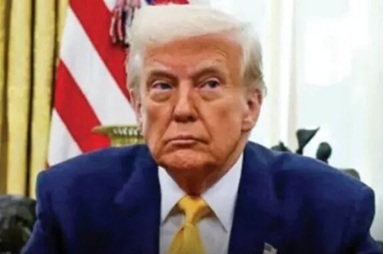
US President Donald Trump has said he would accept a 20-year suspension by Iran of its nuclear programme, in what appears to be confirmation of a shift in position away from a demand for a total end to it.
Trump said it had to be a “real 20 years”. Previously he has called on Iran to permanently cease enriching uranium – a stage in making a weapon – and to be prevented from ever acquiring nuclear weapons.
But he also said his patience with Iran was running out, with no sign of a breakthrough in talks.
Israeli and US forces began massive air strikes on Iran on 28 February. A ceasefire in place since last month meant to facilitate talks has been largely observed, despite some exchanges of fire.
Pakistan has been playing the role of mediator.
However, both sides appear to be far apart, having rejected each other’s most recent proposals to end the war.
Iranian media said Tehran’s proposal had included an immediate end to the war on all fronts – an apparent reference to Israeli attacks against its Shia ally Hezbollah in Lebanon – a halt to the US naval blockade of Iranian ports and guarantees of no further attacks on Iran.
Speaking to reporters on Air Force One after talks in Beijing with Chinese President Xi Jinping, Trump said the two sides had agreed Tehran could not be allowed to have a nuclear weapon and must reopen the Strait of Hormuz, which it is currently blocking, prompting a rise in world oil prices.
When a reporter suggested that a 20-year suspension of Iran’s nuclear programme was not enough, he replied: “Twenty years is enough, but the level of guarantee from them, in other words it’s got to be a real 20 years.” He did no elaborate.
US media reported in April that during a session of talks in the Pakistani capital, Islamabad, Vice-President JD Vance had responded to an Iranian proposal to cease enrichment for five years by insisting on a minimum of 20 years.
However, this is thought to be the first time Trump himself has mentioned a 20-year timeframe.
In his first term as president, he withdrew from a 2015 nuclear agreement reached with Iran by the Obama administration. One of the reasons given was opposition to so-called “sunset clauses” that would have allowed some restrictions on Iran to expire over time.
Israel has so far not reacted to Trump’s remarks. Prime Minister Benjamin Netanyahu has said that Iran’s stockpile of enriched uranium must be “taken out” before the war against Iran can be considered over.
Netanyahu vehemently opposed the 2015 nuclear deal, partly on the grounds that the sunset clauses would leave open the possibility of Iran obtaining nuclear weapons and continuing to present a grave threat to Israel.
We Can’t Curb Nuclear Proliferation If We Don’t Acknowledge Israel’s Nukes.

This letter is a rare and important challenge to one of the most entrenched taboos in U.S. foreign policy: acknowledging that Israel has an undeclared nuclear arsenal for decades and that Washington has largely complied with Israel’s desire to maintain silence around it
The goal of nonproliferation cannot be credible if it is selective. Israel is not a signatory to the Nuclear Non-Proliferation Treaty, while Iran is.
There is no credible nonproliferation policy that begins by pretending not to see the bombs your ally already has.
Etan Mabourakh , Truthout, May 12, 2026, https://truthout.org/articles/we-cant-curb-nuclear-proliferation-if-we-dont-acknowledge-israels-nukes/?utm_source=Truthout&utm_campaign=603e7eec49-EMAIL_CAMPAIGN_2026_05_12_09_25&utm_medium=email&utm_term=0_bbb541a1db-603e7eec49-650192793
Thirty House Democrats, led by Rep. Joaquin Castro, publicly asked Secretary of State Marco Rubio on May 4 to end the long-standing U.S. policy of ambiguity around Israel’s nuclear capabilities. In a letter, the group asked for answers on detailed questions about Israel’s warheads, delivery systems, fissile material production, and nuclear doctrine. They argue that Congress has a constitutional responsibility to understand the nuclear balance in the Middle East and warn that official silence makes coherent nonproliferation policy impossible.
Lawmakers tied their demand for transparency directly to the current U.S.-Israeli war on Iran, warning that fighting alongside a state whose nuclear posture remains officially unacknowledged heightens the risks of miscalculation and escalation. It also makes the United States out to be hypocritical — citing the nonexistent threat of an Iranian nuclear weapon yet to be built, which Iran had forsworn, while simultaneously ignoring Israel’s secret, unmonitored, undiscussed nuclear weapons arsenal.
If the United States claims to be deeply concerned about nuclear proliferation in the region, the government has a responsibility to stop ignoring facts that make the entirety of U.S. foreign policy on proliferation look completely disingenuous. The U.S. cannot keep sending billions in weapons unconditionally to a nuclear-armed state while treating open discussion of that reality as impermissible.
This letter is a rare and important challenge to one of the most entrenched taboos in U.S. foreign policy: acknowledging that Israel has an undeclared nuclear arsenal for decades and that Washington has largely complied with Israel’s desire to maintain silence around it. That posture goes all the way back to a secret 1969 understanding that allowed the issue to remain publicly unspoken even as it has shaped regional calculations. For decades, Washington would not acknowledge Israel’s nuclear capability, and Israel would not confirm it. But declassified National Security Archive material suggests that by 1969, U.S. agencies had already accumulated enough sensitive evidence to treat the issue as a serious intelligence matter, while also deciding that political and foreign policy costs outweighed the benefits of pressing it openly. The result was an unofficial understanding that helped lock the subject inside a veil of deniability, even as internal investigations, wiretaps, and intelligence briefings continued behind the scenes.
If the formal public stance of the U.S. is to not support the existence of nuclear weapons in the Middle East — whether in Iran or Israel — then the foreign policy objective should be to advocate for a Middle East free of weapons of mass destruction. This would require acknowledging that war has utterly failed as a strategy to prevent that goal, especially when the fake threat of an active nuclear weapons program is used to justify military action — as has been the case in costly, useless U.S. wars in Iraq and now in Iran.
The goal of nonproliferation cannot be credible if it is selective. Israel is not a signatory to the Nuclear Non-Proliferation Treaty, while Iran is. Simply acknowledging that fact does not require putting full trust in Tehran to abide by the treaty — indeed, that’s why Iran has been subjected to countless inspection regimes; it simply means that any honest regional nonproliferation framework has to begin with the facts as they are, not as Washington prefers to describe them.
Those facts and suspicions have been a matter of public record for decades, even if U.S. officials have often refused to address them publicly. As far back as 1965, the U.S. government knew that over 200 pounds of highly enriched, weapons-grade uranium had gone missing from the Nuclear Materials and Equipment Corporation (NUMEC) plant in Pennsylvania — triggering enduring investigations and allegations by the CIA and other agencies that the material was clandestinely diverted to the Israeli nuclear program.
Decades later, in 1986, former Dimona technician Mordechai Vanunu leaked photographs and data to the Sunday Times that exposed the full scale of Israel’s covert weapons program. These facts have long been known and reported on by countless media outlets and scholars, even if they were officially evaded by the U.S. government.
That is why the Castro letter deserves attention beyond the news cycle. The lawmakers wrote that ambiguity about Israel’s program makes coherent nonproliferation policy impossible not only for Iran, but for Saudi Arabia, the United Arab Emirates and every other state making decisions based on the capabilities of its neighbors. These 30 Democrats are right to express this concern, and the principle involved is larger than one conflict: There’s no such thing as a rules-based order built on exceptions for allies and punishment for adversaries.
We will not be able to resolve complex issues of nuclear proliferation if we cannot even share a basic reality. The Orwellian “ceasefires” in Gaza, Lebanon, and Iran illustrate this clearly. The U.S. government and its allies lie, and then expect the other side to not just accept their terms, but also their version of the truth — a recipe for perpetual conflict.
Ironically, tragic and repeated U.S. failures of diplomacy have strengthened the most conservative forces inside Iran, who benefit most from isolation, siege, and perpetual confrontation. If U.S. officials profess to care about the Iranian people, regional peace, and genuine nonproliferation, they should be building diplomatic pathways that reduce incentives for weaponization, not destroying the possibility of trust altogether.
The United States should state openly what it knows, demand transparency from all regional actors, and return to the hard work of diplomacy. The rest of Congress should insist on answers to the questions raised in the Castro letter, not bury them. And anyone serious about preventing nuclear catastrophe should be willing to say a simple thing out loud: There is no credible nonproliferation policy that begins by pretending not to see the bombs your ally already has.
Now You See Them… Now You Don’t – Trumpland Is a Man’s World

Focusing on Noem and Bondi, however, misses the larger point. This first year of Trump 2.0 has seen women, one after another, summarily gone from their posts (some fired, some resigning) as part of a larger DEI purge. As I pointed out in a TomDispatch piece in January, the military has led the way with a full-scale attack on women. And that trend started on the administration’s very first day in office when Trump removed Linda Fagan, the first female commandant of the Coast Guard.
Fagan was, in fact, the first woman ever to serve as a military service chief and, among other things, she had exposed “Operation Fouled Anchor,” a previously covered-up investigation into sexual harassment and assault in the Coast Guard. Admiral Lisa Franchetti, the first woman to lead the Navy, was fired as well. Both have now — no surprise — been replaced by men.
Women Leaders and Trump 2.0
Karen J. Greenberg Tom Dispatch, May 10, 2026, https://tomdispatch.com/now-you-see-them-now-you-dont/
It’s been a tough couple of months for women officials in Washington — or, more accurately, in Trumpland. In early March (Women’s History Month, by the way), in a Truth Social post, the president fired Secretary of Homeland Security Kristi Noem, the second woman ever to hold that title. Weeks later, also in a social media post, he fired Attorney General Pam Bondi, the third woman ever to serve as head of the Department of Justice.
While in the first year of his first presidency, Trump 1.0 had fired numerous officials, this time around, Bondi and Noem, who ran the two largest law enforcement agencies in the country, were the first cabinet officials to be dismissed. Both — no surprise — were replaced by men. And just as I was writing this piece, Trump removed another female cabinet official, Secretary of Labor Lori Chavez-DeRemer. Meanwhile, speculation lingers about the possible firing of a fourth female cabinet member, Director of National Intelligence Tulsi Gabbard, the second woman to hold that job. And whether or not Gabbard is formally dismissed, she has recently been effectively sidelined, as her absence from White House meetings on the war in Iran suggests.
Notably, Noem, Bondi, Chavez-DeRemer, and Gabbard are, of course, all women. As Jasmine Crockett, a Democratic House of Representatives member from Texas, recently tweeted, “Well… first it was Kristi Noem, now it’s Pam Bondi… it would be too much like right that Pete [Hegseth] be next. I see a theme. He [Trump] will throw the incompetent women under the bus a lot faster than the incompetent men.”
Equal Opportunity Failure
Crockett has a point. Pete Hegseth’s leadership at the Department of Defense (now all too appropriately retitled the Department of War) has erased time-honored rules and norms in staggering ways. He has, for instance, drastically reduced media access to the Pentagon, purged employees who disagreed with him, as well as those he deemed to be DEI (diversity, equity, and inclusion) appointees, and is now exerting his leadership in a war against Iran for which the exit strategy seems elusive at best, despite his assurance that, as the Guardian reported, “the U.S. would not get bogged down in the conflict.” The U.S. operation, he insisted, was not a “democracy-building exercise,” adding that ‘this is not Iraq. This is not endless.’”
Hegseth’s behavior has led Arizona Democratic Representative Yassamin Ansari to file articles of impeachment against him on six charges. They include the commission of war crimes, especially the killing of at least 165 people, including many children, at a girls’ primary school in Iran hit by a U.S. missile; negligence with sensitive information; and conducting an unauthorized war without congressional approval. In the Senate, Massachusetts Democrat Elizabeth Warren has followed up with a letter to U.S. Securities and Exchange Commission Chairman Paul Atkins asking for an investigation into whether Hegseth attempted to profit from his financial investments in the run-up to the war in Iran.
Crockett might just as easily have highlighted the wayward behavior of FBI Director Kash Patel, recently exposed in a piece in The Atlantic describing “excessive drinking” that interfered with his job (an article over which Patel immediately filed suit for $250 million in damages), or the trashing of health standards by Health and Human Resources Secretary Robert F. Kennedy, Jr.
But whatever the future of those reprehensible men in cabinet positions, it’s unfortunately difficult to defend either Bondi or Noem for their actions while in office. Like their male counterparts, both defiantly tossed professionalism and decency to the winds. Under Noem, with U.S. Immigration and Customs Enforcement (ICE) leading the way, the Department of Homeland Security (DHS) was weaponized and transformed into President Trump’s version of a homeland militia. It’s hardly a stretch to make the comparison to Hitler’s Brownshirts.
So far, in Trump’s second term in office, ICE has terrorized schools and businesses, while cruelly imprisoning migrants without due process of any sort. It has held children in detention centers under abhorrent conditions, attacked peaceful protesters, and killed citizens on the streets of America. Worse yet, Noem appropriated tens of millions of dollars to cover the costs of a pro-ICE ad featuring herself riding a horse in front of Mount Rushmore saying, “Break Our Laws, We’ll Punish You.” (Nor should we imagine that things will get any better without her.)
Bondi’s ouster followed failures of a different order — namely, her stumbling, wildly inept efforts to fulfill Trump’s agenda. She proved unable even to make the case of Trump pal Jeffrey Epstein go away, while what she had to say when releasing documents related to him led to accusations that her statements were riddled with falsehoods. Meanwhile, prosecutions under her watch of New York State Attorney General Letitia James and former FBI Director James Comey, high-priority items for the president, fell apart.
And when called before Congress to explain herself, her rank lack of civility resembled the behavior of a spoiled teenager berating her teacher, knowing that, since her parents wielded power over the school, she should fear no reprisals. Under Bondi, the sacrosanct mission of the Department of Justice as an agency independent of the White House was summarily tossed aside (as the roof-to-ground-floor Trump banner that hung from its office building demonstrated).
Female Purges
Focusing on Noem and Bondi, however, misses the larger point. This first year of Trump 2.0 has seen women, one after another, summarily gone from their posts (some fired, some resigning) as part of a larger DEI purge. As I pointed out in a TomDispatch piece in January, the military has led the way with a full-scale attack on women. And that trend started on the administration’s very first day in office when Trump removed Linda Fagan, the first female commandant of the Coast Guard.
Fagan was, in fact, the first woman ever to serve as a military service chief and, among other things, she had exposed “Operation Fouled Anchor,” a previously covered-up investigation into sexual harassment and assault in the Coast Guard. Admiral Lisa Franchetti, the first woman to lead the Navy, was fired as well. Both have now — no surprise — been replaced by men. As it stands, there are no longer any four-star women generals in the military. And only this month, we learned that Secretary of War Hegseth had reportedly removed two women from a promotion list to become one-star Army generals.
Outside of the Department of Defense, the resignations or firings of women in leadership positions have abounded across agencies ranging from the National Labor Relations Board to the Federal Trade Commission and the CDC.
This widespread purge of women stands in stark contrast to their presence in office during the Biden years. Under President Joe Biden, women held just under 50% of all cabinet or cabinet-level positions. And let’s not forget Kamala Harris, the first female vice-president in American history. It’s worth noting as well that, under Biden, the Deputy Attorney General and the Deputy Secretary of Defense were both women.
Trump is not unmindful of those statistics. Last year, he boasted about the presence of eight women among his 24 cabinet officers, or a third of his cabinet. As Business Insider reports, he was “thrilled to say that we have more women in our Cabinet than any Republican president in the history of our country.” Following the removal of Noem, Bondi, and Chavez-DeRemer, however, women occupy just over one-fifth of the cabinet positions — admittedly an improvement on his first term when, after two years of resignations and firings, women held only 13% of all cabinet-level positions.)
Project 2025
It’s worth noting that the path to the current backlash against women, including all the purges and punishments we’re now witnessing in real time, didn’t come about by mere happenstance. In the run-up to the 2024 election, the conservative think tank the Heritage Foundation published a Project 2025 report entitled Mandate for Leadership: The Conservative Promise, a 900-plus page blueprint for overhauling the federal bureaucracy. It called for gutting DEI programs, eliminating and reducing the size of any offices that didn’t serve a conservative agenda, and enhancing the powers of the president. Among its many recommendations, Project 2025 touted an anti-female message, including removing “gender equality” language from government websites, emphasizing “family planning,” and recommending limitations on access to contraception and cuts to federal funding for abortions.
Although Trump repeatedly distanced himself from Project 2025, many of its recommended policies have indeed become our new reality, including matters affecting women. In the first months of Trump’s second term, images of women, as well as persons of color and LGBTQ+ individuals, were systematically erased from government websites. So, too, protections for women’s health were tossed to the winds. As the abortion rights group Reproductive Freedom for All has reported, as of January 2026, “53% of [Project 2025’s] policies attacking reproductive freedom are completed or in progress.”
And now, there is a brand-new Heritage Foundation report devoted to the need to counter the declining birth rate and the fragility of the American family. “Saving America by Saving the Family: A Foundation for the Next 20 Years” calls for the restructuring of incentives to promote childbearing and “revive the institution of marriage.” Signaling its message, the report makes the case for privileging marriage and children over career advancement and less traditional family arrangements caused by divorce and single-parenthood. While the report underscores the family roles incumbent upon both men and women, the fact is that reforms aimed at incentivizing childbearing will fall primarily on women, while those aimed at privileging childrearing over career choices would likely fall most heavily on women as well.
MS NOW’s Ali Velshi and “Velshi” Segment Producer Amel Ahmed summed up the report well, pointing out that its overall takeaway is: “the freedoms fought [for] and won by America’s women aren’t progress; they are the problem.”
Of course, in the era of Donald Trump, none of this should come as a surprise, not when you consider the histories of the men who are now running the show: a president who, in addition to once touting the fact that he could “grab them by the pussy,” has been convicted in E. Jean Carroll’s civil suit over accusations of sexual abuse and defamation to the tune of $83.3 million in damages, a decision upheld by an appellate court. And let’s not forget that Trump’s first nominee for Attorney General, Matt Gaetz, withdrew his name from consideration under a cloud of accusations of wrongful behavior, including sexual misconduct. Not to mention the shadow cast by the number of individuals within the current administration whose names are said to appear in the Epstein files. While no formal charges of sexual misconduct have been issued against them, Commerce Secretary Howard Lutnick is reportedly being pressured to resign over his alleged ties to Epstein.
A Future Government Without Women?
It’s hard to predict which women will come under the axe from Trump and crew in the coming months. But the onslaught has understandably led women from both sides of the political spectrum to sound the alarm. Months before she announced her resignation from Congress, former Trump supporter Marjorie Taylor Greene had already expressed her own misgivings about the misogyny of the Republican leaders in Congress.
When Trump rescinded New York Congresswoman Elise Stefanik’s nomination to be the U.S. Representative to the United Nations and replaced her with Michael Waltz (who had embarrassed himself by adding a reporter to a private Signal chat about possible future strikes against the Houthis in Yemen), Greene saw it as a sign of a general trend of sidelining women. She summed it up as a case where Stefanik “gets shafted,” while Waltz “gets rewarded.” For Greene, it was proof of an overwhelming Trump administration mood of: “She’s a woman, so it was OK to do that to her somehow.”
Greene’s dissatisfaction wasn’t just over Stefanik but over the general trend that has led to only one Republican woman chairing a committee in Congress. Notably, alongside Greene, Republican representatives Nancy Mace and Laurent Boebert signed a petition pressuring the Department of Justice to release information on the Epstein files.
The signs are everywhere. Expectations are disappearing that women will hold leadership positions inside the Trump administration or in the halls of Congress (unless the Democrats win decisively in November). If you didn’t realize it before, you really can’t hide from it now. The attack on diversity in government has become pervasive and (at least as yet) is undeterred, targeting with abandon females, as well as people of color, immigrants, and critics of the president. In other words, the fate of women leaders should provide us with an insight, however dispiriting, into just how quickly the values and assumptions that guided this nation’s progress in matters of race, gender, and ethnicity for decades have disappeared.
What once amounted to progress is indeed now seen as the problem. Nowhere is this more apparent than in the exorcising of women from the halls of government.
Karen J. Greenberg is a future studies fellow at New America, a non-resident research fellow at the NYU Reiss Center for Law and Security, and co-host of the SpyTalk podcast. She is the author of many books, including Subtle Tools: The Dismantling of American Democracy from the War on Terror to Donald Trump.
Wall Street Is Pairing Up With the Army to Build Data Centers
“the kinds of things AI can be used for, and some of them are horrifying in terms of the speed with which they can enable killing or the extent to which they can expand surveillance networks,”
For example, reporting by the Military Times suggests that the Pentagon’s Maven AI system, which was developed by Palantir and “classifies targets, recommends weapons systems and generates strike packages in near real time,” was involved in the bombing of the Shajareh Tayyebeh primary school in Minab, Iran, which killed 155 people, most of them young schoolchildren.
The Army data center buildout comes as the Pentagon increases its use of AI in military operations.
By Derek Seidman , Truthout, May 11, 2026, https://truthout.org/articles/wall-street-is-pairing-up-with-the-army-to-build-data-centers/?utm_source=Truthout&utm_campaign=65c219f2a8-EMAIL_CAMPAIGN_2026_05_11_09_33&utm_medium=email&utm_term=0_bbb541a1db-65c219f2a8-650192793
Two trends, seemingly separate, have been accelerating over the past few years. First, Wall Street has been plowing billions of dollars into financing data centers. Second, the U.S. military has been ramping up its use of artificial intelligence (AI).
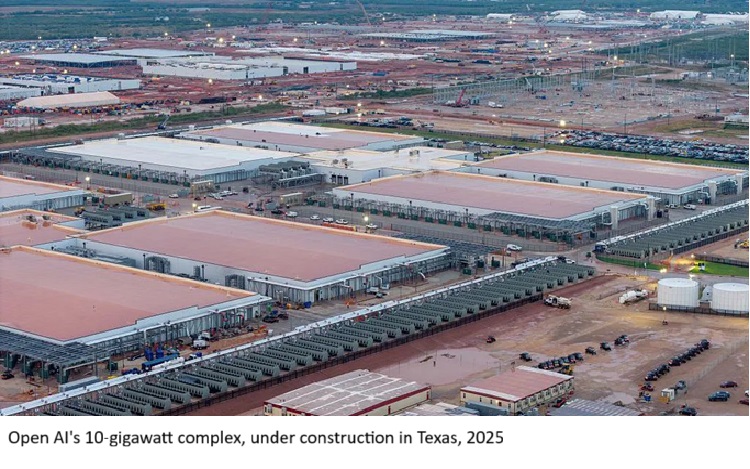
Now, these two trends are directly merging. In late March 2026, the U.S. Army announced its selection of companies to build and operate two hyperscaled data centers on two different military installations. Both data centers — one at Fort Bliss, Texas, the other at Dugway Proving Ground, Utah — will be backed by some of the world’s top Wall Street firms.
An Army spokesperson told Truthout that the Army has entered into “an exclusive negotiation period” with the companies to negotiate “specific lease economics” on what will be “long term, 50-year” leases.
The spokesperson also said that “[i]nstead of receiving cash for the lease, the Army will be compensated through ‘in-kind consideration,’” meaning that “the Army accepts services or improvements of equal or greater value in lieu of cash rent — specifically, a key portion of the dedicated data computation capabilities to directly support our warfighting needs.”
The data centers will be “100 percent privately financed, built, and operated by the developers,” said the Army spokesperson, and confirmed that they “are indeed commercial data centers” that will be allowed to sell off excess computing capacity commercially.
All this comes as the U.S. military accelerates the use of AI in its operations. One top Army official has said the data centers will be used “to meet rising demands for computational power required for AI applications, including drone swarms, advanced simulations, and real-time operational analysis.”
As one industry website put it, “data centers are war infrastructure now.”
But local residents and some experts are expressing alarm over the data centers due to their environmental impacts and their potential burden on water and electric grids, as well as what these deals represent for military and corporate accountability.
“We’ve seen examples of the kinds of things AI can be used for, and some of them are horrifying in terms of the speed with which they can enable killing or the extent to which they can expand surveillance networks,” Roberto J. González, an expert on U.S. militarism at San José State University, told Truthout.
Army Data Center Deals
The two planned Army data center complexes will be massive projects. The Fort Bliss data center will be located on 1,384 acres of military land and is scheduled to become operational in 2027. It will be built and operated by the Carlyle Group, one of the world’s top private equity firms, and a major investor in data centers more broadly.
According to local news outlet El Paso Matters, the three-gigawatt data center complex “would consume more electricity than all of El Paso Electric’s 460,000 customers combined.”
The Dugway Proving Ground data center project will be built on approximately 1,201 acres and is scheduled to become operational in 2029. It will be constructed by data center builder CyrusOne, which is jointly owned by KKR, also a top private equity firm and huge investor in data centers, and Global Infrastructure Partners, the private infrastructure investment arm of BlackRock, the world’s largest asset manager.
The Army spokesperson told Truthout that the 50-year leases for the data centers will be “Enhanced Use Leases authorized by Title 10 of the U.S. Code, Section 2667” — a federal statute permitting the defense secretary to lease out underutilized military land to “promote the national defense or to be in the public interest” — and that “[t]he developer assumes 100 percent of the financial risk to build the infrastructure.”
The deals come after a 2025 executive order from Donald Trump, titled “Accelerating Federal Permitting of Data Center Infrastructure,” which includes a specific statute allowing the Pentagon to “identify suitable sites on military installations” for data center infrastructure and to “competitively lease available lands” for qualifying projects.
While the deals haven’t been finalized, and key details on the terms of the contracts haven’t been announced, the billionaire-led firms developing the data centers will be allowed to sell excess computing power from the facilities on commercial markets.
These two planned facilities are likely just the beginning of the Army’s data center deals. The military news site Task & Purpose reports Army contract requests for two more data centers at Fort Hood, Texas, and Fort Bragg, North Carolina, with the latter including “several potential spots … within one mile of civilian areas and one-half mile of civilian housing.”
Task & Purpose also notes that the Air Force released a request for lease proposals for data centers last year at several bases.
The Army deal breaks new ground for the military. “This will be the first hyper-scale data center that the Pentagon has ever done,” Army Secretary Dan Driscoll told the Wall Street Journal in March.
“Military AI Dominance”
The planned facilities come as the U.S. military accelerates the integration of AI into its operations and, aided by new Trump administration policies, bolsters its access to data centers, which generate the computing capacity that powers AI.
In January, Defense Secretary Pete Hegseth published a memorandum ordering the acceleration of “America’s Military AI Dominance” by “becoming an ‘AI-first’ warfighting force across all components.” The order follows Trump’s January 2025 executive order on “removing barriers to American leadership in artificial intelligence.”
Notably, Hegseth’s memo emphasizes corporate America’s driving role in this initiative, emphasizing that the military’s AI makeover will be “fueled by the accelerating pace of commercial AI innovation coming out of America’s private sector.”
On April 3, a few months after Hegseth’s memo, the Army launched its Army Data Operations Center (ADOC) which, according to a press release, “will serve as the operational engine for the Army’s transformation into a data-centric force.” Labeled a “911 for data,” ADOC will integrate “fragmented” data across the Army’s operations globally to help to “operationalize data” for goals like “shortening the sensor-to-shooter timeline,” and ultimately “securing the Army’s advantage now and in the future,” according to the press release.
González, who’s written about Big Tech’s transformation of the military-industry complex, told Truthout that the Trump administration’s military AI push is focused on developing “autonomous unmanned drones in battlefield situations” that “will rely heavily on AI for everything from navigation, to target selection, to pattern recognition for identifying different potential targets.”
González also said the growing use of AI in the military will bolster “AI decision support systems” that “stitch together different kinds of unstructured and structured data” — which could include things like “metadata about phone conversations, cell phone locations, and internet use patterns” — to “create a list of targets.”
González cites Israel’s genocidal siege against Palestinians as an example. “This is precisely what the Israel Defense Forces were using in [Israel’s] war in Gaza to create lists of suspected enemies who were then targeted for assassination, essentially,” he said.
González warns that growing autonomous, AI-driven military systems will intensify surveillance and weaken the ability to hold individuals to account. “These systems often fail, and they also diffuse accountability when a machine, rather than a person in the loop, is making the decision over life or death,” he said.
For example, reporting by the Military Times suggests that the Pentagon’s Maven AI system, which was developed by Palantir and “classifies targets, recommends weapons systems and generates strike packages in near real time,” was involved in the bombing of the Shajareh Tayyebeh primary school in Minab, Iran, which killed 155 people, most of them young schoolchildren.
The Military Times noted that Maven “generated hundreds of strike coordinates in the first 24 hours of the Iran campaign” and that it was unclear if any human verified the coordinates that targeted the school, which were based on “outdated intelligence.”
In March, U.S. Deputy Secretary of Defense Steve Feinberg declared that Maven would become, as a Reuters headline put it, a “core US military system.”
“Sweetheart Deal”
The proposed data center at Fort Bliss — which would be the third major data center in the El Paso area — has sparked concerns among locals over the potential strain on water and energy resources.
Read more: Wall Street Is Pairing Up With the Army to Build Data CentersWhile many specific terms of the deals remain to be seen, Tyson Slocum, director of Public Citizen’s Energy Program, worries that private interests that covet land to build data centers could get a “sweetheart deal” from the Army well below the pricey market rates for data center square footage.
“My primary concern is that it’s a huge public subsidy to these private data center developers,” said Slocum.
The Army spokesperson told Truthout “[t]he return on investment for the American taxpayer” in these deals “is realized through massive cost avoidance.”
“By having private companies fund and build these data centers on underutilized Army land, the developers take on the financial risk, and the Army receives essential data processing capacity without direct cash outlays,” the spokesperson said.
Slocum also noted that data centers could stress the local grids near the military bases — concerns shared by El Paso residents. “Most military bases in the United States are not isolated islands,” he said. “They’re interconnected with the grid, and they’ll need to draw upon additional power resources from the grid.”
Slocum expressed alarm that placing data centers on military land could support the Trump administration’s efforts to protect fossil fuel-generated power production — which often powers data centers — by connecting it to “national security.”
“Military bases are in all 50 states and every corner of the power grid,” said Slocum. “Any power plant connected to that grid can now conceivably be needed for national security to supply a base.”
The Army spokesperson told Truthout that “[m]inimizing community impact was a primary selection criterion for these projects,” and that “[t]he chosen proposals were selected specifically because they feature innovative solutions designed so as not to burden local communities or utilities.”
The Army spokesperson also said that “before any final lease is signed, a detailed environmental review under the National Environmental Policy Act (NEPA) must be completed.”
“A Larger Tech Ecosystem”
Pentagon deals around tech weaponry with big financial investors are nothing new. González has written about Silicon Valley venture capitalist financiers’ role in transforming the U.S. military-industrial complex, with firms like Palantir and Anduril ascending.
“There’s a shifting of the center of gravity from the traditional, established defense firms like the Lockheed Martins and Boeings to these new groups that we more often associate either with commercial tech products rather than military interests,” said González.
The new Army data centers deals, struck with some of the biggest global diversified Wall Street firms, represent a further strengthening of the nexus between finance and tech for military uses.
“The tech industry is closely aligned with industries like private equity and venture capital firms,” said González. “It’s all a larger tech ecosystem.”
The military also seems intent on striking similar deals in other areas. “Beyond data centers, the Army is looking at doing similar leasing arrangements for critical mineral processing and other types of manufacturing,” reported the Wall Street Journal.
Private equity’s new data center partnerships with the U.S. Army come as this powerful sector is intensifying its investments along the entire AI supply chain. As Truthout previously reported, private equity has been channeling hundreds of billions of dollars into financing data centers and other AI infrastructure — from the data center buildings themselves to the fossil fuel power generation that supports their operations.
The Carlyle Group building the Fort Bliss data center oversees $475 billion in assets. The firm was co-founded by billionaire David Rubenstein, who remains Carlyle’s co-executive chairman. Rubenstein is an influential philanthropic donor, and Joe Biden spent numerous Thanksgivings at Rubenstein’s $34 million Nantucket complex during his presidency.
BlackRock subsidiary Global Infrastructure Partners (GIP) and KKR own CyrusOne, the firm building the Dugway data center. KKR was co-founded by mega-billionaire Henry Kravis, who remains KKR’s co-chair. The firm oversees $744 billion in assets and is a major data center investor globally.
BlackRock, led by billionaire Larry Fink, is the world’s largest asset manager, overseeing $14 trillion in assets. BlackRock has aggressively moved into private investment in infrastructure in recent years, including data centers.
In March 2025, amid Trump’s threats to “take back” the Panama Canal, BlackRock coordinated with the Trump administration to acquire a massive portfolio of global ports that included two Panama Canal ports.
BlackRock has also been acquiring utilities and power generation companies that have been tied to providing energy to proposed data centers. BlackRock also co-owns Aligned Data Centers, one of the world’s largest data center companies.
Truthout reached out to Carlyle, KKR, and BlackRock for comment. Carlyle and KKR did not respond, and BlackRock’s GIP declined to comment.
Pushing Back
While the data center boom is often portrayed as an unstoppable force, communities across the U.S. have been resisting their construction, sometimes successfully.
“There’s a lot that individual communities can do to push back against these trends,” González emphasized, including supporting the “small but important number of elected officials” who oppose the data center frenzy.
Moreover, the grassroots movement against reckless data center construction is accumulating lessons and growing nearly everywhere.
“People should never lose hope in what political commitment can do to confront even the most powerful institutions or trends,” said González.
The Limits of Power -The War on Iran Will Likely End in American Retreat
Jeffrey Sachs and Sybil Fares, May 11, 2026, https://www.savageminds.co/p/the-limits-of-power
The war against Iran that the United States and Israel launched on 28 February 2026 will likely end in an American retreat. The United States cannot continue the war without producing disastrous consequences. A renewed escalation would likely lead to the destruction of the region’s oil, gas, and desalination infrastructure, causing a prolonged global catastrophe. Iran can credibly impose costs that the United States cannot bear and that the world should not suffer.
The US-Israel war plan was a decapitation strike, sold to President Donald Trump by Prime Minister Benjamin Netanyahu and David Barnea, the director of the Mossad. The premise was that an aggressive joint US-Israeli bombing campaign would so degrade the Iranian regime’s command structure, nuclear programme, and IRGC senior leadership that the regime would fracture. The United States and Israel would then impose a pliable government in Tehran.
Trump seems to have been convinced that Iran would follow the same course as had occurred in Venezuela. The US operation in Venezuela in January 2026 removed Venezuelan President Nicolas Maduro in what appears to have been a coordinated operation between the CIA and elements inside the Venezuelan state. The US won a more pliant regime, while most of the Venezuelan power structure remained in place. Trump seems to have believed naively that the same outcome would occur in Iran.
The Iran operation, however, failed to produce a pliant regime in Tehran. Iran is not Venezuela, historically, technologically, culturally, geographically, militarily, demographically, or geopolitically. Whatever happened in Caracas had little relation to what would take place in Tehran.
The Iranian government did not fracture. The Islamic Revolutionary Guard Corps (IRGC), far from being decapitated, emerged with a tightened internal command and an expanded role in the national-security architecture. The supreme leader’s office held; the religious establishment closed ranks behind it; and the population rallied against external attack.
Two months on, Trump and Netanyahu have no Iranian successor government under their control, no Iranian surrender to close the war, and no military pathway whatsoever to victory. The only path, and the one the US seems to be taking, is a retreat, with Iran in charge of the Strait of Hormuz and with none of the other issues between the US and Iran settled.
Several reasons explain America’s disastrous miscalculations and Iran’s successes.
First, American leaders fundamentally misjudged Iran. Iran is a great civilisation with 5,000 years of history, deep culture, national resilience, and pride. The Iranian government was not going to succumb to US bullying and bombing, especially reflecting on the fact that Iranians remember how the US destroyed Iranian democracy in 1953 by overthrowing a democratically elected government and installing a police state that lasted 27 years.
Second, American leaders dramatically underestimated Iran’s technological sophistication. Iran has world-class engineering and mathematics. It has built an indigenous defence industrial base, with advanced ballistic missiles, a homegrown drone industry, and indigenous orbital launch capability. Iran’s record of technological development, built up despite 40 years of escalating sanctions, is a stunning national achievement.
Third, military technology has shifted in a way that favours Iran. Iran’s ballistic missiles cost a small fraction of the US interceptors deployed against them. Iranian drones cost $20,000; US air-defence interceptor missiles cost $4m. Iran’s antiship missiles, with costs in the low six figures, threaten US destroyers that cost $2-3bn. Iran’s anti-access and area-denial network around the Gulf, layered air defence, drone and missile saturation capacity, and sea-denial capability in the strait have made the operational cost of imposing American will on Iran far higher than the United States can sustain, especially taking into account the retaliatory destruction that Iran can impose on the neighbouring countries.
Fourth, the US policy process has become irrational. The Iran war was decided by a small circle of presidential loyalists at Mar-a-Lago, with no formal interagency process and a National Security Council that had been hollowed out across the preceding year. Trump’s director of the National Counterterrorism Center, Joe Kent, resigned on 17 March with a public letter describing “an echo chamber” used to deceive the president. The war was the output of a decision-making system in which the deliberative apparatus had been turned off.
This was neither a war of necessity, nor a war of choice. It was a war of whim. The underlying premise was hegemony. The United States was attempting to preserve a global dominance that it no longer possesses, and Israel was trying to establish a regional dominance that it will never have.
The likely endgame, given all this, is that the war will end with a return to something close to the status quo ante, except for three new facts on the ground. First, Iran will have operational control over the Strait of Hormuz. Second, Iran’s deterrent posture will be significantly raised. Third, the US long-term military presence in the Gulf will be significantly reduced. The other issues that supposedly prompted the US to attack Iran—Iran’s nuclear programme, regional proxies, the missile arsenal—will most likely be left where they were at the start of the war.
Even as the US retreats, Iran will not press its advantage against its neighbours. Three reasons explain why. First, Iran has a long-term strategic interest in cooperation with its Gulf neighbours, not an ongoing war. Second, Iran will have no interest in restarting a war it has just successfully ended. Third, Iran will be restrained, if any restraint is needed, by its great-power patrons, Russia and China, who both desire a stable and prosperous region. The Iranian leadership understands this clearly, and will stop the fighting.
Trump will no doubt try to depict the coming retreat as some great military and strategic victory. No such claims will be true. The truth is that Iran is far more sophisticated than the United States understood; the decision to go to war was irrational; and the underlying technology of war has shifted against the US. The American empire cannot win the war against Iran at an acceptable financial, military, and political cost. What America can regain, however, is some measure of rationality. It’s time for the US to end its regime-change operations and return to international law and diplomacy.
Trump’s deadly trap: By rejecting Iran’s proposal, US enters a strategic nightmare with no escape
Monday, 11 May 2026 , By Press TV Strategic Analysis Desk, https://www.presstv.ir/Detail/2026/05/11/768410/trump-deadly-trap-rejecting-iran-proposal-us-enters-strategic-nightmare-no-escape
In a theatrical move that fooled no one, US President Donald Trump rejected Iran’s comprehensive plan to end the war he illegally imposed on the country 70 days ago.
The US president postured as a victor, dismissing Tehran’s proposal with the bluster of a leader who expects capitulation. But the reality on the ground tells a starkly different story.
By every measurable metric, America is the defeated party in the asymmetric war that was imposed on Iran amid the nuclear talks in Geneva on February 28. And his rejection of Iran’s terms in a social media post has not opened new options for Washington, but it has only trapped the US in a deadly three-way crossroads from which there is no easy escape.
Trump’s rejection of Iran’s plan, which was submitted early on Sunday through Pakistani mediators, is a grave strategic error as Americans hold no winning cards.
Iran’s proposal: Fundamental, natural, and uncompromising
Iran’s plan to permanently end the war was never meant to please Washington. It was designed to restore justice, recognize strategic realities, and secure Iran’s undeniable rights after the unprovoked military aggression against the country and maritime banditry.
The core elements of Iran’s proposal are not maximalist. They are rooted in natural and fundamental principles that any nation subjected to unprovoked aggression and holding the upper hand would rightfully insist upon:
- War reparations – Payment of damages and reparations by the aggressor for the destruction inflicted on Iran’s infrastructure, economy, and civilian population.
- Management of the Strait of Hormuz – Recognition of Iran’s sovereign control over this vital waterway, based on the mechanism already announced by Tehran.
- Lifting of sanctions – The complete removal of all oppressive and illegal sanctions that have targeted the Iranian people for decades.
- Release of frozen assets – The return of billions of dollars of Iranian assets illegally seized by the United States.
- Permanent end to the war – A cessation of hostilities not only against Iran but also against the entire resistance front, including Hezbollah in Lebanon and other allied forces across the region.
None of these demands is unreasonable or impractical. They are the basic entitlements of a nation that has been attacked, bombed, and subjected to economic warfare for nearly half a century. What Iran is asking for is not special treatment but justice.
The American non-offer: Irrelevant demands and nuclear obsession
In stark contrast to Iran’s focused, reasonable and practically sound proposal, the American counteroffer reads like a wish list written by someone who has lost sight of reality.
Washington’s plan has nothing to do with ending the war. Instead, it resurrects the long-dead nuclear file – demands that were irrelevant before the war and are absurd now.
The United States insists on:
Closure of Iran’s nuclear sites – A non-starter that Iran has rejected for decades.
- Long-term halt to enrichment – Effectively disabling Iran’s nuclear program for years to come, which is totally unacceptable to Iran.
- Transfer of enriched uranium to America – A humiliating demand that no sovereign nation would accept, least of all Iran.
What is striking about the American proposal is what it omits. There is no mention of the American responsibility for starting the war in the middle of nuclear diplomacy.
There is also no acknowledgment of the thousands of Iranian civilians killed in the 40-day aggression. There is no offer of reparations. There is no commitment to withdraw the occupation forces from the region. There is no guarantee against future aggression.
Washington simply pretends the war never happened and pivots back to its failed nuclear fixation to deflect attention from the real issue.
The posture of defeat: Trump’s fake victory pose
Trump rejected Iran’s plan while posing as the victor. But this is pure theater. International experts, military analysts, and even sober voices within Western capitals acknowledge what Trump refuses to admit – the United States lost the asymmetric war against Iran.
Consider the evidence. The US entered this war with ambitious objectives: “regime change,” destruction of Iran’s missile program, dismantling of nuclear facilities, and unrestricted access to the Strait of Hormuz.
None of these objectives has been achieved. Iran’s missile cities remain intact. Its nuclear program continues to make progress. Its control over the Strait of Hormuz has been consolidated. And the Iranian people, far from rising against their government, have poured into the streets by the millions to support the leadership and the armed forces.
Trump’s hallucinatory “victory” exists only in his own press releases. In the real world, the United States has been defeated on every front. And rejecting Iran’s proposal does not change that fact – it only prolongs Washington’s agony.
The three-way crossroads: All paths lead to disaster
By rejecting Iran’s plan, Trump has trapped the United States in a deadly strategic dilemma. He now faces three options and none of them are good:
- Resume full-scale war
This is the most dangerous path. Starting the war again would plunge the United States and its Israeli proxy into a “dark corridor” from which there may be no return.
Iran has not yet deployed all its strategic cards. Throughout the 40 days of war, Tehran fought with its eyes fixed on the possibility of an even larger confrontation. The weapons systems, tactics, and capabilities that Iran deliberately held back would be unleashed in a second round, if that actually happens.
The result would likely be far heavier defeats for the US-Israeli war machine, defeats that could become irreversible. Iran’s unrevealed cards, combined with the lessons learned from the first phase of the war, would make any renewed American military campaign a gamble with catastrophic odds.
- Accept Iran’s terms
This is the only path to ending the imposed war, but it requires Trump to swallow his pride and acknowledge defeat like someone who understands the ground realities.
The United States would have to pay reparations, accept Iran’s complete and sovereign control of the Strait of Hormuz, lift illegal sanctions, release frozen assets, and agree to a comprehensive end to the war on all fronts.
For a president who has built his political identity around “maximum pressure” and “America First,” this option is politically toxic. But rejecting it does not make it disappear. It remains the only sustainable exit from a war that Washington cannot win.
Continue the naval blockade
An ambiguous, indefinite naval blockade that neither ends the war nor escalates it decisively is the current situation. But this option is also unsustainable. Iran’s top military command has already made its position clear that for every vessel intercepted or attacked, American centers and American vessels will be struck.
The Khatam al-Anbiya Central Headquarters has announced this equation publicly. It is not a threat but a binding warning. The continuation of the naval blockade will trigger Iranian responses that escalate incrementally but inevitably. There is no “safe” stalemate.
The economic dimension: A losing battle for Washington
The closure of the strategic waterway due to the war imposed on war and US maritime banditry and piracy has already sent shockwaves through global energy markets.
Oil prices have surged past $110 per barrel. Inflationary pressures are mounting across Europe, Asia, and the Americas. The continued naval blockade of Iran, coupled with Iranian retaliatory strikes on regional energy infrastructure, will only worsen these trends.
And who bears the blame? Global public opinion increasingly points to Washington. The United States started this war, and the United States rejected a reasonable peace plan.
The United States continues to strangle Iran’s economy while Iranian civilians suffer. The further economic indicators deteriorate, the more pressure will mount on Trump from domestic constituencies and international allies alike.
Iran understands this dynamic perfectly. Continued economic disruption is not a bug in Tehran’s strategy but a feature. Every day the war continues, the United States bleeds economically and reputationally.
Iran’s trap: No escape for the United States
World media have accurately described the current situation as “Iran’s trap” for the United States. It is a trap with no exit and Trump is yet to wrap his head around this reality.
Trump can neither win the war nor end it on acceptable terms. Resuming full-scale war invites catastrophic defeat. Accepting Iran’s proposal requires humiliating capitulation. Maintaining the status quo triggers escalating Iranian retaliation that systematically degrades American interests in the region.
This is the strategic nightmare that Trump has created for himself and his country. He started a war he could not win. He rejected a peace that would have ended it. And now he stands at a deadly three-way crossroads, with every direction leading to danger.
Iran, meanwhile, holds the strategic advantage. Tehran’s proposal remains on the table — reasonable, principled, and rooted in natural rights. But if the US chooses not to accept it, Iran is prepared to continue the war, escalate it, and inflict far heavier costs than anything seen in the first 40 days.
The choice is Washington’s. The consequences will be for Iran to impose. And history will record who acted with wisdom – and who walked willingly into a trap of their own making.
Brookfield wants to revive a South Carolina megaproject failure known as ‘Nukegate.’ Can it succeed where others failed?
What could go wrong?
At V.C. Summer, the first time around, almost everything did.
By the time 2016 rolled around, the original budget had nearly been spent, construction wasn’t even half-finished, and Westinghouse’s relations with key partners had degenerated into finger-pointing, lawsuits and withheld payments
Santee Cooper’s CEO retired. Prosecutors targeted top officials at the companies involved: SCANA’s former CEO was among those sentenced to prison time
Perhaps the biggest wild card dealt to Brookfield is President Trump.
One of the most daunting hurdles for nuclear projects is obtaining financing. Mr. Trump seemingly made that easier: Just days after Santee Cooper announced its partnership with Brookfield, the U.S. government announced that Japan had agreed to provide up to US$332-billion toward building energy infrastructure on American soil; at least US$80-billion had been specifically earmarked for Westinghouse reactors.
Matthew McClearn, The Globe and Mail, May 8, 2026, https://www.theglobeandmail.com/business/article-brookfield-vc-summer-nuclear-project-south-carolina/
The Virgil C. Summer Nuclear Station, in a sparsely populated corner of Fairfield County, S.C., is a graveyard for nuclear dreams.
Nearly a decade ago, the termination of construction of its two reactors (known as Units 2 and 3) marked an end to hopes of a rejuvenation of American nuclear energy. It bankrupted storied companies. It spawned lawsuits and sent executives to prison. It’s been called the biggest business failure in South Carolina’s history – or just “Nukegate.”
Since workers abruptly departed in 2017, new tenants, including vultures and Canada geese have taken up residence. So far this year, the plant’s owner, Santee Cooper, has identified 14 osprey nests, some atop utility poles. Especially when nesting, the ospreys have “no sense of humour at all,” said Steve Nance, the company’s director of nuclear production and development. With wingspans of about a metre, they’ve been known to attack people and drones.
“They’re extremely territorial,” he said. “If you get close to the light pole, she’ll take off. You’ve got about five minutes before you’re going to get a visit.”
Nonetheless, people are returning to V.C. Summer. Inside a warehouse, roughly 30 workers from nuclear giant Westinghouse Electric Co. have begun reviewing and scanning 5,200 large cardboard boxes of documents. They were generated during construction, which was aborted abruptly in 2017 amid massive delays and cost overruns. Studying them is part of an effort to assess what’s necessary to finish the job.
Eight years after its purchase of Westinghouse, the Brookfield BN-T -1.65%decrease empire (which is now based in New York, but has Canadian roots) stands to reap a huge windfallthat would validate its nuclear gambit.
Santee Cooper, the state-owned utility, selected Brookfield Asset Management as its preferred buyer for the incomplete units. This opportunity squares well with U.S. President Donald Trump’s ambition to reinvigorate the American nuclear sector, and he has publicly identified Westinghouse reactors as a preferred choice for construction.
What could go wrong?
At V.C. Summer, the first time around, almost everything did. Now, Brookfield must deliver what the U.S. nuclear industry’s best and brightest could not, even as it enters business arrangements that bind it more closely with the capricious Trump administration. Its reputation as a shrewd risk manager, built over many decades, is about to undergo what could be its most formidable test.
Brookfield’s nuclear gambit
Located less than an hour’s drive northwest of Columbia, South Carolina’s capital, the Units 2 and 3 construction site sprawls over more than 1,000 hectares. Located roughly a kilometre away, the original unit has generated power since the 1980s.
Each of the two units features a large cylindrical structure that would have housed an AP1000 reactor, Westinghouse’s flagship product. Inside Unit 2’s cavernous, roofless structure, the reactor vessel is already concealed by concrete. Those permitted to visit the site can stand inside a tank designed to store 2.4 million litres of water, which would be released into the reactor by an explosive valve during a dire emergency. The silence is punctuated by the sound of dripping water and the occasional indignant, whistling cry of an angry osprey overhead.
Nearby, a larger, skeletal rectangular structure houses steam turbines and other equipment. Inside Unit 2’s turbine building rest three large Hyundai 9,000-horsepower electric pumps. They’re open to the weather but have been maintained: Santee Cooper spent several million dollars annually on maintenance throughout the plant.
“The guys come and rotate them, change oils and desiccant bags,” Mr. Nance said of the giant pumps.
“They do preventative maintenance on them as if they were in service. And that’s what’s going to keep us from having to replace them.”
Large white storage tents scatter the site. Inside one, Unit 3’s 420-ton reactor pressure vessel rests on its side, covered in a thin layer of rust.
Another tent nearby contains two towering assemblies known as integrated head packages, which would be placed atop the reactor vessels. Each weigh about 360 tons and cost hundreds of millions of dollars.
In another tent sit four bright yellow Caterpillar diesel generators, which look brand new. The 500-ton crane used to lift components into place, though disassembled, remains on-site.
Mr. Nance said that under the original contract, Westinghouse and its partners got paid to deliver equipment, whether installed or not. The upshot is that an estimated 85 per cent of components required to finish both units are already there. Inspections thus far offer a favourable prognosis on their condition, he added: “So far, nobody’s found any showstoppers or deal-breakers.”
That’s part of Santee Cooper’s pitch to Brookfield: Whoever else might answer Mr. Trump’s call to construct AP1000s, the V.C. Summer units have a considerable head start.
Brookfield’s journey to commencing what has been dubbed the first privately funded nuclear project in American history was circuitous. In 2017, an opportunity arose when Westinghouse sought protection from its creditors. Brookfield’s private equity unit bought the stricken company for US$4-billion – far less than the cost of a single nuclear reactor.
It was a gamble.
Westinghouse’s roots date from the nuclear age’s earliest days, having designed and supplied the world’s very first commercial pressurized water reactor in Shippingport, Pennsylvania. It went on to dominate: Most reactors worldwide are pressurized water reactors, and most of those use Westinghouse technology.
By virtue of that legacy, Westinghouse held more than 1,500 patents. Its intellectual property included the AP1000, among the few reactor designs already certified by the U.S. Nuclear Regulatory Commission, or NRC. Westinghouse also had talent, employing 11,500.
But Westinghouse’s collapse did great violence to its prestige. Having botched V.C. Summer so completely, it was hard to conceive how it could attract further orders for AP1000s.
Fortunately, there was more to Westinghouse’s business: It was also a major service provider to utilities, earning revenues during regular outages when reactors needed refuelling and maintenance. “We could really see a path to seeing our returns in that part of the business,” said Jennifer Mazin, a Brookfield partner who sits on Westinghouse’s board, at a conference held by CIBC in Toronto in March. (Brookfield declined several interview requests for this story over a period of a few months.)
Sales prospects for AP1000s have improved considerably since then. Last year, Mr. Trump issued a flurry of executive orders, one of which demanded that construction begin on 10 large new reactors on American soil by 2030. Another order initiated a radical restructuring of the NRC aimed at speeding the permitting process. Yet another order called on the Secretary of Energy to prioritize “completing construction of nuclear reactors that was prematurely suspended.”
Jimmy Staton, Santee Cooper’s chief executive, had already been looking for ways to restart construction. Reading that executive order, he said, “we had a pretty good idea” Mr. Trump meant V.C. Summer.
“The government’s very supportive of this,” he added.
Brookfield agreed to buy the two V.C. Summer units on a “as-is, where-is” basis and finish the job. It’ll pay Santee Cooper US$2.7-billion in exchange for a 75-per-cent ownership stake. (Santee Cooper would retain the remaining quarter.) Potential buyers for the electricity include large data companies, or other utilities in South Carolina, Mr. Staton said.
Brookfield must finish assessing the project’s feasibility and report back to Santee Cooper on a proposed schedule for completing construction. Arriving at a decision on whether to proceed is expected to take between 18 and 24 months, and could cost as much as US$200-million. Mr. Staton said that according to early estimates, it could take five to seven years to finish the plant.
Brookfield can still back out. But if it proceeds, it will accept risks that Westinghouse itself has sworn off.
Unmitigated disaster
Westinghouse had long acted largely as a reactor designer, providing crucial plans that others could use to build nuclear plants.
That changed after Japan’s Toshiba Corp. purchased the company in 2006. Two years later, Westinghouse signed an agreement with Santee Cooper and its partners (the most important of which was South Carolina Electric & Gas, or SCE&G) to build V.C. Summer Units 2 and 3, at an estimated cost of about US$9.8-billion. Westinghouse guaranteed completion of the first reactor by April 1, 2016, the second by 2019 – and agreed to substantial penalties if it missed those targets.
It was a risky move for Westinghouse and also for South Carolinians. That’s because SCE&G had persuaded state lawmakers to introduce legislation that would allow it to recover some of its capital costs during construction.
Scott Elliott is a Columbia-based lawyer who practices mainly before the South Carolina Public Service Commission. His client roster includes the South Carolina Energy Users Committee, which represents large industrial power users. Its members were happy to have a nuclear plant, he said, but worried about the legislation’s implications.
“It made it awfully easy for SCE&G, and the utilities in general, to raise rates,” he said.
Those fears were realized after V.C. Summer got off to a bad start. After Westinghouse had already signed the contracts, the NRC demanded changes to the AP1000’s design, leading to early delays. Concrete wasn’t poured until 2013. Unavailability of basic materials such as standard rebar led to further delays.
“There were like five cost overrun proceedings,” Mr. Elliott recalled.
“And they kept going up: $200-million, then $500-million, and the last one was over $1-billion.”
By the time 2016 rolled around, the original budget had nearly been spent, construction wasn’t even half-finished, and Westinghouse’s relations with key partners had degenerated into finger-pointing, lawsuits and withheld payments.
“I don’t think Westinghouse knew what they were doing,” Mr. Elliott said.
Westinghouse faced a dilemma: It could either pony up the additional billions of dollars needed to complete the plant, or bail out and pay massive penalties. Unable to afford either option, it applied for court protection from its creditors under Chapter 11 of the U.S. Bankruptcy Code.
The fallout was ugly for all involved.
Toshiba withdrew from the reactor-building business and took a US$6-billion writeoff. It eventually agreed to pay US$2.2-billion to exit its obligations.
SCE&G’s owner, SCANA Corp., abandoned the project in 2017. Teetering on bankruptcy, SCANA agreed to merge with Dominion Energy Inc. within months.
Santee Cooper’s CEO retired. Prosecutors targeted top officials at the companies involved: SCANA’s former CEO was among those sentenced to prison time.
Worsening matters, V.C. Summer wasn’t Westinghouse’s only failed project. It was simultaneously the main contractor on two nearly identical units under construction at the Alvin W. Vogtle Electric Generating Plant in Georgia, just two hours away by road.
Georgia Power teamed up with new partners to complete Vogtle. Its AP1000s started generating power in 2023 and 2024, seven years late. The two units cost nearly US$37-billion, as compared to an original budget of US$14-billion. Vogtle has been dubbed the most expensive power plant ever built.
Take two
One lesson from V.C. Summer and Vogtle is that when building a nuclear power plant, one must select one’s partners carefully.
Read more: Brookfield wants to revive a South Carolina megaproject failure known as ‘Nukegate.’ Can it succeed where others failed?Contracts must be structured such that all parties are motivated to solve problems as they arise – because they inevitably will.
After Chapter 11, Westinghouse vowed to never again assume the huge risks of constructing a nuclear plant. Brookfield has deep experience in power generation generally, and has also worked on complex hydroelectric, real estate and infrastructure projects. But it has never before built a nuclear plant. Can it woo the right partners on the right terms?
This could be tricky.
Experts told The Globe that it will probably need a utility partner that is licensed as a nuclear operator by the NRC.
“Let’s say they build the danged things,” said Mr. Elliott. “State law would require them, if they’re going to sell the electricity, to be a regulated utility.”
For Santee Cooper’s part, Mr. Staton makes it clear he has no intention of assuming more risk or contributing capital to the project. It’s Brookfield’s show.
“I feel like we found the best partner in Brookfield,” he said.
“They have a great balance sheet. Most importantly, though, they are risk managers.”
But Brookfield is not keen to repeat Westinghouse’s mistake of shouldering the bulk of the project’s risks. At the CIBC conference, Ms. Mazin said Brookfield regards creating a “risk-sharing model” among the parties involved as crucial to the project’s success.
“We’re looking at all the components of having off-takers, utility, lenders, governments, partners, share risk,” she said.
Brookfield can further reduce risk by not overpaying for the project. As compared to the US$9-billion that Santee Cooper and its partners reportedly spent on the project, the US$2.7-billion Brookfield has promised to pay might seem like a steal.
Tom Clements, an activist and director of Savannah River Site Watch who intervened for many years before the Public Services Commission concerning the project, doubts rosy assessments of the plant’s condition. His organization monitors energy and nuclear issues, particularly nuclear wastes and plutonium management at the U.S. Department of Energy’s Savannah River Site in South Carolina. He points out that much of the plant’s equipment has been exposed to the elements.
A bigger concern, he added, is that the Nuclear Regulatory Commission must certify that plant equipment meets a high standard known as “nuclear quality.” But NRC inspections ceased after the project was halted.
“The fact that Santee Cooper may have been keeping it in buildings with air temperature and humidity controlled, I don’t know if that’s enough to certify that they’re nuclear qualified – the valves, the pipes, the pumps, the whole bit.”
An additional complication is that some plant components were sold. Mr. Staton confirmed that “small components here and there” had been sold to Vogtle as replacement parts, and Santee Cooper also struck an arrangement to sell plant components to Ukraine, which had been exploring construction of AP1000s.
On the other hand, the AP1000’s design has matured greatly during the last 20 years. Mr. Staton said Vogtle’s completion represents a tremendous advantage: It allows would-be AP1000 builders to learn from previous mistakes, and hire professionals who’ve already built one.
“We’ll be able to bring that kind of experience to the table here in South Carolina,” Mr. Staton said.
To that end, Brookfield announced earlier this month that it had formed a partnership with The Nuclear Company, a startup unveiled in 2023 that has hired dozens of former Vogtle and V.C. Summer veterans (some out of retirement) and markets itself as having been “built on the field of Vogtle.” The two partners will establish a new company specializing in deployment of Westinghouse reactors, including the AP1000 – and Brookfield has selected the new company as project manager to complete the V.C. Summer units.
Moreover, Westinghouse recently submitted an application to the NRC seeking to establish Vogtle Unit 4 as the standard design for future AP1000 deployments.
Uneasy bedfellows
Perhaps the biggest wild card dealt to Brookfield is President Trump.
One of the most daunting hurdles for nuclear projects is obtaining financing. Mr. Trump seemingly made that easier: Just days after Santee Cooper announced its partnership with Brookfield, the U.S. government announced that Japan had agreed to provide up to US$332-billion toward building energy infrastructure on American soil; at least US$80-billion had been specifically earmarked for Westinghouse reactors.
Santee Cooper said the unfinished V.C. Summer units will not qualify for that financing. But that money could springboard new AP1000 constructions. In a conference call late last year, Brookfield Asset Management’s then-president, Connor Teskey, said that funding “positions Brookfield at the centre of a historic build-out of clean baseload power, creating one of the most compelling growth opportunities across our transition platform, and potentially one of the most successful investments in Brookfield’s history.”
But Mr. Clements, of Savannah River Site Watch, noted that in the year since that financing was announced, there haven’t yet been any takers.
“Where are the electric utilities that are in on the deal, saying, ‘We want two of these AP1000s right here’?” Mr. Clements asked.
“They’re all looking at Vogtle and they don’t want to get burned. So who’s going to be first out of the gate?”
Brookfield’s co-owner of Westinghouse, Saskatoon-based uranium miner Cameco Corp., has acknowledged uncertainties about what might come out of Westinghouse’s arrangement with the U.S. government. In a recent filing, it noted that Westinghouse’s financial performance will depend on “the ability of the executive branch of the US government to obtain funding and support for the deployments” – a reminder that it’s not a done deal.
If the U.S. government places a final order of US$80-billion for Westinghouse reactors, it earns the right to 20 per cent of the resulting profits, worth about US$17.5-billion. And if Westinghouse reached a valuation of at least US$30-billion by January, 2029, the government could acquire a 20-per-cent ownership stake in Westinghouse.
Brookfield says that stake would come without governance rights. It regards the U.S. government as an unbeatable partner: that US$30-billion target valuation is more than seven times what Brookfield paid for the company in 2018.
Another perennial challenge for nuclear projects is acquiring permits. But Mr. Trump has quickly retooled the U.S. nuclear industry’s regulatory apparatus with a view of establishing “lasting American dominance.” One of his executive orders argued the NRC’s long licensing processes had brought development of nuclear power in the U.S. to a halt. The NRC had “tried to insulate Americans from the most remote risks,” according to Mr. Trump, who ordered it be reorganized; licence applications must henceforth be processed in 18 months or less.
Mr. Clements said that as recently as a few years ago, re-applying for licences for V.C. Summer would have been arduous. But “the way things are going in this country, it may be just a pretty simple process with the NRC,” he conceded.
But if all of this seemingly puts wind in Brookfield’s sails, Mr. Trump’s relations with partners and allies are famously tumultuous. For Brookfield, the price of dissatisfying him are incalculable, but potentially steep.
By some accounts, the Trump administration has already become restless. Citing nine unnamed industry and government sources, Canary Media (an American non-profit news organization covering energy, particularly renewables) reported in March that the administration had begun talks with representatives for two Westinghouse rivals: GE Vernova Hitachi Nuclear Energy and Korea Electric Power Corp. The report asserted that the U.S. Department of Energy felt Westinghouse and Brookfield are moving too slowly.
History suggests nuclear projects require much patience.
Chris Gadomski, lead nuclear energy analyst with BloombergNEF, said that while government policy can help get nuclear plants built, it’s not enough: Utilities, which are typically cautious, must spend large sums and assume great risks.
“I’ve talked to operators of large U.S. fleets about starting 10 large reactors by the end of Trump’s second term. And the response was just laughter – it’s never going to happen.”
Mr. Elliott, the Columbia-based lawyer, said Brookfield was virtually unknown in South Carolina, but completing V.C. Summer could elevate it to heroic status.
“Based on my history with this project, I’ll believe it when I see it.”
‘Effort to Stifle and Intimidate’: Trump DOJ Subpoenas News Outlets Over Iran War Coverage
Trump has said media outlets who circulate what he baselessly calls “false information” should be charged with treason.
By Jake Johnson , CommonDreams, May 12, 2026, https://www.commondreams.org/news/effort-to-stifle-and-intimidate-trump-doj-subpoenas-news-outlets-over-iran-war-coverage
“The government’s subpoenas to The Wall Street Journal and our reporters represent an attack on constitutionally protected newsgathering,” said the newspaper’s publisher.
The US Justice Department has reportedly subpoenaed The Wall Street Journal and other news outlets at the urging of President Donald Trump, who has complained incessantly about coverage of his illegal and disastrous Iran war.
The Journal reported Monday that it received grand jury subpoenas dated March 4 for records of its journalists as Trump pushed the Justice Department—now led by his former personal attorney, Todd Blanche—to investigate war-related leaks. “Blanche vowed to secure subpoenas specifically targeting the records of reporters who have worked on sensitive national security stories,” the Journal reported, citing an unnamed administration official.
During one meeting, the Journal reported, “Trump passed a stack of news articles he and other senior officials thought threatened national security to Blanche with a sticky note on it that said ‘treason.’”
Trump and other top administration officials, including Pentagon Secretary Pete Hegseth, have publicly voiced outrage over the US media’s Iran war coverage and threatened reporters who publish classified information—a common journalistic practice.
In April, Trump said he would work to imprison journalists involved in reporting on a US fighter jet shot down in Iran and subsequent efforts to rescue the warplane’s crew. The previous month, Trump floated “charges for treason” against journalists he accused of circulating “false information” about the Iran war.
Ashok Sinha, the chief communications officer of Dow Jones, the Journal’s publisher, said in a statement that “the government’s subpoenas to The Wall Street Journal and our reporters represent an attack on constitutionally protected newsgathering.”
“We will vigorously oppose this effort to stifle and intimidate essential reporting,” said Sinha.
The subpoena targeting Journal reporters pertained to “a February 23 article that reported that Gen. Dan Caine, the chairman of the Joint Chiefs of Staff, and others at the Pentagon warned the president about the risks of an extended military campaign against Iran,” the newspaper reported Monday.
“Other news outlets, including Axios and the Washington Post, published similar stories that day,” the Journal added. “Trump launched the war five days later, on February 28.”
CNN reported Monday that “in addition to The Journal, other news outlets have also received subpoenas in recent months.”
“But some of the news organizations have chosen not to comment on the matter for the time being,” CNN added.
Scott Stedman, an investigative journalist with The Newsground, accused the leaders of targeted outlets of “cowardice” for not speaking out against the Trump administration’s brazen assault on press freedom.
“The president uses the DOJ to target your news organization with subpoenas because he wants to out your sources and you don’t even have the guts to say anything,” Stedman wrote. “Grow a fucking spine!”
Trump’s nuclear message to Iran? Pentagon reveals rare location of missile submarine after rejecting Tehran deal
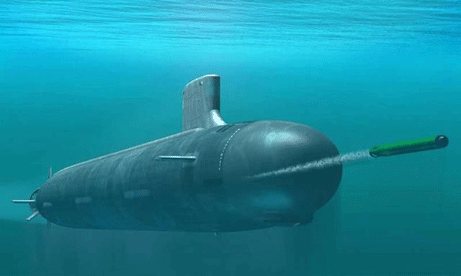
11 May 26, https://www.ynetnews.com/article/skbelo1kzg
The USS Alaska, one of America’s most secretive nuclear-armed submarines, surfaced in Gibraltar as Trump warned the ceasefire with Iran was on ‘life support’ and dismissed Tehran’s counteroffer as ‘totally unacceptable’.
The Pentagon made an unusually public show of force this week, revealing the location of a U.S. Navy nuclear-armed submarine just a day after President Donald Trump rejected Iran’s latest proposal to end the war.
The Ohio-class ballistic missile submarine arrived Sunday in Gibraltar, the British territory on Spain’s southern coast, the US Sixth Fleet said Monday. Such announcements are rare because the locations of America’s nuclear-armed submarines are usually among the military’s most closely guarded secrets
The Sixth Fleet did not initially identify the submarine by name, but local reports said it was the USS Alaska — one of the largest and most powerful submarines in the US Navy.
“The port visit demonstrates U.S. capability, flexibility and continuing commitment to its NATO allies,” the Sixth Fleet said in a statement. “Ohio-class ballistic missile submarines are undetectable launch platforms for submarine-launched ballistic missiles, providing the U.S. with its most survivable leg of the nuclear triad.”
The timing of the visit immediately drew attention. It came after Trump said the US ceasefire with Iran was on “life support” and described it as “unbelievably weak.” On Sunday, he rejected Iran’s counterproposal to end the war, calling it “totally unacceptable.”
Iran’s reported demands included war reparations, recognition of its sovereignty over the Strait of Hormuz and an end to US sanctions. Trump’s rejection has raised fears that Washington and Tehran are drifting back toward escalation.
The public disclosure of the submarine’s location appeared to send a clear signal. Ohio-class ballistic missile submarines are designed to remain hidden at sea for extended periods, forming the most survivable part of the US nuclear triad. Their mission is deterrence: to guarantee that the United States can respond even if its land-based missiles and bombers are targeted.
The Ohio class includes 14 ballistic missile submarines and four guided-missile submarines. Ballistic missile versions can carry Trident II D5 missiles capable of delivering nuclear warheads. Guided-missile variants can carry more than 150 Tomahawk cruise missiles.
The USS Alaska’s arrival in Gibraltar also carried a diplomatic message. The submarine bypassed the nearby US naval base in Rota, Spain, about 141 kilometers away, and instead docked at the British-controlled territory. British Royal Marines were deployed to receive it, and a 200-meter exclusion zone was set up around the vessel.
The move comes amid strained relations between Washington and Madrid. Spanish Prime Minister Pedro Sánchez has criticized the US war in Iran and reportedly refused to allow the United States to use Spanish bases in Rota and Morón as part of its offensive. Trump responded by threatening to “cut off all trade” with Spain and said he would “probably” remove American troops from the country, where about 3,800 US personnel are stationed.
Spain has objected before to US nuclear submarine stops in Gibraltar. In 2022, Madrid protested after US submarines used services there instead of Rota, arguing that the Spanish base had special protocols for nuclear vessels meant to reduce environmental risk and protect public safety.
The USS Alaska has visited Gibraltar before, including in June 2021. Other Ohio-class submarines, including the USS Florida, USS Rhode Island and USS Georgia, also made stopovers there in 2022.
Authorities have not said how long the Alaska will remain in Gibraltar or what the purpose of the visit is beyond the official US statement about capability, flexibility and commitment to NATO allies.
But the message was hard to miss. As Trump weighs his next move on Iran, the United States has chosen to publicly place one of its most secretive nuclear platforms at the edge of the Mediterranean — close enough to be noticed, rare enough to matter, and powerful enough to remind Tehran what is at stake.
The schism between the Pentagon and the Vatican
In the days that followed, the doors of the Pentagon were closed to “the family” (including the Catholic Church). Only pastors of the Communion of Evangelical Reformed Churches (CREC), the Christian Zionist Church of Pete Hegseth, are now authorized there, for the monthly religious service of the Armies. Also, during the next service, on March 18, 2026, Secretary of War Pete Hegsteh delivered the homily himself.
He prayed that U.S. troops would inflict “overwhelmingly violent action against those who deserve no mercy… We ask this with bold confidence in the name of Almighty Jesus Christ.
by Thierry Meyssan, Voltaire Network | Paris (France) | 9 May 2026
Seen from the outside, we do not perceive the metamorphosis of the United States: in four months, it has changed its political ideology (they are no longer “Jacksonians”), its military doctrine (they no longer apply the “Rumsfled-Cebrowski” strategy), and faith (they no longer believe in the plurality of religions). We are publishing a study on this change which requires us to completely revise our perception of this country.
In January 9, 2026, Pope Leo XIV presented his New Year wishes to foreign ambassadors. He declared in particular: “These days, the weakness of multilateralism on the international level is particularly worrying. Diplomacy that promotes dialogue and seeks consensus among all is replaced by diplomacy by force, individuals or groups of allies. War has come back into fashion and warlike fervor is spreading. The principle established after World War II, which prohibited countries from using force to violate other people’s borders, was violated. [1]. We no longer seek peace as a gift and a desirable good in ourselves “in the pursuit of an order willed by God, which implies a more perfect justice between men”, auto_awesome [2] but we seek it by arms, as condition for asserting one’s own domination. This seriously threatens the rule of law which is the foundation of all peaceful civil coexistence. ” [3].
This speech greatly displeased the United States Secretary of War, Pete Hegseth. He is a Christian Zionist, member of the Communion of Evangelical Reformed Churches (CREC), the sect of Pastor Douglas Wilson. Since September 30, 2025, he has been reforming the Pentagon, dismissing officers who had been appointed in favor of woke ideology and the rules of “diversity, equity and inclusion” (DEI) [4]. Above all, he questioned the role of “the family”, International Christian Leadership, within the Pentagon itself. This association of military chaplains of all faiths was created in 1935 by the Methodist pastor Abraham Vereide. It had become, after the Second World War, the main justification for the Cold War: the struggle of the armies of the United States, defenders of the Faith, against the atheist communist armies. All the chiefs of staff were part of it until last year, and many politicians, American and allied, frequented it [5]. For 73 years, Pastor Billy Graham was its spokesperson. It was in this capacity that he was the spiritual advisor to twelve presidents of the United States, from Truman to Obama [6]. In France, the President of the Senate, Alain Poher, prayed within this group.
Also, on January 22, the Secretary of War summoned the apostolic nuncio to Washington, the French Cardinal Christophe Pierre. In principle, only foreign ministers can summon the ambassador of the Holy See. This was an exception. The prelate was not received by the secretary, but by his deputy, Elbridge Colby.
It is common knowledge that Pete Hegseth is more concerned with the culture war against the woke movement than with military issues. Elbridge Colby, for his part, is responsible for the strategy of the United States armies. He is a Catholic, grandson of William Colby who was director of the CIA during the Nixon mandate and knight of the Sovereign Order of Malta. Elbridge played a central role during Donald Trump’s first term and wrote a strange book: The Strategy of Denial: American defense in an age of great power conflict [7]. He explains that, to be free, the United States must prevent any other state from becoming more powerful than itself. There he developed a strategy to stop China’s development, not by waging war directly against it, but by waging war against its suppliers of energy and raw materials.
Elbridge Colby explained to His Eminence Christophe Pierre that the Holy See must have known for a long time that the United States is its best allies and that the pope should be more “loyal” (sic). The tone of the discussion escalated and Colby reminded the prelate that when a pope came into conflict with a king of France, the latter had a second pope elected. From 1378 to 1417, two popes, that of the Vatican and that of Avignon, mutually excommunicated each other within the framework of the “great Western schism”. Similarly, when it came to Protestant churches when they were the majority in the United States, his own grandfather, William Colby, launched the International Congress on World Evangelism with Pastor Billy Graham to compete with the World Council of Churches (WCC) which spoke out against the Vietnam War. At the end of the interview, Elbridge Colby manifested the schism, in a gesture of defiance, by placing his pistol on the table.
The scene was recounted in different ways by several news outlets after The Free Press reported on it. [8]. The version that I am giving you was previously explained to me by a collaborator and friend who played a role in the Vatican. April 9, on the occasion of the new apostolic nuncio taking office in Washington, His Eminence Gabriele Caccia, the spokesperson for the Holy See, the British Matteo Bruni, confirmed that this meeting did take place, but did not wish to report on its progress. He just said the media reports were “absolutely false”. For his part, the United States Ambassador to the Holy See, Brian Birch, “categorically refu His Eminence ted” the reconstruction of the events presented by The Free Press.
Regardless, the Holy Father canceled his planned trip to the United States.
[10]. Later in the day, his department announced that the number of religions accepted in the armies would no longer be 200 or so, but 31. In addition, military chaplains would no longer wear their rank on their uniform and would instead wear religious insignia [11]. It seems that the Secretary of War wishes on the one hand to refocus the work of chaplains on the propagation of their faith and no longer on the personal problems of their flock [12] and, on the other hand, to gradually impose a particular conception of religion, breaking with current diversity [13]…………………………………………………………………………………………………………………………………
The poison of the political instrumentation of religion is spreading. On April 12, 60 Minutes (CBS) broadcast a report in which three US cardinals support Pope Leon XIV’s statements against the war in Iran and President Trump’s anti-migratory policy. President Trump responded the next morning on Truth Social with this declaration of war: Pope Leo XIV is weak on crime, and terrible on foreign policy. ……………………………………………………………………………………………………………………………………..
On April 15, the third religious service of the new system was broadcast on YouTube. The Secretary of War alluded to the heroic rescue operation of a pilot shot down in Iran. In reality, it was an operation aimed at seizing stocks of enriched uranium. The pilot was not saved. He is still a prisoner of the Revolutionary Guards. Never mind. Hegseth cited a prayer from the Sandy 1 team of the combat search and rescue unit. He said, referring to the Book of Ezekiel: The path of the righteous man is assailed on every side by the injustices of the selfish and the tyranny of evil men. Blessed is he who, in the name of charity and good will, guides the weak through the valley of darkness………………. And you will know that my name is the Lord when I unleash my vengeance on you. “Alas! the quote does not refer to the Bible, but to the script of the film Pulp Fiction.
………………………………….A few hours later, Leo XIV published on X: “Woe to those who manipulate religions and the very name of God for their own military, economic and political ends, dragging what is sacred into darkness and filth!” [17]………………………………
The “Kulturkampf” has just begun. The “fight for civilization” was a policy of Chancellor Otto von Bismarck to sever ties between the German Empire and the Catholic Church. This time, it is a break between the United States and the Holy See, while, due to Mexican immigration, the country’s population is now 40% Catholic [19]. It is also a backlash after Pope Francis’ support for Democratic President Joe Biden [20].
(To be continued…) Translation
Jean-Sébastien La Tour https://www.voltairenet.org/article224466.html
1 This Month
10 June – Assessing Canada’s Investments in Small Modular Nuclear Reactors – https://zoom.us/meeting/register/IiqHA5feRhaEBycOLNTJlA#/registration



Cuba Is Not a Failed State – It Is a Besieged State
PETITION: “Global Appeal to Endorse Palestinian Right of Return of Refugees”
To see nuclear-related stories in greater depth and intensity – go to https://nuclearinformation.wordpress.com
-
Archives
- June 2026 (89)
- May 2026 (306)
- April 2026 (356)
- March 2026 (251)
- February 2026 (268)
- January 2026 (308)
- December 2025 (358)
- November 2025 (359)
- October 2025 (376)
- September 2025 (257)
- August 2025 (319)
- July 2025 (230)
-
Categories
- 1
- 1 NUCLEAR ISSUES
- business and costs
- climate change
- culture and arts
- ENERGY
- environment
- health
- history
- indigenous issues
- Legal
- marketing of nuclear
- media
- opposition to nuclear
- PERSONAL STORIES
- politics
- politics international
- Religion and ethics
- safety
- secrets,lies and civil liberties
- spinbuster
- technology
- Uranium
- wastes
- weapons and war
- Women
- 2 WORLD
- ACTION
- AFRICA
- Atrocities
- AUSTRALIA
- Christina's notes
- Christina's themes
- culture and arts
- Events
- Fuk 2022
- Fuk 2023
- Fukushima 2017
- Fukushima 2018
- fukushima 2019
- Fukushima 2020
- Fukushima 2021
- general
- global warming
- Humour (God we need it)
- Nuclear
- RARE EARTHS
- Reference
- resources – print
- Resources -audiovicual
- Weekly Newsletter
- World
- World Nuclear
- YouTube
-
RSS
Entries RSS
Comments RSS
 nuclear-news