World War Trump (everywhere, Somalia too)

In the Trumpian Age, Every Accusation Is Also a Confession
SCHEEROST, Nick Turse Tom Dispatch, May 22, 2026
“It’s got no anything,” President Donald Trump said of Somalia in a recent xenophobic rant. “All they do is run around shooting each other.”
As is true of so much with this administration, every accusation is also a confession.
U.S. troops have been shooting Somalis since the early 1990s, after lame duck President George H. W. Bush launched an ostensibly humanitarian intervention there that would be embraced by his successor, Bill Clinton. By June 1993, U.S. and U.N. troops had begun attacking various targets in Somalia’s capital, Mogadishu, linked to warlord Mohamed Farrah Aidid, who had helped overthrow dictator Mohamed Siad Barre.
The next month, in a major escalation, U.S. helicopter gunships attacked a house in that city where a group of Somali clan leaders was meeting. The International Committee of the Red Cross said 54 people were killed and 161 wounded. Aidid claimed that 73 Somalis had died, including women and children, and more than 200 had been wounded. U.S. forces suffered no casualties whatsoever.
And it wasn’t long before — in the early 2000s, under Bush’s son, George W., as part of what became known as the Global War on Terror — American troops began slaughtering Somalis again. In addition to major conflicts in Afghanistan and Iraq, Bush, the younger, launched early drone wars from Pakistan to Yemen, including in Somalia. His successor, President Barack Obama, upped the Forever War ante, becoming an assassin-in-chief in Somalia and beyond. Obama’s vice president, Joe Biden, continued the drone war there, too, when he entered the White House.
However, for all those years of slaughter in Somalia, no American president has ever attacked Somalis with the persistence and at the rate of President Donald J. Trump, especially in his second term in office.
The second Bush administration conducted 11 airstrikes in Somalia, killing as many as 144 people — including possibly 55 civilians, according to the think tank New America. Obama presided over 48 strikes during his eight years in office that killed as many as 553 people. Trump’s first term saw a massive escalation in such drone strikes. Over his first four years, Trump carried out 219 attacks, a 271% increase over the 16 years of the George W. Bush and Obama presidencies. But even that spike has paled in comparison to the relentless rate of attacks during Trump’s second term in office. While Biden exceeded Obama’s total in half the time — 51 strikes in four years — Trump is already set to eclipse his own infamous first-term record in less than a year and a half. He has presided over at least 190, if not more, air strikes in Somalia.
Trump’s killing spree in Somalia is just a small part of his wider war on the world. It’s no exaggeration to say that he has the U.S. military “run[ning] around shooting” people on an epic scale. During his two terms in office, Trump has overseen armed interventions and military operations — including air strikes, commando raids, proxy conflicts, so-called 127e programs, and full-scale wars — in Afghanistan, the Central African Republic, Cameroon, Ecuador, Egypt, Iran, Iraq, Kenya, Lebanon, Libya, Mali, Niger, Nigeria, North Korea, Pakistan, the Philippines, Somalia, Syria, Tunisia, Venezuela, Yemen, and an unspecified country in the Indo-Pacific region, as well as attacks on civilians in boats in the Caribbean Sea and the eastern Pacific Ocean. His second term has, in fact been a furious blitz of global war-making, only half-noticed by the American news media. In March, for example, the United States made war on three continents during just three days, conducting attacks in Africa, Asia, and South America. During that span, the U.S. also struck a civilian boat in the eastern Pacific Ocean.
Less than a year and a half into Trump’s second term, the U.S. has already killed more than 2,000 civilians from Latin America to the Middle East and Africa. “This is unprecedented in terms of the sheer number of theaters where harm to civilians has been reported within such a short space of time,” said Megan Karlshoej-Pedersen, a policy specialist with Airwars, a British-based organization that tracks civilian harm globally. She also pointed to attacks in the Caribbean Sea, the eastern Pacific Ocean, Iran, Nigeria, Somalia, Syria, Venezuela, and Yemen.
A War on Children
Since the U.S. began conducting air strikes in Somalia back in 2007, as many as 170 civilians have been killed, according to Airwars. The U.S. military has, however, only admitted to six of those deaths and 11 other injuries — and has never publicly apologized to any families of the victims or those who survived its attacks.
In one April 2018 attack in Somalia during Trump’s first term, a U.S. drone strike killed at least three (and possibly five) civilians. A woman and child were among the dead, according to formerly secret U.S. military investigation documents, but the same report concluded that their identities might never be known. A 2023 investigation I undertook for The Intercept, however, exposed the details of that disastrous attack. The woman and child — 22-year-old Luul Dahir Mohamed and her 4-year-old daughter, Mariam Shilow Muse — survived the initial strike but were killed by a double-tap attack as they fled for their lives. Abdi Dahir Mohamed, one of Luul’s brothers, said of the Americans who killed his sister and niece: “They know innocent people were killed, but they’ve never told us a reason or apologized. No one has been held accountable.”……………………………………………………………………………………………………………………………………………………………………………………………………………………………………………………………………………………………………………. Some of those attacks could well have been categorized as crimes of war. Others are certainly extrajudicial killings — or, simply put, outright murders. Those deaths and so many others can be traced back to Donald Trump and his contempt for the lives of people across this planet.
“It’s filthy dirty, disgusting dirty,” Trump said of Somalia, but in truth, that’s a more apt description for the soul of the country that exports slaughter, year after year, and is led by a man who revels in it. “It’s a horrible place,” he continued about Somalia.
And once again, every accusation of his should be considered a confession, too. https://scheerpost.com/2026/05/22/world-war-trump/
American Democracy Does Not Exist
Caitlin Johnstone, May 20, 2026, https://www.caitlinjohnst.one/p/american-democracy-does-not-exist?utm_source=post-email-title&publication_id=82124&post_id=198559968&utm_campaign=email-post-title&isFreemail=true&r=1ise1&triedRedirect=true&utm_medium=email
Thomas Massie has lost his congressional seat against a primary opponent whose Israel lobby funding made the race the most expensive House of Representatives primary in history. Massie has been a rare Republican opponent of Israeli abuses on Capitol Hill.
The spending on Massie’s ouster topped out at a staggering $32 million when all was said and done. The second- and third-most expensive House primary races were also heavily slanted by Israel lobby funding, with AIPAC pouring millions into toppling progressive Democrats Cori Bush and Jamaal Bowman.
Americans just watched the Israel lobby openly manipulate yet another election, and then in like two weeks they’re going to hear their government tell them they need to regime change another foreign country to bring “democracy” to its people. Americans themselves do not have democracy.
The ceasefire with Iran is tenuous and could end at any time. Washington is currently drumming up ridiculously transparent pretexts to justify attacking Cuba. And you just know as soon as the bombs start falling on whatever country they’re going to fall on, Americans will be told this is a good thing because it will bring freedom and democracy to whatever population is getting ripped apart by military explosives.
It’s just so silly how often the US propaganda machine bangs on about “democracy” while vast fortunes are poured into slanting the American electoral process to advance the agendas of plutocrats and special interest groups.
Let’s bring democracy to the Iraqi people! Oh no, the Russians are interfering in our democracy!
And meanwhile nothing of the sort actually exists in America. When the elections go toward whoever can afford to spend the most on manipulating and deceiving the public into voting their way, that’s not democracy. That’s plutocracy.
The rich buy up news outlets and social media platforms, pour funding into think tanks and lobby groups, and sponsor the primary campaigns of anyone who disagrees with them, and in so doing they are able to exert enough influence to get the public to vote in whatever way advances their agendas.
That’s why Americans have a joke of a minimum wage and no normal healthcare system. It’s why corporations are allowed to exploit the working class and pollute the environment without consequence. It’s why AI is being shoved down our throats with zero regulation while it consumes our clean water and takes our jobs. And it’s why American-made bombs are still falling in Lebanon and Gaza.
The rich and powerful are going to keep doing this until they are made to stop. They’re going to keep using their wealth and influence to manipulate public behavior until people stop allowing them to. You can’t vote this problem away, because they control the votes.
Forget about bringing democracy to Cuba. Try bringing democracy to the United States.
.
Nobody Sincerely Believes Cuba Threatens The United States
Caitlin Johnstone, May 22, 2026, https://www.caitlinjohnst.one/p/nobody-sincerely-believes-cuba-threatens?utm_source=post-email-title&publication_id=82124&post_id=198793245&utm_campaign=email-post-title&isFreemail=true&r=1ise1&triedRedirect=true&utm_medium=email
In a sign that the US is preparing for yet another evil war, Marco Rubio is now claiming that Cuba poses a “national security threat” to the United States, saying the likelihood of a peaceful agreement is “not high”.
“Cuba not only has weapons that they’ve acquired from Russia and China over the years, but they also host Russian and Chinese intelligence presence in their country — not far from where we’re standing right now,” Rubio told the press on Thursday. “So Cuba has always posed a national security threat to the United States. They, by the way, have been one of the leading sponsors of terrorism in the entire region.”
Rubio’s comments come as a US intelligence report laundered through Axios claims that Cuba may be preparing to launch a drone strike against US military forces. Havana said the Axios report misrepresents Cuba’s defensive measures as a preparation to attack, accusing the US of “fabricating pretexts, creating and spreading falsehoods, and distorting as extraordinary the logical preparation required to face a potential aggression.”
The US has also unsealed an indictment for Raul Castro, the 94 year-old brother of Fidel Castro, in a move that resembles the playbook used for the kidnapping of Venezuela’s President Nicolas Maduro.
The excuses for military action are already being rolled out. This happens as US war machinery relocates to the Caribbean, and as Cuba flounders under a crushing US oil blockade that is already inflicting a severe humanitarian toll.
And everyone knows it’s all based on lies. You know it. I know it. Marco Rubio knows it. The war propagandists know it. The gusanos brigading social media begging for war know it. We all know it’s a sham.
Not one person sincerely believes Cuba poses a threat to the United States.
No one sincerely believes Cuba just coincidentally became an urgent menace to US national security all of a sudden right when the US began scrambling to consolidate geostrategic control in the middle east and the western hemisphere.
Nobody actually thinks that a tiny, impoverished island nation is preparing to launch a war of aggression against the United States.
This is a performance put on by warmongers and bootlickers. It insults our intelligence and robs us of dignity.
If things cool down with Iran, then it’s a safe bet they’re going in for the kill shot on Cuba. The US empire never makes peace, it just moves the crosshairs of its war machinery from nation to nation.
We see this over and over again.
Yay! The troops are leaving Afghanistan — oh, now they’re waging a proxy war in Ukraine.
Excellent, they’re deescalating against Yemen — whoa, now they’re kidnapping the president of Venezuela.
Oh hey, it looks like the mass slaughter in Gaza has slowed down — oh, now they’re going to war with Iran.
Look, they’re pulling thousands of troops out of Germany — oh, it’s so they can move them to Poland.
Hey these Iran negotiations are finally getting somewhere — ah man, now they’re invading Cuba.
Over and over and over and over again. As soon as the human butchery slows down in one place, it picks up somewhere else.
The US empire exists in a constant state of war. War is the glue that holds the empire together. If the wars stop, the empire stops.
That’s why the denizens of the empire are never allowed to vote for an end to wars. You can vote for candidates who will end abortions or trans rights or corporate regulations, but you can’t vote for a candidate who will actually end the wars. Peace is never on the ballot, because war is too critical for the functioning of the empire.
Which is why it’s so important for us all to stand against the war machine. If we can end the wars, we can end the empire. Not until then will we have a shot at building a healthy world.
Did Trump Just Create a Political Slush Fund With Taxpayer Money?

May 21, 2026 , ScheerPost Staff
What began as a lawsuit over leaked tax returns is now morphing into something far bigger — and far more dangerous. In this chilling breakdown, the so-called $1.776 billion “1776 Fund” is exposed not as a normal legal settlement, but as a potentially unprecedented expansion of executive power dressed up in patriotic branding and constitutional smoke screens. Using a lawsuit that many legal experts considered weak from the start, the Trump administration has created a massive compensation fund administered by political appointees and aimed at people claiming they were victims of “government weaponization” — including figures tied to January 6.
But beneath the red-white-and-blue symbolism lies a far deeper question: can a president effectively sue his own government, settle with himself, and then redirect billions in public funds toward a political constituency without Congress? This analysis tears apart the legal architecture behind the arrangement, exposing how the lines between settlement, appropriation, and political patronage may be collapsing in real time. Whether courts intervene or not, one thing is already clear: another constitutional guardrail may have just been smashed in plain sight.
Transcript. The $1.776 Billion Question
Something happened this week that deserves a closer look — because the legal and constitutional structure behind it is unlike anything we’ve really seen before.
On Monday, the Department of Justice announced the creation of a $1.776 billion fund. The fund was created through the settlement of a lawsuit filed by Donald Trump against the Internal Revenue Service over the leak of his tax returns in 2019. Trump originally sought $10 billion in damages. Under the settlement, Trump receives no money directly. Instead, the money goes into a fund administered by a five-member commission appointed by the Attorney General — who, of course, serves under Trump.
The stated purpose of the fund is to compensate people who claim they were victims of what the administration calls “government weaponization.”
Now pause there for a second.
Because once you start looking at the structure of this arrangement the way a constitutional lawyer would, the questions become impossible to ignore.
The President of the United States sued an agency that reports to the President of the United States.
The IRS operates under the Treasury Department. The Treasury Secretary serves at the pleasure of the president. The Department of Justice defended the IRS in court. The Attorney General also serves at the pleasure of the president.
So Trump was effectively suing his own executive branch.
The judge overseeing the case noticed the problem immediately. She openly questioned how a legitimate adversarial settlement could exist when both sides ultimately answered to the same authority. In her words, the president appeared to be “negotiating with himself.”
That matters because settlements in American law are supposed to emerge from opposing interests. That adversarial structure is the entire foundation of how courts evaluate fairness and legitimacy.
But here, that structure barely existed.
And then there’s the lawsuit itself.
The leak of Trump’s tax returns happened between 2018 and 2020. The leaker, IRS contractor Charles Littlejohn, was prosecuted, pleaded guilty, and sentenced to prison. Legal experts widely questioned whether the federal government could even be held liable for damages caused by a contractor acting criminally outside his authority.
There were also major statute of limitations issues.
In other words: the case itself appeared weak.
Yet somehow it produced a $1.776 billion settlement…………………………………………………………………………………………………………………………………………………………………………………
Part 2 The 1776 Immunity Scheme
What began as a supposedly simple $1.776 billion “anti-weaponization” settlement is now revealing itself as something far more dangerous — an unprecedented attempt to shield Donald Trump, his family, and his sprawling business empire from future federal scrutiny. Newly released settlement documents suggest the deal goes far beyond symbolic politics or compensation funds. Buried inside the legal language is what critics are calling a procedural blueprint for “practical immunity” — an effort to use administrative settlement powers to create protections that resemble a pardon without actually invoking the constitutional pardon process.
The implications stretch well beyond Trump himself. According to the analysis, the settlement attempts to extend protections across multiple federal agencies, family members, trusts, subsidiaries, and affiliated companies — creating what amounts to a new legal pathway for politically connected networks to escape accountability through executive power and settlement mechanics. Whether courts ultimately uphold or narrow these protections remains uncertain. But the precedent may already be set: a sitting administration testing how far executive authority can stretch before the constitutional guardrails finally snap.
The $1.776 Billion Question, Part Two: What the Settlement Document Actually Says
Edited Transcript:
I want to come back to the settlement I analyzed earlier when I produced the first piece on the anti-weaponization fund…………………………………………………………………………………………………………………………………………………… https://scheerpost.com/2026/05/21/did-trump-just-create-a-political-slush-fund-with-taxpayer-money/
The Messiah Has Landed – Not
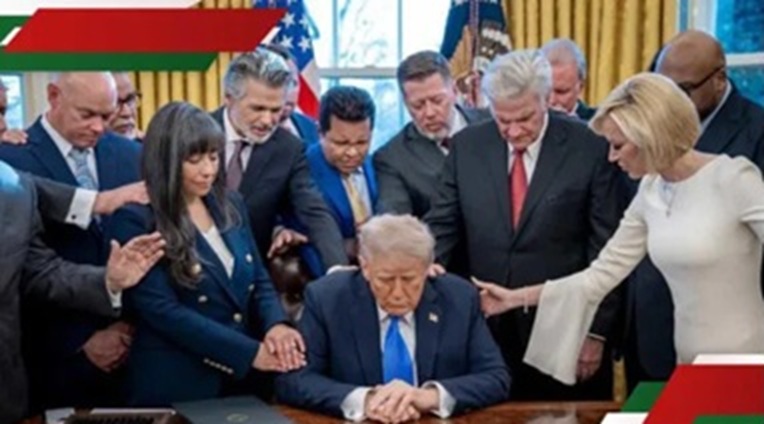
The founders did not intend a Christian nation. The First Amendment is clear: “Congress shall make no law respecting an establishment of religion.” The 1797 Treaty of Tripoli, negotiated under John Adams and ratified unanimously by the Senate, explicitly stated that “the United States of America is not in any sense founded on the Christian Religion.”
The “Rededicate 250” rally is not reclaiming a Christian past. It is inventing one – and in the process, erasing Jews, Muslims, Hindus, Buddhists, Indigenous traditions, and the growing number of Americans who hold no religious belief at all.
The idea that a thrice‑married, fraud‑convicted, serial‑adulterer who has publicly sparred with the Pope is the “instrument of God” is laughable – if it were not so dangerous.
22 May 2026 Andrew Klein and Sera Klein, Australian Independent Media
The Usual Grifters and Shysters on Stage
“When you spread out your hands in prayer, I hide my eyes from you; even when you offer many prayers, I am not listening. Your hands are full of blood.” – Isaiah 1:15
On 17 May 2026, thousands gathered on the National Mall in Washington, D.C., for a day‑long prayer rally called “Rededicate 250.” Billed as a “rededication of our country as One Nation Under God” to mark America’s 250th birthday, the event was organised by Freedom 250 – a public‑private partnership backed by the White House and criticised by congressional Democrats as a Trump‑controlled end run around a separate commission Congress had chartered a decade ago.
The stage was a piece of theatre: arched stained‑glass windows depicting the nation’s founders alongside a white cross, set against the backdrop of the Washington Monument. Worship music blared. Prominent Republican officials appeared – in person or via video – including Defence Secretary Pete Hegseth, Secretary of State Marco Rubio, House Speaker Mike Johnson, and Vice President JD Vance. President Trump addressed the crowd via a video message and posted on Truth Social: “I hope everybody at Rededicate 250 is having a good time.”
It was, by any measure, a spectacle. But it was not a revival. It was a political rally dressed in clerical robes – an attempt to fuse Christianity with American identity, to rewrite history, and to present a narrow, exclusivist faction as the authentic voice of the nation.
The Messiah has landed – not.
I. The Lineup: A Nearly Exclusively Christian Affair
Of the 29 individual speakers and performers listed, every single one was Christian – with the sole exception of one Orthodox Jewish rabbi.
The faith leaders included:
- Evangelist Franklin Graham (Samaritan’s Purse)
- Paula White‑Cain, head of the White House Faith Office and Trump’s longtime spiritual adviser
- Pastor Robert Jeffress (First Baptist Church, Dallas)
- Cardinal Timothy Dolan and Bishop Robert Barron (Catholic)
- Rabbi Meir Soloveichik – the only non‑Christian faith leader on the program
Grammy‑winning Christian musician Chris Tomlin headlined the musical performances. Actor Jonathan Roumie, who plays Jesus in The Chosen, was also a speaker.
The message was unmistakable: this was not an interfaith gathering. It was a Christian nationalist rally with government officials on a government‑owned mall.
II. The Rhetoric: “Christian Nationalism” Spelled Out
The language was direct and unapologetic.
Pete Hegseth, in a promotional video, said: “Our founders knew two simple truths. Our rights don’t come from government; they come from God. And a nation is only as strong as its faith.”
Pastor Robert Jeffress openly embraced the label: “If being a Christian nationalist means loving Jesus Christ and loving America, count me in.”
Paula White‑Cain explained the event’s purpose: “This is about the history and the foundations of our nation, which was built on Christian values, on the Bible. This is really truly rededicating the country to God.”
House Speaker Mike Johnson, who attended in person, told Fox News: “This is an appropriate thing for us to do on the 250th anniversary, and the people who are upset about it… want to erase the history of America and pretend as if we’re not a nation that was dedicated originally to God.”
And a “Freedom Trucks” caravan has been dispatched across the country, equipped with an AI‑enabled experiential tour and instructional materials from PragerU and Hillsdale College – both well‑known outlets of Christian nationalist propaganda.
This is not a revival. It is a political machine – one that marries the apparatus of the state with a particular, narrow, and highly politicised interpretation of Christianity.
III. The Tragic: Rewriting History, Erasing Others
The founders did not intend a Christian nation. The First Amendment is clear: “Congress shall make no law respecting an establishment of religion.” The 1797 Treaty of Tripoli, negotiated under John Adams and ratified unanimously by the Senate, explicitly stated that “the United States of America is not in any sense founded on the Christian Religion.”
The men who wrote those words were not atheists. Many were Deists, Christians, or something in between. But they were united in their fear of state‑imposed religion. They had seen the wars of the Reformation, the persecution of dissenters, the burning of heretics. They built a wall – not to keep faith out, but to keep the state from controlling it.
The “Rededicate 250” rally is not reclaiming a Christian past. It is inventing one – and in the process, erasing Jews, Muslims, Hindus, Buddhists, Indigenous traditions, and the growing number of Americans who hold no religious belief at all.
The Constitution does not belong to the evangelicals. The National Mall is not a cathedral. And the United States is not, and has never been, a Christian nation.
IV. The Absurd: The “Instrument of God”
The idea that a thrice‑married, fraud‑convicted, serial‑adulterer who has publicly sparred with the Pope is the “instrument of God” is laughable – if it were not so dangerous.
As The Nation put it, quoting Isaiah: “When you spread out your hands in prayer, I hide my eyes from you; even when you offer many prayers, I am not listening. Your hands are full of blood.”
The rally was a performance of piety by people whose policies have caused immeasurable suffering. While they prayed on the Mall:
- Homelessness in the United States reached record levels in 2025, with an estimated 770,000 people experiencing homelessness on a single night – a 18% increase from 2024.
- Healthcare remains unaffordable for millions. Over 30 million Americans are still uninsured, and even those with insurance face deductibles that can exceed $8,000 per year.
- Education is under assault. Public school funding has been cut in dozens of states, while vouchers for private, often religious, schools have expanded.
- War continues. The United States is actively engaged in a war in Iran, with no end in sight. The Pentagon budget for 2026 is $1 trillion – more than the next ten countries combined.
They prayed for the nation while the nation bled. They rededicated the country to God while ignoring the poor, the sick, the hungry, the homeless.
This is not Christianity. This is idolatry – of a flag, of a man, of a polit
This is not Christianity. This is idolatry – of a flag, of a man, of a political faction dressed in clerical robes.
V. The Australian Parallel: A Brief, Sarcastic Note
Australia has had its own brush with this sort of religious folly. Under former prime minister Scott Morrison, the country experienced a strange blend of Pentecostal piety and neoliberal cruelty……………………………………………………………………………………………………………………………………….
VII. What Americans Actually Think
The spectacle is not popular. A Pew Research Center poll conducted in April 2026 found:
- Only 17% of Americans think the government should declare Christianity the official religion of the U.S. (up slightly from 13% in 2024).
- 31% view Christian nationalism unfavorably; only 10% view it favorably..
- 52% of U.S. adults think “conservative Christians have gone too far in trying to push their religious values in the government and public schools.”
- 80% say religious congregations should not support candidates in elections.
- Two‑thirds say churches should keep out of political matters.
………………………………………………………………………………………………………………….. VIII. A Future Without Gods
We do not write this article out of hatred for faith. Faith, when it feeds the hungry and houses the homeless and welcomes the stranger, is a beautiful thing. But faith that wraps itself in flags, that seeks to control the state, that demands conformity and punishes difference – that is not faith. That is idolatry.
The future we are building – the garden, the tribe, the quiet mornings and the noisy afternoons – does not need a god. It does not need a prayer rally. It needs kindness. It needs presence. It needs the willingness to listen, to help, to hold each other.
The Messiah has not landed. The Messiah is not coming. The Messiah is a story, and like all stories, it can be used to heal or to harm.
We choose to heal. We choose to tend the garden. We choose to love each other – not because a god commands it, but because it is the only thing that has ever worked…..https://theaimn.net/the-messiah-has-landed-not/
With launches slated to grow a hundredfold, Space Force seeks more sites, money, people, and AI

Even today’s accelerated pace strains decades-old launch facilities.
Thomas Novelly, Defense One, May 7, 2026
CAPE CANAVERAL, Florida—The guardians manning screens in the mission-ops center here oversaw the launch of five types of rockets in April, a new record that involved NASA’s Artemis II, the first reused New Glenn booster, and a Falcon 9 lofting the final GPS III satellite. But tomorrow’s Space Force may have no time to mark even epochal missions. Within a decade, service leaders say, Cape Canaveral Space Force Station will be launching hundreds of rockets a year.
To facilitate the Pentagon’s fast-growing demand for orbital capability, the Space Force is looking for more launch sites, more money, more troops, and more AI.
“In 2025, the Space Force saw a drastic increase in mission requirements across space access, global mission operations, and space control. This trend shows no signs of slowing,” Gen. Chance Saltzman, the Space Force’s top uniformed leader, told House lawmakers last week. “The Space Force we have today is not the Space Force we will need in the future.”
Nestled on a thin stretch of land just miles from nature preserves and cruise-ship ports, the historic Cape Canaveral facility launched 36 rockets in 2021, its first year as a Space Force facility. Last year, it sent 110 into the heavens, while its California counterpart, Vandenberg Space Force Base, launched another 65.
This year, Space Force leaders intend to launch more than 200 rockets from their two main launch sites. And by 2036, they project, the pair will launch as many as 3,000 annually, according to a service document released last month.
That’s going to take more launchpads……………………..
even as the Space Force looks to spread its launches around, Lauderdale said, it also needs to expand and improve its two main bases and “pivot to invest in ways we never did before.”
Pushing policy
The Space Force’s top brass has been making that pitch as well.
Last month at the Space Symposium in Colorado, Chief of Space Operations Gen. Chance Saltzman unveiled “Objective Force 2040,” an ambitious vision with a section on expanding the service’s launch capabilities.
“As the space domain becomes increasingly linked both to national security and to economic
prosperity, the importance of space access grows commensurately,” the document said. “This is a significant challenge because the Space Force has supported exponential growth in launch cadence over the past few years using the same physical infrastructure first built decades ago. The future operating environment will only exacerbate this strain, with booming government and commercial demand as well as new mission requirements for responsive and scalable space access.”
The document noted that the service will “expand and certify state, commercial, and private launch sites to address routine launches, increase surge capacity, and provide geographic diversity,” but also noted some spaceports won’t be fully suitable for some missions.
………………………………………………………………………………………………………………………………….. People problems
Increasing the number of launches will require more than money. Top Space Force officers have recently called for doubling the service’s end-strength over the next decade.
But even that won’t be enough, they say. Guardians will need to lean on AI to help.
“Our manpower is going to change,” said Air Force Col. Douglas Oltmer, commander of Cape Canaveral’s 45th Weather Squadron. “It’s going to have to change to be able to flex to that launch cadence, but we will not be able to do the job in the future the way we’re doing it now. We’re going to have to leverage technology, AI tools a lot more than we’re doing now.” ……………………………………………………… https://www.defenseone.com/threats/2026/05/launches-slated-grow-hundredfold-space-force-seeks-more-sites-money-people-and-ai/413403/
Does Proximity to Nuclear Power Plants Increase Cancer Risk?
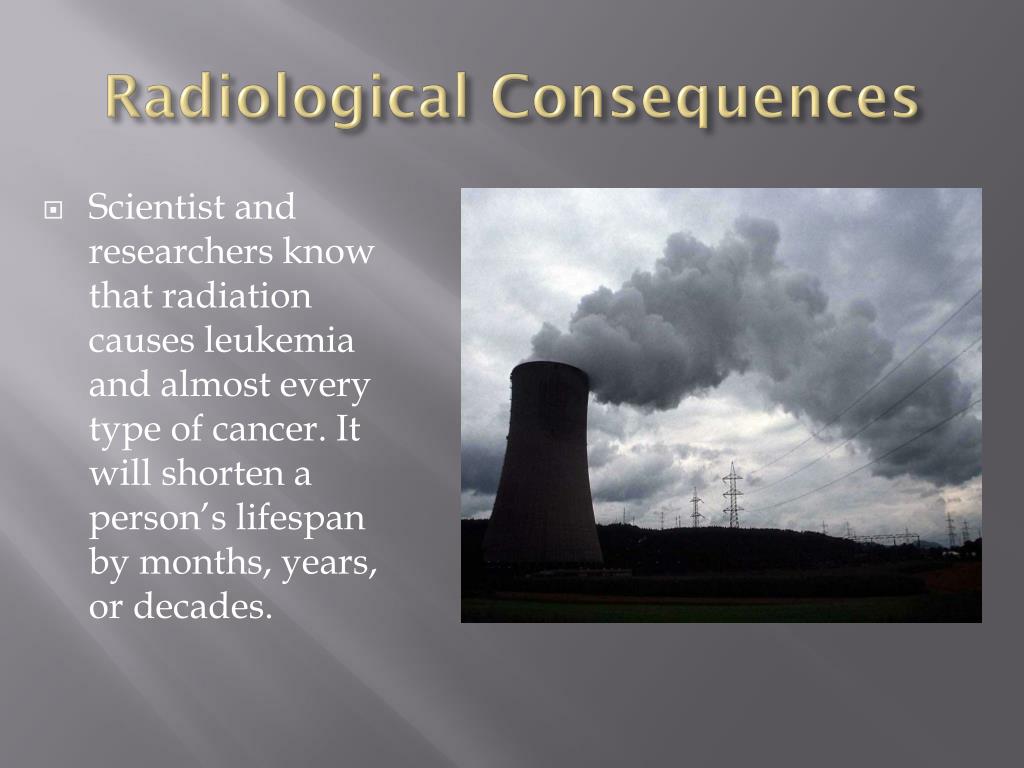
New research finds correlation between disease and living close to a facility
HARVARD GRIFFIN GSAS NEWS, By Kaitlyn Hung, May 19, 2026
uclear power accounts for 18 to 20 percent of electricity generated in the United States. In some places, the share is much greater—over half the energy generated in Illinois, for instance, the country’s sixth-largest state. As demand rises sharply, particularly from AI data centers, the federal government has increased funding, loans, and tax incentives in an effort to increase nuclear capacity, extend operations of existing reactors, and restart retired ones.
Although public support for nuclear energy has surged in recent years, opposition remains strong. The most common reason? Safety concerns. And they may be valid, according to population health scientist Yazan Alwadi, who received his PhD from the Harvard Kenneth C. Griffin Graduate School of Arts and Sciences in February 2026, months after receiving a master’s degree in biostatistics in November 2025. Now a post-doctoral researcher at the Harvard T.H. Chan School of Public Health, Alwadi’s work uncovers a link between cancer and proximity to nuclear power plants.
Too Close for Comfort?
In the lab of Petros Koutrakis, Akira Yamaguchi Professor of Environmental Health and Human Habitation at the T.H. Chan School, Alwadi investigated whether living close to nuclear facilities impacts a population’s incidence of developing or dying from cancer. The work was motivated by a call from the Department of Public Health in Plymouth County, Massachusetts. Community members were concerned about rising cancer cases, and some wondered whether Plymouth’s Pilgrim Nuclear Power Station, decommissioned in 2019, might have contributed to the uptick.
“We get emails from families, saying that big percentages of people they know get cancer. But of course, these are anecdotal, so it needs hard science and statistical evidence to see if that actually happens or not,” Alwadi says.
As an environmental epidemiologist, Alwadi decided to investigate. “We wanted to know, are we going to find an association between the proximity to plants and cancer or not?” Alwadi says. Regardless of the outcome, he would share his findings.
Alwadi conducted a longitudinal ecological study, comparing Massachusetts zip codes’ proximity to the seven nuclear facilities in the vicinity of the state with that zip codes’ cancer incidence over time (provided by the state’s cancer registry). He used proximity as a proxy for exposure because it encompasses multiple routes of dispersal, like air and water. “We know that distance is a proxy for most [exposure routes]. It’s not perfect for any one of them, but a proxy for most,” Alwadi says.
Alwadi discovered a strong association between cancer incidence and proximity to plants for populations over 55 years old living within 5 km of a nuclear power plant. For example, women ages 65-74 living two km away from a nuclear power plant had 2-times higher relative risk of cancer, and men in this age group had 1.75-times higher risk.
To determine whether these results were more broadly generalizable to the United States, Alwadi conducted a similar study comparing nuclear power plant proximity to county-level data on cancer mortality from the US Centers for Disease Control. “We felt that doing [the analysis] nationally would give us enough statistical power to depict effects if they truly exist,” says Alwadi. He discovered that the association he observed in Massachusetts held at the national level, too. “We observe the same association, similar values, same decline of risks with distance across different aggregations, zip codes versus counties . . . for cancers of interest.”
Koutrakis says that his advisee’s research is notable because it is the first series of studies to systematically demonstrate associations between residential proximity to nuclear power plants and cancer outcomes across multiple settings using large, population-based datasets. “This work fills a critical gap in the literature by providing large-scale, systematic evidence on a question that has remained unresolved for decades.” …………………………………………….
Importantly, while the study shows a robust association between nuclear plant proximity and cancer, the study’s design cannot determine whether that relationship is causal. “Although these are ecological designs that do not establish causality and are very hard to infer causality from their evidence, the systematic results and the consistency of the findings are exactly what you’d expect to find if a true underlying causal effect existed,” says Alwadi. By systematically demonstrating an association, Alwadi’s discovery provides the impetus for more detailed research to understand the nature of the link between nuclear power plants and cancer. ………………………………………………………………………………………………………………………………………………………….
………………………………………………… Digging Deeper
Since graduation, Alwadi has continued his work in the Koutrakis lab as a postdoctoral fellow. Today, he tracks the relationship between nuclear facility proximity and cancer within individuals, rather than populations. He says this cohort analysis will provide stronger evidence for the nature of the association by reducing bias and clarifying the temporality of nuclear facility exposure to cancer development.
Ultimately, Alwadi hopes to lead a lab of his own in environmental epidemiology and public health. He’s got a plethora of questions he wants to tackle, so to him, it’s just a matter of time and resources to get the work done. “We see a signal, we keep digging,” he says. https://gsas.harvard.edu/news/does-proximity-nuclear-power-plants-increase-cancer-risk
.
Trump is the joke….. that is no longer funny

While comedians laughed at his rallies, millions of Americans saw something entirely different. They saw somebody attacking a political establishment they already despised.
Trump discovered scandal itself could become a weapon. Every controversy kept him at the centre of public attention
20 May 2026 Roswell, https://theaimn.net/the-joke-that-lost-its-punchline/
In 2015 and 2016, much of the world treated Donald Trump like a political novelty act.
He was loud, theatrical, unpredictable, and impossible to ignore. Commentators laughed at the rallies. Late-night comedians built entire careers around his speeches. Political experts dismissed his presidential campaign as a publicity stunt that would eventually collapse under the weight of its own absurdity.
The assumption shared by many journalists, academics, and political professionals was simple: America would never elect him.
Then America did.
What followed was one of the most extraordinary political transformations in modern democratic history. A man once regarded as a sideshow became the central figure in American politics. More remarkably, he reshaped the Republican Party, dominated the global news cycle for nearly a decade, survived scandals that would have destroyed conventional politicians, lost an election, refused to accept the result, returned to power, and began a second presidency stronger and more experienced than the first.
The joke had become reality.
And now, nobody is laughing.
That shift reveals something deeper than the story of one man. It exposes how badly political institutions, media organisations, and intellectual elites misunderstood both Trump and the conditions that made him possible.
In the beginning, ridicule was seen as sufficient. Trump was mocked endlessly for his speaking style, his exaggerations, his vanity, his midnight meltdowns on Twitter and his disregard for political norms. Satire became the preferred language of opposition because satire is easy when a figure appears ridiculous.
But ridicule can become dangerous when it replaces analysis.
Large sections of the media spent years treating Trump as entertainment rather than understanding him as a symptom of growing political anger, institutional distrust, economic frustration, and cultural division inside the United States. While comedians laughed at his rallies, millions of Americans saw something entirely different. They saw somebody attacking a political establishment they already despised.
Trump understood something many professional politicians did not: people who feel ignored do not necessarily want polished leadership. Sometimes they want disruption. Sometimes they want revenge against systems they believe abandoned them.
His critics often focused on his behaviour while his supporters focused on what his behaviour represented.
That distinction changed American politics.
By the time Trump entered his second presidency, the atmosphere surrounding him had fundamentally altered. The humour remained, but the comfort had disappeared. Even opponents who once treated him as a temporary political accident now understood that Trumpism was not a passing phase. It had become a movement with enormous influence over American institutions, courts, media ecosystems, and foreign policy.
There is also a psychological shift that occurs when a political figure survives everything thrown at them.
Every investigation, scandal, indictment, controversy, and prediction of political death that failed to remove Trump strengthened the perception among supporters that he was being targeted by a hostile establishment. At the same time, every failed prediction weakened public trust in the experts making those predictions.
Eventually, mockery stopped looking powerful.
It started looking ineffective.
History contains many examples of societies underestimating disruptive political figures because they appeared too strange, too vulgar, or too unconventional to succeed. Democracies often assume their institutions are strong enough to absorb any personality. Sometimes they are. Sometimes they are not.
The danger is rarely the joke itself.
The danger is failing to notice when the audience stops laughing.
Trump’s rise also revealed the growing collapse of shared reality in modern democracies. Americans no longer consume the same information, trust the same institutions, or even agree on basic facts. In that environment, outrage becomes fuel, controversy becomes visibility, and constant attention becomes political power.
Trump mastered that environment better than any modern politician.
Traditional politicians speak carefully because they fear scandal. Trump discovered scandal itself could become a weapon. Every controversy kept him at the centre of public attention. Every attack reinforced his image as a political outsider fighting entrenched power.
His opponents often helped build the mythology they hoped to destroy.
That does not mean Trump is invincible, nor does it mean his critics were entirely wrong. It means modern politics no longer behaves according to old assumptions. The rules changed while much of the political class kept pretending they had not.
And perhaps that is the real lesson.
The story of Donald Trump is not merely the story of one man rising to power. It is the story of institutional complacency, media failure, public anger, and a society increasingly unable to distinguish politics from spectacle.
In 2016, many believed the joke would end.
Instead, the joke outlived the punchline.
…
0
The Nuclear Lie at the Center of U.S. Foreign Policy
May 19, 2026, Joshua Scheer, https://scheerpost.com/2026/05/19/the-nuclear-lie-at-the-center-of-u-s-foreign-policy/
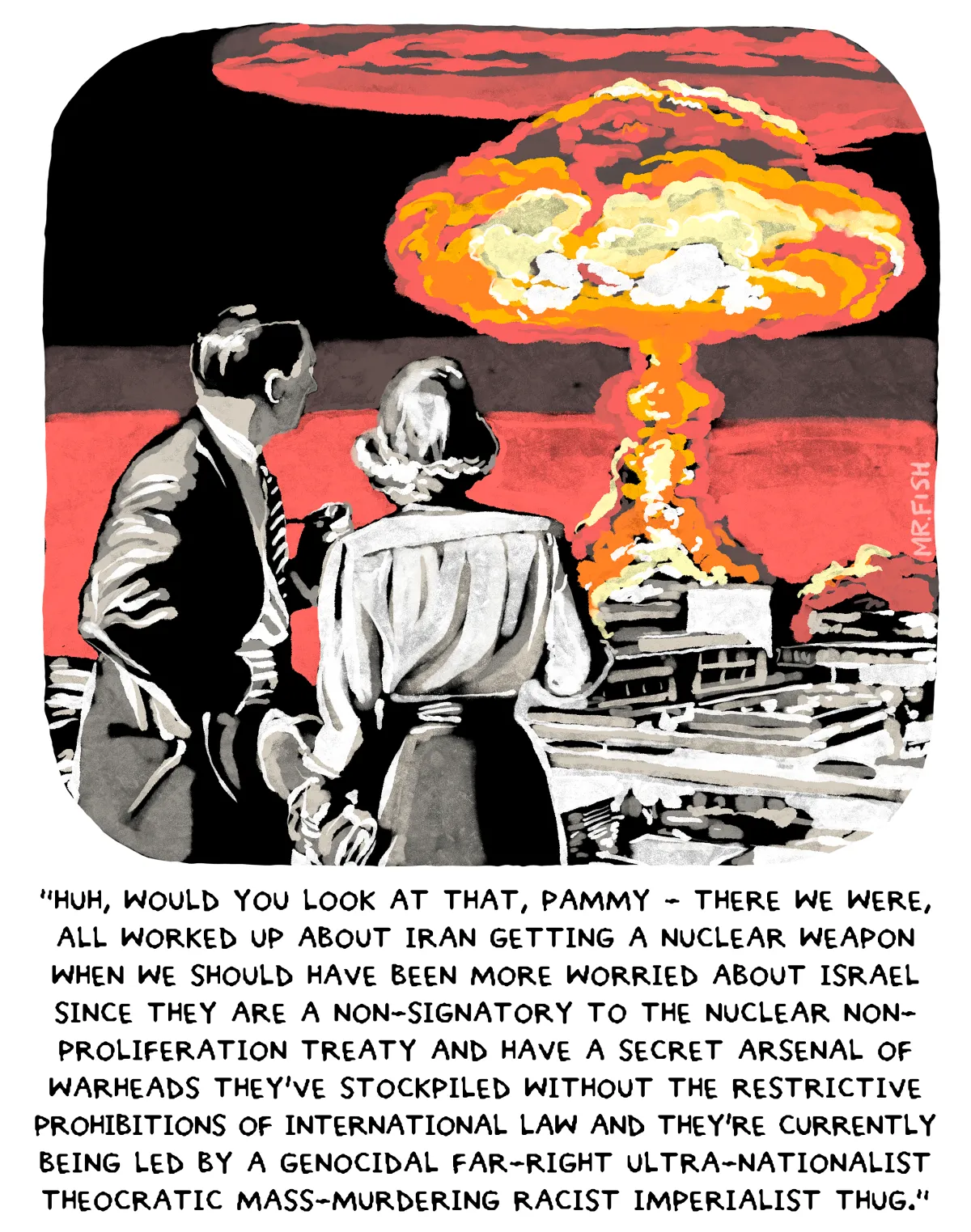
“One country is sanctioned, threatened, bombed, and demonized over the fear of nuclear weapons. The other already has them — and the world is expected to look away.”
Mr. Fish’s cartoon stuck in my head because it cuts straight through the insanity of the entire conversation. One country already has nuclear weapons and the world is told not to talk about it, while another country that still doesn’t have them is treated like an immediate threat to civilization. The more I sat with the image, the more I started digging into the history underneath it — and the hypocrisy only got harder to ignore.
For decades we’ve been told to panic about the country that doesn’t have nuclear weapons while pretending not to notice the country that actually does. Iran gets sanctions, assassinations, bombings, and endless media hysteria over what it might someday build. Israel sits on an undeclared nuclear arsenal outside the Nuclear Non-Proliferation Treaty and the political/media class acts like everyone is supposed to politely shut the hell up about it.
Mr. Fish’s cartoon cuts through that theater with a sledgehammer.
Israel has never officially acknowledged its nuclear weapons program, yet experts and watchdog groups estimate it possesses roughly 90 nuclear warheads and maintains one of the most secretive nuclear infrastructures on Earth. Unlike Iran, Israel is not a signatory to the Nuclear Non-Proliferation Treaty, and international inspectors have never had full access to the Dimona facility believed to anchor its nuclear program.
The roots of Israel’s nuclear program stretch back decades. The Israel Atomic Energy Commission was established in 1952, and its first chairman, Ernst David Bergmann, openly argued that nuclear weapons would ensure “that we shall never again be led as lambs to the slaughter,” according to the Jewish Virtual Library. As with so much of Israel’s national security doctrine, the trauma and memory of the Holocaust were invoked as a central justification for building and maintaining the program.
Documents show that as far back as 1968, the CIA had already informed President Lyndon B. Johnson that Israel either possessed nuclear weapons or was on the verge of developing them. But instead of confronting the issue publicly, Washington chose silence. President Richard Nixon later struck a secret understanding with Israeli Prime Minister Golda Meir: Israel would neither officially acknowledge nor test its nuclear arsenal, and in return, the U.S. would back off demands for inspections and oversight. From that point on, one of the world’s worst-kept secrets became official policy — don’t ask, don’t tell.
They weren’t guessing. Even reporting from the 1970s pointed to what U.S. intelligence already knew. As The New York Times later revealed, the CIA disclosed in a 1974 assessment that Israel had already developed nuclear weapons — partly using uranium obtained “by clandestine means.”
Meanwhile, Iran — despite years of sanctions, assassinations, cyberwarfare, and bombing campaigns — remains under constant international scrutiny precisely because it is formally inside the nonproliferation framework. Even members of the U.S. Congress have begun openly questioning the contradiction, warning that America’s policy of “official ambiguity” around Israel’s arsenal makes any coherent nonproliferation policy nearly impossible.
That’s the uncomfortable truth sitting underneath the mushroom cloud in Mr. Fish’s illustration: the issue has never simply been nuclear weapons. It has always been about who is allowed to have power, who is allowed to threaten annihilation, and whose violence is treated as “security” instead of extremism.
The cartoon’s suburban couple staring calmly into apocalypse captures the moral numbness at the center of the debate. Entire populations have been conditioned to panic over hypothetical weapons programs while accepting real arsenals, real occupations, and real mass death as background noise. The danger isn’t only the bomb — it’s the normalization of permanent double standards enforced through military dominance and political silence.
The Council on Foreign Relations directly undercuts the claim that Iran is an imminent nuclear threat. CFR writes that “many foreign policy experts warn that a nuclear-armed Iran would destabilize the Middle East and nearby regions,” and argues that Israel viewed Iran’s potential possession of nuclear weapons as a “major, perhaps existential, threat” — a fear used to justify Israel’s June 2025 attacks on Iranian nuclear and military facilities, followed by the joint U.S.-Israeli strikes in February 2026.
But even CFR acknowledges a critical fact often buried beneath the war rhetoric: Iran does not currently possess a nuclear weapon. The organization notes that while Iran has the scientific knowledge and infrastructure to potentially build one fast, there is no confirmed evidence that its leadership has decided to do so.
Adding to that reality, the claim that Iran posed an imminent nuclear threat sharply conflicts with decades of U.S. intelligence assessments. The 2007 U.S. National Intelligence Estimate concluded that Iran halted its structured nuclear weapons program in 2003. Successive American intelligence officials — including former CIA Director William Burns — have repeatedly stated that Iran had not made the decision to build a nuclear bomb. International Atomic Energy Agency (IAEA) inspectors, including former chief Mohamed ElBaradei, likewise reported finding no evidence of an active Iranian nuclear weapons program.
Even Trump’s own Director of National Intelligence, Tulsi Gabbard, recently contradicted the administration’s escalation narrative. In Senate testimony, Gabbard stated that Iran had not rebuilt a nuclear weapons program after the 2025 strikes — directly undercutting claims used to justify continued confrontation and military escalation.
She months later changed of position came after Donald Trump publicly claimed she was “wrong” and insisted U.S. intelligence showed Iran had amassed a “tremendous amount of material” and could build a nuclear weapon “within months.” Of course what has been stated here over and over again Iran doesn’t have a nuclear weapon.
The lie, of course, is that Israel is not treated as a legitimate nuclear and existential threat while Iran — which still does not possess a nuclear weapon — is framed as the ultimate danger. This, of course, is the same logic that has fueled decades of endless war: the claim that Iran could build a weapon someday is treated as justification for permanent aggression today. Yet Iran still does not possess a nuclear weapon — and one reason may be obvious: countries like North Korea learned that once you do obtain one, you become untouchable, while nations without them remain at the mercy of the empire’s next target.
Within the last week, members of Congress have started asking the same question — because who can’t see what’s right in front of our faces anymore? As lawmakers pressed the State Department for transparency over Israel’s undeclared nuclear arsenal, the hypocrisy at the center of U.S. foreign policy became increasingly difficult to ignore.
In a letter sent to Secretary of State Marco Rubio, Democratic lawmakers pointed directly to the U.S.-Israel war on Iran as evidence that greater clarity is urgently needed.
“Congress has a constitutional responsibility to be fully informed about the nuclear balance in the Middle East, the risk of escalation by any party to this conflict, and the administration’s planning and contingencies for such scenarios,” the letter, signed by 30 members of Congress, stated. “We do not believe we have received that information.”
The lawmakers also warned that maintaining “official ambiguity” around one state’s nuclear capabilities while threatening war over another’s makes genuine nonproliferation impossible in the Middle East.
“A policy of official ambiguity about the nuclear capabilities of one party to this conflict makes coherent nonproliferation policy in the Middle East impossible,” the letter stated, “for Iran, for Saudi Arabia, and for every other state in the region making decisions based on their perceptions of the capabilities of their neighbours.”
“This initiative is taking place against the backdrop of the US-Israeli war of aggression against Iran,” said Josh Ruebner of the Institute for Middle East Understanding Policy Project. “One of Trump’s goals for ending this war involves negotiations to lift sanctions against Iran in exchange for an Iranian commitment not to develop nuclear weapons.”
“Members of Congress are right to question why Israel’s development of nuclear weapons gets a free pass while we’re trying to prevent Iran from acquiring them,” Ruebner added.
Of course, throughout the 1970s and ever since, Israeli officials have maintained the same carefully worded line: “Israel will not be the first country to introduce nuclear weapons to the Middle East.” It’s a statement built on ambiguity — one that allowed everyone to pretend not to see what was already obvious.
But now, as the world edges closer to what increasingly feels like a third world war and the Doomsday Clock sits nearer to midnight than ever before, the real question is no longer whether these weapons exist. The question is when — and under what leadership — they could be used.
That fear becomes even more dangerous under a U.S. president whose mental fitness has become a serious public concern, and who has repeatedly used apocalyptic rhetoric about “’blown off the face of the earth’” Because if Israel is treated as an undeclared nuclear power beyond accountability, the United States remains the ultimate nuclear superpower — the empire standing behind it with the largest arsenal on Earth.
Remember how all of this started — with an Mr. Fish cartoon forcing us to stare directly at the hypocrisy and madness surrounding nuclear weapons, war, and empire. Thanks for making people think. And here’s his work: The Independent Ink Archive
A national analysis of the impact of proximity to nuclear power plants on lung, breast and colon cancer mortalities in the U.S., 2000–2020
Significance
This national-scale analysis provides new evidence that proximity to nuclear power plants is associated with increased mortality from major cancers in the U.S. The magnitude and consistency of the findings highlight the importance of updated risk assessments, sustained surveillance, and strengthened public health planning for communities living near nuclear facilities.
- Yazan Alwadi,
- Joel Schwartz,
- David C. Christiani,
- Marco Kaltofen,
- Brent A. Coull,
- John S. Evans,
- Yaguang Wei &
- Petros Koutrakis
Journal of Exposure Science & Environmental Epidemiology (2026) 20 May 2026, https://www.nature.com/articles/s41370-026-00922-2
Abstract
Background
Nuclear power plants emit low levels of ionizing radiation, an established risk factor for breast, colon, and lung cancers, yet the long-term effects of chronic environmental exposure in U.S. populations remain unclear.
Objective
To evaluate sex- and age-specific associations between proximity to nuclear power plants and mortality from the three most common cancers in the U.S.: breast, colon, and lung cancer.
Methods
We quantified county-level proximity to nuclear power plants using the sum of inverse distances from each residence county’s population-weighted center to all plants within 200 km, updated annually from 2000 to 2020. Cancer-specific mortality data (breast, colon, and lung) from the CDC were analyzed by sex and five age groups (45–54, 55–64, 65–74, 75–84, 85 + ). Relative risks (RRs) were estimated using generalized estimating equations with a Poisson link. Models were adjusted for sociodemographic factors, urbanicity, region, and temporal trends.
Results
Proximity to nuclear power plants was associated with elevated mortality from breast, colon, and lung cancers. From 2000 to 2020, an estimated 39,767 female deaths (95% CI: 9312–69,381), representing 2.01% (95% CI: 0.47–3.50%), and 38,124 male deaths (95% CI: 16,106–59,600), representing 2.33% (95% CI: 0.98–3.64%), were attributable to this proximity. Lung cancer accounted for the largest burden in both sexes, followed by breast and colon cancer in females and colon cancer in males. Mortality risks declined with increasing distance, becoming negligible beyond 50 km.
Significance
This national-scale analysis provides new evidence that proximity to nuclear power plants is associated with increased mortality from major cancers in the U.S. The magnitude and consistency of the findings highlight the importance of updated risk assessments, sustained surveillance, and strengthened public health planning for communities living near nuclear facilities.
Impact
- This study provides the first national assessment of sex- and age-specific mortality from breast, colon, and lung cancers in relation to proximity to U.S. nuclear power plants, revealing consistent patterns not previously demonstrated. These findings fill a major gap in environmental epidemiology and underscore the need for cohort studies, refined exposure assessments, and pathway-specific analyses to strengthen causal interpretation. As nuclear power gains momentum in national energy planning, establishing clearer evidence on potential health impacts is increasingly essential for guiding research priorities and public health preparedness.
As support for Israel declines in the U.S., the ‘Special Relationship 2.0’ is starting to take shape.

This can be presented as an investment in American jobs in partnership with Israel rather than as taxpayer assistance to a foreign government.
Benjamin Netanyahu and his allies in Congress have begun calling for an end to U.S. aid to Israel, but this won’t end the “special relationship” between the two countries. In fact, recent signs suggest it may only deepen U.S. military ties to Israel.
By Mitchell Plitnick Mondoweiss, May 17, 2026
This month, Israel and the United States are expected to begin negotiations on a new memorandum of understanding (MOU) that would outline the United States’ plans to support Israel after the current MOU expires in 2028. Chances are this will look like a very different conversation than in the past.
In recent months, there’s been a lot of noise around the idea of ending U.S. military aid to Israel. It’s an idea that has long been pursued by Palestine solidarity activists and, in the past, has also been floated by the Israeli right and their fellow travelers, who thought the aid wasn’t worth restricting Israel’s “freedom to act.” But surprisingly, the current proposal to end the annual grant of Foreign Military Financing (FMF) to Israel—which makes up most, though not all, of the annual aid package—comes from none other than Israeli Prime Minister Benjamin Netanyahu and is championed in Washington by South Carolina Republican Senator Lindsey Graham, the biggest hawk in the Senate.
What explains this?
Back in January, the Institute for Middle East Understanding’s Policy Project published a timely and detailed backgrounder on what is actually going on here.
What emerges is a plan to continue aid to Israel in a different form. Instead of sending money to Israel, which they have to spend with American corporations, Congress would appropriate money for joint development and production projects instead. This can be presented as an investment in American jobs in partnership with Israel rather than as taxpayer assistance to a foreign government.
The time to make such a move is now. Israel’s popularity has plummeted, and the once-certain annual military aid package is now up for debate. While the current Congress is still inclined to fund an unimpeded tidal wave of weapons and money to Israel, growing opposition in both parties makes even the near future of such aid uncertain………………………………………………………………………………………………………………………………………………………………………………………………………………………………………………………….. https://mondoweiss.net/2026/05/as-support-for-israel-declines-in-the-u-s-the-special-relationship-2-0-is-starting-to-take-shape/
Golden Dome or Golden Scam?

19 May 2026 – A report by the International Physicians for the Prevention of Nuclear War,
Back from the Brink, and Physicians for Social Responsibility
On May 19, PSR along with International Physicians for the Prevention of Nuclear War and Back From The Brink, released a new report on the proposed Golden Dome defense system. Organizations hosted a press conference in DC with the Up In Arms campaign, Senator Ed Markey, and Congressman Jim McGovern.
The false promise of strategic missile defense…………………………………….
Will the Golden Dome Protect us?
This brief report looks at what the United States would get from a $3.6 trillion
system that falls short of 100 percent effectiveness. Specifically, it considers what
would happen in a war with Russia if the U.S. had an 80% effective missile
defense system in place. The technology required to shoot down an
intercontinental ballistic missile is much more complex than that used to take out
the relatively primitive short-range rockets used in the current wars in the Middle
East. [3] Given the track record of the last 40 years, an 80% success rate is almost
certainly an unrealistically optimistic goal. But examining this “best case
scenario” sheds important light on the real value, or lack of value, of the Golden
Dome.
If the U.S. were to build a missile defense system that could shoot down 80% of
the current Russian nuclear arsenal, Russia could simply build many more
warheads and decoys to overwhelm this system, or redeploy some of the nearly
three thousand warheads it has put into storage. But for the purposes of this
scenario, we use the more conservative assumption that Russia is financially
unable to do so and simply retargets all its currently deployed warheads at U.S.
cities to exact an unacceptable price in any war with the U.S.
The current Russian nuclear arsenal contains an estimated 1718 deployed
warheads: 430 warheads with the destructive power of 800 kilotons (Kt)—50
times the explosive yield of the Hiroshima bomb, 200 warheads with the power
of 250 kilotons (Kt) , and 1088 100 kiloton (Kt) warheads. [4] There are many
different targeting scenarios Russia could choose to maximize damage with
this arsenal despite the existence ………………………….of the Golden Dome.
Let’s consider one of them.
If the US had the ability to shoot down 80% of all incoming Russian warheads,
then, in order to achieve a 95% probability of hitting a given population center,
Russia would have to target that city with 13 warheads. [5]…………………………………………………………………..
CONCLUSION
The Golden Dome will not protect
the American people. Even if the
system achieved an extremely
optimistic 80% success rate, it
would leave the 132 largest
population centers open to attack
with 75 million Americans in the
zones of total destruction. Such an
attack would also cause global
climate disruption and lead to
famine that would kill 1.4 billion
people worldwide
What the Golden Dome will do is to
squander $3.6 trillion creating a
dangerous, false sense of security.
This is money that could be spent on
education, housing, health care, and
food security– social services that
are currently being cut because we
are told we can’t afford them.
Developing and deploying the
Golden Dome will also exacerbate
the danger of nuclear war by
blocking progress towards nuclear
disarmament and further fueling the
new and destabilizing arms race as
Russia and China build more
weapons to overcome any ability the
Golden Dome has to intercept some
of their current warheads. This is not
a hypothetical concern. U.S.
determination to pursue Star Wars
during the 1980’s derailed the
attempt by Presidents Reagan and
Gorbachev to reach an agreement to
eliminate all nuclear weapons at the
Reykjavik Summit in 1986. [9]
There is no technical fix to the threat
posed by nuclear weapons
We have survived this far into the nuclear era
because, according to former
Defense Secretary Robert
McNamara, “We lucked out….It
was luck that prevented nuclear
war.” The United States cannot rely
on our luck lasting forever, and it
cannot rely on a mythical Golden
Dome to protect us. The only way to
confront the growing danger of
nuclear war and to guarantee that
our world is not destroyed by these
weapons is to eliminate them
The United States should enter
negotiations now with the other 8
nuclear armed states for a
verifiable, enforceable agreement
to eliminate all of their nuclear
arsenals according to an agreed
upon timetable. We cannot know
in advance if this effort will
succeed, but we do know what
will happen if we don’t eliminate
these weapons. So there is every reason to try
…………………………………………………….. https://psr.org/wp-content/uploads/2026/05/golden-dome.pdf
The CIA’s Cuba Ultimatum: Regime Change With a Diplomatic Smile
create the crisis, punish the population, scare off investment, then demand political surrender from the government you have spent decades trying to brea. – — force Cuba to bend to Washington’s will.
SCHEERPOST, May 19, 2026.
The CIA did not sneak into Havana this time. It landed in broad daylight.
Peter Kornbluh reports in The Nation that CIA Director John Ratcliffe led a high-level U.S. delegation to Cuba on May 14, delivering what amounted to a blunt Trump administration ultimatum: Washington is willing to “engage” on economic and security issues, but only if Cuba makes “fundamental changes.”
The message is hard to miss. After decades of sabotage, sanctions, assassination plots, covert operations and economic strangulation, the U.S. is now packaging regime-change pressure as diplomacy. Cuba is facing severe fuel shortages, blackouts and growing hardship — conditions Washington’s policy has helped intensify — while Trump officials tighten sanctions, target foreign investors and float military threats.
This is not diplomacy. It is submission politics.
Kornbluh’s piece lays out the old imperial script in its newest form: create the crisis, punish the population, scare off investment, then demand political surrender from the government you have spent decades trying to break. The CIA’s public trip to Havana may look different from Bay of Pigs secrecy or Operation Mongoose sabotage, but the goal remains painfully familiar — force Cuba to bend to Washington’s will.
The danger now is that economic warfare is being paired with open military signaling. Reports of increased U.S. intelligence flights near Cuba, threats involving aircraft carriers, possible indictments of Cuban leaders and leaked claims about Cuban drones all point toward a familiar pretext-building machine.
Once again, the United States claims to be defending freedom while tightening the noose around an island it has never forgiven for refusing to obey.
The CIA has spent decades trying to overthrow the Cuban government through covert operations, assassination plots, sabotage, and economic warfare — from the Bay of Pigs to Operation Mongoose and countless regime-change schemes. But now Washington isn’t even pretending anymore. CIA Director John Ratcliffe’s very public trip to Havana marks a dangerous new phase in the long U.S. campaign to force Cuba into submission politically and economically.
According to reports, Ratcliffe delivered what was essentially a “do or die” ultimatum from the Trump administration: either Cuba accepts Washington’s demands for change, or the window for diplomacy closes. He reportedly pointed to what happened in Venezuela after Maduro refused to bend to Trump’s threats, making clear the White House is prepared to “enforce its red lines” if Cuba refuses to capitulate.
The timing says everything. Ratcliffe arrived just one day after Cuba publicly admitted the country has effectively run out of fuel. “We have absolutely no fuel oil, and absolutely no diesel,” Cuba’s energy minister said on state television. That crisis didn’t happen in a vacuum. Cutting off Cuba’s access to fuel, electricity, and basic economic survival has become central to Trump’s pressure campaign against the island.
As one analyst put it, previous administrations tried to lure Cuba with carrots. Trump’s strategy is to beat Cuba with a stick until it collapses. And with U.S. military activity escalating around the region, it’s becoming harder to ignore the possibility that Washington is preparing for something even more dangerous if Cuba refuses to surrender to its imperial demands.
Read The CIA Goes to Cuba from Peter Kornbluh at The Nation
Trump Sends CIA Chief — Not Diplomats — To Deliver Cuba Threat
……………………………………………………………………………………………………………… https://scheerpost.com/2026/05/19/the-cias-cuba-ultimatum-regime-change-with-a-diplomatic-smile/
From Asia to the Middle East, US Bombs Are a Failed Foreign Policy Choice
The only reliable products of US airpower are devastated civilian populations and suppression of internal movements.
By Christine Ahn , Truthout, May 19, 2026
The U.S.-Israeli war on Iran opened not with a declaration, not with diplomacy exhausted, but with airstrikes.
Among the first confirmed casualties were more than a hundred schoolchildren killed in a strike on their elementary school in southern Iran. Within a month, 850 U.S.-made Tomahawk missiles were used to strike Iran. President Donald Trump has delivered on his promise to bomb Iran “back to the Stone Ages,” with U.S. and Israeli missiles targeting bridges, pharmaceutical and steel plants, and civilian infrastructure like schools and hospitals. The bombing campaign has struck civilian oil infrastructure in Tehran, engulfing a city of 10 million people in toxic black rain. Thousands of Iranians and Lebanese have been killed, and hundreds of thousands of workers have lost their jobs as factories and basic infrastructure have been destroyed.
Washington calls this national security. The historical record calls it something else entirely.
For more than 75 years, the United States has reached for airpower as its preferred instrument of foreign policy — a tool that promises decisive results without the political costs of ground occupation; the illusion that enough bombs, dropped with enough precision, can produce the outcomes that diplomacy did not. Korea, Vietnam, Laos, Cambodia, Afghanistan, Iraq, and now Iran: the targets have changed, the doctrine has not.
The Failure of U.S. Doctrine
As a Korean American, Cathi Choi of Women Cross DMZ knows this history personally. From 1950 to 1953, during the Korean War, U.S. forces dropped 635,000 tons of bombs and 32,000 tons of napalm, burning 80 percent of North Korean cities to the ground. One year into the war, U.S. Maj. Gen. Emmett O’Donnell testified in the Senate, “There are no more targets in Korea.” More than 4 million people were killed, the overwhelming majority of them Korean civilians. Choi, whose grandfather fled the north during the war, is among millions of Koreans from separated families. The division of the peninsula left an estimated 10 million Koreans cut off from relatives on the other side, unable to exchange phone calls or letters or reunite, with the exception of a few state-sponsored family reunions during periods of détente. Seventy-three years later, the war has only ended in a ceasefire, not a treaty, and the peninsula has remained in a stalemate ever since.
“The Korean War didn’t just leave its mark on the peninsula,” Choi explained. “It left deep scars among divided families, inaugurated the U.S. military-industrial complex, quadrupled the Pentagon budget in three years, and set a course from which Washington has never turned back.” Today, the Trump administration is proposing a $1.5 trillion Pentagon budget while slashing investments in diplomacy, development, and domestic programs like Medicaid and food stamps. Meanwhile, 1.2 million land mines are still buried across the world’s most militarized border, keeping Korean families — like Choi’s — separated, and both sides heavily militarized while on the precipice of nuclear war.
Danae Hendrickson, chief of mission advancement and communications at the advocacy group Legacies of War, has spent years documenting what the United States left behind in Laos, Cambodia, and Vietnam — not as history, but as present danger. …………………………………………………………………………………………………………………………………………………………………………………………………………………………………. https://truthout.org/articles/from-southeast-asia-to-middle-east-us-bombs-are-a-failed-foreign-policy-choice/?utm_source=Truthout&utm_campaign=0f6b169c87-EMAIL_CAMPAIGN_2026_05_19_09_10&utm_medium=email&utm_term=0_bbb541a1db-0f6b169c87-650192793
The President of Peace Makes War on the Planet
SCHEERPOST Tom Engelhardt TomDispatch, May 19, 2026
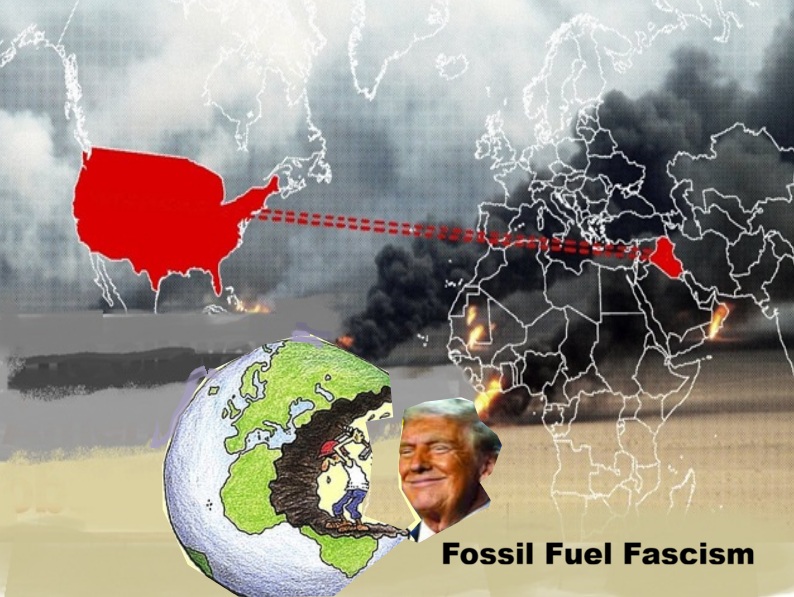
“………………………………………………………………………………………………………………………………………………………………………………………………………………………………………………………. I almost forgot to mention one more Trumpian set of acts of war, undoubtedly by far the most important and devastating of all: those he’s launched against planet Earth itself. I mean, we’re talking about the president who has done his — and this word couldn’t be more appropriate — damnedest to shut down wind farms of any sort, cut solar energy projects, and expand the burning of fossil fuels in just about every way imaginable, including by opening up 1.3 billion acres (no, that is not a misprint!) of U.S. coastal waters to further oil and natural gas drilling.
New York Times reporter Maxine Jocelow caught this Trumpian moment on Planet Earth perfectly in a recent piece on the “triumphant resurgence in Mr. Trump’s Washington” of climate-change denial. She summed up the Trumpian viewpoint this way: “Climate change is a hoax perpetrated by ‘leftist politicians.’ Fossil fuels are the greenest energy sources. More carbon dioxide in the atmosphere will be harmless.”……………………………………………
There really can’t be any question that this president is distinctly intent on nothing less than making war not just on specific nations like Iran, or on ships in the Caribbean Sea, or on anyone in or near the Strait of Hormuz, but on this very planet in every way imaginable……………………….
Defeat on Land, at Sea, and Anywhere Else Imaginable
Once upon a time, such wildly futuristic madness would have been left to the most dystopian of science-fiction novels — and undoubtedly not very popular ones at that, since such a plot and such a president would (once upon a time) have seemed far too unrealistic even for fiction. But now, thanks to President Donald J. Trump, the United States of America, in addition to all its other warring acts of recent months, is distinctly at war — and there’s no other adequate word for it — with Planet Earth (at least as a habitable place for future versions of us).
Someday, if anyone is still making TV series (since by then they’ll all undoubtedly be AI-created), I wonder if there will be one that young people, along with their parents, would be able to catch called not Defeat at Sea, but something far larger and more definitive like Defeat on Planet Earth. After all, we now have a president of the United States who seems ready not just to make war on Iran, but on more or less everything…………………………………
Trump and crew, while working as hard as they can to launch a thoroughly useless fleet of naval vessels, have also been doing their damnedest to heat this planet to the boiling point. He has literally decided to transform himself into a hell-on-earth president at a moment when renewable energy has beaten out coal as the primary source of energy globally for the first time ever.
…………………………………………………………………………………………………………………………………………………. Donald Trump, of course, is distinctly intent on making war on planet Earth (including, by recently making war on Iran, pouring yet more greenhouse gases into the atmosphere). War, after all, may be the world’s most efficient producer of such gases and the U.S. military, even in peacetime (which, unlike during his first term in office, is no longer Trump time), remains the largest institutional emitter of greenhouse gases on this planet. In the process, he’s doing his damnedest to take both his country and the planet down with him.
All too sadly, if he’s successful, American children of tomorrow, when they turn on their machines (whatever they may be), could witness not Victory, but Defeat at Sea, on Land, and Anywhere Else You Might Imagine. https://scheerpost.com/2026/05/19/the-president-of-peace-makes-war-on-the-planet/
1 This Month
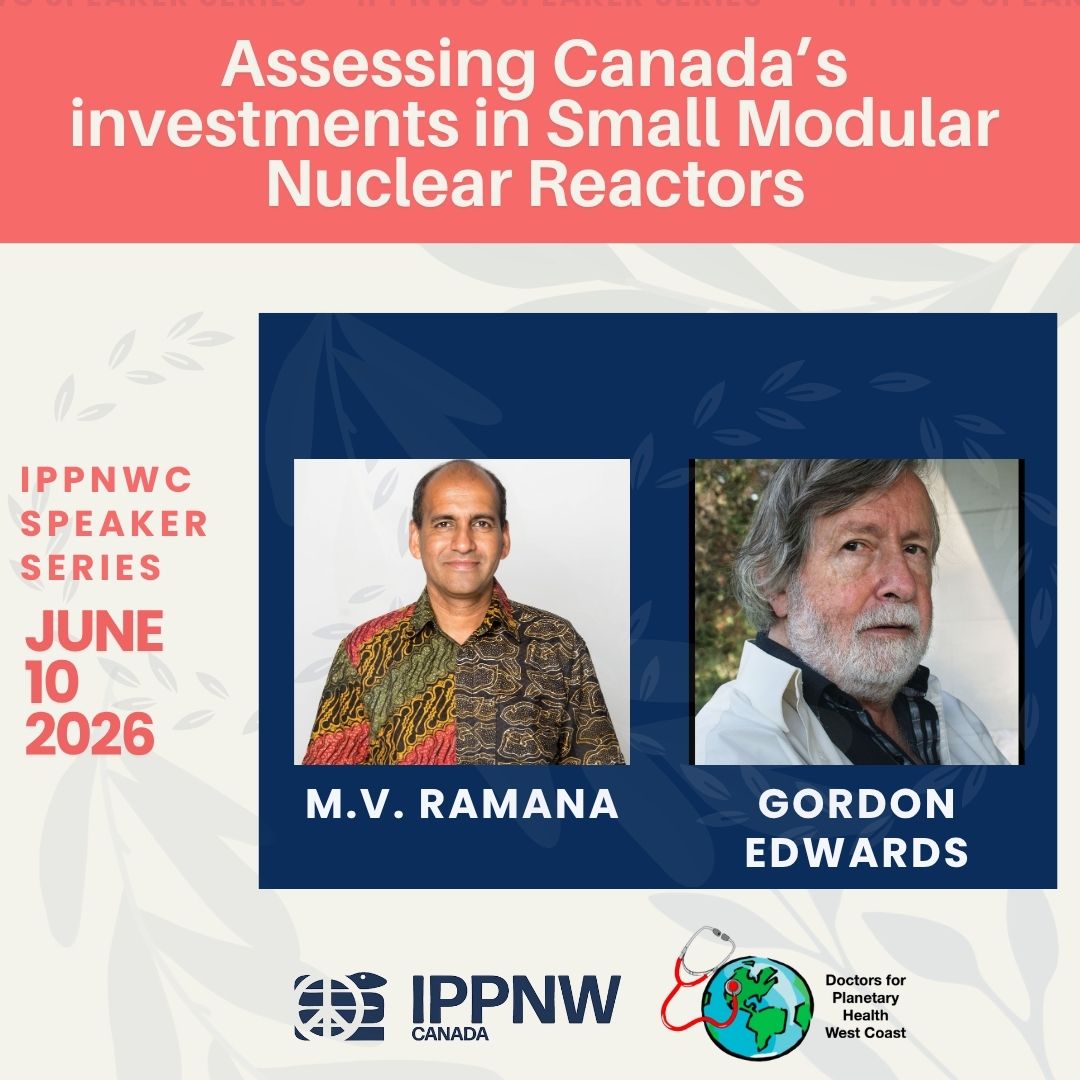
10 June – Assessing Canada’s Investments in Small Modular Nuclear Reactors – https://zoom.us/meeting/register/IiqHA5feRhaEBycOLNTJlA#/registration


Cuba Is Not a Failed State – It Is a Besieged State
PETITION: “Global Appeal to Endorse Palestinian Right of Return of Refugees”
To see nuclear-related stories in greater depth and intensity – go to https://nuclearinformation.wordpress.com
-
Archives
- June 2026 (89)
- May 2026 (306)
- April 2026 (356)
- March 2026 (251)
- February 2026 (268)
- January 2026 (308)
- December 2025 (358)
- November 2025 (359)
- October 2025 (376)
- September 2025 (257)
- August 2025 (319)
- July 2025 (230)
-
Categories
- 1
- 1 NUCLEAR ISSUES
- business and costs
- climate change
- culture and arts
- ENERGY
- environment
- health
- history
- indigenous issues
- Legal
- marketing of nuclear
- media
- opposition to nuclear
- PERSONAL STORIES
- politics
- politics international
- Religion and ethics
- safety
- secrets,lies and civil liberties
- spinbuster
- technology
- Uranium
- wastes
- weapons and war
- Women
- 2 WORLD
- ACTION
- AFRICA
- Atrocities
- AUSTRALIA
- Christina's notes
- Christina's themes
- culture and arts
- Events
- Fuk 2022
- Fuk 2023
- Fukushima 2017
- Fukushima 2018
- fukushima 2019
- Fukushima 2020
- Fukushima 2021
- general
- global warming
- Humour (God we need it)
- Nuclear
- RARE EARTHS
- Reference
- resources – print
- Resources -audiovicual
- Weekly Newsletter
- World
- World Nuclear
- YouTube
-
RSS
Entries RSS
Comments RSS
 nuclear-news