Russia’s nuclear submarine disaster will test President Vladimir Putin and his navy. ABC News, By Alexey Muraviev 4 July 19, Russia’s Ministry of Defence has officially acknowledged an incident this week with one of its deep-submergence vehicles (DSV) within Russian territorial waters.
The incident seems to point to one of Russia’s most closely guarded naval assets — the Project 10831 AS-31 (AS-12) Kalitka (Norsub-5), more commonly known as Losharik.
It is named after a popular Soviet cartoon character because of its design specifications — a series of titanium spheres under the hull designed to withstand extreme water pressure.
A secret assignment According to the latest reports, all those killed onboard were assigned to a secret naval unit stationed in St Petersburg, which is responsible for operations of Project 18510 Nel’ma (X-Ray) “autonomous deep-sea stations” — Russia’s official description of the DSV-type platforms — the AS-21 and the AS-35.
However, the declared number of casualties and the seniority of the deceased personnel is unclear. It is assumed the tragedy occurred onboard the AS-12, which has an estimated crew of some 25 officers.
All these special-purpose submarines are assigned to the 29th “deep water” Submarine Division based at the Gadzhievo submarine base on the Kola peninsula.
Formally assigned to the Russian Northern Fleet, the “deep-water” submarine division is under the direct control of the Russian Ministry of Defence’s GUGI Directorate, which oversees covert marine and naval activities ranging from deep-sea oceanographic research to covert testing of advanced sea-based combat systems, to undersea special operations.
Covert trials of a nuclear-armed torpedo? While official word suggests the submarine was undertaking scanning of the seabed in one sector of the Barents Sea, the actual mission being undertaken may be different.It is possible the submarine was taking part in the covert sea trials of the Poseidon sub-sea strategic combat system (a large calibre nuclear torpedo) .
The tragedy would be the first reported large-scale fatality sustained by GUGI’s secret force.
But it cannot be compared with previous disasters involving Russian nuclear-powered submarines such as the RFS Kursk Oscar II class catastrophe back in 2000 or the incident onboard RFS Nerpa Akula IIclass back in 2008.
This disaster has happened within a unit designed specifically to operate in extreme physical environments where the safety and professionalism of the crew is a key to survival and success.
The crew comprises only middle-to-senior rank officers…….
Was a nuclear disaster averted?
It is understood that the fire onboard led to the fatal intoxication of more than half of the crew — about 14 out of some 25 onboard — and serious injuries of another four or five onboard.
Any submariner would concur that a fire onboard a submarine on deployment poses a serious risk. Fire onboard a nuclear-powered submarine is even worse.
While it is unknown what triggered that fatal fire, a mechanical failure or a human error, the fact is clear: the crew, at the cost of their lives, prevented a potentially major environmental disaster if the DSV had sunk to the bottom of the ocean, or exploded…… https://www.abc.net.au/news/2019-07-03/russias-nuclear-submarine-disaster-test-vladimir-putin-navy/11274964
July 4, 2019
Posted by Christina Macpherson |
incidents, Religion and ethics, Russia |
Leave a comment
Fishermen witnessed nuclear submarine drama, The sub quickly surfaced and there were subsequent signs of panic on the deck, the local fishermen say. The accident might have been caused by a gas explosion. Barents Observer, By Atle Staalesen,July 03, 2019
They were out doing illegal fishing and do not want to reveal their names. But the men who late Monday evening were onboard a small local fishing boat off the coast of the Kola Peninsula told news agency SeverPost that they witnessed what appeared as a state of emergency.
Eye witnesses
It happened around 9.30 pm near the Ura Bay, one of the witnesses says.
«We were heading towards Kildin, and then, about half past nine in the evening, a submarine surfaces. Suddenly and completely surfaces. I have never seen anything like it in my life. On the deck, people were running around and making fuss,» he told SeverPost.
The fishermen hid in nearby bay from where they saw that a navy vessel and two tugs quickly arrived on site. Around 11 pm, the vessels accompanied the submarine away from the area. There was no sign of smoke, they say.
Other locals later reported that they saw bodies being taken out of the submarine and to an approaching ship.
A source in the Russian Navy later told SeverPost that the submarine seen by the local fishermen was most likely the «Podmoskovie», the mother vessel of the special purpose submarine «Losharik» (AS-31). The «Podmoskovie» is a rebuilt Delta-IV class submarine designed to carry the much smaller «Losharik».
Sources in the Navy on Tuesday told Russian media that the accident had happened in the «Losharik». …… https://thebarentsobserver.com/en/security/2019/07/fishermen-witnessed-nuclear-submarine-drama
July 4, 2019
Posted by Christina Macpherson |
incidents, Russia |
Leave a comment
What We Know About Russia’s Deadly Nuclear Sub Fire So Far https://www.themoscowtimes.com/2019/07/03/what-we-know-about-russias-deadly-nuclear-sub-fire-so-far-a66264 3 July 19 Fourteen sailors were killed in a fire on board a Russian Defense Ministry research vessel while carrying out a survey of the sea floor off Russia’s Arctic coast.
President Vladimir Putin has dispatched Defense Minister Sergei Shoigu to Severomorsk, the Russian naval base on the Barents Sea where the submarine is now located, to find out what caused the incident and report back to him.
Here’s what we know so far:
— The incident took place on Monday — nearly a day before the news was released — in Russian territorial waters in the Barents Sea, Shoigu reported to Putin.
— The 14 sailors died of smoke inhalation, Shoigu told Putin late on Tuesday.
— He said the crew extinguished the fire “through their decisive action.”
— A Navy commission has been tasked with investigating the cause of the tragedy and a military branch of Russia’s Investigative Committee has openedan inquiry into the deaths.
— The Defense Ministry had informed Putin of the accident on the day it occurred, Kremlin spokesman Dmitry Peskov said on Wednesday.
The submarine
— Russian officials have not commented on the type of vessel involved in the deadly fire.
— An unnamed source in the security forces told the RBC news website the incident took place on the AS-31, a secretive deep-sea nuclear submarine.
— Launched in 2003, the submarine nicknamed Losharik was designed for research, rescue and special military operations, and can hold up to 25 crew members. — It is made from a series of interconnected spheres, making it stronger than conventional submarine designs and allowing it to resist water pressure at great depths.
— Analysts believe the vessel is a key asset of GUGI, the Defense Ministry’s Main Directorate of Deep-Sea Research, and not part of the Russian Navy. St. Petersburg’s fontanka.ru news website and the Kommersant business daily reported that Losharik’s crew members allegedly belong to a military unit that reports to GUGI.
Casualties
— The Defense Ministry has not released the names of those on board the vessel.
— Putin noted that of the 14 casualties, seven held the rank of captain 1st rank and two had held the Hero of Russia award, the highest military honor issued in the post-Soviet period. — Shoigu confirmed that there were survivors, but did not specify how many. Anonymously sourced reports suggested four to five crew members survived the fire.
— RBC, citing social media, listed four names of possible casualties. They include the son of the military unit leader; a submarine commander who holds captain 1st rank and Hero of Russia; and a second captain 1st rank.
— An Orthodox cathedral in Murmansk, a city north of Severodvinsk, has listed 14 names in its announcement of a service “for the fallen seamen-submariners” on Wednesday evening.
Reactions
— Putin called the incident “a great loss for the [Northern] Fleet, and indeed for the Army.”
— Acting governor of St. Petersburg Alexander Beglov and Murmansk region governor Andrey Chibis expressed their condolences to the victims. — “The Losharik incident will likely have a deep operational impact on [GUGI], given how advanced and relatively few these submarines are,” a former U.S. National Security Council staffer told the Radio Free Europe/Radio Liberty news outlet.
— The United States has allegedly not received requests for assistance from the Russian government, a U.S. 6th Fleet spokesperson told the U.S. Naval Institute’s USNI News website.— Norwegian officials said they had been in touch with their Russian counterparts and were monitoring, but had not detected abnormally high levels of radiation.
— Colleagues around the world, including the U.S., will mourn the loss of 14 Russian sailors because of a “special bond between all submariners,” wroteWashington Examiner columnist Tom Rogan.
Past accidents
— This is the largest accident to take place on a Defense Ministry submarine since 2008, when a freon gas leak on the nuclear-powered submarine Nerpa killed 20 and injured 21.
— In August 2000, the Russian nuclear-powered submarine Kursk sank to the floor of the Barents Sea after two explosions in its bow, killing all 118 men aboard. That accident, soon after Putin took office, focused official attention on the state of the military and its hardware, which had been underfunded and neglected after the collapse of the Soviet Union.
July 4, 2019
Posted by Christina Macpherson |
incidents, Russia |
Leave a comment
The simple reason why nuclear power is finished – Dr Richard Dixon https://www.scotsman.com/news/opinion/columnists/the-simple-reason-why-nuclear-power-is-finished-dr-richard-dixon-1-4957211
Half of Scotland’s nuclear reactors are off-line over safety concerns, but the lights still stayed on, writes Dr Richard Dixon. July 3 2019
Nuclear power is the ultimate unsustainable form of energy. For some electricity today, we are leaving a thousand generations of future humans dangerous radioactive waste.
During the 1990s public inquiry into the Hinkley Point C nuclear station, I saw a poster showing a Roman legionary standing outside a nuclear plant and carrying the message “If the Romans had had nuclear power, we would still be guarding the waste”.
I thought it was terribly clever but it took me quite a while to realise that Roman Britain was far too close at hand. To cover the generally accepted 25,000 years, it would need to have referred to Cro-Magnon humans.
The politics of Scotland mean that new reactors here are almost unthinkable and the price of the renewable energy alternatives has fallen so far below the cost of nuclear that you would have to be crazy to go for new nuclear.
Labour’s Jack McConnell was the First Minister who said he would block new nuclear plants until there was a solution to the waste problem (14 years later, there is none). And while it is in the SNP’s DNA to oppose nuclear power. EDF and some unions do still try to lobby Scottish Ministers and officials, but to no avail. Meanwhile the industry is doing a great job of showing how terrible a bet nuclear is.
The nuclear industry is almost unique in that every new reactor costs more than the last, while everything else gets cheaper, including offshore wind power which is now coming in at just over half the price of nuclear for a unit of energy.
Hinkley Point C, the only nuclear station under construction in the UK, was supposed to be cooking the Christmas turkey in 2017. It is now expected to be producing electricity at the end of 2025 at the earliest. The only way it could be built was for the UK Government to agree that electricity consumers would pay bills well over the odds for the next 35 years.
The same sort of reactor is being built in Finland. It may start producing electricity next year – 11 years late. The other one of the same design is in France and is currently running 12 years late, at twice the original budget.
The latest wheeze the industry has come up with is to ask the UK Government to agree to pay any costs more than 30 per cent above the original budget for any more reactors. Not a good bet given their history.
Of course we already have four reactors in Scotland. The two at Torness are the second newest in the UK, having been opened by Margaret Thatcher in 1989. The two at Hunterston in Ayrshire are already well past their sell-by date, having started up in 1976. They were supposed to have closed in 2006 but have had three extensions with planned closure now in 2023. Because of a large number of cracks in their cores one reactor stopped generating in March last year and the other in October. Owners EDF are arguing with regulators about whether they can safely restart.
Did you notice the lights going out across Scotland with Hunterston not producing a single electron for eight months? No, thanks largely to renewables having a record first quarter of 2019 and supplying nine out of ten households in Scotland.
We certainly don’t need new nuclear and, with renewables rapidly on the rise, we should not take the unnecessary risk of starting up the Hunterston reactors ever again.
Dr Richard Dixon is director of Friends of the Earth Scotland.
July 4, 2019
Posted by Christina Macpherson |
renewable, UK |
Leave a comment
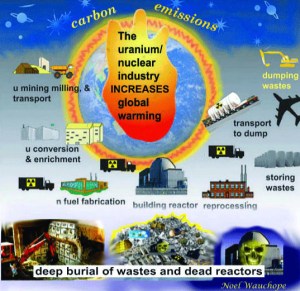 Nuclear power is helping to drive the climate crisis, Guardian, 3 July 19 Linda Rogers says the CBI has its head in the sand over nuclear reactors and Iain Climie wants politicians prepared to fund action to combat the climate emergency
Has the Confederation of British Industry got its head in the sand, or in the record levels of carbon-intensive concrete just poured at the Hinkley C nuclear site (
Build more nuclear reactors to help climate crisis, says CBI, 28 June)? Nuclear power, apart from destroying biodiversity throughout its life cycle, produces up to 37 times the CO2 emissions of renewable energy sources, owing partly to the mining and refining of uranium. The impact of this process on people and the environment is not included in the rationale for nuclear power in the UK.
As the CBI looks for investment from abroad, UK taxpayers will pick up the bill for the likely time and cost overruns of new nuclear build under the regulated asset-based funding proposals so welcomed by the CBI. Nuclear has failed to achieve the investment needed so far because it is no longer seen as economically viable. Even Hitachi (one of the world’s largest multinationals) cannot magic Wylfa Newydd into a commercially viable business. In January this year, Hitachi announced it had failed to squeeze the UK government for the very high levels of subsidies desired by large investors upfront for Wylfa. Nobody can afford the costs or the many risks attached to building new nuclear power stations.
Linda Rogers
July 4, 2019
Posted by Christina Macpherson |
business and costs, climate change, politics, UK |
Leave a comment
Critics Accuse Russia of Covering Up Nuclear Sub Fire, Compare to Chernobyl. https://www.themoscowtimes.com/2019/07/03/critics-accuse-russia-of-covering-up-nuclear-sub-fire-compare-to-chernobyl-a66267 3 July 19 Russian commentators have challenged officials for not releasing full details about an accident on board a military submarine that killed 14 sailors.
The incident took place on Monday, according to the Defense Ministry, but was not officially disclosed until late on Tuesday. Nearly two days on, there was still no word on whether the submarine was nuclear-powered.
Some Russian media accused officials of starving the public of details and drew parallels with the dearth of official information during the meltdown of a Soviet nuclear reactor in Chernobyl in 1986.
The type of vessel was not specified by the ministry and there were few details of the circumstances beyond the fact that it had been in Russian territorial waters and the fire had been extinguished.
“Absolutely nothing is known at the moment — who, what… I don’t understand one thing: why did a day go by and only then did they make the statement about the deceased?” said Yevgeny Buntman, an anchor for the Ekho Moskvy radio station. “Why don’t we know their names? Is this normal?”
The Bell, a news site often critical of the government, wrote: “Nearly a day without information about the accident in a nuclear facility and the need to look out for Norwegian statements about the level of radiation should have given a shudder to those who remember the Chernobyl nuclear power station.”
Secret sub Norway’s authorities said on Tuesday they had not detected any abnormal radiation.
Asked on Wednesday if the vessel had a nuclear reactor on board, Kremlin spokesman Dmitry Peskov referred the question to the Defense Ministry.
He told reporters in a conference call that details of the submarine were classified, but that information had been provided in good time. Several hours before the official statement, blogger Yevgeny Karpov reported a fire on a vessel belonging to the Northern Fleet, but he then took down the report at the fleet’s request, he told the Meduza news site.
The fire is one of the deadliest submarine accidents since August 2000, when the nuclear-powered Kursk sank to the floor of Barents Sea, killing all 118 men aboard.
Authorities then, and in particular President Vladimir Putin, who was at the beginning of now almost two decades as president or prime minister, came under fire for their slow response and shortcomings in the rescue operation.
July 4, 2019
Posted by Christina Macpherson |
media, Russia, secrets,lies and civil liberties |
Leave a comment
14 Russian Sailors Killed in Fire on Nuclear Sub https://www.themoscowtimes.com/2019/07/02/14-russian-sailors-killed-in-fire-on-nuclear-sub-reports-a66257 3 July 19 Fourteen submariners on board a Russian Defense Ministry research vessel were killed in a fire while carrying out a survey of the sea floor off Russia’s Arctic coast, the ministry was quoted as saying by Russian news agencies.
The incident took place on the AS-31 deep-sea nuclear submarine nicknamed Losharik, an unnamed source in the security forces told the RBC news website. Launched in 2003, Losharik was designed for research, rescue and special military operations and can hold up to 25 crew members.
The fire broke out at 8:30 p.m. on Monday, RBC cited its source as saying, nearly a day before the ministry released the news. “On July 1 in Russian territorial waters a fire broke out on board a deep-water scientific research vessel that was studying the marine environment of the world ocean on behalf of the Russian navy,” Interfax cited a ministry statement as saying.
“Fourteen submariners died as the result of smoke inhalation … Work is underway to establish the cause of the incident. The investigation is being conducted by the commander-in-chief of the navy.”
The fire has been extinguished and the submarine is now at the Russian Northern Fleet’s base in Severomorsk on the Barents Sea, Interfax quoted the ministry as saying. The statement as cited by the agencies did not identify the type or model of the underwater vessel.
This is the largest accident to take place on a Defense Ministry submersible since 2008, when a freon gas leak on the nuclear-powered submarine Nerpa killed 20 and injured 21.
In August 2000, the Russian nuclear-powered submarine Kursk sank to the floor of Barents Sea after two explosions in its bow, killing all 118 men aboard.That accident, soon after President Vladimir Putin took office, focused official attention on the state of the military and its hardware, which had been subject to underfunding and neglect after the collapse of the Soviet Union.
Since then, Putin has overseen a massive increase in military funding that has allowed the armed forces to renew their equipment and improve training and morale.
However, accidents have continued to happen as the military, used by the Kremlin to project its growing international muscle, has ramped up its activities and extended into new theatres of operation.
In December 2016, a Russian military plane carrying 92 people, including dozens of Red Army Choir singers, crashed into the Black Sea en route to Syria where Russian forces are deployed. Everyone on board was killed.
July 4, 2019
Posted by Christina Macpherson |
incidents, Russia |
Leave a comment
Putin signs bill suspending participation in nuclear treaty https://www.japantimes.co.jp/news/2019/07/03/world/putin-signs-bill-suspending-participation-nuclear-treaty/#.XR0oyOszbGg 3 July 19
MOSCOW – President Vladimir Putin has signed a bill suspending Russia’s participation in a pivotal nuclear arms treaty. Putin’s decree released on Wednesday formalizes Russia’s departure from the 1987 Intermediate-Range Nuclear Forces treaty with the United States following Washington’s withdrawal from the pact.
The U.S. gave notice of its intention to withdraw from the INF in February, setting the stage for it to terminate in six months unless Moscow returns to compliance. Russia has denied any breaches, and accused the U.S. of violating the pact. Moscow followed Washington’s example in February, also suspending its obligations under the treaty.
Putin has warned the U.S. against deploying new missiles in Europe, saying that Russia will retaliate by fielding new fast weapons that will take just as little time to reach their targets.
July 4, 2019
Posted by Christina Macpherson |
politics international, Russia |
Leave a comment
Inside new £1,300,000,000 structure built over destroyed Chernobyl nuclear reactor https://metro.co.uk/2019/07/03/inside-new-1300000000-structure-built-destroyed-chernobyl-nuclear-reactor-10106545/ Georgia Diebelius [excellent photos] 3 Jul 2019 Anew structure built to confine the Chernobyl reactor at the centre of the world’s worst nuclear disaster was previewed for the media yesterday. Reactor No. 4 at the Chernobyl nuclear power plant in Ukraine exploded and burned April 26, 1986. The complex construction effort to secure the molten reactor’s core and 200 tons of highly radioactive material has taken nine years to complete under the control of the European Bank for Reconstruction and Development. The structure itself cost £1.5 billion and the entire shelter project cost £2.2 billion. The European Bank for Reconstruction and Development managed a fund with contributions from 45 countries, the European Union and £715 million in the bank’s own resources.‘
This was a very long project,’ said Balthasar Lindauer, director of the bank’s Nuclear Safety Department
He said Ukraine was a big contributor, contributing €100 million in cash along with expertise and personnel. Journalists were invited to view the new safe confinement shelter ahead of the handover to Ukrainian authorities.
July 4, 2019
Posted by Christina Macpherson |
business and costs, Ukraine, wastes |
Leave a comment
British Nuclear Expert Says U.S. Has Put Europe In A Tough Spot On Iran, NPR, July 2, 2019 Heard on All Things Considered
NPR’s Audie Cornish talks with former British Iran deal negotiator Richard Dalton. He’s a nuclear expert and talks about Iran’s decision to exceed the uranium limit in the 2015 nuclear agreement
AUDIE CORNISH, HOST:……….
RICHARD DALTON: The Europeans have been put in a position where, after more than a year of patience by Iran, it’s inevitable that they won’t be the only country observing the agreement in full. They are bound to negotiate to try and improve the position in which the United States has left them. But the trouble is that the United States is not showing any interest in putting forward terms that would be negotiable. Iran would, for example, go back into compliance if some of the restrictions on its sale of oil were permitted, thus allowing the Europeans to put more funds into the special purpose vehicle which they’ve put in place to facilitate trade in humanitarian goods. …………
DALTON: Well, most British companies that were interested in trading with Iran are now no longer interested in doing so. There are some maintaining their links in the hope of profitable deals in future when the situation improves. What is needed now is a diplomatic effort involving not just the European Union but also the United States to take some of the heat out of the situation and set the stage for meeting some of the United States’ long term objectives for its diplomacy with Iran.
CORNISH: You used the term bully earlier in talking about the U.S. effort when it comes to Iran. Do you see this as a test of European power, whether it’s strong enough to oppose the U.S. and enforce this deal?
DALTON: European companies and the European Union recognize that the dominance of the dollar in international trading gives the United States very considerable power. And I believe that the Iran episode is going to be a turning point. It will show Russia, China, India, the European Union the value of building up alternative mechanisms for concluding international trade that do not use the dollar in any shape or form.
So I think the United States is set maybe to use their excessive power on this occasion but, over the long term, to lose power. ……https://www.npr.org/2019/07/02/738146393/british-nuclear-expert-says-u-s-has-put-europe-in-a-tough-spot-on-iran
July 4, 2019
Posted by Christina Macpherson |
EUROPE, politics international |
Leave a comment
France Bleu 1st July 2019 Tricastin power plant: are the defects of the tank dangerous? The reactor vessel of the Tricastin NPP was delivered with defects 40 years ago.
Anti-nuclearists point to this problem to demand the shutdown of the
reactor. https://www.francebleu.fr/infos/economie-social/centrale-de-tricastin-les-malfacons-de-la-cuve-sont-elles-dangereuses-1561481499
July 4, 2019
Posted by Christina Macpherson |
France, safety |
Leave a comment
Daily Mail 26th April 2019 , Exposed: Britain’s largest nuclear power plant Sellafield is rocked by claims of bullying and sexual harassment with female staff ‘routinely
propositioned by male bosses’ https://www.dailymail.co.uk/news/article-6965179/Exposed-Britains-largest-nuclear-power-plant-rocked-claims-bullying-sexual-harassment.html
July 4, 2019
Posted by Christina Macpherson |
culture and arts, UK |
Leave a comment
 ‘Worst is still to come’: Sizzling Europe battles wildfires, health risks, New records are being set as Europe swelters, sparking forest fires – and debates over public nudity. SBS News, 29 June 19, Wildfires raged across Catalonia and French authorities stepped up restrictions on water use and driving in cities as swathes of western Europe remained in the grip of an intense heatwave.Temperatures climbed towards 44 degrees Celsius (111 degrees Fahrenheit) in parts of northern Spain and southern France, driving many people to seek relief in the sea, rivers, lakes, fountains and swimming pools.
Grid operator RTE said French electricity demand on Thursday was close to a summer record seen two years ago, as people turned on fans and coolers to full blast for relief from the scorching temperatures……….
The stifling heat has elsewhere prompted traffic restrictions in France and fanned debate in Germany over public nudity as sweltering residents stripped off. …….
Exceptional for arriving so early in summer, the heatwave will on Thursday and Friday likely send thermometers above 40 degrees in France, Spain and Greece.
In Spain, hundreds of firefighters and soldiers, backed by water-dropping aircraft, battled on Wednesday to put out a wind-fuelled forest fire that erupted in Torre del Espanol in the northeastern region of Catalonia…….
Scientists warn that global warming linked to human fossil fuel use could make such scorchers more frequent.
“Global temperatures are increasing due to climate change,” said Len Shaffrey, professor of climate science at the University of Reading.
“The global rise in temperatures means the probability that an extreme heatwave will occur is also increasing.”……… European heatwave could be the norm in a climate change affected world…….. https://www.sbs.com.au/news/worst-is-still-to-come-sizzling-europe-battles-wildfires-health-risks
July 2, 2019
Posted by Christina Macpherson |
climate change, EUROPE |
Leave a comment

Heatwave may force nuclear power shutdown in France as cooling water runs out, https://www.telegraph.co.uk/news/2019/06/30/heatwave-may-force-nuclear-power-shutdown-france-cooling-water/ David Chazan, Paris 30 JUNE 2019
Drought and overheating of river water may force some of the nuclear power plants that supply two-thirds of France’s electricity to shut down temporarily in the wake of the European heatwave.
The extreme temperatures are beginning to abate, but shortages and excessive temperatures of river water needed to cool reactors are worrying EDF, the largely state-owned electricity company.
If the hot weather continues, households, offices and factories will require large quantities of electricity for air conditioning and ventilation.
River levels have fallen in eastern, central and southern France, the Journal du Dimanche newspaper reported on Sunday.
The Civaux nuclear plant is cooled by water from the River Vienne, now close to a historic low following the heatwave.
EDF uses two dams to augment the river water, but the local authority has complained that the company uses the river almost exclusively for its power station, jeopardising farming, drinking water supplies, leisure activities and tourism.
Residents of areas near the River Loire have made similar criticisms.
The Loire has four nuclear plants on its banks, but the local authority has reported water levels close to the historic lows registered during France’s terrible 2003 heatwave, blamed for 15,000 deaths, mostly elderly people affected by dehydration.
Last year, hot weather forced EDF to temporarily shut down three reactors in eastern France, at the Bugey power plant near the Swiss border, at its Saint-Alban plant on the Rhône, and at the Fessenheim plant near the German border.
The heatwave has revealed that France is ill-prepared to face extreme temperatures, according to green party leaders. The government is to unveil new measures to manage water resources this week.
A record high of 45.9 degrees Celsius was reached in the southern village of Gallargues-le-Montueux, near Montpellier, on Friday.
Three swimmers died of “thermic shock” from plunging into cool water, and a cyclist died after collapsing in the heat in the southern Vaucluse département.
In Spain, a British mountaineer was airlifted to hospital after suffering heatstroke.
The unnamed 48-year-old collapsed in the Western Pyrenees’ Baztan Valley and was taken to hospital in a serious condition.
July 1, 2019
Posted by Christina Macpherson |
climate change, France |
1 Comment
Secrets of Chernobyl spill out more than three decades after the nuclear disaster, By SERGEI L. LOIKO sergei.l.loiko@gmail.com, JUN 30, 2019| CHERNOBYL, UKRAINE [good photographs on original]
Seated in a jeep and clutching a screeching Geiger counter, Lt. Col. Viktor Chershnev led a convoy of 30 military trucks through the center of sleeping Kiev.
The measuring device was sounding off loudly on that night 33 years ago, not because of the convoy’s cargo — 30 antiaircraft missiles, three of them tipped with nuclear warheads — but because of where and when the post-midnight parade had kicked off: at the Chernobyl air defense missile base just three days after the explosion of a reactor at the adjacent Chernobyl nuclear power plant that had sent enough radioactivity spewing into the air that it at one point had the potential of poisoning much of Eastern Europe.
Chershnev knew that the missiles, the trucks and his crew were badly contaminated and that they should not have been ordered to drive through a city of more than 2 million people. But there was no bypass road at the time — and orders were orders. What Chershnev didn’t know in the early hours of the morning of April 30, 1986, was that a radioactive cloud had already caught up with them and blanketed the city on the eve of its annual May Day festivities.
The reaction to HBO’s recent “Chernobyl” miniseries has been almost as far-reaching as the initial tragedy and has spurred a daily line of buses packed with foreign tourists at the gate of the Chernobyl Exclusion Zone, which extends for 20 miles around the plant. But Chernobyl still boasts secrets more than three decades later, including the story of Chershnev and his charges — a saga of dysfunction and disregard for human life that lays bare conditions in the waning years of the Soviet Union.
When the red alert sounded, Chershnev, then the deputy commander and chief engineer of the Kiev Air Defense Brigade, was responsible for the readiness of weaponry and equipment at the Chernobyl antiaircraft battalion’s base in a massive in-ground bunker with 10-inch-thick, rusty metal doors.
These days, the site also features a 10-yard-long missile launcher’s towing trolley, half-buried in silver moss, the former walls of a second smaller bunker surrounded by dense pines and a vast carcass of barracks with missing floorboards, dilapidated walls and a mural of a Soviet soldier cheerfully calling upon comrades to defend the motherland.
Seventy officers and men — ill-informed, unprotected and exposed to deadly radiation — were housed at the site along with the missiles back in 1986, under orders to arduously protect and save the weapons and structures rather than themselves.
The site included the nuclear plant and the Chernobyl over-the-horizon early warning radar station, a 500-meter-long, 150-meter tall installation designed to detect strategic missiles launched from the United States. The now-rusty structure still towers over the area and is a major tourist attraction, a frightening monument to the Cold War that even the complex‘s normally fearless marauders have not attempted to cut into pieces to sell as scrap metal outside the zone, a routine business in these parts.
In the aftermath of the 1986 explosion — as the government evacuated more than 50,000 residents from the town of Pripyat, including the families of nuclear plant workers, plus more than 75,000 residents of nearby villages — the men of the Chernobyl air defense unit stayed put until they received fresh orders.
“Three days after the explosion, on April 29, I arrived at the base with 30 heavy trucks and we loaded on them 30 missiles from the storage hangars,” recalls Chershnev, who headed the evacuation effort. “Twenty-seven of them were conventional, but the other three were tactical rockets with nuclear warheads. We were to take them to a facility outside Boryspil, near Kiev.
“After that, we were ordered to go back and salvage the remaining equipment that could be dismantled.”
The men traveled — without protective gear — for 14 hours at speeds lower than 20 mph as radiation from the explosion leaked into the air.
Chershnev admits he knew the dangers but says he was a career officer and could not disobey orders………….
When Chershnev got back from that trip, he repeated the ritual of burning his uniform.
“No one in the world knows that we existed and what we went through,” he said. “And all for nothing. All so stupid and futile. We didn’t save anyone. We didn’t clean up anything.
“All those I personally know and have kept track of all these years are either badly sick like myself or dead by now. My driver who accompanied me on all the convoys was discharged and died at 28. My fellow deputy brigade commander, … who was also dealing with contaminated equipment, died [in 1995] of cancer. Warrant Officer Petro Pozyura went blind. And so on and so forth. I have a heart ailment and every year spend a couple of weeks in hospital.”
The cardiologist who has been treating Chershnev for the last few years once asked him to retrieve his Chernobyl-era medical records from the military. But Chershnev was told that the records no longer exist.
“Here I am on a pension with a monthly Chernobyl health compensation of about $11 a month,” he concluded bitterly. “It is not even enough to buy a bottle of decent vodka, let alone medicines.”
The official death toll related to the explosion is listed as 39, but out of the officially registered 3.2 million people who were exposed to radiation in Ukraine alone, 1.3 million have died in the last 33 years, said Vladimir Kobchik, a former Chernobyl cleanup worker who is now a leader of a group that aims to protect the rights of fellow survivors.
“For the last four years, the government of Ukraine has been allocating $70 million annually for the needs of the affected. That is $37 per person per year! Not a penny more! How many of those remaining 1.9 million people affected by Chernobyl are sick [and] we can’t even tell? The doctors will never tell you you are sick or dying because of radiation.”……… https://www.latimes.com/world/la-fg-ukraine-chernobyl-secrets-20190630-story.html
July 1, 2019
Posted by Christina Macpherson |
health, PERSONAL STORIES, Reference, secrets,lies and civil liberties, Ukraine |
Leave a comment




 nuclear-news