ACTIVISTS WALK “CEASE AND DESIST” ORDER INTO NUCLEAR WEAPONS BASE
BÜCHEL, Germany — Eleven international peace activists entered the Büchel Air Base southwest of Frankfurt early this morning to deliver what they called a “Treaty Enforcement Order” declaring that the sharing of US nuclear weapons at the base is a “criminal conspiracy to commit war crimes.”
Upon entering the base’s main gate with a printed “cease and desist order,” they insisted on seeing the base commander to deliver the order in person.
“We refuse to be complicit in this crime,” said Brian Terrell of Voices for Creative Nonviolence in Chicago, Illinois. “We call for the nuclear bombs to be returned to the US immediately. The Germans want these nuclear weapons out of Germany, and so do we.”
The group included people from Germany, The Netherlands, the United Kingdom, and the United States. All eleven were detained by military and civilian authorities and were released after providing identification. This is the third year in a row that a delegation of US peace activists has joined Europeans and others in protesting the US nuclear weapons at Büchel. The local group Nonviolent Action for Abolition of Nuclear Weapons (GAAA) convenes the International Action Week, demanding permanent ouster of the US nuclear weapons, cancellation of plans to replace today’s B61s with new hydrogen bombs, and Germany’s ratification of the 2017 Treaty on the Prohibition of Nuclear Weapons.
“Delivery of the ‘Cease and Desist Order’ is an act of crime prevention,” said John LaForge, of the US peace group Nukewatch and coordinator of the US delegation. “The authorities think the entry is a matter of trespass. But these nuclear bomb threats violate the UN Charter, the Treaty on Nonproliferation of Nuclear Weapons, and the 2017 Treaty on the Prohibition of Nuclear Weapons.” he said, adding, “Interrupting government criminality is a duty of responsible citizenship.”The activists included: (from the United States) Susan Crane, Richard Bishop, Andrew Lanier, Jr., Brian Terrell, Ralph Hutchison, and Dennis DuVall; (from the UK) Richard Barnard; (from The Netherlands) Margriet Bos, and Susan van der Hijden; and (from Germany) Dietrich Gerstner, and Birke Kleinwächter.
Susan van der Hijden of Amsterdam, who is just back from the US where she visited the Kansas City, Kansas site of a factory working on parts of the new replacement bomb, known as the B61-12. “The planning and training to use the US H-bombs that goes on at Büchel cannot be legal, because organizing mass destruction has been a criminal act since the Nuremberg Trials after WWII,” van der Hijden said.
Vladimir Shevchenko – heroic photographer of Chernobyl nuclear catastrophe
 I watched the “Chernobyl” miniseries, and I was struck by the accuracy. The scene on the roof of the reactor as depicted in the fictional episode, was accurate in so much detail, compared to the 1986 real film.
The Soviet film maker who filmed his own death at Chernobyl https://www.news.com.au/technology/science/the-soviet-film-maker-who-filmed-his-own-death-at-chernobyl/news-story/b06e971263baff167fdeab00061d9e9c
There were many who risked their lives after the Chernobyl disaster — but none more so than a man desperate to show the world what happened, LJ Charleston, 21 July 19 When Soviet filmmaker Vladimir Shevchenko took his camera onto the roof of Chernobyl’s reactor four in the aftermath of the fatal explosion, he had no idea he was right in the middle of what was — in April 1986 — the most dangerous place on earth.
He also had no idea that his chilling documentary Chernobyl: Chronicle of Difficult Weeks, about the clean-up of the radioactive material at Chernobyl, would be his very last.
He died of acute radiation sickness a year later.
The award-winning film director, who was working for Ukrainian TV at the time, was said to have been quite unaware of the dangers he was putting himself in when he agreed to film from the roof next to reactor four.
He’d been hired to film in the exclusion zone. But his gravest error was agreeing — along with two assistants — to climb up to the most lethal area of all, just days after one of the worst man-made disasters of all time.
Even 33 years after the explosion, Shevchenko’s film is still an eerie reminder of the sacrifices made by those who risked their lives in the clean-up efforts at Chernobyl.
Today, as the world focuses once again on those events due to HBO’s series Chernobyl, it’s worthwhile putting the spotlight on the courageous Shevchenko.
He gave his life so that we could see with our own eyes what went on during the clean-up. It was, at times, incredibly basic and put so many lives at risk.
And, by doing so, Shevchenko was unknowingly filming his own death……
Shevchenko, who was the first and only film maker allowed on location in the exclusion zone of Chernobyl, is best known for Chernobyl — Chronicle of Difficult Weeks. You can watch the full cut of his film here.
The film is entirely in Russian, although it’s believed people are currently working on English subtitles. It includes interviews with beleaguered scientist Valery Legasov, now famous due to the HBO series in which he’s played by Jared Harris.
Legasov committed suicide two years after the disaster, on the anniversary, due to the horror of his experiences and the lies he had to tell the International Atomic Agency in Vienna to cover up Soviet mishandling of the event.
Shevchenko’s footage of Chernobyl has not been widely seen and the fact he lost his life a year after the explosion has been completely obscured, as his name isn’t listed on official records of deaths. At the time, his two assistants were receiving hospital treatment, but there is no word of what became of them.
Sydney archaeologist Mr Robert Maxwell, the only archaeologist who has worked in Chernobyl across two field excursions, told news.com.au Shevchenko was well-respected and trusted to film the clean-up efforts, as it was such a highly sensitive time for the Soviets.
“He was granted permission to film the clean-up, including the incredibly dangerous work of the ‘biobots’,” Mr Maxwell said, referring to the name given to the workers sent in to clean up……..
THE ‘BIOBOT FOOTAGE’
One of the most memorable and unbelievable scenes in the TV series Chernobylfeatures liquidation workers on the roof, using shovels to throw highly radioactive material back into the core.
If it wasn’t for Shevchenko’s 1986 footage, we would not know that this happened. The men could only work in frantic 90 second shifts; any longer and their exposure to the radiation would be fatal.
What makes the footage so compelling is that we can clearly see some men picking up the radioactive graphite with gloved hands. We also see Shevchenko filming from the roof top, wearing only a flimsy mask and cap for protection. Then we can see how badly damaged the footage is as the radiation makes an impact on the film itself.
It’s harrowing to see how much work the men are doing with their hands.
This is Shevchenko’s footage focusing on the rooftop clean-up.
Chernobyl. Cleaning the roofs. Soldiers (reservists). 1986.
Hinkley Pt nuclear station’s cooling system will mean massacres of fish

 Times 20th July 2019 Nuclear power plant will suck fish to their deaths, The Times, Ben Webster,, Oceans Correspondent, July 20 2019 It has been described as a giant plughole under the sea, sucking in 130,000 litres of water a second along with vast numbers of fish. The twin inlet tunnels stretching two miles out into the Severn estuary are so big that a Times 20th July 2019 Nuclear power plant will suck fish to their deaths, The Times, Ben Webster,, Oceans Correspondent, July 20 2019 It has been described as a giant plughole under the sea, sucking in 130,000 litres of water a second along with vast numbers of fish. The twin inlet tunnels stretching two miles out into the Severn estuary are so big that adouble-decker bus could drive through them. The system will cool a new
nuclear power station being built at Hinkley Point in Somerset but conservation groups say it will kill up to 250,000 fish a day and must be altered or scrapped. They say that EDF, the French state-owned energy group, has grossly underestimated the system’s impact on marine life in the estuary, a special conservation area. A 5mm mesh will be installed to
prevent larger fish being swallowed but the groups, including the Blue Marine Foundation, Wildfowl & Wetlands Trust and Somerset Wildlife Trust, say many fish will be fatally injured when pressed against it. Small fish, eels and the fry of many species, such as salmon, whiting and cod, will be sucked through the mesh and into the cooling system. The groups say it
could damage the population of twaite shad in the UK, a small herring-like fish that used to spawn in the estuary by the millions but has dwindled to tens of thousands. EDF says the system will kill about 650,000 fish a year.
It has asked to vary its original permits and planning permission for the power station to allow it to remove an “acoustic fish deterrent” from the cooling system. It argues that, even without it, the impact of the system on fish populations will still be “negligible”. EDF says fish will be adequately protected by other measures, one which will slow the water entering the system and another which will return to the sea the fish sucked in. Conservation groups argue that scientific analysis they obtained
of the cooling system shows far greater harm to marine life. This analysis is partly based on measurements of fish swallowed by the cooling system of Hinkley Point B, a nearby nuclear power station which consumes a quarter of the sea water that will be extracted to cool Hinkley C. They want the
government to reject EDF’s application and, if the company cannot mitigate the damage, force it to use other ways to cool the station, such as cooling towers or ponds. James Robinson, of the Wildfowl & Wetlands Trust, said:
“The authorities must decide if it’s worth building a giant plughole to suck millions of sea animals to their deaths, in one of our most important protected marine areas, in order to produce electricity.” Charles Clover, director of Blue Marine Foundation, said the groups would also challenge plans by EDF for a similar system at its proposed new nuclear power station at Sizewell in Suffolk. https://www.thetimes.co.uk/article/e0c7e83e-aa68-11e9-89e4-5e7e89de8df9 |
|
|
UK: Camden’s Citizens Assembly works on climate change action
on Saturday morning at which more than 50 Londoners will decide on
carbon-cutting measures they want their district to enact in order to
confront climate change.
interrogate what locals, neighbourhoods and the council can do for the
environment, is deliberating action that would reduce fossil fuel usage in
homes and public buildings and on roads. The wishlist will be considered by
the council as it draws up an environment action plan for 2020.
of the assembly will be closely watched by other councils planning to
follow suit this year, and by Westminster which will hold its own national
climate assembly in the autumn. Council officials say there is a clear
intention to implement at least some of the recommendations.
there will be some concrete action that we can take forward as a
council,” said Georgia Gould, the council leader. “That’s the idea of
it being an open process – you are letting go of that control. Our
climate is in a crisis and we need to act in radical new ways and this
assembly is part of developing those new ideas.”
include community energy projects such as solar panels on schools, GP
surgeries and public buildings, a revolution in heating buildings that
favours air source heat pumps over old-style gas boilers, better insulation
and urban greening.
Great Britain GB electricity system operator – demand-side response (DSR) is more reliable than nuclear power
The Energyst 18th July 2019 The GB electricity system operator has suggested demand-side response (DSR) is more reliable than nuclear power in its latest Capacity Market auction
guidelines. National Grid ESO has given DSR a de-rating factor of 86 per
cent, while nuclear is de-rated to 81 per cent.
DSR is also deemed to be
marginally more reliable than biomass, coal and most interconnectors, per
the guidelines. Industry participants suggested the move reflected the
expertise of DSR providers in managing their portfolios. “Presumably [the
de-rating factors] reflects recent reliability of the UK nuclear fleet, and
superior performance of aggregators in delivering contracted response,”
wrote Jon Ferris, strategy director at energy blockchain firm Electron.
His comments were welcomed by the Association for Decentralised Energy.https://theenergyst.com/national-grid-dsr-more-reliable-than-nuclear/
World security needs nuclear New Start agreement – USA-Russia, not a distraction about China
|
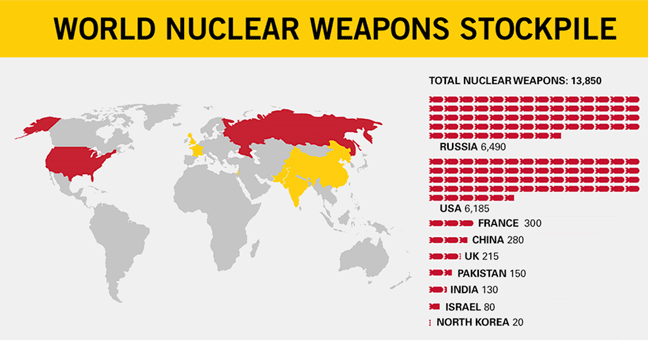
Nobody wins a nuclear war — especially not two nuclear behemoths. https://thehill.com/opinion/international/453576-nobody-wins-a-nuclear-war-especially-not-two-nuclear-behemoths BY DANIEL R. DEPETRIS,— 07/17/19 U.S. and Russian officials met this week in Geneva for what one hopes will be new strategic arms reduction talks. Trump administration officials are cautiously optimistic the discussions could lead to a more substantive negotiation about capping — and perhaps even decreasing — the number of nuclear weapons both countries have in their stockpiles. This matters for U.S. and global security because these two nations possess more than 90 percent of all nuclear weapons. President Trump, however, wants to go further than a simple extension of the 2010 The New Strategic Arms Reduction Treaty (START) agreement or a new bilateral treaty with the Russians. Instead, he is prodding China to join a trivariate arrangement. But in prefacing or linking an extension of New START to a fresh accord that includes the Chinese, the administration is increasing the possibility of ending up with neither. For one, pushing Beijing to into a three-way deal is like pushing on a locked door. The Chinese have shown no interest in a three-way deal, in large measure because their nuclear arsenal is a fraction (roughly 2 percent) of the globe’s entire inventory. At roughly 290 warheads, Beijing’s nuclear weapons program is minuscule when compared to the thousands of combined warheads Washington and Moscow have stockpiled. Indeed, China stockpile is less than 1/20th the size of the United States and about 1/22th the size of Russia’s. To expect the Chinese to participate in a new arms control negotiation with two nuclear superpowers when the numbers are so steadily stacked against them is a fool’s errand. Beijing’s no-first use nuclear policy, in place since its first ever nuclear explosive test in 1964, was recently reaffirmed just last year. An offensive nuclear strike is not something U.S. officials in Washington have to worry about. To focus on a U.S.-Russia-China nuclear agreement at the expense of keeping an already existing New START accord alive is the wrong priority. New START, signed in April 2010, was a win-win, pragmatic arms control agreement for both sides. The pact cut the U.S. and Russian stockpiles byaround one-third; capped the amount of nuclear warheads on deployed intercontinental ballistic missiles at 1,550; limited the number of deployed and non-deployed ICBM launchers to 800; and allowed each country to verify compliance with the treaty, including on-site inspections, information exchanges and advanced notices. Unlike the Intermediate Range Nuclear Forces Treaty, inspectors have verified Moscow’s compliance with the letter of the deal. For two countries that possess a combined 12,675 nuclear weapons, New START is a critical enforcing mechanism for nuclear parity and a stable balance of power. It is now the only functional arms control accord preventing the U.S. and Russia from entering another costly, risky arms race. The deal expires in February 2021 but could be extended for another five years if both Presidents Trump and Putin agree to do so. Putin has already expressed his interest. Trump, someone who considers himself a transactional pragmatist, shouldn’t waste any more time before doing the same. An extension of New START, however, is not only important for strategic stability between the two nuclear superpowers (without New START, there is nothing stopping either the United States or Russia from building and deploying more and better nuclear warheads). but also valuable for stabilizing the entire U.S.-Russia relationship in desperate need of improvement. For this reason, a constructive relationship with Moscow is unquestionably a good thing for U.S. security. Extending New START is a no-brainer and indeed could very well be an opportunity to mend relations. It’s not hyperbole to describe U.S.-Russia relations as being at their lowest since the land-based missile build-up in Europe in the early 1980s. From Syria and Ukraine to NATO and cybersecurity, Washington and Moscow are often on opposite sides of the issue. Even though both nations share some interests, including arms control and countering terrorism, Washington has become the epicenter of anti-Russia sentiment, where condemning Putin and advocating for sanctions is sport. Good politics, however, doesn’t necessarily correspond with good statecraft or foreign policy. Talking with adversaries, rivals, or competitors is a critically important component of effective foreign policy. We must engage with the world as it is, not as we wish it to be. Simply ignoring the Russians, pretending they don’t exist, or believing that using the stick unreservedly against Moscow will force it to cry uncle and change its policies to our liking makes conflict between nuclear superpowers more likely. Giving New START another five years of life is perhaps the only issue Washington and Moscow can agree on in today’s political climate. It’s perhaps the most important reason the U.S. and Russia must find a way to co-exist. Ensuring New START survives should be pursued aggressively for the sake of U.S. and global security Nobody wins a nuclear war — especially especially not two nuclear behemoths with thousands of warheads apiece. Daniel R. DePetris is a fellow at Defense Priorities, a foreign policy think tank focused on promoting security, stability and peace. |
|
|
Doubts on the safety of Ukraine’s nuclear reactors

experts are still studying the cancerous, continent-spanning impact of the 1986 meltdown, which took place just outside the small town of Prypyat, some 150 kilometers north of Kyiv, and belched billions of radioactive particles into the wind.
In Ukraine alone, nearly two million people are estimated to have been victims in some way of the disaster, caused by cost-cutting and negligence. The Ukrainian government pays the price today: in compensation to the families of at least 35,000 people who died of Chornobyl related cancers. Across Ukraine, Belarus and Russia, fatality estimates reach into the hundreds of thousands
A major complaint is that Energoatom’s environmental impact assessments are unconvincing. Safety and security are insufficiently addressed, waste disposal is barely mentioned and plans to mitigate risks are severely lacking in detail..
Ukraine’s nuclear power disasters may not be over, experts warn, Kyiv Post, By Jack Laurenson. July 19 2019
After more than three decades in the shadow of the Chornobyl catastrophe — the world’s worst nuclear energy-related disaster — Ukrainians continue to live with nuclear power plants as part of their country’s landscape. A whopping 15 reactors power their towns and cities, while Ukraine’s total installed capacity makes it the seventh-largest nuclear nation in the world today.
At the same time, experts are still studying the cancerous, continent-spanning impact of the 1986 meltdown, which took place just outside the small town of Prypyat, some 150 kilometers north of Kyiv, and belched billions of radioactive particles into the wind.
In Ukraine alone, nearly two million people are estimated to have been victims in some way of the disaster, caused by cost-cutting and negligence. The Ukrainian government pays the price today: in compensation to the families of at least 35,000 people who died of Chornobyl related cancers. Across Ukraine, Belarus and Russia, fatality estimates reach into the hundreds of thousands.
Only two nuclear energy-related disasters have been rated at the maximum severity available on the International Nuclear Event Scale: the Chornobyl explosion, and the meltdowns that shook Japan and the world during the 2011 Fukushima disaster. There, some 170,000 evacuees still cannot return to their irradiated homes in the exclusion zone.
Today in Ukraine, difficult questions linger. Have the painful lessons of Chornobyl and Fukushima been learned, and can a country struggling with war, corruption and political turmoil guarantee the safety of its nuclear infrastructure?
Safety, security lacking
These days, at least 55 percent of all Ukrainian electricity comes from its 15 fission reactors, operating at four different nuclear power plants, or NPPs, around the country. They are all operated by the state-owned National Nuclear Energy Generating Company of Ukraine, widely known as Energoatom.
These nuclear reactors in Ukraine are still not as safe and secure as they could be. They are vulnerable to external shocks, internal sabotage, cybersecurity threats and terrorism, according to shortcomings identified in expert assessments.
Ukraine scored poorly in a 2018 security index published by the Nuclear Threat Initiative organization, scoring 70 out of 100 points, ranking it 30th out of the 45 countries indexed.
The most recent overall safety assessment of all Ukrainian NPPs, completed in 2010 by the International Atomic Energy Agency, or IAEA, and the European Commission, found that Ukrainian plants were non-compliant with 22 out of 194 vital safety requirements. Weak areas included the “consideration of severe accidents, NPP seismic resistance, completeness of deterministic safety analysis, and post-accident monitoring.”
The National Ecological Center of Ukraine, or NECU, and other nongovernmental organizations here warn that nine Ukrainian nuclear reactors are currently operating beyond their safe lifespan, on the basis of 10-year lifetime extension permits granted following an assessment they have labelled as “deeply flawed.”
And now, in Khmelnytsky Oblast, scientists, experts and campaigners are starting to raise their voices in protest at the latest and perhaps most serious concern.
Experts say that two new reactors which are planned to go into operation there have serious, known safety flaws and do not meet modern safety standards, widely adopted following lessons learned from the Fukushima disaster in Japan eight years ago………..
Khmelnytsky expansion
On May 16, a senior official with an Austrian government ministry taking part in talks on the Khmelnytsky project, contacted the Kyiv Post to express concern over its feasibility and safety. The official asked not to be named for fear of jeopardizing talks with Ukrainian counterparts, but shared an official report with the Kyiv Post that makes for alarming reading.
The 87-page report from Austria’s environment agency was commissioned by the country’s Federal Ministry of Sustainability and Tourism. Its lead authors are two Austrian scientists — Oda Becker, a physicist specializing in nuclear safety, and Gabriele Mraz, an expert on nuclear policy.
A major complaint is that Energoatom’s environmental impact assessments are unconvincing. Safety and security are insufficiently addressed, waste disposal is barely mentioned and plans to mitigate risks are severely lacking in detail.
And Energoatom’s plan to simply “continue” construction of facilities that would house KhNPP 3&4 is unthinkable, because the partially-finished constructions have been largely abandoned for nearly three decades and are no longer suitable, the report’s authors said.
“I was surprised that (KhNPP 3&4) was restarted…the site is in ruins… nothing has been done to protect the construction and the conditions there,” the official said.
The official asked how anyone can “think of using this ruin to build a nuclear power plant,” considering that the site and components had been exposed to ice, snow and rain over the years.
The experts also voiced concerns over the shady choice of supplier for the two new reactors.
Energoatom has selected a type of Russian-built reactor from the Czech-based (but ultimately Russian-owned) company Škoda JS. The reactor is cheap and fits within the existing, partially abandoned buildings, but features a number of known safety deficiencies, according to experts.
“They wanted a cheaper reactor — but this reactor is not considered good enough and it lacks safety features that have become required after what we learned since Fukushima,” the official said.
The Kyiv Post repeatedly tried to speak with Energoatom about its plans for the Khmelnytsky NPP, but the agency was uncooperative. Ultimately, Energoatom did not provide information or answer questions by deadline.Unanswered questions
In the report from Vienna seen by the Kyiv Post, the Austrian environment agency poses at least 89 separate questions to Energoatom which it said had so far gone unanswered. Some questions are highly technical, while others address issues of basic safety and security. The authors state that the Ukrainian side has not responded to many questions, or have provided materials that are insufficient and do not address their concerns.
Questions relating to the proposed choice of a reactor, a VVER‑1000/V‑320, and its safety deficiencies, are raised repeatedly. It states that the Ukrainian side has not sufficiently demonstrated how it will cope with any of the “known safety issues” of the reactors……… https://www.kyivpost.com/business/ukraines-nuclear-power-disasters-may-not-be-over-experts-warn.html?cn-reloaded=1
Secret Locations of U.S. nuclear weapons in Europe revealed

Leaked NATO report reveals where USA is hiding SIX nuclear weapons – and they’re in EUROPE https://www.express.co.uk/news/world/1155277/us-nuclear-weapons-map-secret-locations-nukes-europe-nato-news
THE SECRET locations of US nuclear weapons in Europe were been accidentally revealed in a NATO-affiliated report. By KATE WHITFIELD, , Jul 19, 2019 The document was titled “A new era for nuclear deterrence? Modernisation, arms control and allied nuclear forces”. It was first published in April and written by a Canadian senator for the Defense and Security Committee of the NATO Parliamentary Assembly. The document, which has now been deleted, seems to confirm long-held suspicions that US nuclear weapons are being stored in Europe.
The document referred to the sites of roughly 150 American nuclear weapons.
Locations in Belgium, Germany, Italy, the Netherlands and Turkey were identified.
The report was seen by Belgian newspaper De Morgen, which said: “These bombs are stored at six US and European bases — Kleine Brogel in Belgium, Büchel in Germany, Aviano and Ghedi-Torre in Italy, Volkel in The Netherlands, and Incirlik in Turkey.”
The document did not attribute this information to any source.
In the final version of the document, published last week, the reference was removed.
The latest version of the report instead makes reference to aircraft capable of carrying nuclear weapons.
The report says: “The European Allies often cited as operating such aircraft are Belgium, Germany, Italy, The Netherlands, and Turkey.”
A NATO official told The Washington Post the report was “not an official Nato document” and pointed out that it was written by the alliance’s parliamentary assembly.
The official added: “We do not comment on the details of Nato’s nuclear posture.”
While the storage of US nuclear weapons has long been suspected, many are viewing this as confirmation.
De Morgen’s report was headlined: “Finally in black and white: There are American nuclear weapons in Belgium.”
And Dutch broadcaster RTL News said: “NATO reveals the Netherlands’ worst-kept secret.”
Kingston Reif, director for disarmament and threat-reduction policy at the Arms Control Association, said the presence of US nuclear weapons in Europe was “no surprise”.
He added: “This has long been fairly open knowledge.”
The presence of the weapons resulted from an agreement reached in the 1960s and is thought to be a relic of the Cold War era.
But in recent years, fears have grown over whether parts of the continent, such as Turkey, are the best place to store them in the wake of terrorist extremism in the region.
How many nuclear weapons does the USA have?
The US was the first country to manufacture nuclear weapons and, to date, is the only country to have used them in combat – in the Hiroshima and Nagasaki bombings in World War II.
Since 1945, the United States produced more than 70,000 nuclear warheads – more than all other nuclear states combined.
At its peak in 1967, the US military had a stockpile of 31,255 warheads.
Now, the most recent figures suggest the US has an estimated 4,018 nuclear weapons in either deployment or storage.
For the second time in a week, take-down of Russian nuclear reactors, due to malfunction
|
Second Russian Nuclear Plant Taken Down After Malfunction, July 18, 2019 https://www.themoscowtimes.com/2019/07/18/second-russian-nuclear-plant-taken-down-after-malfunction-a66464 Three units have been unplugged at a nuclear power plant in Russia after a short circuit, less than a week after another nuclear plant unit was briefly taken down in the country over an unspecified malfunction. Russia operates 10 nuclear power plants, including the four-reactor Kalinin plant 350 kilometers northwest of Moscow, according to the London-based World Nuclear Association. Second Russian Nuclear Plant Taken Down After Malfunction Kalinin’s first, second and fourth reactors were taken offline, Russia’s state-run TASS news agency reported, citing emergency services in the town of Udomlya on Thursday. The Tver region branch of Russia’s Emergency Situations Ministry told the agency the three reactors were taken down due to a short-circuit. “The radiation level at the station and surrounding territory remains without change and is in line with normal background levels,” said Rosenergoatom, a subsidiary of state nuclear corporation Rosatom, in a statement. Last Friday, a nuclear power plant reactor in Beloyarsk was knocked out, triggered by a safety mechanism. It resumed operations on Tuesday. |
|
Uncertainty over safety of Russia’s floating nuclear power plants
|
Floating Nuclear Power Plants: Solution or Nightmare?, Homeland Security, By Dr. Brian Blodgett, Faculty Member, Homeland Security, American Military University,18 Jul 19, Russia continues to project its power north of the Arctic Circle with the launch of the Akademik Lomonosov, a floating barge with two 35-megawatt nuclear reactors. Icebreakers will tow the Akademik Lomonosov along the Northern Sea Route, from Murmansk to Pevek.
Once the Akademik Lomonosov arrives at Pevek, the Russians will decommission the 48-megawatt, Bilibino land-based nuclear power plant that entered operation in 1974. Currently, this reactor generates most of the electricity for Russia’s autonomous, mineral-rich Chukotka region in the far northern area of Siberia. The Akademik Lomonosov will be over 4,200 miles from Moscow but less than 1,250 miles upwind of Anchorage, Alaska. Floating Nuclear Power Plants Have Been Used BeforeThe concept of floating nuclear power plants is not new. …. Use of Akademik Lomonosov Causing Environmental ConcernsEnvironmentalists are worried about the radioactive steam that the Akademik Lomonosov’s reactors will produce. The radioactivity could have adverse effects on the local populace. Additionally, there is a concern about an earthquake-triggered tsunami destroying the Akademik Lomonosov.Such a tsunami would cause a release of radioactive material and fuel into not only the air but also the water, impacting marine life. Russia Not Worried about Nuclear Disasters with the Akademik LomonosovRussia dismisses environmental concerns since it has over 50 years of experience in safeguarding nuclear-powered Arctic icebreakers…… Recently, there have been revelations that the Soviet nuclear submarine K-278 Komsomolets that sunk over 30 years ago is now releasing radiation levels 800,000 times higher than expected. As a result, there is a concern of what would occur if the Akademik Lomonosov was to sink into the Arctic waters that enter the Pacific near Alaska and then flow down our western coast. Additionally, the recent fire on the unnamed Russian AS-12 submarine that occurred on July 1, resulting in the death of 14 crewmembers, reminds the world how dangerous nuclear power can be. According to a comment reportedly made by a high-ranking military official at their funeral, the servicemen averted a “planetary catastrophe” before they died……… 2011 Japanese Nuclear Accident Serving as Disaster Model…….. A meltdown occurring on the Akademik Lomonosov or any future sister nuclear floating platforms could be much worse for the local population and the environment. While the remoteness of Pevek will complicate crucial security procedures, such as the routine disposal of nuclear fuel to rescue operations, it will also limit the spread of deadly radiation.But with Rosatom avidly seeking future countries as partners in spreading nuclear power to areas with electrical needs, such as New Jersey considered doing in the 1960s, only time will provide us with proof that floating nuclear power plants are a potential solution to energy needs.https://inhomelandsecurity.com/floating-nuclear-power-plants-solution-or-nightmare/ |
|
France’s nuclear reactors impacted by latest heat wave
 Latest hot spell set to deepen drought pain in France, Saudi Gazette, July 17, 2019
The hot weather and lack of rainfall throughout the year have led to very low levels of groundwater, which contributes to the volume and flow of rivers, said Violaine Bault, hydrologist at French Geological Survey BRGM.
When groundwater decreases and there is no rainfall, rivers dry up.
The situation was more critical in the Loire, Auvergne-Rhone-Alpes and Burgundy regions in central and eastern France. The Rhone River has been severely impacted. There has been very little rainfall in the region over the past three winters, Bault said.
French state-controlled utility EDF said on Tuesday that due to flow forecasts for the Rhone river, electricity generation could be restricted at its Bugey, St-Alban and Tricastin nuclear power plants from Saturday, July 20.
The nuclear plants, with a combined capacity of around 10,800 megawatts, use water from the river as coolant.
EDF’s use of water is regulated by law to protect plant and animal life. It is obliged to reduce output during hot weather when water temperatures rise, or when river levels and the flow rate are low.
The company said two nuclear reactors at the St. Alban plant and one at Bugey could be impacted over the weekend, but production losses are expected to be lower from Monday……… http://saudigazette.com.sa/article/572195
Moscow’s Polymetals Plant’s slag heap – an intractable radioactive hazard=- could become Moscow’s Chernobyl?
 Will a Road Through a Nuclear Dumping Ground Result in ‘Moscow’s Chernobyl’? https://www.themoscowtimes.com/2019/07/16/will-a-road-through-a-nuclear-dumping-ground-result-in-moscow-chernobyl-a66404
Activists warn that construction will release radioactive dust into the air and the Moscow River. By Evan Gershkovich, July 16, 2019
When Yelena Ageyeva moved to the Moskvorechye-Saburovo neighborhood in southeastern Moscow in 1987, she was aware that there was a radioactive site across the railroad tracks from her apartment building.
“They calmed us down by saying that it was all buried under soil and so we had nothing to worry about,” said the 59-year-old pensioner on a recent evening at the commuter rail station adjacent to the site. “We lived in peace all these years.”
The site, the Moscow Polymetals Plant’s slag heap, contains tens of thousands of tons of radioactive waste left over after the extraction of thorium and uranium from ore. The factory ceased production of metals in 1996 for “environmental reasons,” according to its website — it now produces weapons and military equipment — and the dump is now a hill half a kilometer wide sloping down to the banks of the Moscow River.
City officials had been considering a full-scale clean-up for years, but never rubber-stamped a plan due to the risky location of the site near a source of water for Moscow’s southern suburbs.
Now residents of nearby neighborhoods say new plans for an eight-lane highway across the southern band of the city that will pass next to the site have eclipsed environmental and health concerns. They warn that the construction will unleash the buried radioactive materials into the river at the bottom of the hill and the air that the city’s 12 million residents will breathe.
A legacy of a rushed Soviet effort to begin nuclear research as the race to build an atomic bomb gained steam in the 1930s, the hill is one of many contaminated sites across Russia — some of which are smack bang in the middle of the country’s capital and most populated city, where research first began at the Kurchatov Institute.
Just 13 kilometers from the Kremlin and steps from Kolomenskoye Park, a popular spot for Muscovites to ski in winter and picnic in summer, the Moskvorechye-Saburovo hill is the most contaminated of the bunch, according to Radon, a government agency tasked with locating and clearing radioactive waste.
“Operations in such an environment are a serious engineering challenge — one incautious step, and radioactive soil gets into the river,” said Alexander Barinov, Radon’s chief engineer for Moscow, when asked about the site in a 2006 interview.
“Full decontamination by removing all of the radioactive waste is simply impossible,” he added, noting that Radon every year conducts “a kind of therapy” to ensure the site’s safety — in short, dumping dirt on top of the waste to keep it buried after topsoil runoff each spring.
“The alternative is to assign this territory a special status and impose restrictions on its use, but the city authorities keep postponing this decision.”
More than a decade later, the authorities have apparently postponed that decision indefinitely. According to activists and local politicians, city officials are pretending the problem doesn’t exist at all.
“I believe the authorities know full well the risks,” said Pavel Tarasov, a Communist Party municipal deputy representing the Lefortovo neighborhood. “But it’s a lot easier to steal state budget funds allocated to construction than to clean up radioactive waste.”
Officials last fall started to push ahead with plans to build the new highway. In November, they began holding public hearings in neighborhoods through which the road will pass, including those around the radioactive site. Activists say officials didn’t mention that the hill holds radioactive waste during those hearings.
“We’ve been well aware that there was radioactive waste here for a long time,” said Andrei Ozharovsky, a specialist with the radioactive waste safety program of the country-wide Social-Ecological Union non-profit organization, during a recent tour of the site.
Ozharovsky, who in 1989 graduated from the National Research Nuclear University, located within walking distance of the plant, said he studied under a professor who used to be its former director and would mention the waste left there in lectures.
That information was not exclusive to nuclear scientists. In 2011, the popular state-run Rossia 1 television channel toured the site. “The radiation there exceeds the permissible level by tens of times,” a broadcaster said on air.
With the information out in the open, it wasn’t long until activists began to raise concerns on social media after the public hearings began last year. As anxiety swelled, local residents and municipal deputies demanded that the authorities conduct a safety test. In April, specialists from Radon and the Emergency Situations Ministry measured a rate two hundred times higher than the norm.
In the weeks since, officials have attempted to placate concerns by noting that construction won’t actually touch the radioactive parts of the site but just pass nearby — 50 meters away, to be exact. In a statement released Thursday, Radon called the reactions by local public figures “extremely emotional.”
A day earlier, Greenpeace Russia had released a statement demanding that construction be halted.
“Once trucks start driving near the site, the topsoil will slide and the radioactive dust will be released,” said Rashid Alimov, the director of the organization’s energy program, noting that the April examination didn’t dig deep enough to determine the danger level of the waste beneath.
“If radioactive dust gets into people’s lungs, it can increase the likelihood of cancer,” he added.
That worry has hit close to home for Katya Maximova, 32, who lives across the river from the site. When the Chernobyl reactor exploded in 1986, the year before she was born, her aunt lived in Ponyri, a village in Russia’s southern Kursk region about 500 kilometers away. The aunt believes the tragedy killed off almost everyone in the village over the next decade.
“Pretty much everyone got cancer within the next five to 10 years,” Maximova said.
Maximova, who has been a driving force behind the social media campaign to raise awareness about the Polymetals Plant hill, criticized the authorities for withholding information from the public and not attempting to understand the full picture in the first place.
“We’re not specialists so it’s hard to know what’s true,” she said. “We’re not against the authorities or against the construction. What we want is a full-scale examination first.”
A public hearing at the State Duma is scheduled for Wednesday morning, but Maximova said construction of the highway has already started on her side of the river.
“We have a long history of tragedies due to negligence,” she said, noting Chernobyl and last year’s fire at the Winter Cherry Mall in the Siberian city of Kemerovo that killed more than 60 people, many of them children. “These are preventable tragedies.”
Maximova has recruited others to help with the social campaign, including her friend Ruslana Lugovaya. Thinking about what could happen frightens Lugovaya, so she is allaying her fears by focusing on the work, with a dab of dark humor.
“Why go visit Chernobyl when we have our own Chernobyl right here in Moscow?” she said.
In 2019, in Germany, renewables are providing more electricity than are coal and nuclear
 German renewables deliver more electricity than coal and nuclear power for the first time, DW,17July19
In Germany, sun, wind, water and biomass have so far produced more electricity in 2019 than coal and nuclear power combined. But it’s a snapshot of a special market situation and might not be a long-term trend.
In Lippendorf, Saxony, the energy supplier EnBW is temporarily taking part of a coal-fired power plant offline. Not because someone ordered it — it simply wasn’t paying off. Gas prices are low, CO2 prices are high, and with many hours of sunshine and wind, renewable methods are producing a great deal of electricity. And in the first half of the year there was plenty of sun and wind.
The result was a six-month period in which renewable energy sources produced more electricity than coal and nuclear power plants together. For the first time 47.3% of the electricity consumers used came from renewable sources, while 43.4% came from coal-fired and nuclear power plants.
In addition to solar and wind power, renewable sources also include hydropower and biomass. Gas supplied 9.3% while the remaining 0.4% came from other sources, such as oil, according to figures published by the Fraunhofer Institute for Solar Energy Systems in July.
A vision of the future
Fabian Hein from the think tank Agora Energiewende stresses that the situation is only a snapshot in time. For example, the first half of 2019 was particularly windy and wind power production rose by around 20% compared to the first half of 2018.
Electricity production from solar panels rose by 6%, natural gas by 10%, while the share of nuclear power in German electricity consumption has remained virtually unchanged.
Coal, on the other hand, declined. Black coal energy production fell by 30% compared to the first half of 2018, lignite fell by 20%. Some coal-fired power plants were even taken off the grid. It is difficult to say whether this was an effect of the current market situation or whether this is simply part of long-term planning, says Hein………
The increase in wind and solar power and the decline in nuclear power have also reduced CO2 emissions. In the first half of 2019, electricity generation emitted around 15% less CO2 than in the same period last year, reported BDEW. However, the association demands that the further expansion of renewable energies should not be hampered. The target of 65% renewable energy can only be achieved if the further expansion of renewable energy sources is accelerated. https://www.dw.com/en/german-renewables-deliver-more-electricity-than-coal-and-nuclear-power-for-the-first-time/a-49606644-0
US nuclear weapon locations in Europe accidentally exposed in NATO committee report,
US nuclear weapon locations in Europe accidentally exposed in NATO committee report, BY OWEN DAUGHERTY – 07/16/19 A report from a NATO committee that has since been deleted reportedly exposed the the secret locations of U.S. nuclear weapons in Europe.
The Washington Post reports that the document by a Canadian senator for the Defense and Security Committee of the NATO Parliamentary Assembly detailed the future of the organization’s nuclear deterrence policy but accidentally exposed the open secret.
The report stated that U.S. nuclear weapons are being stored in Belgium, Germany, Italy, the Netherlands and Turkey.
While the document titled “A new era for nuclear deterrence? Modernisation, arms control and allied nuclear forces” was originally published in April without making waves, a Belgian newspaper Tuesday published a copy of the document featuring the locations of about 150 U.S. nuclear weapons .
“These bombs are stored at six US and European bases — Kleine Brogel in Belgium, Büchel in Germany, Aviano and Ghedi-Torre in Italy, Volkel in The Netherlands, and Incirlik in Turkey,” a section of the newspaper’s report read, according to the Post.
The Post made note that the original document did not attribute this information to any source.
A final version of the report was reportedly published last week that did not have any specific references to where the weapons are stored…… https://thehill.com/policy/international/europe/453426-us-nuclear-weapon-locations-in-europe-accidentally-exposed-in
Long-delayed Finland Olkiluoto 3 nuclear reactor to start July 2020 – TVO
 Long-delayed Finland nuclear reactor to start July 2020 – TVO https://www.reuters.com/article/finland-nuclear/long-delayed-finland-nuclear-reactor-to-start-july-2020-tvo-idUSL8N24I4LH PARIS, July 17 (Reuters) – Finnish Teollisuuden Voima Oyj (TVO) said in a statement on Wednesday that the long-delayed Olkiluoto 3 nuclear plant would start generating electricity in July 2020.
TVO said that the Areva-Siemens Consortium that is building the reactor had informed it that nuclear fuel will be loaded into the reactor in Jan. 2020, the first connection to the grid will take place in April 2020, and start of regular electricity production in July 2020.
The EPR reactor in western Finland is already more than a decade behind schedule and had been due to start producing electricity in January 2020.
A similar reactor under construction for French utility EDF in Flamanville, France is also years behind schedule and billions over budget due to a string of major technical problems, including weak spots in its steel and faulty weldings.
In Taishan, China the world’s first EPR reactor went into commercial operation in Dec. 2018 and the second one is expected to go into full operation in the fourth quarter of 2019.
EDF, which has a 30 percent stake in the Taishan reactors, is also building two EPR reactors in Hinkley Point, Britain. (Reporting by Geert De Clercq Editing by Bate Felix)
1 This Month
1 June Webinar – The High Cost of Nuclear Power – Register


of the week– Nuclear Reactor Information Task Force
To see nuclear-related stories in greater depth and intensity – go to https://nuclearinformation.wordpress.com
-
Archives
- May 2026 (255)
- April 2026 (356)
- March 2026 (251)
- February 2026 (268)
- January 2026 (308)
- December 2025 (358)
- November 2025 (359)
- October 2025 (376)
- September 2025 (257)
- August 2025 (319)
- July 2025 (230)
- June 2025 (348)
-
Categories
- 1
- 1 NUCLEAR ISSUES
- business and costs
- climate change
- culture and arts
- ENERGY
- environment
- health
- history
- indigenous issues
- Legal
- marketing of nuclear
- media
- opposition to nuclear
- PERSONAL STORIES
- politics
- politics international
- Religion and ethics
- safety
- secrets,lies and civil liberties
- spinbuster
- technology
- Uranium
- wastes
- weapons and war
- Women
- 2 WORLD
- ACTION
- AFRICA
- Atrocities
- AUSTRALIA
- Christina's notes
- Christina's themes
- culture and arts
- Events
- Fuk 2022
- Fuk 2023
- Fukushima 2017
- Fukushima 2018
- fukushima 2019
- Fukushima 2020
- Fukushima 2021
- general
- global warming
- Humour (God we need it)
- Nuclear
- RARE EARTHS
- Reference
- resources – print
- Resources -audiovicual
- Weekly Newsletter
- World
- World Nuclear
- YouTube
-
RSS
Entries RSS
Comments RSS
 nuclear-news