Europe hit by heatwave and hailstorms as experts warn Greenland ice could melt , 27 July 19, Soaring temperatures have broken records in Germany, France and the Netherlands, as a heatwave gripped Europe for the second time in a month, while experts warned the heat could move north towards Greenland causing record ice melts.
Key points:
A 66-year-old woman was found dead in Belgium after basking in the blazing sun
All-time record temperature were measured in Germany on two consecutive days
Hailstorms forced an extraordinary halt to the Tour de France.
On Friday (AEST), temperatures reached as high as 43.6 degrees Celsius near Paris as fires devastated some 6,500 hectares of forests, farm fields and other land.
Belgium, where temperatures topped 41C in some areas, suffered the first death recorded this year as a direct result of the record-breaking heat when a woman was found dead near her caravan close to the beach…….
The UN’s weather agency is warning that record-breaking temperatures will become more frequent in the near future due to climate change. …..
Hailstorms cause flight delays, halt Tour de France
But the heat was closely followed by hailstorms, forcing an extraordinary halt to the Tour de France.
The riders had pushed through a sweltering 40C — riding with ice vests and drinking double the usual amount of liquids — before organisers stopped the world’s premier cycling event for the safety of riders when the sudden storm made the route through the Alps too dangerous……..
High temperatures could melt Greenland ice sheet
The UN’s weather agency voiced concern that the hot air which produced the extreme heatwave is headed towards Greenland, where it could contribute to increased melting of ice.
Ice has been melting at high levels over the last few weeks in Greenland, which is home to the world’s second-largest ice sheet…… The Greenland Ice Sheet covers 80 per cent of the island and has developed over many thousands of years, with layers of snow compressed into ice.
A nuclear power plant in northern Germany has come to the verge of being taken off the grid on Friday, a Lower Saxony state environment ministry spokesperson told Clean Energy Wire. The ministry on Thursday had said the Grohnde nuclear plant near Hannover would likely be taken offline, as high temperatures were excessively warming a river used for the plant’s cooling system, and should be started up again once the heat wave that has hit Germany and other European countries with unprecedented temperatures has abated. On Friday, the plant’s operator, Preussen Elektra had informed the ministry that water temperatures were not rising as quickly as expected. However, precautions for a possible shutdown were taken nonetheless, the operator said. The river Weser, into which the plant’s cooling water is discharged, is suffering low water levels and has warmed to above 26 degrees Celsius. Additional heat from the nuclear reactor could damage the river’s ecosystem, the ministry said.
According to preliminary figures from meteorological service DWD, 25 June set another temperature record for Germany. Lingen in Lower Saxony recorded a high of 42.6 degrees, breaking the previous day’s all-time German high of 40.5 degrees.
Protesters say construction risks disturbing dangerous particles at nuclear waste site , Ft.com,Nastassia Astrasheuskaya in Moscow 26 July 19, A plan to build a new Moscow road adjacent to a Soviet-era nuclear waste site has put city planners on a collision course with activists and residents who fear the spread of radiation in the Russian capital. Moscow officials deny there is any risk from building the so-called Southeast Chord — a 34km expressway designed to alleviate growing congestion in the city of more than 12m people.
The motorway would run past the Moscow Polymetal Plant and its radioactive waste disposal site — dating back to the 1930s — where dangerous volumes of radium, thorium and uranium were stored.
Opponents of the plan say they want to stop “Chernobyl repeating in Moscow” and warn that construction risks releasing buried particles into the air and waterways. They fear these will be picked up on vehicles using the road and dispersed across the city.
“Of course this is not on the Chernobyl scale, but it can undoubtedly lead to additional health problems,” said Konstantin Fomin of Greenpeace Russia. Hundreds of people took to the streets this week to protest against the road plan.
The public outcry comes amid a series of protests in Moscow this month against the decision not to allow opposition figures to contest upcoming local elections, and follows mass rallies that helped free a Russian journalist in June who had been detained on fabricated charges.
…….People in Belarus, Ukraine and south-west Russia continue to suffer the effects of the 1986 Chernobyl nuclear plant explosion, which has contaminated large territories and resulted in significant growth in thyroid gland cancer rates.
Some 30 per cent of Russians believe a catastrophe similar to Chernobyl could reoccur, according to a recent Levada poll. ………
Rosatom, Russia’s state nuclear corporation, which controls the plant, declined to comment. In a letter to Greenpeace published by the organisation, Rosatom admitted some areas of the plant contained radioactive waste and said the Moscow government had not co-ordinated the road construction areas with the plant. “We are being ignored. They are planning to build the motorway anyway. Why can they let such a catastrophe take place and no one is doing anything about it?” wrote Lucy Pickalova, a resident of the area, on her Facebook page. https://www.ft.com/content/771f7ec8-aebf-11e9-8030-530adfa879c2
Renewable energy providing more electricity than coal and nuclear power combined in Germany Independent Solar, wind, biomass and hydroelectric power generates nearly half of country’s output. Emma Snaith, 25 Jul 19,
Renewable sources of energy produced more electricity than coal and nuclear power combined for the first time in Germany, according to new figures.
Solar, wind, biomass and hydroelectric power generation accounted for 47.3 per cent of the country’s electricity production in the first six months of 2019, while 43.4 per cent came from coal-fired and nuclearpower plants.
However, some scientists have attributed the high renewable power output to favourable weather patterns and “market-driven events”.
Fabian Hein, from the think tank Agora Energiewende, told Deutsche Welle the 20 per cent increase in wind production was the result of particularly windy conditions in 2019……..
Renewables accounted for 40 per cent of Germany’s electricity consumption in 2018, according to government figures.
Germany is aiming to phase out its nuclear power plants by 2022. Its renewable energy has been rising steadily over the last two decades thanks in part to the Renewable Energy Act (EEG), which was reformed last year to cut costs for consumers.
But Germany still relies heavily on coal, gas and lignite for its energy needs.
..electricity production from solar panels rose by six per cent, natural gas by 10 per cent, while the share of nuclear power in the country’s electricity production has remained virtually unchanged.
The Government’s proposed new ‘Regulated Asset Base’ (RAB) means of funding nuclear has just been published, and it is living as far down to its expectations as could be expected. I’ve ploughed through the sometimes (deliberately?) convoluted description of the scheme and translated a few key passages to help you understand it all.
The Government failed to learn from the days when nuclear power were constructed from the 1950s to the 1990s. In those days nuclear power was very expensive, but the Government was able to con the public into believing that it was cheap. They did this by making sure the public could not understand the vaguaries of nuclear power funding and by putting all of the cost overruns that building the power stations involved onto consumer bills without them noticing. Basically, we are reurning to these days when the public was kept in the dark about the cost of building nuclear power plant and the same public will be paying for the cost overruns resulting from the project.
The Government made the mistake of giving a contract price for Hinkley C. Although it featherbedded the developers EDF by giving an ultra long premium price contract (35 years) and the promise of Government lending to cover the bulk of the costs, the contract (CfD) allowed some sort of comparison to be made with competitior sources. Solar and wind power’s costs have fallen well below the price given to Hinkley C (£92.50 in 2012 prices).
So now the Government, having learned this mistake, has produced the RAB. This will allow the Government, though an appointed ‘Regulator’ to launder electricity consumer’s money to pay for the inevitable cost overruns, whilst the Regulator assures the public that this all represents ‘value for money’. The project that is earmarked for RAB funding is Sizewll C, involving the same reactor type (EPR) as is being constructed at Hinkley C.
What some key passages mean:
1. ‘Despite the progress at HPC, the challenges facing the global nuclear industry have meant that replicating a CfD model for further new nuclear projects has proved very challenging. Few project developers have a balance sheet that can accommodate the £15-20bn cost of delivering a new nuclear project, and financial investors have been unwilling to invest during the construction phase given the long construction period and risk of cost increases and delays. We are therefore looking to work with the sector to develop an alternative funding model for new nuclear projects that can attract private finance at a cost that represents value for money to consumers and are considering its wider applicability to other firm low carbon technologies’ (page 9) Translation: The Hinkley C contract (CfD) was a big boobie by the UK Government since it showed just how expensive nuclear power could be even if we believe the developers own (French Government backed) hopes that the project works out as planned. The nuclear industry around the world has tanked – all the projects in the West this century have been monumental disasters and even the French EPR model built in China took twice as long to build as planned. (As a rule of thumb the cost is more or less directly proportional to its construction time). So no private investor in their right minds would invest in nuclear power. So, essentially, we’ve got to give the next nuclear project a state-backed blank cheque and cover this up by having a Regulator publish a lot of accountancy jargon that will fool the public into thinking they’re getting a reasonable deal
2. ‘A large-scale new nuclear project bears some similarities with the Thames Tideway Tunnel (TTT) project, in that it is a complex single asset construction project with a significant upfront capital expenditure requirement, long construction period and a long asset life. In developing a potential nuclear RAB model, we have taken the model used for TTT, which was also developed under a RAB, as a starting point, whilst recognising that new nuclear projects are greater in scale and face specific challenges that were not relevant to TTT’ (page 11) Translation:Nuclear power stations are not real power plant, but rather they are giant civil engineering projects involving lots of radiation when they get switched on, and thus complex measures to protect the public. However, this great complexity means they are much more prone to cost overruns compared to projects like the TTT, so we have to make sure that the consumer picks up the tab for the cost overruns, whilst pretending that this is a normal well run civil engineering project, which it isn’t of course.
3. ‘A target total construction cost would be set for the project company which would be used as the Baseline for incentivisation and risk sharing. If construction costs increased above the Baseline, a portion of the additional costs would be added to the RAB, such that the impact would be shared between investors and suppliers (and through them, their consumers) (page 14)…(this approach will) ‘provide clarity and certainty to investors, suppliers and consumers, which is particularly important for a large single-asset project with a complex and relatively long construction period’ (page 15) Translation:The Regulator will produce lots of impenetrable accountancy jargon based on hilariously optimistic projections about construction times and costs which the regulator will swallow whole. When the inevitable happens and costs overrun the investors will still get a reasonable rate of return on their investments and the electricity consumers will pay for most of the cost overruns.
4. ‘Role of the Regulator
We currently consider that the Regulator should have responsibility for protecting the interests of consumers, whilst having regard to the ability of the project company to finance the project i.e. construction and operation of the plant’ (page 19) Translation:The Regulator will have no choice but to adopt the ridiculously optimistic cost projections and construction time estimates made by the developers (EDF). They will declare the whole project great value for money for the consumer, whilst in practice allowing the developer to run up whatever bills they want and pass most of them onto the consumer. A facade of an auditing system will be set up, but since EDF have all the information anyway, the Regulator will not be able to make more than token adjustments even if they wanted to.When the time comes for the consumer to shell out for cost overruns the Regulator will not want to point this out too much as they will get the blame.
‘The EPR technology has now started commercial operations in China’ (pages 8-9) Translation: So far the constructions of the EPR have been disastrous in all cases, in Finland, France and even in China. The last one is a bit of a shocker. It took twice as long as planned to get the first reactor at Taishan generating electricity – that’s despite the fact that the Chinese have a massive reserve of workers and engineers compared to us, and, as our Office for Nuclear Regulation has put it, a different approach to health and safety compared to what is practiced in the UK. Of course EDF are announcing a ‘triumph’ of early construction at Hinkley C – yet they have only just started seriously constructing the project in March this year having spent a lot of money since 2013 acheving remarkably little. But EDF have the French Government to rely upon to fund its own (French state owned) reactor model at Hinkley. In the case of Sizewell C, through the aegis of the so-called RAB mechanism, it will be the British electricity consumer who will be paying for the cost overruns.
Guardian 23rd July 2019 Let’s face it: nuclear power is hideously dear and far from ideal. The
government should be backing renewables, not tying itself to an expensive
nuclear future. That bill-payers got stuffed in the deal that brought the
Hinkley Point C project into existence is beyond dispute these days.
Even government ministers barely quibble with the National Audit Office’s
assessment that consumers will be paying through the nose for 35 years.
Instead, the defence has tended to run along these lines: don’t worry,
we’ve triggered a “resurgence” in the nuclear industry in the UK and
the next reactors will be relative bargains.
Now here’s the government’s latest effort to resurrect the show – “an innovative
funding model”. Of course, it’s not really innovative. The “regulated
asset base” (RAB) approach, which could be used at Sizewell B in Suffolk,
and is intended to copy the design of Hinkley, is common in other parts of
the utility world.
Aside from exposing consumers to the cost of overruns,
RAB in effect also requires them to provide financing at zero interest, a
point made by the National Infrastructure Commission last year. Little
wonder, then, that the juice should be cheaper than Hinkley’s – some of
the costs will be hidden from view.
The same NIC report said: “There is limited experience of using the RAB model for anything as complex and risky as nuclear.” Second, no financing model can disguise the core truth about
nuclear – the technology is hideously expensive. Even after recognising
the need to have secure “baseload” supplies, it recommended
commissioning only one more nuclear plant, on top of Hinkley, before 2025.
That remains a commonsense analysis. Renewables are winning the price race.
Let us pray, then, that a love-in with RAB does not reignite ministerial
fantasies about a “resurgence” in nuclear. We don’t want a
resurgence. We want to build as few new reactors as possible.
Although the initial commitment is just £18m, it will allow the consortium to mature the design of the reactors. The move, which is subject to a final sign-off, would still require significant levels of additional investment before the reactors can become a commercial reality. The UK aero-engine maker has long argued that its technology in this sphere should be regarded as a “national endeavour” to develop nuclear skills that can be used to create an export-led industry.
A consortium spokesperson said on Tuesday that the £18m investment would be used to “mature the design, address the considerable manufacturing technology requirements and to progress the regulatory licensing process”. He added: “We believe with early co-investment by the government, this power station design is a compelling commercial opportunity.”
Rolls-Royce and its team, which includes Laing O’Rourke and Arup, was one of several consortiums that bid in an initial government-sponsored competition launched in 2015 to find the most viable technology for a new generation of small nuclear modular reactors (SMRs). Most of these will not be commercial until the 2030s
Supporters argue that they can deliver nuclear power at lower cost and reduced risk. They will draw on modular manufacturing techniques that will reduce construction risk, which has plagued larger-scale projects. However, when a nuclear sector deal was finally unveiled last June, the government allocated funding only for more advanced modular reactors.
MRs, which typically use water-cooled reactors similar to existing nuclear power stations, were omitted from funding even though they were closer to becoming commercial. Rolls-Royce threatened last summer that it would shut down the project if there was no meaningful support from the government.
Ministers have in recent months scrambled to recast Britain’s energy policy after the collapse of plans to build several large reactors and on Monday evening published proposals to finance new nuclear plants by having taxpayers pay upfront through their energy bills. The government added that, as part of its plans to fund advanced nuclear technologies, it would make an “initial award” of up to £18m under the industrial strategy challenge fund to the Rolls-Royce-led consortium in the autumn. The consortium has said any government funding will be matched in part by contributions from the companies as well as by raising funds from third-party organisations.
Guardian 23rd July 2019 The government has confirmed plans for consumers to begin paying for new nuclear reactors before they are built, and for taxpayers to pay a share of
any cost overruns or construction delays. In a consultation document
launched on Monday night, officials said the model is “essential” to
attract private investors to back the UK’s new nuclear ambitions at a
price that is affordable for bill payers. The public purse would also
compensate nuclear investors if the project was scrapped. The new funding
structure could be used to prop up EDF Energy’s £16bn plans for a new
nuclear reactor at Sizewell B in Suffolk, which was left in doubt after
fierce criticism of the costs surrounding the Hinkley Point C project in
Somerset.
A Horizon spokesman said it “warmly welcomed” the announcement. He added: “As we said when we announced the suspension of our projects, a new funding and financing model is one of the essential steps if we are to potentially restart our development activities.
“We will now look in detail at what the government has set out and continue our engagement with them on this issue.”
It allows investors to receive returns before the projects have been completed. The government said RAB had “the potential to attract significant investment for new nuclear projects at a lower cost to customers.”
But it said “significant challenges” remained, including raising capital and creating appropriate risk sharing arrangements.
The government has invited responses to the proposals, set out in a consultation paper. A White Paper on energy is expected later in the year……https://www.bbc.com/news/uk-wales-49085776
Leaked government analysis reveals UK demand for new nuclear power plants, Times, 23 July 19, Britain needs to build a fleet of nuclear or carbon-capture power plants equivalent to a dozen Hinkley Point Cs to hit climate change targets, a leaked government analysis suggests.
Up to 40 gigawatts of non-intermittent low carbon power stations could be needed in 2050 to reduce Britain’s emissions to “net zero”, ministers believe.
Just one is under construction: EDF’s 3.2-gigawatt Hinkley Point C nuclear power station in Somerset.
Greg Clark, the business secretary, disclosed the estimates to industry in a private meeting on Monday as his department published plans for a new funding model to support such plants.
Consumers on hook for cost overruns at nuclear plants, Emily Gosden, Times 23rd July 2019,Energy consumers and taxpayers could have to pay for cost overruns at new nuclear plants after the government backed a funding model proposed by EDF.
The business department said last night it believed the “regulated asset
base” model that the French energy giant wants for its proposed Sizewell
plant in Suffolk could reduce consumer bills compared with the subsidy
contract used to back the £20 billion Hinkley Point plant EDF is building
in Somerset.
A consultation document published last night confirms that
consumers would, however, be asked to start paying for the plants on energy
bills while they were still under construction and to share in the risks of
cost overruns.
In the case of an extreme overrun, the government –
effectively the taxpayer – could either have to step in and pay the extra
cost or scrap the project and pay compensation to investors. Under the
regulated asset base model, the developer would receive a regulated price
to give it a return on its investment expenditure, including during the
construction period, and this would be levied on energy bills.
TASC 22nd July 2019 Together Against Sizewell C (TASC) has called for plans for a twin nuclear
reactor development at Sizewell to be scrapped after the fourth
consultation documentation reveals no new data upon which to judge the true
environmental, social or infrastructure impact.
Having reviewed the documentation, TASC expressed extreme disappointment, although not
surprise, at the lack of extra detail included. Chris Wilson, TASC Press
Officer, said “Many respondents to the stage 3 consultation asked for
more environmental information.
Yet, despite EDF promising that the
Environmental Impact Assessment (EIA) would play a “key role” in
finalising their proposals, we now know that these will not be available
until the Development Consent Order (DCO) is submitted to the Planning
Inspectorate. Therefore, the environmental impact on people, places, flora
and fauna, will not be available for public consultation before EDF submit
their DCO. This makes the job of making an accurate assessment of EDF’s
plans impossible”.
22/07/2019 –PARIS (Reuters) – French utility EDF <EDF.PA> could prolong planned outages at its two Golfech nuclear reactors because of a heatwave expected across France this week, the power utility said on Monday.
EDF plans to halt production at the 1,300 megawatt (MW) Golfech 2 reactor from Tuesday until July 29 and will stop power generation at Golfech 1 on Wednesday until same day next week.
The utility had said on Friday that it could halt electricity generation at the 2,600 megawatt (MW) Golfech plant in southern France because of high temperatures forecast on the Garonne river, water from which is used to cool the reactors.
EDF said on Monday that the current forecast for the end of the outages was based on available temperature forecasts and that the outages at both reactors could be prolonged.
The company’s use of water from rivers to cool its reactors is regulated by law to protect plant and animal life. It is forced to cut output when water temperatures rise or when river levels and the flow rate are low.
Another spell of sizzling temperatures is expected in France and much of western Europe this week, the second heatwave this summer. A record temperature of 46 degrees Celsius (114.8 Fahrenheit) was set in southern France last month.
Separately, EDF delayed the restart of its 1,500 MW Chooz 2 nuclear reactor by a couple days to Aug. 1, saying that the planned maintenance outage could be extended because of the amount of work required for its second 10-year overhaul.
(Reporting by Bate Felix; Editing by David Goodman)
Greta Thunberg awarded first Normandy Freedom Prize
Teen climate activist Greta Thunberg wins France’s first Freedom Prize, SBS News, A 16-year-old Swedish climate champion has received the first Freedom Prize in France, and has urged people to recognise the link between climate change and “mass migration, famine and war.”
Swedish teen climate change activist Greta Thunberg, whose Friday school strikes protesting government inaction over climate change helped spark a worldwide movement, has received the first Freedom Prize in France.
Flanked by two WWII veterans who sponsor the prize, the 16-year-old accepted the award at a ceremony in the northwestern city of Caen, Normandy, on Sunday.
“This prize is not only for me,” Greta said. “This is for the whole Fridays for Future movement because this we have achieved together.”
She said she would donate the AU$28,000 prize money to four organisations working for climate justice and helping areas already affected by climate change.
The prize was awarded before an audience of several hundred people and in the presence of several D-Day veterans, including France’s Leon Gautier and US native American Charles Norman Shay.
Greta said she had spent an unforgettable day with Mr Shay on Omaha Beach, one of the sites of the 1944 Normandy landings that launched the Allied offensive that helped end World War II.
Paying tribute to their sacrifice, she said: “the least we can do to honour them is to stop destroying that same world that Charles, Leon and their friends and colleagues fought so hard to save for us.”
Mr Shay said that young people should be prepared to “defend what they believe in.”………
She said the “link between climate and ecological emergency and mass migration, famine and war was still not clear to many people” and urged change.
New UK nuclear plants could be paid for upfront through energy bills, Consumers face financial burden of future projects even before they are built Ft.com, David Sheppard and Harry Dempsey, 22 July 19,
The UK government has thrown its backing behind proposals to finance new nuclear plants by having taxpayers pay upfront through their energy bills as it looks to reinvigorate a sector beset by cancellations and high costs. The consultation on the new financing model, which aims to lower overall costs by having consumers fund future nuclear projects before they are built, comes as the government targets cutting carbon emissions to net zero by 2050.
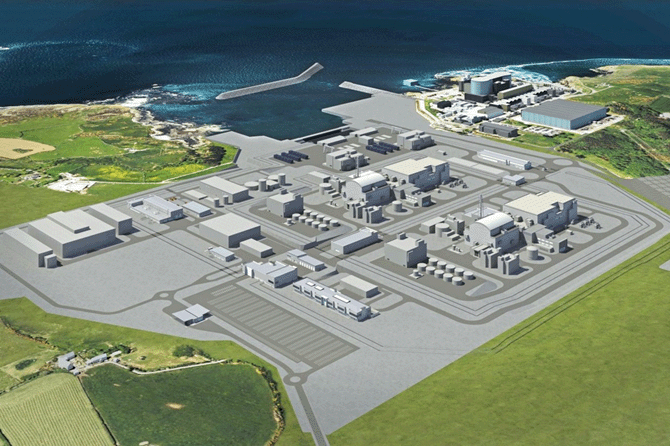
Half of all new nuclear projects planned in the UK have collapsed in the past year after failing to secure the necessary private financing, including Hitachi’s decision to suspend the £20bn Wylfa plant in north Wales and Toshiba’s cancellation of its development in Moorside, Cumbria. Seven of the UK’s eight existing nuclear plants are set to close by 2030.
But the proposal is likely to face criticism for loading risks on to consumers and the government at a time when renewable alternatives to nuclear like wind and solar are rapidly becoming cheaper. Boris Johnson, who is widely expected to become prime minister later this week, has in the past supported nuclear projects but also criticised their high costs.
The Department for Business, Energy and Industrial Strategy, which is launching a three-month consultation on the proposals, said it believed the new financing model had the “potential to reduce the cost of raising private finance . . . thereby reducing consumer bills”.
France’s state-backed EDF Energy has been a vocal champion for the proposed model, known as Regulated Asset Base or RAB, after the cost of its Hinkley Point project in Somerset was heavily criticised for its cost to consumers.
BEIS said using an RAB model for future projects was suitable as companies such as EDF would look to replicate the Hinkley Point design in future plants. EDF said on Monday that its proposed Sizewell C plant would be a “near replica” and therefore “cheaper to construct and finance”. …..
Greenpeace UK’s chief scientist Doug Parr criticised the proposal saying it would shift liabilities from private investors to taxpayers. “The nuclear industry has gone in just 10 years from saying they need no subsidies to asking bill payers to fork out for expensive power plants that don’t even exist yet, and may never,” Mr Parr said.
The government is expected to release its highly anticipated energy white paper in summer, which will indicate future electricity generation plans, with the UK’s 2013 energy strategy widely seen as defunct due to the faltering nuclear projects. https://www.ft.com/content/e2cf07ae-acaa-11e9-8030-530adfa879c2




 nuclear-news