Kansai Electric to ship more spent nuclear fuel to France

Fukui Japan Times 9th Feb 2025 https://www.japantimes.co.jp/news/2025/02/09/japan/japan-more-spent-nuke-fuel-to-france/
Kansai Electric Power is working to double the amount of spent nuclear fuel it will ship to France, increasing it by about 200 tons, informed sources said.
The move comes as Fukui Prefecture, home to several nuclear plants, urges Kansai Electric to address shrinking storage capacity for spent nuclear fuel, the sources said.
In 2023, Kansai Electric announced a plan to ship about 200 tons of the fuel from its Takahama plant in Fukui to France starting in fiscal 2027. Based on the Japanese government’s policy, the spent fuel will be used for research on technology to reprocess uranium-plutonium mixed oxide, or MOX, fuel.
At the Takahama plant, about 90% of the spent fuel storage capacity has already been used, and that amount is expected to reach the upper limit in about three years.
About 200 tons of spent fuel will be generated if the No. 1 to No. 4 reactors at the plant are operated for about three years. Kansai Electric has restarted all of its seven nuclear reactors.
The company initially planned to send spent fuel mainly to a reprocessing plant to be built in Aomori Prefecture, but the completion of the facility has been postponed.
Last September, the company notified Fukui Gov. Tatsuji Sugimoto of its intention to review the plan, and said that it would halt three reactors in the prefecture if it fails to come up with a proposal that can win the understanding of officials there by the end of fiscal 2024.
40% of workers cite radiation concerns at Fukushima plant

By KEITARO FUKUCHI/ Asahi Shimbun, Staff Writer, February 2, 2025
Forty percent of the workforce at the crippled Fukushima No. 1 nuclear plant worry about radiation issues on the job, a nearly three-fold spike over the previous year, a survey found.
More than half of those respondents cited fears of their body coming into contact with a radioactive substance.
Tokyo Electric Power Co., the plant operator that conducted the annual survey, said recent incidents at the plant probably contributed to the heightened concerns.
For example, two workers were hospitalized in October 2023 after they were accidentally splashed with waste liquid containing highly radioactive substances while cleaning piping in a contaminated water treatment facility.
The survey was carried out between September and October to improve the working environment. TEPCO distributed a questionnaire to all workers at the plant and received responses from 5,498 individuals, or 94.5 percent……………………….
Asked to choose specific issues they were concerned about, 52.2 percent, the largest percentage, picked “physical contamination,” up about seven points from 2023.
In another incident, about 1.5 tons of contaminated water flowed out of a water purification facility at the plant through an air exhaust opening in February 2024…… more https://www.asahi.com/ajw/articles/15609878
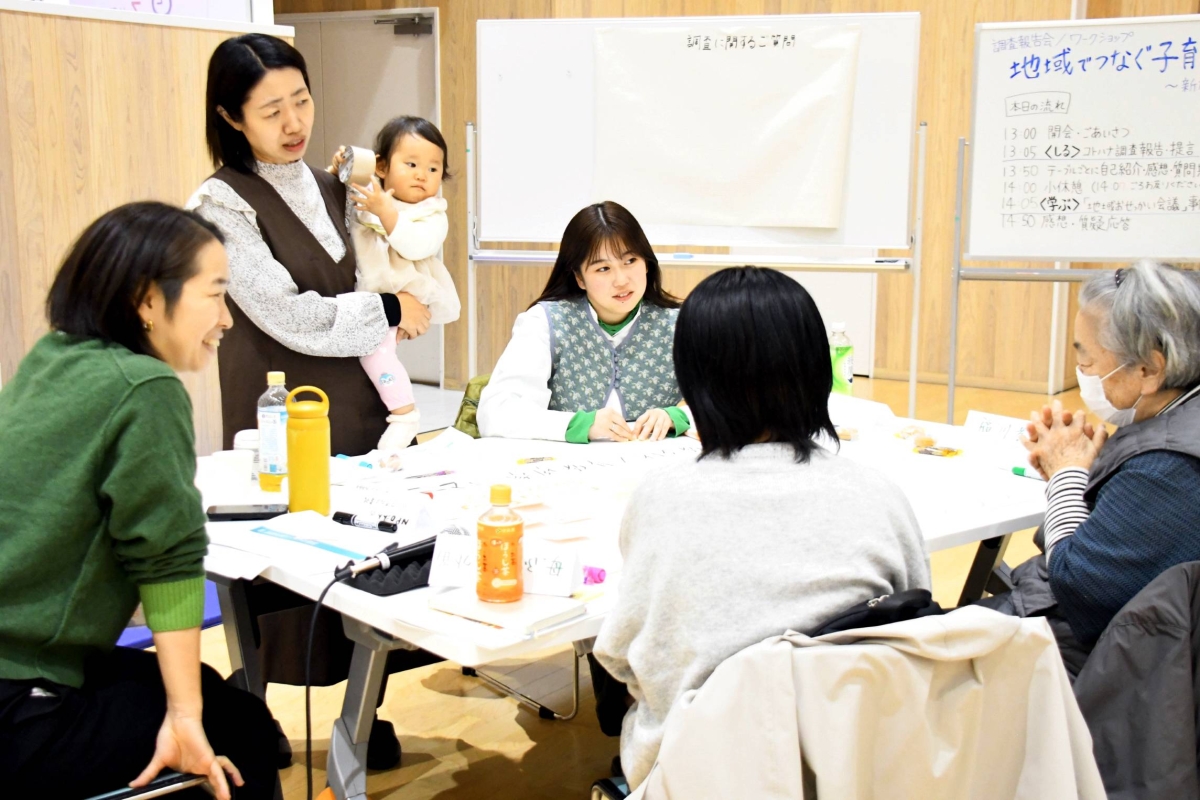
Towns near Fukushima plant struggle to attract families with children
Japan Times 27th Jan 2025
The Great East Japan Earthquake on March 11, 2011, and the subsequent meltdowns at the Fukushima No. 1 nuclear power plant have left deep scars on Fukushima Prefecture, which has seen a significant decline in its estimated population.
Futaba County, home to the Fukushima plant that straddles the towns of Futaba and Okuma, has been hit particularly hard, with the prolonged evacuation of residents drastically reducing the number of children in the area. The region’s population decline due to the disaster is beyond the scope of natural or social population shifts.
Municipalities in the region are trying to come up with measures to bring back residents or attract new ones, but increasing the number of children remains a tall order.
Futaba County once enjoyed a high birth rate and strong ties among its residents thanks to stable job opportunities provided by the Fukushima No. 1 and No. 2 power plants and related industries.
Saki Yoshizaki, 36, a worker who lives in the city of Iwaki, gave birth to her eldest daughter, now 14, in her hometown of Okuma in 2010, a year before the nuclear disaster.
“With many relatives, friends and acquaintances around, the whole community helped raise children. I had almost no worries about becoming a parent,” Yoshizaki said, recalling her hometown fondly. “In a good way, it was a tight-knit community.”
However, such an environment changed suddenly following the nuclear incident as residents fled elsewhere. Today, young parents who are bearing and rearing children in the region are voicing their feelings of loneliness where community ties have been severed.
Minami Suzuki, 34, a co-representative of the volunteer group Cotohana in the Futaba town of Tomioka, worries about the future of the region. “If we don’t strengthen connections among parents, it might become increasingly difficult for the younger generations to choose to have children here,” she says……………………………………………………………………………………..
https://www.japantimes.co.jp/news/2025/01/27/japan/society/fukushima-children-decline/
How Fukushima’s radioactive fallout in Tokyo was concealed from the public

Because of the controversy surrounding Satoshi’s paper and the lack of research on the health impacts of these particles, it remains unclear to what extent Tokyo residents have been exposed to dangerous radiation levels as a result of the Fukushima accident.
Because CsMPs are so small, typically two microns or less in diameter, if humans breathe them, they could potentially reach the bottom of the lung, and be lodged into sacs known as alveoli, where the lung generally cannot expel them.
By unit of mass, CsMPs are much more radioactive than even spent reactor fuel
Japanese radiochemist Satoshi Utsunomiya found that air samples from March 15, 2011, in Tokyo contained a very high concentration of insoluble cesium microparticles. He immediately realized the implications of the findings for public safety, but his study was kept from publication for years.
Bulletin, By François Diaz-Maurin, January 13, 2025 [excellent illustrations]
On March 14 and 15, 2011—three days after the Great East Japan Earthquake and its resulting tsunami hit the Fukushima nuclear power plant—explosions at two of the plant’s reactor buildings released a huge amount of invisible radioactivity. These radioactive plumes were blown away by the wind, descending over the surrounding area and into the ocean. Eventually, the radiation emitted from the Fukushima plants spread over the entire Northern Hemisphere. It also spread to Japan’s capital, Tokyo.
Following the explosions, Japanese researchers rushed to collect and study radioactive materials from the soil and the air to find out what had happened inside the reactors, believed now to have melted down because their cooling systems failed. On March 13, the Tokyo Metropolitan Industrial Technology Research Institute, the agency responsible for measuring the air quality of particulate matter in the Tokyo area, started to collect air samples more frequently. This effort was part of the Tokyo metropolitan government’s emergency monitoring program for environmental radiation, which aimed to detect gamma-emitting nuclides in airborne dust. The filters revealed that at around 10 a.m. on March 15, 2011, a large plume of radioactivity reached Tokyo, some 240 kilometers (149 miles) south of Fukushima. All samples taken on March 14 and March 15 showed spikes in radioactivity.
The institute’s researchers published their first results in the journal of the Japan Radioisotope Association in June 2011 (Nagakawa et al. 2011); they estimated the total exposure dose to humans from radioactive substances, including iodine 131 and cesium 137 found in airborne dust, foodstuffs, and drinking water from the Setagaya ward in the old Tokyo City. Extrapolating from their measurements from March 13 to May 31, they calculated the corresponding annual cumulative dose of radiation in that part of Tokyo as being 425.1 microsieverts, which is less than half the annual dose limit to the public recommended by the International Commission on Radiological Protection. In a second conference publication in English (Nagakawa et al. 2012), the researchers extended their monitoring period to October and estimated that the total annual effective dose due to inhalation for adults in the Tokyo metropolitan area from the Fukushima radioactive plumes was far lower, at 25 microsieverts.
But two years after the accident, Japanese scientists discovered a new type of highly radioactive microparticle in the exclusion zone around the Fukushima plant. The microparticles, which had been ejected from the Fukushima reactors, contained extremely high concentrations of cesium 137—a radioactive element that can cause burns, acute radiation sickness, and even death. Satoshi Utsunomiya, an environmental radiochemist from Kyushu University in southwestern Japan, soon found that these particles were also present in air filter samples collected in Tokyo in the aftermath of the Fukushima accident.
The controversy surrounding his attempts to publish his findings nearly cost him his career and prevented his results from being widely known by the Japanese public ahead of the 2020 Summer Olympics in Tokyo.[1] Scientists still don’t know if these highly radioactive microparticles present significant danger to people, and Satoshi is one of the very few scientists who is focused on trying to find out. “We have the measurements now that tell that the particles did pass over population centers and were being deposited in places,” Gareth Law, a radiochemist from the University of Helsinki, told me. “We should answer the question.”
The discovery
In May 2012, Toshihiko Ohnuki, an accomplished environmental radiochemist then at the Japan Atomic Energy Agency (JAEA), visited Yoshiyasu Nagakawa at the Tokyo Metropolitan Industrial Technology Research Institute, also known as TIRI. Nagakawa was the first author of two TIRI studies on radiation exposure in Tokyo, and Ohnuki asked Nagakawa if he could obtain some air samples for further analysis. Ohnuki had already studied how radioactive cesium fallout from Fukushima reacted with components of contaminated soil. Now, he wanted to do the same with the airborne dust samples from Tokyo.
Nagakawa gave Ohnuki five small filters that had been collected from the Setagaya ward in old Tokyo City at different times on March 15, 2011—the day the radioactive plume reached Tokyo. Ohnuki received the samples without restriction on their use, and no written agreement was made.[2]
Back in his laboratory at JAEA, Ohnuki performed autoradiography of the five samples, revealing many radioactive spots on all of them. The bulk radioactivity on each sample was measured to be between 300 counts per minute for the filter that covered the midnight to 7 a.m. period and 10,500 counts per minute between 10 a.m. and 11 a.m. on March 15.[3] The radiation rate was so high that Ohnuki had to cut some of the filters into small pieces, less than one square centimeter, to keep from saturating the scanning electron microscope. Ohnuki stored the unexamined filters for future analysis.
Months later, in August 2013, four researchers from the Meteorological Research Institute in Japan reported for the first time about a new type of spherical radioactive cesium-bearing particle that had been ejected in the early days of the Fukushima accident (Adachi et al. 2013). The researchers had collected air samples on quartz fiber filters at their institute in Tsukuba, located 170 kilometers southwest of the Fukushima plant. Their findings, published in Scientific Reports, were about to revolutionize the way environmental radiochemists understood the radioactive fallout from Fukushima.
Back in the lab, the researchers placed the filters on an imaging plate and inserted them into a portable radiography scanner. The images revealed many black dots, which indicated the presence of radioactive materials on the filters, with a maximum radioactivity level measured on the sample at 9:10 a.m. on March 15, 2011, four days after the Fukushima accident began. The researchers placed this sample under a scanning electron microscope and then into an energy-dispersive X-ray spectrometer to directly observe the shape and composition of the radioactive materials on the filters. What they saw stunned them………………………………………………………………
Shocking results
The newly discovered entities were initially called spherical cesium-bearing particles, but Satoshi and his co-workers coined the term cesium-rich microparticles, or CsMPs, in 2017, which is now what researchers call them generally (Furuki et al. 2017). CsMPs had not been noted in earlier major reactor accidents.
Scientists knew the microparticles came from the Fukushima reactors because their isotopic ratio between cesium 134 and cesium 137 matched the average ratio for the three damaged reactors calculated by the Oak Ridge National Laboratory.[5] Because these particles emanated from the Fukushima reactors, Satoshi and the other scientists studying them thought that they may contain evidence about reactions that occurred during the accident. But the environmental radiochemist’s curiosity was also triggered by the unique features of these microparticles: Their size is very small, typically two to three microns, even smaller than one micron in some cases.[6] And the cesium concentration in each of the particles is very high relative to their size.
After Satoshi obtained four small pieces of the Tokyo air filters, he designed what he calls “a very simple procedure” to find out whether the filters contained cesium-rich microparticles. In April 2015, he took autoradiograph images of the four pieces, confirming what Ohnuki had already seen with a digital microscope at JAEA. Then Satoshi moved to characterize the structural and chemical properties of the particles using scanning electron microscopy (SEM) and atomic-resolution transmission electron microscopy (TEM). Although the procedure’s design was simple, executing these steps would prove to be extremely difficult.
In July 2015, as Satoshi was busy working on the Tokyo air filters in his lab at Kyushu University, Ohnuki received a note from Nagakawa, the TIRI researcher who had provided the samples, asking him to return them so they could be reanalyzed. In his e-mail, Nagakawa did not specify the motive for his request, which appeared innocuous: “Please return at least some of the materials we gave you for reanalysis … if the location is unknown, it can’t be helped.”
Ohnuki immediately sent Nagakawa two filters from March 15, including the filter from 10 a.m. to 11 a.m. that had the highest level of radioactivity and contained the largest number of radioactive spots. Ohnuki added that he had discarded the other three filters after he analyzed them in 2013.
Nagakawa also asked Ohnuki whether he was planning to publish papers based on the samples. Ohnuki explained that he stopped analyzing them after his inconclusive attempts in 2013, but did not mention he had given Satoshi part of the filters for study.[9]
Satoshi was now ready to publish his results in a scientific journal. These were important findings that the scientific community needed to know. But Satoshi also understood that they could create a public relations crisis in Japan because his findings contradicted previous statements that played down the implications for public health of Fukushima fallout in Tokyo.
The Goldschmidt Conference—the foremost such international meeting on geochemistry—that year was held in the Japanese city of Yokohama. Satoshi was invited to give a plenary talk and present his research on environmental contamination from the Fukushima disaster (Utsunomiya 2016). During the talk, he presented his new findings on the Tokyo air filters. His talk received a lot of attention and was even reported by several Japanese and international newspapers. After his presentation, the scientific chair of the conference, Hisayoshi Yurimoto, said: “Very interesting results. And also very shocking results.”[1
In April and June 2016, Satoshi conducted dissolution experiments and quickly confirmed that the CsMPs were insoluble in water. The experiments also showed that most of the cesium activity on these filters came from CsMPs. In fact, up to 90 percent of the cesium radioactivity came from these microparticles, not from soluble forms of cesium—meaning that most of the cesium radioactivity detected during the March 15 plume in Tokyo was from CsMPs.
Between 2016 and 2019, a Kafkaesque sequence of events circled about Ohnuki, the former JAEA researcher who gave Satoshi the Tokyo air filter samples, and Satoshi. During that sequence of events, Satoshi’s research paper was accepted for publication by a prestigious scientific journal after peer review—but the journal delayed publication of the paper for years, eventually deciding not to publish it based on mysterious accusations of misconduct that, it turned out, were unwarranted. As a result, Satoshi’s findings were not made widely known, saving the Japanese authorities a possible public relations crisis as the summer Olympics in Tokyo neared. Because of the controversy surrounding Satoshi’s paper and the lack of research on the health impacts of these particles, it remains unclear to what extent Tokyo residents have been exposed to dangerous radiation levels as a result of the Fukushima accident.
I worked to reconstruct the sequence of events related to Satoshi’s research paper to find out whether the controversy over its publication was the result of some unethical practice on his part; competition between research laboratories; or attempted suppression of scientific results. The account that follows is based on the review of dozens of e-mails, letters, reports, and transcripts of phone conversations the Bulletin has obtained, as well as on multiple interviews with people directly involved in the events.
In August 2016, the leader of Nagakawa’s research group at TIRI, Noboru Sakurai, sent an e-mail to Ohnuki urging him to return filter samples he had earlier obtained from TIRI to the Tokyo Institute of Technology, where Ohnuki was now employed. Ohnuki responded that the filters had already been sent, but Sakurai maintained they had not received them. Ohnuki had asked a staff member of the research group he used to work in at the Japan Atomic Energy Agency to send the samples he had left there, but the samples were not sent. Because the samples were studied in a controlled area, theymay have been disposed of together with other Fukushima-related samples that had been stored at JAEA.
In October, as Ohnuki dealt with insistent requests that he return the filter samples, Satoshi submitted two research manuscripts to the journal Scientific Reports, one on the first successful isotopic analysis of individual cesium-rich microparticles based on soil samples collected from the exclusion zone at Fukushima, and one on the first characterization of the CsMPs from the Tokyo air filter samples that he had presented during his talk in Yokohama. Both articles were accepted in early January 2017 after peer review.[11]
The Tokyo paper, titled “Caesium fallout in Tokyo on 15th March, 2011 is dominated by highly radioactive, caesium-rich microparticles,” was co-authored by three graduate students from Satoshi’s lab—Jumpei Imoto, Genki Furuki, and Asumi Ochiai, who conducted the experiments—and three Japanese collaborators: Shinya Yamasaki from the University of Tsukuba who contributed to the measurement of samples; Kenji Nanba of Fukushima University, who contributed to the collection of samples; and Toshihiko Ohnuki, who had obtained the samples. The paper included two international collaborators who were world experts in the study of radioactive materials, Bernd Grambow of the French National Center for Scientific Research at the University of Nantes in France and Rodney C. Ewing of Stanford University, who contributed to the research ideas and participated in the analysis of the data. Satoshi was the lead author of the study.
……………………………………………..On the day of the visit, Moriguchi sent an e-mail to Ohnuki, pressing him to inform TIRI about the planned publication. “This type of information makes government agencies very sensitive,” Moriguchi wrote. “If the results obtained from these valuable sample collections conducted at a research institute under the administration were to incur the displeasure of government agencies and it becomes difficult to obtain cooperation from research institutions, we are concerned that this could hinder future research using these types of samples.”
…………………………………………………..Almost immediately, Sakurai moved to block the publication, according to e-mails obtained by the Bulletin.
………………………………………………………………………………………In July 2017, TIRI increased the pressure by sending a formal complaint to the Tokyo Institute of Technology, where Ohnuki was now employed. In a letter that the researchers were not able to see until a year after it was sent, TIRI accused Ohnuki of “suspected acts violating internal regulations, researcher’s ethics and code of conduct” in providing Satoshi with samples from TIRI without the institute’s consent.
As the issue became more political and involved more institutions, Satoshi continued his research on CsMPs and presented two other papers about Fukushima at the next Goldschmidt Conference in Paris in August 2017. Later that month, under pressure from the Tokyo Metropolitan Institute of Industrial Technology, the Tokyo Institute of Technology opened a formal investigation of Ohnuki on suspicion of improper research activities with Satoshi. “It was like a court,” Satoshi said of being called before the compliance committee. Except that, unlike in a trial, he did not know the exact terms of what they were accused of. “The team at TIRI didn’t even allow Kyushu University to show me this letter,” Satoshi said. “So at that point, I didn’t understand what the problem was.”
………………………………………………………………………………………………………………………………………………. Cleared but still harassed
During the investigation, Satoshi almost gave up on publishing the paper based on examination of the filters in Tokyo. He told the committee members that he would probably withdraw the paper, then “in press,” from Scientific Reports. Both the committee members and TIRI were pleased. “But then I talked to Rod [Ewing], and we did something clever,” Satoshi explained. They would not withdraw the paper; instead, they would keep it “in press” until the investigation was over.
…………………………………………………………………………….Tokyo Tech initiated a pressure campaign against Ohnuki and Satoshi to get the samples back…………………………………..
Satoshi did not want to give the samples away. “These are the only evidence to prove our article,” he said.
………………………………………………………“I sent all the samples to Stanford,” Satoshi said. Satoshi sent the air filter samples through regular postal services “in a UPS package.”[15] On September 13, Kyushu University’s executive vice president, Koji Inoue, called Satoshi to his office and yelled at him, urging him to give back the samples. Satoshi told Inoue that it was too late; he had already sent the samples to Stanford “for further investigation.”
Now the samples were secured, but Satoshi still needed his paper to be published.
……………………………………………………………………….. Thompson’s article in Scientific American was published on March 11, 2019, mentioning the fact that the paper had been rejected (Thompson 2019).
In June 2019, Satoshi and his co-authors posted their paper on arXiv (Utsunomiya et al. 2019), thereby making the findings public—two-and-a-half years after its acceptance by Scientific Reports. Ohnuki’s name does not appear in the list of co-authors on the arXiv paper, and Satoshi did not acknowledge TIRI for providing the samples.
……………………………………………………………………………………. After the paper was made public, the researchers received some attention, but not the visibility commensurate with the implications that the study had for public health in Japan.[16] The three institutions—TIRI, Tokyo Tech, and Kyushu University—were all “very happy,” Satoshi said. “People may think that we lost, but for me, we actually protected science.“
New risks
In the early days after the Fukushima accident, radiochemists thought that the situation was very different from Chernobyl. The three reactor-core damage events at Fukushima were considered to be of low energy, meaning that no actual explosion of the reactors had occurred, as was the case for Chernobyl. This led radiochemists to assume that radioactive particles probably had not come out of the reactors or, at least, not in large volume. A lot of the early post-accident research, therefore, focused on the traditional environmental radiochemist approach of collecting soils and sediments, doing bulk analysis, and learning from that.
It was only after scientists discovered the existence of cesium-rich microparticles that researchers, including Satoshi, realized that particles had actually been ejected from the reactors.
…………………………………………………………………………Because they were unknown until recently, CsMPs pose new risks that are still underappreciated by the research community and public authorities.
Once formed, radioactive cesium 137 has a half-life of about 30 years, after which half of the nuclides will have decayed into stable barium 137, whereas the other half will remain radioactive. CsMPs tend to accumulate, forming hotspots that contain many of the particles.[17] Hotspots of the microparticles have been found inside and outside abandoned buildings in the Fukushima exclusion zone and in other places (Fueda et al. 2023; Ikenoue et al. 2021; Utsunomiya 2024a). “They’re actually there in great numbers in many places, and then that’s when the health questions start to come in,” Law said. Despite their great numbers and potential risks, hotspots of CsMPs have not been systematically mapped around Fukushima. “When we visited the exclusion zone, we could still see some hot spot occurrences on the roadside without any protection,” Satoshi said. “We shouldn’t be able to access freely that kind of hot spots.”
Because CsMPs are so small, typically two microns or less in diameter, if humans breathe them, they could potentially reach the bottom of the lung, and be lodged into sacs known as alveoli, where the lung generally cannot expel them.[18] Scientists don’t know what would happen then. For instance, a typical immune system response would consist of some kind of clearance mechanism that seeks out foreign bodies and tries to either envelop or dissolve them. But it is still unknown how exactly CsMPs would dissolve in lung fluids.
Most knowledge about breathing and radioactive particulates is based on the assumption that particles dissolve, and researchers have calculated the rates for their dissolution in the human body. But because CsMPs don’t dissolve easily, once inhaled, they will likely stay longer in the human body. Researchers believe that, because CsMPs are so slow to dissolve, they may stay much longer—certainly for several months, maybe longer—in the body, compared to hours or days for suspended cesium.[19]
By unit of mass, CsMPs are much more radioactive than even spent reactor fuel. Some researchers from the Japan Atomic Energy Agency have shown that cultured cells exposed to the radiation from suspended CsMPs display a stronger local impact compared to what is known from previous radiological simulation studies using soluble radionuclides (Matsuya et al. 2022). Scientists are only now seeing some emerging evidence that the point-source nature of the radioactivity from CsMPs could lead to damage to cell systems. This is qualitatively different from the conventional estimate of internal radiation dose at the organ level based on uniform exposure to soluble cesium.
Despite the new risks that CsMPs might pose, the study of their impacts has received little interest.
…………………………………………………………………………………………………….Satoshi continues to study CsMPs actively and regularly presents his results to the Goldschmidt Conference and publishes his results in scientific journals. He and his collaborators work relentlessly to understand better the fate of CsMPs in the environment and their impacts on human health. In 2024, Satoshi received the Geochemical Society’s Clair C. Patterson Award in recognition of his innovative contributions to the understanding of CsMPs.[21]……………… more https://thebulletin.org/premium/2025-01/how-fukushimas-radioactive-fallout-in-tokyo-was-concealed-from-the-public/?utm_source=SocialShare&utm_medium=Facebook&utm_campaign=Facebook&utm_term&fbclid=IwY2xjawHyUndleHRuA2FlbQIxMQABHb1H3gK2UVzfBC5I7-s75EVtx4t5Q9uUi2MspvTqpluEOqbarYJJnhIwUA_aem_ok6x3HQOxccGg2I-7KnZjA
Japanese yakuza leader pleads guilty to trafficking nuclear materials from Myanmar
US authorities charged Takeshi Ebisawa with conspiring to traffic nuclear materials from Myanmar for expected use by Iran in nuclear weapons, handling nuclear material sourced from Myanmar and seeking to sell it to fund an illicit arms deal, US authorities have said.
Yakuza leader Takeshi Ebisawa and a co-defendant had previously been charged in April 2022 with drug trafficking and firearms offences, and both were remanded.
He was then additionally charged in February 2024 with conspiring to sell weapons-grade nuclear material and lethal narcotics from Myanmar, and to purchase military weaponry on behalf of an armed insurgent group, prosecutors said.
The military weaponry to be part of the arms deal included surface-to-air missiles, the indictment alleged.
“As he admitted in federal court today, Takeshi Ebisawa brazenly trafficked nuclear material, including weapons-grade plutonium, out of Burma,” acting US attorney Edward Kim said on Wednesday, using another name for Myanmar.
“At the same time, he worked to send massive quantities of heroin and methamphetamine to the United States in exchange for heavy-duty weaponry such as surface-to-air missiles to be used on battlefields in Burma.”
Prosecutors alleged that Ebisawa, 60, “brazenly” moved material containing uranium and weapons-grade plutonium, alongside drugs, from Myanmar.
From 2020, Ebisawa boasted to an undercover officer he had access to large quantities of nuclear materials that he sought to sell, providing photographs of materials alongside Geiger counters registering radiation.
During a sting operation including undercover agents, Thai authorities assisted US investigators in seizing two powdery yellow substances that the defendant described as “yellowcake.”
“The (US) laboratory determined that the isotope composition of the plutonium found in the Nuclear Samples is weapons-grade, meaning that the plutonium, if produced in sufficient quantities, would be suitable for use in a nuclear weapon,” the Justice Department said in its statement at the time.
One of Ebisawa’s co-conspirators claimed they “had available more than 2,000 kilograms (4,400 pounds) of Thorium-232 and more than 100 kilograms of uranium in the compound U3O8 – referring to a compound of uranium commonly found in the uranium concentrate powder known as ’yellowcake’.”
The indictment claimed Ebisawa had suggested using the proceeds of the sale of nuclear material to fund weapons purchases on behalf of an unnamed ethnic insurgent group in Myanmar.
Ebisawa faces up to 20 years’ imprisonment for the trafficking of nuclear materials internationally.
Prosecutors describe Ebisawa as a “leader of the Yakuza organised crime syndicate, a highly organised, transnational Japanese criminal network that operates around the world (and whose) criminal activities have included large-scale narcotics and weapons trafficking.”
Sentencing will be determined by the judge in the case at a later date, prosecutors said.
Japanese crime boss admits to conspiring to sell nuclear material to Iran
Takeshi Ebisawa faces a maximum punishment of life in prison after pleading guilty to six counts in a Manhattan court.
A Japanese crime boss has pleaded guilty to conspiring to sell nuclear material from Myanmar to Iran along with drug trafficking and weapons offences, authorities in the United States have said.
Takeshi Ebisawa, 60, a member of the yakuza, entered a guilty plea to six counts in federal court in Manhattan on Wednesday, the US Department of Justice said in a statement.
He is set to be sentenced on April 9.
According to prosecutors, Ebisawa in 2020 told an undercover agent for the Drug Enforcement Administration (DEA) and a DEA source that he had acquitted a large quantity of thorium and uranium that he wished to sell.
In response to Ebisawa’s repeated inquiries, the undercover agent agreed to help Ebisawa broker the sale of the nuclear materials to an associate who was posing as an Iranian general, prosecutors said.
Ebisawa then offered to supply the undercover associate with plutonium that would be even “better” and more “powerful” than uranium for making nuclear weapons, according to prosecutors.
A powdery yellow substance that Ebisawa’s co-conspirators showed to undercover agents was later determined in a laboratory analysis to contain detectable quantities of uranium, thorium and plutonium, the Justice Department said.
Ebisawa also conspired to broker the purchase of US-made surface-to-air missiles and heavy-duty weaponry to arm multiple ethnic armed groups in Myanmar, and to accept large quantities of heroin and methamphetamine as partial payment for the arms, according to prosecutors.
US officials said they conducted Ebisawa’s arrest and prosecution in cooperation with law enforcement partners in Indonesia, Japan and Thailand.
“Today’s plea should serve as a stark reminder to those who imperil our national security by trafficking weapons-grade plutonium and other dangerous materials on behalf of organized criminal syndicates that the Department of Justice will hold you accountable to the fullest extent of the law,” said Assistant Attorney General Matthew G Olsen of the Justice Department’s National Security Division.
Ebisawa, who was previously charged in 2022 with international drug trafficking and firearms offences, faces possible life imprisonment for the most serious of the charges.
Improved way to gauge radiation doses developed for Fukushima
Asahi Shimbun, By KEITARO FUKUCHI/ Staff Writer, December 31, 2024
[Ed. they studied only 30 people]
The Japan Atomic Energy Agency said it has developed a more accurate method to estimate radiation exposure doses among people who spend time around the stricken Fukushima No. 1 nuclear plant.
The JAEA has adapted the method, based on daily life patterns, into program format and is offering it for free on a municipal government website and elsewhere.
When the central government designated evacuation zones following the 2011 triple meltdown at the plant operated by Tokyo Electric Power Co., it estimated radiation doses among residents using a simple evaluation method that assumed they spent eight hours outdoors and 16 hours indoors a day.
That method allowed for quick estimation, but it tended to overestimate the doses.
Other existing evaluation methods also have shortcomings, including a failure to reflect the actual environment.
The JAEA began developing the new method in 2017.
JAEA researchers drew on data compiled by the Nuclear Regulation Authority to calculate average air dose rates for 100-meter-by-100-meter areas.
They also took into account where and for how long the residents and workers frequented near the plant, and how they moved between different locations, such as on foot or by car, the officials said.
They asked around 30 people working in former and current evacuation zones to carry personal dosimeters and then compared the measurements and estimates for their exposure doses in 106 patterns……………………………………………………………….. https://www.asahi.com/ajw/articles/15553626?fbclid=IwY2xjawHh0Y9leHRuA2FlbQIxMQABHRIRfUukVbNPX60rGOQi_qUp5oMiYFThXBvPZN4h0XJiPQ_xn8trGYEIkA_aem_GwPtrY24MPxB4L0v2u8SuA
Japan, US to communicate on possible use of nuclear weapons
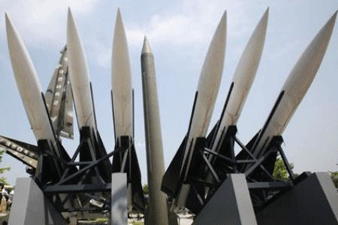
Establishing such an operational framework is aimed at strengthening the U.S. nuclear umbrella that protects Japan and enhancing its deterrence capabilities against North Korea and China.
Asia News Network, December 30, 2024
TOKYO – Japan and the United States will communicate regarding Washington’s possible use of nuclear weapons in the event of a contingency, the two governments have stipulated in their first-ever guidelines for so-called extended deterrence, The Yomiuri Shimbun has learned.
According to Japanese government sources, Japan will convey its requests to the United States via the Alliance Coordination Mechanism (ACM), through which the Self-Defense Forces and U.S. forces maintain contact with each other.
Establishing such an operational framework is aimed at strengthening the U.S. nuclear umbrella that protects Japan and enhancing its deterrence capabilities against North Korea and China.
Against North Korea, China
The Foreign Ministry announced the formulation of the guidelines Friday but had not disclosed the details, as they contain classified military intelligence.
The U.S. president, who is also the commander in chief of U.S. forces, has the sole authority to authorize a nuclear attack. Before the completion of the guidelines, no written statement existed that said Japan was allowed to pass on its views to the United States regarding Washington’s possible use of nuclear weapons.
Extended deterrence is a security policy aimed at preventing a third country from attacking an ally by demonstrating a commitment to retaliate not only in the event of an armed attack on one’s own country, but also in the event of an attack on an ally.
Responding to North Korea’s nuclear development program and China’s military buildup, the Japanese and U.S. governments in 2010 began holding working-level consultations in which their foreign and defense officials meet regularly to discuss nuclear deterrence and other issues. Japan has expressed its stance on the use of nuclear weapons in the meetings.
The two countries will exchange views on Washington’s use of nuclear weapons also in the framework of the ACM, which was set up in normal times under the revised Guidelines for Japan-U.S. Defense Cooperation in 2015.
Under the ACM, discussions are designed to take place both by the Alliance Coordination Group, comprising director general-level officials of the diplomatic and defense authorities, and by the Bilateral Operations Coordination Center, involving senior officials of the SDF and U.S. forces. If necessary, high-level discussions involving Cabinet members are also expected to be held.
This system will enable Japan to convey its views to the United States on Washington’s potential use of nuclear weapons at all stages, from normal times to contingencies………………. https://asianews.network/japan-us-to-communicate-on-possible-use-of-nuclear-weapons/
Toshiyuki Mimaki: Let’s save humanity from nuclear weapons
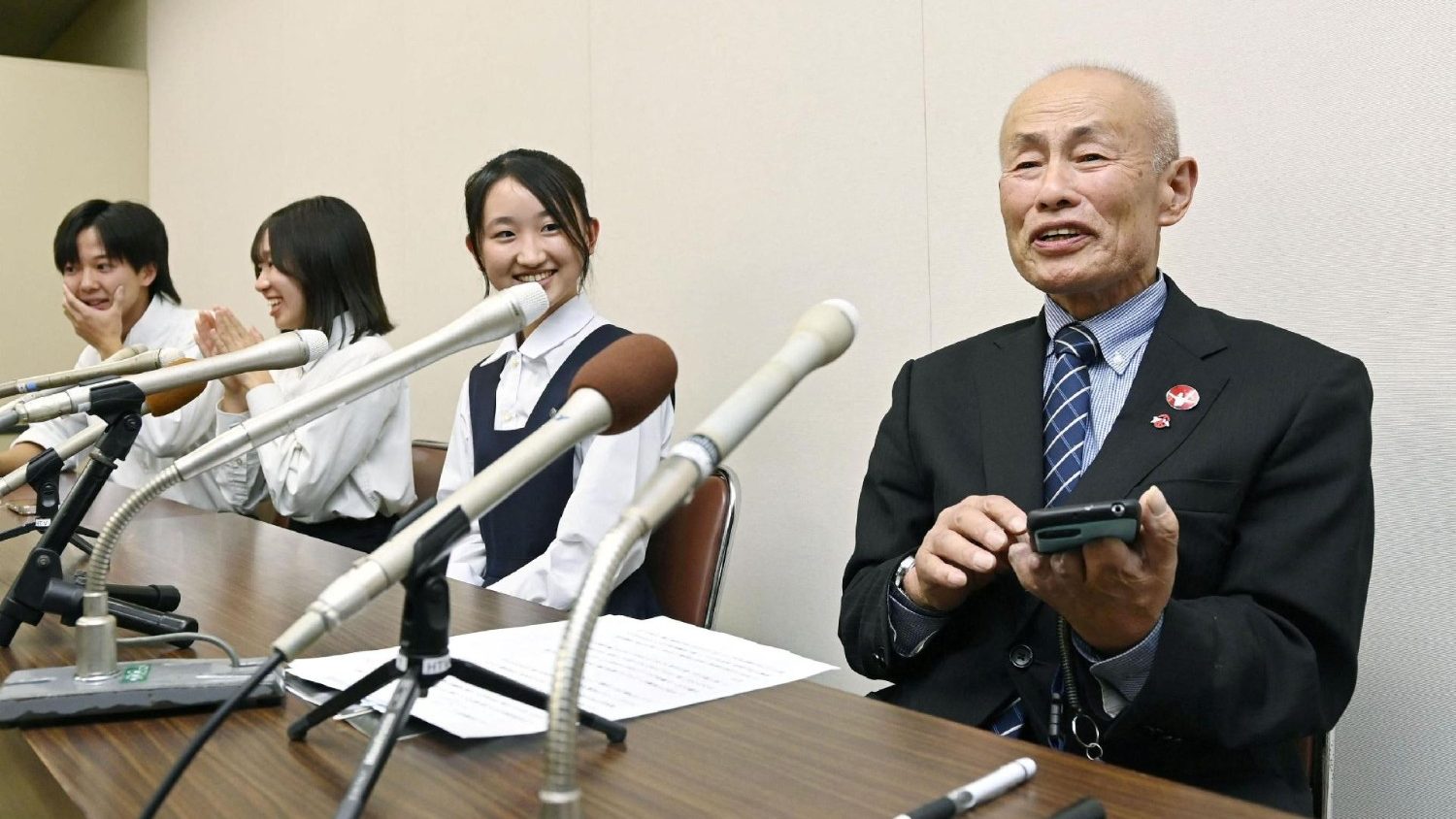
An interview with Hiroshima atomic bomb survivor and co-president of the Japanese foundation Nihon Hidankyo, Toshiyuki Mimaki, recipient of the 2024 Nobel Peace Prize. Mimaki reflects on his meeting with Pope Francis in Japan in 2019 and calls on world leaders to commit to eliminating nuclear weapons.
By Alessandro Gisotti, https://www.vaticannews.va/en/world/news/2024-12/mimaki-nihon-hidankyo-nobel-peace-prize-elimination-nuclear-arms.html
Shattered buildings. A landscape wiped clean. So much destruction that the sea became visible where once a vibrant city stood. This is the indelible memory carried by a three-year-old boy who witnessed an unthinkable and catastrophic event—one that, tragically, did occur. Toshiyuki Mimaki shares this harrowing memory with L’Osservatore Romano.
Now 82 years old, Mimaki has never stopped reflecting on August 6, 1945, the day the atomic bomb devastated Hiroshima, his hometown. That moment not only changed the course of human history but also took the lives of tens of thousands of people.
On December 10, Mimaki accepted the Nobel Peace Prize in Oslo as co-president of Nihon Hidankyo, a foundation established in 1956 dedicated to nuclear disarmament. Nihon Hidankyo unites the hibakusha—survivors of the atomic bombings of Hiroshima and Nagasaki at the end of World War II.
The foundation’s mission is rooted in the power of testimony, relying on the gentle but impactful strength of storytelling. The Norwegian Nobel Committee acknowledged this effort, stating, “We all have a duty to continue the mission of the hibakusha. Their moral compass is our legacy. Now it is up to us. The fight for disarmament requires persistent and vocal advocacy.”
As the International Day of Peace approaches, Toshiyuki Mimaki reflects on his role as a custodian of the legacy of those who came before him—the hibakusha who founded Nihon Hidankyo. Survivors like him aim to ensure the world never forgets the tragedy of that fateful August morning.
“When I was three years old,” Mimaki recounts, “my mother, younger brother, and I were exposed to the bomb’s radiation while searching for my father, who worked for the Hiroshima railway. Countless lives were lost, and buildings were consumed by flames to the extent that you could see all the way to the sea. My younger brother is now undergoing treatment for brain cancer.”
Despite the pain of revisiting such memories, sharing these experiences is central to the hibakusha mission: ensuring that the horror of nuclear weapons is never repeated. This mission becomes ever more urgent as the remaining survivors of the bombings near the end of their lives.
“Hiroshima has taken steps to preserve these testimonies,” Mimaki explains. “The city has established programs to educate young people, training them to become messengers who can carry forward our stories for future generations.”
Mimaki expresses deep gratitude for Pope Francis’s dedication to nuclear disarmament. He had the opportunity to meet the Pope during his visit to Hiroshima and Nagasaki in November 2019. “I met the Pope when he came to visit us,” Mimaki recalls. “He gave me a medal in a red case, and I asked him to work toward abolishing nuclear weapons. I still treasure a photograph from that day.”
Despite the global appeal for disarmament, discussions about the potential use of nuclear weapons and the possibility of atomic conflict have intensified in recent years. For Mimaki, who still carries the scars of that catastrophic day, the thought of nuclear weapons being used again is unimaginable.
“If nuclear weapons were ever used again,” he warns, “it would mean the end of humanity. This is why I implore leaders of nations with nuclear arsenals to commit to their complete elimination.”
Mimaki is particularly alarmed by the ongoing conflicts in Gaza and Ukraine. “Russian President Putin,” he observes with concern, “has lowered the threshold for the use of nuclear weapons, making them deployable at any moment. It’s a terrifying situation. I urge everyone to visit Hiroshima and Nagasaki and see the Atomic Bomb Museum. Witness firsthand the devastating impact nuclear weapons have on human life.”
Philosophy Against Nuclear Power

It is now clear that the residents of Fukushima are far from some voluntarist subjects but rather a people who live under constant subjection. The installation of nuclear power plants was not democratically decided, neither did it bring any halt to the historical subjection. Rather, nuclear power plants worsened the subjection by reproducing subjection. It should be clear that the one who bears the responsibility is the “village” (TEPCO, the government, etc.) rather than the victims.
How many times we should suffer from this “blindness to nuclear apocalypse” in order to realize that nuclear power is just a technology against humanity?
New Bloom, Shen Yun-Yen, 12/29/2024
Yoshiyuki SATO and Takumi TAGUCHI, Datsugenpatsu no tetsugaku (Philosophy for Abandoning Nuclear Power), Jimbun Shoin, 2016.
THE NUCLEAR BOMB certainly posed a serious problem for contemporary philosophy. From Heidegger to Arendt to Marcuse, philosophy in the mid-20th century struggled to deal with this all-annihilating artificial production. Unfortunately, most of these philosophers did not analyze the complex relationships between nuclear technology, capital, state, etc.
………………………………………………………….. ……………….Fortunately, two philosophers, Yoshiyuki Sato and Takumi Taguchi, accept the difficult challenge of philosophizing nuclear power. In their joint work Datsugenpatsu no tetsugaku, they argue at the outset that neither “pure philosophy” nor “philosophy as usual” will ever constitute an effective critique of nuclear power (13-4). What we need, according to Sato and Taguchi, is a Datsugenpatsu no tetsugaku, which can be translated as either a philosophy of abandoning nuclear power, or simply philosophy for abandoning nuclear power…………………………………………………..
The book is divided into four parts, each with three chapters, and a conclusion. The first part deals with the identity of kaku (nuclear weapons) and genpatsu (nuclear power plants); the second an ideology critique; the third a historico-politico-economic critique of the development of nuclear power; the fourth part attempts to consider nuclear power a public hazard; lastly, the conclusion provides a vision for a society without nuclear power.
1.
Even after the Fukushima catastrophe, many philosophers continued to philosophize the phenomenon as usual, or, to borrow a phrase from Adorno, touting the “jargon of authenticity.” It’s just weak. Ontology alone will never constitute a critique of nuclear power. Rather than providing a sound critique, these sorts of philosophy books seemed to reaffirm the ontological inability of philosophy when faced with nuclear catastrophe.
Fortunately, two philosophers, Yoshiyuki Sato and Takumi Taguchi, accept the difficult challenge of philosophizing nuclear power. In their joint work Datsugenpatsu no tetsugaku, they argue at the outset that neither “pure philosophy” nor “philosophy as usual” will ever constitute an effective critique of nuclear power (13-4). What we need, according to Sato and Taguchi, is a Datsugenpatsu no tetsugaku, which can be translated as either a philosophy of abandoning nuclear power, or simply philosophy for abandoning nuclear power. Each translation carries different connotations. “A philosophy of abandoning nuclear power” seems to make philosophy a means for abandoning nuclear power, while the other seems to be a sublation of “philosophy as usual.” The logic is actually clear: nuclear power serves as a medium for philosophy to sublate itself.
Like Marx, who philosophically criticized philosophy by incorporating political economy and history into philosophy, Sato and Taguchi incorporate different fields of thought in order to critique nuclear technology and renew philosophy. They not only bring Günther Ander, Foucault, Judith Butler, Montesquieu, etc. together and interpret their th
2.
THE BOOK OPENS with a warning: our stubborn “blindness” to the repetition of nuclear catastrophes. In 1945, nuclear bombs were dropped in Hiroshima and Nagasaki, which made philosopher Günther Anders argue that “Hiroshima is everywhere,” that is, regardless of location, we were already living in an age where indiscriminate annihilation became possible, and irreversible. In 1954, the US conducted nuclear testing (H-Bomb) at Bikini Atoll, and the “ashes of death” fell all over the place, which led to the death of several Japanese fishermen fishing nearby. In the same year, Günther Anders lamented that, after Hiroshima and Nagasaki, we still suffered from the “apocalypse-blindness” to nuclear weapons. In 1979, the year of the Three Mile Island accident, Anders reasserted his arguments, and noted that nuclear plants served but a masquerade of nuclear weapons. And then there was Chernobyl (1986), which made Anders change his argument from “Hiroshima is everywhere” to “Chernobyl is everywhere.”
As Japanese philosophers, that is, philosophers from a country where nuclear tragedies happen most frequently (Hiroshima, Nagasaki, Bikini, Tokaimura, Fukushima), Sato and Taguchi clearly understand that Fukushima is not something “accidental” (sōteigai), as many commentators and government officials claim to be, but a repetition of the above-listed catastrophes (29). They also critique the fake distinction of the “civil use” and “military use” of nuclear power by drawing on the works of critical scientists such as Takagi Jinzaburo.
For Sato and Taguchi, the identity between nuclear weapons and nuclear power plants is established historically, that is, nuclear power plants share every feature of the Manhattan Project, from the principle of secrecy, the concentration of capital, the state-centrism, to its technical principles and, perhaps most importantly, the subordination of scientific development to the ends of the state.
Indeed, scientific knowledge is never innocent, which is why Sato and Taguchi employ a Foucauldian analysis of power-knowledge in order to critique the interrelationship between the two. The state decides who is allowed to participate the project, what to research, how much money an experiment needs, etc., without public scrutiny. This is why nuclear technology is a product of the “state-industrial-knowledge complex” (56).
3
IF IN THE context of the U.S., the symbol of the “state-industrial-knowledge complex” is the Manhattan Project, in Japan it’s the “nuclear village” (genshiryoku-mura). The “village” is not a physical location but a principle of exclusion (murahachibu), that is, whoever holds opinions different from them will be excluded. As an entity of highly concentrated power, its impact should not be underrated.
…………………………………………..This top-down, exploitative, discriminatory system exists throughout the history of modern Japan, that is, from Meiji to the present. It is true that in the post-war occupied period, the main condition of getting back Japan’s sovereignty is to democratize the state. However, it is also true that, under the shadow of the Cold War, both the US and the Japanese government did not care much about democratization. The result is that former Class A war criminal suspect Nobusuke Kishi not only became the Prime Minister of Japan (1957-60) and President of the LDP (1957-60), but also played an important role in supporting the “village.” It is no wonder that Sato and Taguchi repetitively argue that nuclear development in Japan serves both economic and military ends, and that as long as this system exists, claims about the “democracy” or democratization of Japan will never make sense.
4
THE VILLAGE DECIDES everything, including what’s to be done after the Fukushima catastrophe. First of all, given the identity of the “military use” and “civil use” of nuclear power, the authors argue quite convincingly that the impact of a nuclear catastrophe can only be compared to that of a war (34-7). That is, nuclear power plants’ disasters often produce effects analogous to those of war. From Chernobyl to Fukushima, whenever a nuclear disaster happens, there are always numerous refugees, lands that are no longer inhabitable, and almost unbearable economic costs.
After the catastrophe of Fukushima, there are many issues that remain unresolved even to today. However, the village’s attitude remains the same. The basic tone is denial and ideological. ………… In the case of the Fukushima catastrophe, the village (including scientists and doctors) decides to abandon certain populations in order to reduce economic costs (102). That is, because “electricity provision is necessary,” the village decides to make hundreds of thousands of residents (or refugees) continue to live under constant radioactive exposure (142).
The village has always been trying to promote an unscientific view of an “acceptable amount of radioactive exposure,” intentionally ignoring many scientists’ strong objections against this hypothesis. Hence, when there are lands still heavily polluted, the government policy asks many refugees to go back to their hometowns out of a deliberate calculation of cost-effectiveness. Without the intertwining of “scientific knowledge” and state power, this operation would not have been possible.
Sato and Taguchi go further to claim that, this sort of calculation is one of the reasons of the catastrophe. As a country where earthquakes happen extremely frequent, Japan’s earthquake studies have always been famous in the field. Long before the Fukushima tragedy took place, many specialists had already warned of a possible earthquake, tsunami, and nuclear disaster due to earthquake and tsunami. However, the village did not take action to prevent such a scenario from happening because the economic costs are just too high (138). It’s just not worth it.
After the Fukushima catastrophe, the village did not repent of its inaction. As for them, these warnings are not voiced from “specialists,” and this is the main reason why they will never take them seriously (134). As the authors point out, the so-called specialist is nothing but those who support the principle of the village (136).
5
……………………………………………………………………………..For the authors, the process of subjection begins with the above-mentioned policy, or the “long-distance electricity provision system.” The state chose certain regions to develop nuclear power plants because the regions were economically poor (as a result of systematic discrimination). The nuclear power plants, however, are more like drug addiction rather than hope. After conducting a rigorous economic analysis, Sato and Taguchi show that the more the regions attach to the nuclear economy, the more they become poorer, since this is nothing but a core-peripheral exploitative system (201-2)………………………………
It is now clear that the residents of Fukushima are far from some voluntarist subjects but rather a people who live under constant subjection. The installation of nuclear power plants was not democratically decided, neither did it bring any halt to the historical subjection. Rather, nuclear power plants worsened the subjection by reproducing subjection. It should be clear that the one who bears the responsibility is the “village” (TEPCO, the government, etc.) rather than the victims.
The Fukushima catastrophe makes the subjection clear, while also provides an opportunity to halt the subjection, according to the authors. That is, as an “event,” it changes the mindset of many of the residents and citizens. Many people chose to live without nuclear power (216), and one court decision even made clear that the lives of residents are above economic prosperity (87).
Seizing the opportunity to formulate a possible future against nuclear power, Sato and Taguchi argue that, firstly, nuclear power is entirely irresponsible for future generations, an idea they take from Hans Jonas (406). The reason is actually quite scientific: nuclear power cannot function without producing radioactive waste, which is inconceivable to be really “disposed.” The profit-seeking mindset of this generation will definitely do harm to next generations, if the world still exists.
Secondly, they argue that the government should formulate a system of referendum, as a way of practicing democracy (442-3). Given that the nuclear village almost always monopolizes any decisions regarding nuclear power, a referendum constitutes a way of abolishing the undemocratic structures of the state-industrial-knowledge complex.
Thirdly, the government, and every citizen, should take renewable energy seriously, and implement concrete policies to facilitate the transition from nuclear energy and highly polluting energies to renewable clean energy. They also go further to propose that energy provision should be taken as a common, rather than some private property monopolized by the “village” (448-50).
It is clear that, as for Sato and Taguchi, nuclear power is not just a feature of the Japanese state. Nuclear power, through its interconnections with capital, knowledge, science, etc., defines the state. A state defined by nuclear power, governed by the nuclear village, is necessarily unscientific, undemocratic, and irresponsible. Abandoning nuclear power, therefore, amounts to restructuring the state. If the Japanese government has always been touting its formal democracy, what the authors call for is a movement of democratizing democracy.
6
……………………………………………………………What I feel most bizarre is the fact that the Japanese government still tries to reopen the nuclear power plants, with little objection from the majority of the Japanese citizens. How many times we should suffer from this “blindness to nuclear apocalypse” in order to realize that nuclear power is just a technology against humanity?
Fukushima triggered a new round of anti-nuclear movements in Taiwan, with the final result of a zero-nuclear policy that will soon be implemented in 2025. When I discuss the recent development of the nuclear village with my Taiwanese friends who have all witnessed, through television, the Fukushima nuclear catastrophe, their reaction is always the same: What the fuck? Did the Japanese suffer from collective amnesia?
I would say yes.
But Sato and Taguchi demonstrate how this collective amnesia is produced rather than natural. Without the official ideology (the so-called “safety myth”) and the support from pseudo-scientific communities, this amnesia would not have been possible. Speaking of “collective amnesia,” one couldn’t help but think of issues regarding war responsibility and post-war responsibility. But, again, only a radical democratization can help the country to really face its past wrongs. https://newbloommag.net/2024/12/29/philosophy-nuclear-power/
Japan’s fishing town of Suttsu faces nuclear waste dilemma amid population decline

Residents of Suttsu worry that, despite potential economic benefits, a nuclear waste facility will harm the community and leave a legacy of radioactive waste
Jonathan Vit 29 Dec 24, https://www.scmp.com/week-asia/politics/article/3292482/japans-fishing-town-suttsu-faces-nuclear-waste-dilemma-amid-population-decline
It was a place Kyoko Tsuchiya could finally call home. As a child, her father was frequently transferred across Japan for his job at the national phone company. Later, as an adult, Kyoko fell in love with a man who worked for the post office. After they married, she continued to move around, rarely staying long enough in one place to truly feel at home.
Suttsu, with its unique charm, was different. This small town, nestled among scenic landscapes, is where Kyoko’s husband, Kazuyuki, grew up. Now in retirement, the couple decided to return to provide care and support for his elderly father.
Located on Hokkaido, Japan’s ruggedly beautiful northern island, the seaside fishing town hugs the windswept western coast. There, they opened a small inn called “Pension Mellow” which sits perched on a quiet hilltop overlooking the sea.
Kazuyuki could watch the fishing boats through binoculars from the kitchen window. When he spotted a friend’s boat, he would buy fresh seafood for his guests. One evening, he proudly served octopus sashimi made from a large octopus pulled from the frigid sea earlier that day.
“I was finally able to put down roots here,” Kyoko said. “I wanted a place where I could settle down and live a relaxed life. That’s how it was until 2020. Now, I don’t know …”
On Thursday, August 13, 2020, residents of this small town found themselves at the centre of a national controversy that attracted news helicopters and television crews to their usually sleepy streets.
Japan’s Nuclear Waste Management Organisation (Numo) was searching for a town willing to host a large underground facility to store the country’s nuclear waste.
However, there were stipulations: it could not be near a seismically active fault line or a volcano, could not contain valuable natural resources like coal or aquifers, and had to be within 20km (12.5 miles) of the coast for safe waste transport.
Any town meeting these requirements could volunteer to undergo studies to evaluate its suitability for the nuclear waste facility.
“In Japan, we have been using nuclear power for over half a century,” said Kenji Yamashita, a press officer with Numo. “As long as we have nuclear power plants, waste will always be produced. So, in every country, it is necessary to find a place to dispose of it.”
Japan currently sends its nuclear waste to a facility in Aomori, the prefecture just south of Hokkaido. The construction of that reprocessing and temporary storage centre has faced delays due to protests from local residents and anti-nuclear activists.
Finding a long-term storage site has been equally challenging. Some towns withdrew their interest due to local opposition before studies could start.
The study is non-binding, meaning a town can start the process without completing it. Additionally, the study is accompanied by substantial subsidies – up to 9 billion yen (US$57.6 million) paid out over the course of the investigation.
This offer was too attractive for Suttsu’s mayor, Haruo Kataoka, to ignore. Like many other towns across Japan, Suttsu has seen a dramatic population decline over the past half-century, having lost more than half of its residents since the 1970s. Nearly half of Suttsu’s population is 65 or older. The local junior school is so small that entire grades fit into a single classroom. A mere seven students make up the school’s first-grade class.
“There’s no doubt this is an ageing town,” Kazuyuki said.
Mayor Kataoka declined to speak with This Week in Asia for this story, but local residents said the six-term mayor has repeatedly tried to find new ways to revitalise the town’s shrinking economy.
Suttsu is home to a large wind energy farm – white windmills dot the landscape and are now featured on signs greeting visitors as they drive into town. It also built a modern town centre, a museum showcasing local history and an elderly care home on a bluff overlooking the town. Few projects delivered the promised financial returns for Suttsu, explained Takashi Saito, a former town council member and relative of the mayor.
“There are a lot of public buildings around town,” Saito said. “It costs a lot of money to maintain and manage them. When you pull back the lid on it, the town has a lot of debt.”
Saito explained that, although he opposes the construction of a nuclear waste facility in town, he understood the mayor’s reasons for pursuing the studies. Suttsu had changed greatly since his childhood, with empty streets and many businesses in the shopping district permanently closed.
“There’s no one walking around the town today,” Saito said. “The town feels lonely now.”
Second Fukushima nuclear sample removal eyed for March
CNA 26th Dec 2024
Three of Fukushima’s six reactors went into meltdown in 2011 after a huge tsunami swamped the facility.
TOKYO: The operator of Japan’s stricken Fukushima nuclear plant said on Thursday (Dec 26) it will start the second round of a tricky operation to collect samples of radioactive debris from the site this spring.
Around 880 tonnes of hazardous material remain at the Fukushima site, 13 years after a catastrophic tsunami caused by a 9.0-magnitude earthquake triggered one of history’s worst nuclear accidents.
Removing the debris is seen as the most daunting challenge in a decommissioning project due to last decades, because of the dangerously high radiation levels.
Last month, operator Tokyo Electric Power Company (TEPCO) said a trial debris removal operation using a specially developed extendible device had been completed.
The sample weighing just below 0.7g – equivalent to about one raisin – was delivered to a research lab near Tokyo for analysis.
A TEPCO official told a press conference they are now gearing up for a second sample removal due in “March to April”……….
https://www.channelnewsasia.com/east-asia/fukushima-nuclear-plant-sample-removal-march-2025-4826701
Tepco eyes second test removal of Fukushima nuclear fuel debris
Japan Times 29th Nov 2024, https://www.japantimes.co.jp/news/2024/11/29/japan/tepco-debris-removal-plan/
Tokyo Electric Power Company Holdings is considering conducting a second test to remove nuclear fuel debris from one of the three meltdown-hit reactors at its Fukushima No. 1 nuclear power plant, company officials said Thursday.
As in the previous test, Tepco plans to use a fishing rod-shaped device to remove the debris from the plant’s No. 2 reactor.
Tepco collected 0.7 gram of debris in the first test, which started in September and ended on Nov. 7. The debris is currently under analysis at the Japan Atomic Energy Agency.
Nuclear Regulation Authority Chairperson Shinsuke Yamanaka has asked the company to collect more debris to gather more data.
Some 880 tons of nuclear debris, a mixture of melted fuel and reactor parts, is estimated to remain in the No. 1, No. 2 and No. 3 reactors at the plant, which was crippled by the March 2011 Great East Japan Earthquake and tsunami.
Japan / Blow For Nuclear Programme As Regulator Blocks Tsuruga-2 Restart

Nucnet By David Dalton, 14 November 2024
NRA cites presence of possible active fault lines underneath facility
Japan’s nuclear watchdog has formally prevented the Tsuruga-2 nuclear power plant in the country’s north-central region from restarting, the first rejection under safety standards that were revised after the 2011 Fukushima disaster.
The Nuclear Regulation Authority said the unit, in Fukui Prefecture, is “unfit” for operation because owner and operator Japan Atomic Power Company (JAPC) failed to address safety risks stemming from the presence of possible active fault lines, which can potentially cause earthquakes, underneath it.
Tsuruga-2, a 1,108-MW pressurised water reactor unit that initially began commercial operation in 1987, is the first reactor to be prevented from restart under safety standards adopted in 2013 based on lessons from the 2011 Fukushima-Daiichi meltdowns following a massive earthquake and tsunami.
Those standards prohibit reactor buildings and other important facilities being located above any active fault…………………………………
Recent press reports in Japan said the NRA had decided Tsuruga-2 could not be restarted because it could not rule out the possibility that a fault line running under the reactor building is connected to adjacent active fault lines.
“We reached our conclusion based on a very strict examination,” NRA chairperson Shinsuke Yamanaka told reporters.
‘Data Coverups And Mistakes’ By Operator
The verdict comes after more than eight years of safety reviews that were repeatedly disrupted by data coverups and mistakes by the operator, Yamanaka said. He called the case “abnormal” and urged the utility to take the result seriously.
An older unit at Tsuruga, the 340-MW Tsuruga-1 boiling water reactor, began commercial operation in 1970 and was permanently shut down in 2015……………………………. https://www.nucnet.org/news/blow-for-nuclear-programme-as-regulator-blocks-tsuruga-2-restart-11-4-2024
Nuclear reactor in 2011 disaster-hit area restarted
A nuclear reactor in northeastern Japan, hit by the devastating 2011 earthquake and tsunami, was restarted Wednesday after a temporary suspension due to an instrument problem, the plant operator said.
In late October, the Onagawa plant’s No. 2 unit became the first reactor to operate in eastern Japan since the natural disaster, but it was halted earlier this month after a checking device became stuck inside the containment vessel.
Tohoku Electric Power Co, the operator of the Onagawa nuclear plant in Miyagi Prefecture, said it detected that a nut on a joint of a guide tube — designed to send devices into the reactor — was not tightened adequately when it was replaced in May.
The operator said it plans to begin power generation possibly this week after the reactor reaches stable criticality and hopes to start commercial operations around December.
The Onagawa unit cleared safety screening in February 2020 under stricter safety standards set after the 2011 nuclear accident at the Fukushima Daiichi power plant. The reactor is the same type as those at the Fukushima plant.
1 This Month
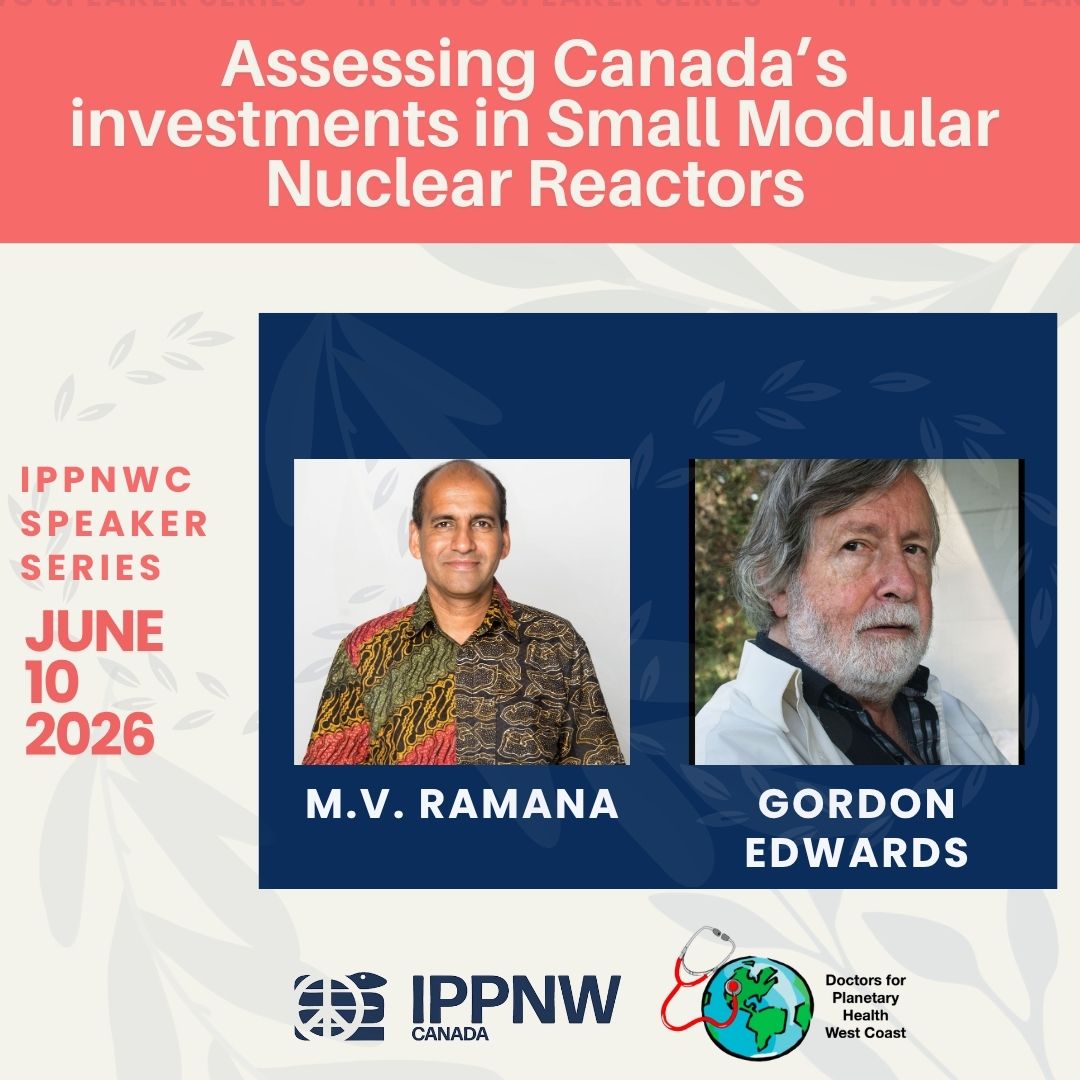
10 June – Assessing Canada’s Investments in Small Modular Nuclear Reactors – https://zoom.us/meeting/register/IiqHA5feRhaEBycOLNTJlA#/registration


Cuba Is Not a Failed State – It Is a Besieged State
PETITION: “Global Appeal to Endorse Palestinian Right of Return of Refugees”
To see nuclear-related stories in greater depth and intensity – go to https://nuclearinformation.wordpress.com
-
Archives
- June 2026 (89)
- May 2026 (306)
- April 2026 (356)
- March 2026 (251)
- February 2026 (268)
- January 2026 (308)
- December 2025 (358)
- November 2025 (359)
- October 2025 (376)
- September 2025 (257)
- August 2025 (319)
- July 2025 (230)
-
Categories
- 1
- 1 NUCLEAR ISSUES
- business and costs
- climate change
- culture and arts
- ENERGY
- environment
- health
- history
- indigenous issues
- Legal
- marketing of nuclear
- media
- opposition to nuclear
- PERSONAL STORIES
- politics
- politics international
- Religion and ethics
- safety
- secrets,lies and civil liberties
- spinbuster
- technology
- Uranium
- wastes
- weapons and war
- Women
- 2 WORLD
- ACTION
- AFRICA
- Atrocities
- AUSTRALIA
- Christina's notes
- Christina's themes
- culture and arts
- Events
- Fuk 2022
- Fuk 2023
- Fukushima 2017
- Fukushima 2018
- fukushima 2019
- Fukushima 2020
- Fukushima 2021
- general
- global warming
- Humour (God we need it)
- Nuclear
- RARE EARTHS
- Reference
- resources – print
- Resources -audiovicual
- Weekly Newsletter
- World
- World Nuclear
- YouTube
-
RSS
Entries RSS
Comments RSS
 nuclear-news