US troops to China? Not a good idea, really
Some pertinent comments to New York Post’s rather war-mongering article.
bob bob. 8 April, 2023
No, “Sending Troops” is not on the table. Taiwan is part of China as Puerto Rico is to the US. Imagine China intervening with our island and threatening us. Taiwan recently held elections, based on pro and anti China issues. Voters overwhelming support China regardless of what our own press and politicians say. Any country deciding to put their fate in US hands should take a long look at Afghanistan.
Cronkyte, 8 April, 2023
China has no desire to “invade” Taiwan, which would require a massive military operation and likely destroy the goose that lays the golden egg. China will do everything it can to persuade Taiwan to agree to reunification, most likely by offering semi-autonomous governance as they promised Hong Kong (and just like Hong Kong, they will then renege on those promises).
There is a growing push for reunification on the island, and after former Taiwan President Ma Ying-jeou’s speech upon returning from China, that will likely grow. He describes the choice as “peace or war,” and no one on either side of the Taiwan Strait want to see the island razed. https://nypost.com/2023/04/07/rep-michael-mccaul-us-troops-to-taiwan-on-the-table-if-china-invades/
China on track to triple its terawatt-scale wind and solar target.
The research arm of American banking giant Goldman Sachs has concluded
that China is currently on track to generate almost three times more power
from wind turbines and solar panels than the government has targeted.
According to a report published by Goldman Sachs in late March, combined
capacity from China’s solar and wind energy sector will reach 3.3
terawatts (TW) by 2030. This far outstrips the Chinese government’s
current target of 1.2TWh. The conclusion from the report is that, with such
an accelerated pace for wind and solar deployment, China could become
energy self-sufficient by 2060.
Renew Economy 5th April 2023
China warns of World War III with ‘nuclear sword hanging over our heads’ over Putin’s plan to send nukes to Belarus
China has called for superpowers to step back from the brink of nuclear war as Russia announces a plan to deploy tactical nukes.
news.com.au Alike Kraterou and Jack Evans 2 Apr 23
China has issued a warning of a possible World War III after Russia’s announcement to deploy tactical nuclear weapons in Belarus.
Geng Shuang, China’s representative in the United Nations, called for all world powers to step back from the brink and maintain “global strategic stability”.
He urged nations to prevent nuclear proliferation and crisis, avoid armed attacks against nuclear power plants and the use of nuclear weapons in Ukraine.
Speaking at a Security Council meeting on international peace, Shuang made clear China’s opposition to Kremlin’s plan to send nuclear weapons to Minsk.
He described nuclear weapons as “the sword of Damocles hanging over our heads” and called on all nuclear weapon states to reduce the risk of a nuclear war and avoid any armed conflict between nuclear weapons states.
“We call for the abolition of the nuclear-sharing arrangements and advocate no deployment of nuclear weapons abroad by all nuclear weapons states, and the withdrawal of nuclear weapons deployed abroad,” Shuang said.
Shuang stressed that “nuclear proliferation must be prevented and nuclear crisis avoided.” He added that “a nuclear war cannot be won and must not be fought,” and that China’s position on nuclear weapons has been “clear and consistent”.
China has firmly committed to a defensive nuclear strategy, not using or threatening to use nuclear weapons against non-nuclear weapon states or nuclear-weapon-free zones, and to no first use of nuclear weapons at any time and under any circumstances.
While not directly mentioning Russia, Geng called for all parties to “stay rational, avoid aggravating tensions, and intensifying frictions, or fanning the flames”.
China has claimed to maintain a neutral stance in the war but has also pointed out its “no-limits friendship with Russia”.
Last month, China released a point peace plan to end the war, calling for a ceasefire and talks between Ukraine and Russia…………………………………………………….
China’s new warning to Australia over nuclear submarine deal
China has fired off another dire warning to Australia, amid growing tension over the nuclear submarine deal with the US and Britain.
Carla Mascarenhas, 1 Apr 23
Global superpowers unite against US
‘Anytime, anywhere’: Kim’s nuke threat
Dan appears on Chinese TV
China has fired off a frightening warning to Australia over its nuclear submarines deal with the US and the UK, declaring it may trigger an unpredictable global arms race.
The Chinese foreign ministry said on Thursday that once a Pandora’s box is opened, the “regional strategic balance will be disrupted and regional security will be seriously threatened”.
The United States, Australia and UK this month unveiled details of a plan to provide Australia with nuclear-powered attack submarines from the early 2030s to counter China’s ambitions in the Indo-Pacific.
“China firmly opposes the establishment of the so-called ‘trilateral security partnership’ between the United States, the United Kingdom and Australia,” said Tan Kefei, a spokesman at the Chinese defence ministry, during a regular press briefing.
“This small circle dominated by Cold War mentality is useless and extremely harmful.”
Mr Tan added such co-operation was an extension of the nuclear deterrence policy of individual countries, a game tool for building an “Asia-Pacific version of NATO” and seriously affected peace and stability in the Asia-Pacific region………………………………………………………….
Richard Dunley, a naval and diplomatic historian, said the deal “looks best from Washington – they get major wins in terms of basing, maintenance support and recapitalisation in their yards”.
He noted the Australian perspective was “less clear”.
“The cost is astronomical,” he wrote on Twitter.
Huge but still unknown amounts will be paid to the US in subsidies and then to buy the Virginias. This capability will only realise materialise mid-next decade, and is only a stopgap.”
carla.mascarenhas@news.com.au https://www.news.com.au/world/asia/chinas-new-warning-to-australia-over-nuclear-submarine-deal/news-story/16904f97d0a534af20dd69815f9c1986
Aukus subs deal firms China support for Asean nuclear weapon-free zone
Beijing ‘willing’ to become first nuclear-armed state to sign treaty pledging to keep the weapons out of Southeast Asia
China’s efforts to woo its neighbours is a counter to US alliance building in the region, which now includes nuclear-powered submarines for Australia
Laura Zhou SCMP, 28 Mar 23
China is willing to sign a treaty making Southeast Asia a nuclear weapons-free zone, in Beijing’s latest effort to woo its neighbours and counter Washington’s decision to speed the sale of nuclear-powered submarines and technology to Australia.
Chinese Foreign Minister Qin Gang made the pledge at a meeting with Kao Kim Hourn, secretary general of the Association of Southeast Asian Nations, in Beijing on Monday. It would make China the first major nuclear power to commit to the zone.
Asean secretary general Kao Kim Hourn (left) and Chinese foreign minister Qin Gang in Beijing on Monday. Photo: Xinhua
China is willing to sign a treaty making Southeast Asia a nuclear weapons-free zone, in Beijing’s latest effort to woo its neighbours and counter Washington’s decision to speed the sale of nuclear-powered submarines and technology to Australia.
Chinese Foreign Minister Qin Gang made the pledge at a meeting with Kao Kim Hourn, secretary general of the Association of Southeast Asian Nations, in Beijing on Monday. It would make China the first major nuclear power to commit to the zone.
“China is willing to take the lead in signing the protocol to the Southeast Asia Nuclear Weapon Free Zone treaty and advocate with Asean for solidarity and win-win cooperation to safeguard regional security and stability,” he said.
The treaty has been in force since 1997 and obliges the 10 Asean member states “not to develop, manufacture or otherwise acquire, possess or have control over nuclear weapons; station or transport nuclear weapons by any means; or test or use nuclear weapons”.
None of the five recognised nuclear-armed states – China, France, Russia, Britain and the US – has acceded to the treaty’s protocol, which implies a commitment not to use nuclear weapons within the zone or against any contracting state.
Chinese President Xi Jinping said in 2021 that Beijing was ready to sign the protocol – also known as the Bangkok Treaty – “at the earliest possible date”, just months after the US-led Aukus alliance with Australia and Britain was unveiled.
The latest pledge comes at a time when China is increasingly vigilant towards Aukus, which two weeks ago announced a pathway for Australia to acquire three, possibly five, US nuclear-powered submarines by the early 2030s.
In his meeting with Kao, Qin said China’s domestic and foreign policies had maintained “a high degree of stability and continuity”, according to a Chinese foreign ministry readout.
Qin said China’s policies would “inject more stability into regional peace and tranquillity, while providing more strong momentum for regional development and prosperity”………………….
Beijing is strongly opposed to Aukus and the Quad – a US-led partnership with Japan, India and Australia – which together form the centrepiece of Washington’s strategy of building alliances to contain China, in its view.
The Aukus announcement – which may pave the way for Canberra to eventually build its own attack submersibles – was described by Chinese foreign ministry spokesman Wang Wenbin as “nothing but selfish”. The US, Australia and Britain “had gone further down a wrong and dangerous road”, he said.
The deal also intensified regional concerns in Southeast Asia. Hours after the announcement, Malaysia said it was important for all countries to refrain “from any provocation that could potentially trigger an arms race or affect peace and security in the region”.
Indonesia, another major power in Southeast Asia, urged Australia to comply with its non-proliferation treaty obligations, saying that it was the responsibility of all countries to maintain peace and stability in the region………………………….. https://www.scmp.com/news/china/diplomacy/article/3215103/aukus-subs-deal-firms-china-support-asean-nuclear-weapon-free-zone
Xi Jinping’s Russia trip reduced chance of nuclear war, says EU foreign policy chief
Josep Borrell says Chinese leader made it clear Vladimir Putin should not deploy atomic weapons
The Chinese president’s trip to Moscow this month has made the world safer, reducing the chance that Vladimir Putin will use nuclear weapons, according to the EU’s foreign policy chief.
Josep Borrell told reporters that President Xi Jinping had made it “very, very clear” to the Russian leader that he should not deploy nuclear weapons, citing China’s peace 12-point Ukraine peace plan, which condemned their use.
“One important thing is this visit reduces the risk of nuclear war and they [the Chinese] have made it very, very clear,” Borrell said. ………………………………… https://www.ft.com/content/8f895b27-9e16-47b4-8608-dbd002facd65
China is competing in a great Asian arms race because it has no other choice
Timur Fomenko, more https://www.sott.net/article/478199-China-is-competing-in-a-great-Asian-arms-race-because-it-has-no-other-choice
Thu, 09 Mar 2023
Hechi City, Guangxi Province, China • Feb. 17, 2023Beijing’s continued militarization is a forced response to US pressure. But can it keep its cool?
During the two sessions of the National People’s Congress (NPC) over the weekend, China announced that its military budget would increase by 7.2% year on year. The news made headlines around the world.
The Chinese premier’s work report, submitted to the NPC, says the country’s military “should intensify military training and preparedness across the board,” and points to escalating “external attempts to suppress and contain China.” The country’s state media reacted conservatively, stressing that the defense spending increase is in keeping with the “single-digit” growth pattern of recent years (7.1% in 2022, 6.8% in 2021, 6.6% in 2020).
Western media took a much different angle, with many outlets making obligatory mention of warnings from analysts and officials that China’s real military spending could be much higher than the announced budget. For example the Guardian cited the US Department of Defense as claiming it could be up to two times higher. These outlets do mention that China’s defense budget is still dwarfed by that of the US ($224B versus $772B), before moving on to talk about the size of China’s navy and infantry, its “militarization” of the South China Sea and, of course, repeating the warnings emanating from Washington DC that “China may invade Taiwan” soon.
Such warnings from the US come coupled with a string of deliberate provocations such as official visits to Taiwan, flyovers, and ‘freedom of navigation’ operations. The US itself has made it a priority to militarize the region and to encircle China. None of these points can be found in Western media reports on Beijing’s defense spending – even though they are directly responsible for continued growth in China’s military budget.
Owing to the US attempt to contain China, the Asia-Pacific is now locked in a growing arms race and military competition, and Beijing has no choice but to participate. Washington has initiated a militarization of the region, under the label of its “Indo-Pacific” strategy, with the focus on suppressing the rise of China. To do this, the US has created minilateral blocs targeting China,one being the Quad (Australia, India, Japan, US) and the other being AUKUS with Britain. Additionally, the US has dramatically increased its deployment of military assets in the region, has pushed the Philippines to increase access to its bases, and has also deliberately pushed the Taiwan issue and walked back from its existing commitments to China in order to escalate regional tensions.
The US has actively encouraged and pushed for the arming of its regional allies too, the most notable example being Japan’s pledge to double its military spending and to buy hundreds of cruise missiles from the US. This militarization has been complementary to the parallel expansion of sanctions and embargoes aimed at crushing China’s rise in high-end technologies, which the US sees as directly contributing to its military capabilities. In this sense, the technological and military aspects of China-US competition are intrinsically linked, all in the name of American supremacy over the region.
So facing this growing military encirclement and competition, how does China respond? The answer is that it continues to develop and strengthen its military, with the optimism that it can keep up with the United States in the long term. The US military budget continues to be over three times the size of China’s, which is also sobering for those calling Beijing a “threat.” However, this does not mean that China is incapable, as its resources are concentrated in one region around itself, while the US is aiming for worldwide domination. When it comes to raw numbers, for example, China already has a larger navy than the United States and greater shipbuilding capacity.
2023 will be a year of significantly increased tensions. It hasn’t started well, with the US kicking up a storm over an alleged Chinese spy balloon, continuing provocations around Taiwan and reviving the Covid-19 lab leak theory. But will China bite? It seems unlikely.
One of the primary goals of this US-led effort is precisely to provoke Beijing so that Washington might be able to induce instability and therefore increase its geopolitical clout over other countries, breaking up positive regional integration. That is why China needs to be careful.
With Beijing recognizing it is facing US encirclement, it has to defend its critical national interests, but in conjunction, it also needs to play a diplomatic game to reassure other countries simultaneously. China does not want ties with India to deteriorate further, or to create anxiety for ASEAN claimants in the South China Sea, such as Vietnam, Malaysia, Indonesia or the Philippines.
It also wants to avoid Europe becoming more militarily involved against China, which would represent a great success for the US. China strives to be firm but also calm and cautious. There is a lot to lose in facing a hostile US, but sitting idly by is not an option. A military competition has begun, and it isn’t going away. Beijing must be strong but also avoid “rocking the boat” too much.
China increasing the number of nuclear warheads, aiming to match USA’s nuclear arsenal
Moscow is cementing its alliance with Beijing through deliveries of highly
enriched uranium that are fuelling China’s race to match the nuclear
arsenal of the United States, the Pentagon has warned. President Xi’s
military chiefs are seeking nuclear parity with Washington by increasing
the number of nuclear warheads from the present estimated 350 to 400 to
1,500 by 2035.
That total would approximately equal the strategic nuclear
arsenal of the US, limited to 1,550 warheads by New Start, the only
remaining arms control treaty between the US and Russia, which President
Putin has announced could be abandoned.
Times 10th March 2023
https://www.thetimes.co.uk/article/putin-china-plutonium-nuclear-xwlzvjfwh
China calls for Russia to not go down the ‘nuclear weapons route’
DFAT Australia China Council Scholar Andrew Phelan says that China has called for Russia to ‘leave nuclear power plants’ and not pursue the ‘nuclear weapons route’ in a 12-point peace plan released this afternoon.
“There are a couple of good things about it,” Mr Phelan told Sky News host Caleb Bond.
China’s Position on the Political Settlement of the Ukraine Crisis
2023-02-24 https://www.fmprc.gov.cn/mfa_eng/zxxx_662805/202302/t20230224_11030713.html
1. Respecting the sovereignty of all countries. Universally recognized international law, including the purposes and principles of the United Nations Charter, must be strictly observed. The sovereignty, independence and territorial integrity of all countries must be effectively upheld. All countries, big or small, strong or weak, rich or poor, are equal members of the international community. All parties should jointly uphold the basic norms governing international relations and defend international fairness and justice. Equal and uniform application of international law should be promoted, while double standards must be rejected.
2. Abandoning the Cold War mentality. The security of a country should not be pursued at the expense of others. The security of a region should not be achieved by strengthening or expanding military blocs. The legitimate security interests and concerns of all countries must be taken seriously and addressed properly. There is no simple solution to a complex issue. All parties should, following the vision of common, comprehensive, cooperative and sustainable security and bearing in mind the long-term peace and stability of the world, help forge a balanced, effective and sustainable European security architecture. All parties should oppose the pursuit of one’s own security at the cost of others’ security, prevent bloc confrontation, and work together for peace and stability on the Eurasian Continent.
3. Ceasing hostilities. Conflict and war benefit no one. All parties must stay rational and exercise restraint, avoid fanning the flames and aggravating tensions, and prevent the crisis from deteriorating further or even spiraling out of control. All parties should support Russia and Ukraine in working in the same direction and resuming direct dialogue as quickly as possible, so as to gradually deescalate the situation and ultimately reach a comprehensive ceasefire.
4. Resuming peace talks. Dialogue and negotiation are the only viable solution to the Ukraine crisis. All efforts conducive to the peaceful settlement of the crisis must be encouraged and supported. The international community should stay committed to the right approach of promoting talks for peace, help parties to the conflict open the door to a political settlement as soon as possible, and create conditions and platforms for the resumption of negotiation. China will continue to play a constructive role in this regard.
5. Resolving the humanitarian crisis. All measures conducive to easing the humanitarian crisis must be encouraged and supported. Humanitarian operations should follow the principles of neutrality and impartiality, and humanitarian issues should not be politicized. The safety of civilians must be effectively protected, and humanitarian corridors should be set up for the evacuation of civilians from conflict zones. Efforts are needed to increase humanitarian assistance to relevant areas, improve humanitarian conditions, and provide rapid, safe and unimpeded humanitarian access, with a view to preventing a humanitarian crisis on a larger scale. The UN should be supported in playing a coordinating role in channeling humanitarian aid to conflict zones.
6. Protecting civilians and prisoners of war (POWs). Parties to the conflict should strictly abide by international humanitarian law, avoid attacking civilians or civilian facilities, protect women, children and other victims of the conflict, and respect the basic rights of POWs. China supports the exchange of POWs between Russia and Ukraine, and calls on all parties to create more favorable conditions for this purpose.
7. Keeping nuclear power plants safe. China opposes armed attacks against nuclear power plants or other peaceful nuclear facilities, and calls on all parties to comply with international law including the Convention on Nuclear Safety (CNS) and resolutely avoid man-made nuclear accidents. China supports the International Atomic Energy Agency (IAEA) in playing a constructive role in promoting the safety and security of peaceful nuclear facilities.
8. Reducing strategic risks. Nuclear weapons must not be used and nuclear wars must not be fought. The threat or use of nuclear weapons should be opposed. Nuclear proliferation must be prevented and nuclear crisis avoided. China opposes the research, development and use of chemical and biological weapons by any country under any circumstances.
9. Facilitating grain exports. All parties need to implement the Black Sea Grain Initiative signed by Russia, Türkiye, Ukraine and the UN fully and effectively in a balanced manner, and support the UN in playing an important role in this regard. The cooperation initiative on global food security proposed by China provides a feasible solution to the global food crisis.
10. Stopping unilateral sanctions. Unilateral sanctions and maximum pressure cannot solve the issue; they only create new problems. China opposes unilateral sanctions unauthorized by the UN Security Council. Relevant countries should stop abusing unilateral sanctions and “long-arm jurisdiction” against other countries, so as to do their share in deescalating the Ukraine crisis and create conditions for developing countries to grow their economies and better the lives of their people.
11. Keeping industrial and supply chains stable. All parties should earnestly maintain the existing world economic system and oppose using the world economy as a tool or weapon for political purposes. Joint efforts are needed to mitigate the spillovers of the crisis and prevent it from disrupting international cooperation in energy, finance, food trade and transportation and undermining the global economic recovery.
12. Promoting post-conflict reconstruction. The international community needs to take measures to support post-conflict reconstruction in conflict zones. China stands ready to provide assistance and play a constructive role in this endeavor.
Why the US seeks War with China by 2025
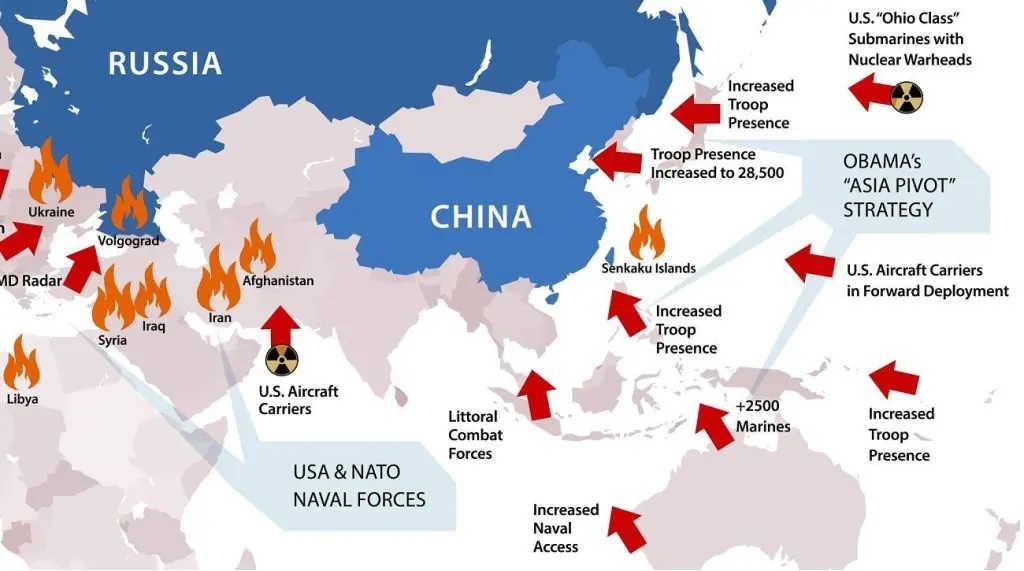
A clash between the United States and China over Taiwan would be the result of the United States willfully going to war with China over a matter the United States officially recognizes as China’s internal political affairs.
The current US State Department’s website regarding “U.S. Relations With Taiwan” admits that officially, “we do not support Taiwan independence.”

The US has also poured billions of dollars’ worth of weapons into Taiwan, just as the US did in Ukraine from 2014 onward. The weapons are clearly intended for a Ukraine-style proxy war with China
.
New Eastern Outlook, : Brian Berletic 8 Feb 23
In recent weeks there has been a build-up of talk regarding a US war with China. Not because of any actual provocation from Beijing, but instead because of a collective resignation to its supposed inevitability.
This is best illustrated by comments made by US Air Force General Michael Minihan. In TIME Magazine’s article, “U.S. General’s Prediction of War With China ‘in 2025’ Risks Turning Worst Fears Into Reality,” General Minihan is quoted as saying:
Worst of all is the small but growing presence of US military activity on Taiwan itself.
Even as the US State Department claims it does not support Taiwan independence, in 2021 Voice of America in its article, “US Nearly Doubled Military Personnel Stationed in Taiwan This Year,” admits that not only are there US troops on Taiwan, the number is increasing.
The article explains:……………………………
“My gut tells me we will fight in 2025.”
The article goes on to claim:
“I hope I am wrong,” Minihan, who heads the Air Force’s Air Mobility Command, wrote in an internal memo, which circulated on social media, to the leadership of its 110,000 members. Chinese President Xi Jinping, he explains, “secured his third term and set his war council in October 2022. Taiwan’s presidential elections are in 2024 and will offer Xi a reason. United States’ presidential elections are in 2024 and will offer Xi a distracted America. Xi’s team, reason, and opportunity are all aligned for 2025.”
Yet nothing General Minihan says explains why the United States itself would conceivably find itself at war with the United States. Instead, General Minihan is more or less admitting that the US will go to war with China over Chinese actions regarding Taiwan. In fact, the article goes on to admit:
Minihan’s comments are merely the most immediate of a worrying, emerging consensus that the U.S. and China are destined to clash over Taiwan, the self-ruling island of 23 million that Beijing claims as its sovereign territory.
A clash between the United States and China over Taiwan would be the result of the United States willfully going to war with China over a matter the United States officially recognizes as China’s internal political affairs.
The current US State Department’s website regarding “U.S. Relations With Taiwan” admits that officially, “we do not support Taiwan independence.”
If the US does not support Taiwan independence then by extension the US acknowledges Taiwan is not independent and therefore Washington, officially, recognizes Beijing’s sovereignty over Taiwan. This is what defines the “One China” policy Washington and virtually every other nation on Earth has agreed to in order to establish diplomatic relations with the People’s Republic of China in Beijing.
At a time when Washington regularly lectures Moscow about “violating sovereignty,” Washington’s stance toward Beijing and Taiwan should be a simple matter of respecting Chinese sovereignty. Yet it is not because of the double-game the United States plays both internationally and with China specifically.
Washington’s Deliberate Provocations
TIME Magazine and other Western media publications attempt to depict Beijing as the aggressor, omitting any discussion of either the “One China” policy or the US State Department’s own official declaration of supposedly upholding it.
Instead, Western audiences are led to believe that Taiwan somehow is independent and that Beijing is “bullying” it. The inevitable clash between the US and China is supposedly driven by America’s desire to “stand up” for Taiwan and its inferred sovereignty. In reality, a potential clash between the US and China would be the result of Washington once again violating the sovereignty of another nation thousands of miles from its own shores.
Washington’s double game of officially recognizing Chinese sovereignty over Taiwan while openly and deliberately trampling that sovereignty is best illustrated by former US Speaker of the House Nancy Pelosi’s visit to Taiwan utilizing an official US Air Force aircraft against the protests of Beijing. Pelosi’s trip to Taiwan is only one of many made by US representatives who openly use visits like this in an attempt to goad Beijing……….
Looking at any map of US military deployments in the “Indo-Pacific” region reveals China as virtually surrounded by the US military by way of South Korea, mainland Japan, Okinawa, and with new basing agreements in the works with Manila, potentially the Philippines as well.
This puts US troops, naval assets, and hundreds of warplanes within striking distance of China, including Taiwan from north, east, and potentially the south.
The US has also poured billions of dollars’ worth of weapons into Taiwan, just as the US did in Ukraine from 2014 onward. The weapons are clearly intended for a Ukraine-style proxy war with China.
Worst of all is the small but growing presence of US military activity on Taiwan itself.
Even as the US State Department claims it does not support Taiwan independence, in 2021 Voice of America in its article, “US Nearly Doubled Military Personnel Stationed in Taiwan This Year,” admits that not only are there US troops on Taiwan, the number is increasing.
The article explains:………………………………….
One could only imagine the reaction in Washington if Beijing and a government in, say San Juan, revealed the presence of Chinese forces in Puerto Rico. Yet as is the case in many instances regarding international relations, American “exceptionalism” not only absolves the US from any penalty for blatant violations of another nation’s sovereignty, it transfers the blame to the nation being targeted itself, in this case, China.
Why US War with China by 2025?
Despite serial provocations, Beijing has exercised exemplary patience and restraint. China has invested heavily in its military and is indeed preparing for conflict with the United States, not because it seeks to wage war with the United States but because the United States has placed its military on China’s doorstep, very clearly seeking war with China.
Taiwan’s full reintegration with the rest of China is inevitable. Already its economy is heavily dependent on access to markets across the rest of China. Harvard University’s Atlas of Economic Complexity reveals that nearly 50% of all exports from Taiwan go to the rest of China. The rest of China also accounts for the largest amount of imports to the island. Many of these imports are crucial inputs for Taiwan’s semiconductor and electronic component production which constitutes, by far, Taiwan’s largest industry.
Only through Washington’s persistent and extensive interference in Taiwan’s local political affairs has gradual reintegration been suspended. Before the US-backed Democratic Progressive Party (DPP) came to power in 2016, the incumbent Kuomintang (KMT) party was on track to sign a trade agreement with the mainland that would have increased already extensive economic integration even further.
Ironically, as the US captured Ukraine politically in 2014, it was also backing opposition protests in Taiwan dubbed the “Sunflower Movement,” paving the way for the DPP’s ascent into power 2 years later. Just like the US-installed client regime in Kiev, the DPP immediately set a course for self-destruction, irrationally rolling back ties with the mainland at the expense of the people living on Taiwan.
More recently, local elections in Taiwan saw the DPP fare poorly, serving as an unofficial referendum rejecting the DPP’s separatist platform, the damage it has consistently done to the local economy, and the instability it has created across the strait with the mainland. However, just as was the case in Ukraine where public sentiment sought peace, Washington and its client regime have every intention of overriding that sentiment in Taiwan, and pushing the island closer still to yet another US-engineered proxy war.
It is clear that it is not China rushing for war with the United States, but precisely the other way around. Time, economics, and proximity favor China. In 10 years, China will be economically and militarily stronger while the US will continue its slow decline. At that point the window of opportunity will have closed for the United States to wage any type of military conflict with China and obtain anything close to resembling “victory.”
Some could argue that the window has already closed.
The Center for Strategic and International Studies (CSIS) recently published the outcome of “wargames” regarding a theoretical Chinese “invasion” of Taiwan in a paper titled, “The First Battle of the Next War: Wargaming a Chinese Invasion of Taiwan.”The paper concludes:
In most scenarios, the United States/Taiwan/Japan defeated a conventional amphibious invasion by China and maintained an autonomous Taiwan. However, this defense came at high cost. The United States and its allies lost dozens of ships, hundreds of aircraft, and tens of thousands of servicemembers. Taiwan saw its economy devastated. Further, the high losses damaged the U.S. global position for many years.
Regarding China, it says:
China also lost heavily, and failure to occupy Taiwan might destabilize Chinese Communist Party rule. Victory is therefore not enough. The United States needs to strengthen deterrence immediately.
In essence, the US will suffer unprecedented military losses and Taiwan itself will be scoured clean of its industry and infrastructure. While CSIS claims that the Chinese amphibious landing was successfully foiled in its wargames thus preserving Taiwan’s political existence, the cost is Taiwan’s physical existence.
Both the CSIS paper together with public comments made by the Pentagon about their own classified wargames indicate disparity between the US and China militarily is narrowing quickly. If there is to be a conflict between the US and China, the sooner it takes place the better chance the US has of achieving a favorable outcome. It is therefore the US racing eagerly toward war, not China. China’s military posture reflects the close proximity of US forces to Chinese territory and their obvious intent to menace China in its own territory, not a China expanding its military capabilities to threaten the United States. In fact, the CSIS paper made a specific note about China’s ability to attack the US “homeland.”
The paper claims:
Because the United States will be striking the Chinese homeland, the base case assumes that the U.S. homeland is not a sanctuary. However, the ability of the Chinese to conduct strikes against the U.S. homeland and thereby affect operations in the Western Pacific is extremely limited. A few special forces might infiltrate and attack a small number of high-value targets but not enough to materially affect military operations in the Western Pacific.
Thus, even in a war between the US and China where the US is conducting strikes on Chinese territory, CSIS admits that China has very limited means to likewise strike at the US. This reveals that US policymakers are not concerned about any real threat China poses to the US, but instead to US “interests” thousands of miles from its own shores and, in fact, within the sovereign territory of China itself.
Potential war between the US and China, if it takes place, will merely be the most recent example of US military aggression in pursuit of global hegemony targeting and attempting to undermine another nation’s sovereignty in violation of international law, not as a means to uphold it. As the US often does, the lead up to this potential war sees the US projecting its own menace toward international law, peace and stability onto the very target of US military aggression, in this case China.
Brian Berletic is a Bangkok-based geopolitical researcher and writer, especially for the online magazine “New Eastern Outlook”.
Checking Back in on China’s Nuclear Icebreaker
Over four years after the project was announced, updates remain scarce on China’s first nuclear icebreaker.
The Diplomat, By Trym Eiterjord 13 Feb 23
In 2018, it became known that the state-owned China National Nuclear Corporation (CNNC) was embarking on a project to develop nuclear-powered icebreakers…………….
Over four years later, information about the project remains scarce, but a handful of patents recently filed by engineers at the CNNC Marine subsidiary would seem to indicate that development is moving forward. The content of these patents may give some insight into what is potentially China’s first nuclear-powered surface vessel.
The patents filed so far are concerned mainly with nuclear engineering. ……………………
Finally, the new subsidiary has filed a patent titled simply “A nuclear-powered icebreaker,”………………..
This is more or less the extent of new information to have come out since the project was first revealed in 2018……………………………….
The People’s Liberation Army Navy has also seemingly become interested in nuclear propulsion for polar-going icebreakers…………………….. more https://thediplomat.com/2023/02/checking-back-in-on-chinas-nuclear-icebreaker/
China’s spy balloon can help deflate US nuclear tensions with Beijing
Defense News, By David Gompert and Hans Binnendijk 8 Feb 23
The row over China’s surveillance balloon could, once the dust settles, present a chance to begin lessening the risk of nuclear war between the two superpowers.
While the United States is right to charge China with violating its airspace in an apparent attempt to spy on America’s strategic missile systems in Montana, this episode reminds us that the two nations have no mechanism to exchange views and clear up misconceptions on the purpose of their respective nuclear arsenal.
Consequently, suspicions abound.
It is understandable that this infamous spy balloon has riled up the American body politic. Yet, it is important to keep the strategic situation in mind. The United States and China are in a stable state of mutual deterrence, meaning that neither power could launch a nuclear first strike on the other without inviting devastating retaliation. That said, the greater the mutual suspicions about intent, the greater the danger that this stability could fail.
The absence of a way to build mutual confidence between the United States and China regarding nuclear weapons and nuclear war is potentially dangerous. The United States is unsure what to make of China’s build-up of its nuclear arsenal, and China is fearful that the United States seeks the capability to deny China a credible deterrent. What makes this situation increasingly perilous are the rising tensions in Sino-U.S. relations in the Pacific and the growing risks of escalating crises and even war there.
In an article in the journal Survival to be published soon, we spell out the case and agenda for a process whereby the superpowers could clarify why they have nuclear weapons and the doctrines governing their use.
Specifically, we recommend direct and candid bilateral strategic stability talks on nuclear doctrines, forces, intentions, and worries. This would be coupled with confidence-building measures such as providing prior notifications of missile testing, clarifying the purpose of new weapons, and managing disconcerting intelligence.
This could reduce suspicions, such as Chinese fears that the United States aspires to have a first-strike capability and American fears that China will relentlessly expand its capability to target U.S. deterrent forces. Each nation would of course continue independent intelligence-gathering. But “worst-case” interpretation of intelligence could be mitigated by dialogue.
These strategic stability talks might include implementing a bold concept: a bilateral US-Chinese pledge not to use nuclear weapons first against each other or against the other nation’s treaty allies……………………………. more https://www.defensenews.com/opinion/commentary/2023/02/07/chinas-spy-balloon-can-help-deflate-us-nuclear-tensions-with-beijing/
Renewables In China Trend Upward While Nuclear Trends Flat.

The blue line at the bottom is nuclear, and not particularly sharp eyes will note that it’s trending to flat. The red line at the top is wind, water, and solar cumulative additions to annual TWh of electricity flowing into China’s grid, and not particularly sharp eyes will note it’s curving upwards.
The natural experiment of renewables vs nuclear continues in China, and it continues to unfold in renewables’ favor.
Clean Technica, ByMichael Barnard, 7 Feb 23,
I’ve been publishing assessments of the poor performance of nuclear compared to wind and solar in China for years (2014, 2019, 2021, 2022). My premise nine years ago was a first principles assertion with limited empirical results that wind and solar would radically outstrip nuclear in China. Why? Modularity reducing long-tailed risks, as Professor Bent Flyvbjerg, global expert and go to person for megaprojects, puts it in his new book How Big Things Get Done, where he includes my assessment of the natural experiment.
Subsequent assessments found that was true. Every year, the combination of wind and solar, and usually both individually, outstripped new nuclear generation, both in raw nameplate capacity and in additional TWh of annual generation. But as Professor Mark Z. Jacobson likes to remind us, it’s not WS, it’s WWS, that is wind, water, and solar. And so, today I spent a bit of time looking at hydroelectric generation capacity additions around the world since 2000, which turned out to be almost entirely in China. Of the 132.5 GW of new big hydroelectric projects connected to the grid in the world since 2000, 113 GW were in China. Unsurprising to anyone paying the slightest attention, but still, big numbers.
But what does that mean when added to wind and solar and compared to nuclear, leveraging the 2010 to 2022 data set I already had?…………………………………….
there is an interesting question about all forms of electrical generation, which is what capacity factors they are operating at. China’s wind and solar were historically curtailed by transmission connection challenges, which have been being resolved every year. Last year’s bumper crop of offshore wind, of course, were connected with HVDC to the grid without challenges.
What about hydro? It has different challenges for capacity factors, typically having a spring spate with often far too much water to use for generation, and a fall lull where generation is low. In the case of China, the best data I have at present is from the International Hydropower Association (IHA) which lists 1,355 TWh of electrical generation from 370,160 MW of capacity in 2020. That’s a 42% capacity factor, which I used for the generation.
I was somewhat surprised by this, and would be interested in better data, should anyone have some at hand. What it does mean is that while nuclear added a total of about 243 TWh of net new electrical generation from 2010 through 2022, hydro only added about 229 TWh of new generation. It was an interesting result which I’ll spend a little time assessing in a bit. Of course, wind energy added about 711 TWh of new generation annually over that period and solar added about 474 TWh. Both outstripped nuclear and hydro.
For purposes of wind, solar, and nuclear, I’d been simply presenting the new TWh of generation added each year. But in adding water to the data set, it seemed reasonable to make it cumulative.
In the graph above , the blue line at the bottom is nuclear, and not particularly sharp eyes will note that it’s trending to flat. The red line at the top is wind, water, and solar cumulative additions to annual TWh of electricity flowing into China’s grid, and not particularly sharp eyes will note it’s curving upwards.
Poking at the disparity between additions of actual TWh by renewable generation source a bit more, there are a few things to note.
The first, of course, is that wind and solar siting is much simpler than major hydroelectric siting. They just need flattish areas with good wind and sun, and wind likes ridge lines where flat bits can be made. Big hydro needs a big river with a reasonably significant drop along its length and at least one place where it’s carved a big valley. Meandering rivers like the Mississippi need not apply, although they are much better for inland shipping. The combination means that it’s typically easier to get materials and workers for wind and solar farms to the sites, easier to move construction vehicles around them and the like.
And hydroelectric reservoirs have another reality: you can’t live or work where they are. Unlike solar farms which can simply be built around existing buildings or roads, or wind farms where turbines can be built in the non-productive corners of farm fields, hydroelectric reservoirs displace everybody and everything where they exist. …………………………………
Still, China has managed to construct and attach 16 of them [hydro-electric dams] to the grid since 2000. I was aware of the Three Gorges Dam, of course, but was unaware that it was a small portion of the hydroelectric China had constructed. And while each project’s cost and schedule results vs plans are unavailable, China did succeed in building them.
The natural experiment of renewables vs nuclear continues in China, and it continues to unfold in renewables’ favor. https://cleantechnica.com/2023/02/06/renewables-in-china-trend-upward-while-nuclear-trends-flat/
China expresses dissatisfaction and protest over US shooting down civilian airship; US sets bad precedent
The Pentagon earlier said on Friday that the balloon did not pose a “military or physical” threat.
It’s widely known that US aircraft, appearing in civilian or military purposes, operate around China much more frequent than Chinese aircraft do around the US
Global Times, By Chen Qingqing and Liu Xuanzun, Feb 05, 2023
China expressed strong dissatisfaction and protest on Sunday against the US’ move to shoot down a non-threatening Chinese airship for civilian use, calling the US’ move an overreaction and vowing to reserve the right to take necessary actions. By turning an unintentional accident into an incident that has been hyped by the US officials and media, Washington is adding new uncertainties into the already-intense relations with China, creating a bad precedent for blurring the line between civilian and military uses, experts said.
The Chinese Foreign Ministry expressed strong dissatisfaction and protested against the US’ use of force to shoot down a Chinese civilian unmanned airship, urging the US to properly handle the incident.
The Chinese side has verified the situation and communicated with the US side multiple times, saying the unintended entry of the airship into US airspace was due to force majeure and the incident was totally an accident, the ministry said.
The US military on Saturday local time shot down a “suspected Chinese spy balloon” off the Carolina coast following an authorization of the Biden administration after the airship has been flying over the US for days. The action was hailed by the US President Joe Biden as “a success,” according to US media reports.
The “balloon episode” went viral on the US social media. A number of US hawks on China-related matters have been hyping the use of balloon for spying purpose and deliberately distorted it as “a direct assault on the US national sovereignty.”
“The US attack on Chinese civilian unmanned airship by force is an obvious overreaction,” Senior Colonel Tan Kefei, a spokesperson at China’s Ministry of National Defense, said in a statement on Sunday.
China will reserve the right to take necessary measures in dealing with similar situations, Tan said.
Tan’s remarks mean that if a foreign airship accidentally enters the Chinese airspace, the Chinese forces could also shoot it down in a similar manner, observers said.
Biden was first briefed on the balloon Tuesday and has been receiving updates from his national security team, CNN said. The Pentagon earlier said on Friday that the balloon did not pose a “military or physical” threat………………………………………….
Overreaction, bad precedent
The US shooting down the Chinese civilian balloon is also considered an overreaction from a technical point of view, said military aviation experts.
Despite admitting that the balloon did not pose a military or physical threat, an F-22 fighter of the US Air Force fired an AIM-9X air-to-air missile and shot down the balloon, supported by F-15 fighters, tankers and warships, the Pentagon said on the day on its website.
The missile was fired from the F-22 from an altitude of 58,000 feet (17,678 meters) when the balloon was 60,000 and 65,000 feet, the Pentagon said.
This is like shooting a mosquito with a cannon, which is not only overreacting but also impractical, a Chinese military expert who requested anonymity told the Global Times on Sunday.
Compared with an unmanned balloon that flies with the wind, the US interception method that featured an advanced stealth fighter jet and fired a missile is too costly………………………………….
It’s widely known that US aircraft, appearing in civilian or military purposes, operate around China much more frequent than Chinese aircraft do around the US, Lü noted. …………
more https://www.globaltimes.cn/page/202302/1284857.shtml
1 This Month
10 June – Assessing Canada’s Investments in Small Modular Nuclear Reactors – https://zoom.us/meeting/register/IiqHA5feRhaEBycOLNTJlA#/registration


Cuba Is Not a Failed State – It Is a Besieged State
PETITION: “Global Appeal to Endorse Palestinian Right of Return of Refugees”
To see nuclear-related stories in greater depth and intensity – go to https://nuclearinformation.wordpress.com
-
Archives
- June 2026 (89)
- May 2026 (306)
- April 2026 (356)
- March 2026 (251)
- February 2026 (268)
- January 2026 (308)
- December 2025 (358)
- November 2025 (359)
- October 2025 (376)
- September 2025 (257)
- August 2025 (319)
- July 2025 (230)
-
Categories
- 1
- 1 NUCLEAR ISSUES
- business and costs
- climate change
- culture and arts
- ENERGY
- environment
- health
- history
- indigenous issues
- Legal
- marketing of nuclear
- media
- opposition to nuclear
- PERSONAL STORIES
- politics
- politics international
- Religion and ethics
- safety
- secrets,lies and civil liberties
- spinbuster
- technology
- Uranium
- wastes
- weapons and war
- Women
- 2 WORLD
- ACTION
- AFRICA
- Atrocities
- AUSTRALIA
- Christina's notes
- Christina's themes
- culture and arts
- Events
- Fuk 2022
- Fuk 2023
- Fukushima 2017
- Fukushima 2018
- fukushima 2019
- Fukushima 2020
- Fukushima 2021
- general
- global warming
- Humour (God we need it)
- Nuclear
- RARE EARTHS
- Reference
- resources – print
- Resources -audiovicual
- Weekly Newsletter
- World
- World Nuclear
- YouTube
-
RSS
Entries RSS
Comments RSS
 nuclear-news