IAEA chief confident of nuclear energy’s future
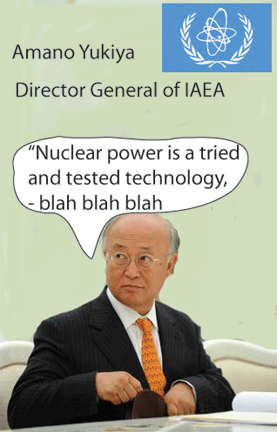
Nuclear industry has learnt its lessons: IAEA chief The global nuclear industry has learned its lessons from the Fukushima nuclear plant accident in Japan in 2011 and can look to the future with “confidence and optimism,” said the United Nations nuclear energy chief….“Nuclear power is a tried and tested technology,” Mr Amano THE HINDU 27 June 13
Exelon tries (unsuccessfully) to blame wind energy for nuclear power’s commercial failures
 Exelon Still Blaming Wind PTC For Nuclear Challenges, Exelon Still Wrong About It Think Progress, By Adam James, Guest Blogger on Jun 27, 2013 Exelon recently shelved plans to expand nuclear capacity at their LaSalle and Limerick plants, taking a $100 million hit and once again reverting to the tired old strategy of blaming subsidized wind. The specific target of their ire is the Production Tax Credit (PTC). For wind, that is, not the one that they happily collect for nuclear.
Exelon is (again) wrong about the PTC, as anyone who read our last post already knows.
First, let’s look at the big picture. Wind power has been a tremendous boon for North America. Costs have fallen 90 percent since 1992, the domestic content of wind turbines has dramatically risen, and 75,000 people are employed in the industry. This growth is directly tied to the continued extension of the Production Tax Credit. Wind power is cheap and carbon free, making it good for consumers and the climate alike.
However, Exelon has decided that wind power is bad for their business. The argument they’ve been making is that because wind can collect tax credits for producing energy at times when demand for electricity is very low, electricity prices become negative as the generator pays consumers to take electricity. This hurts their other generators, like nuclear plants, who then have to sell at a loss. Buried in the story about Limerick and LaSalle is a very important point though: negative prices didn’t occur once in springtime.
We debunked this tale before, but I’ll recap the highlights here:……http://thinkprogress.org/climate/2013/06/27/2210711/exelon-still-blaming-wind-ptc-for-nuclear-challenges-exelon-still-wrong-about-it/?mobile=nc
New Mexico protests against uranium mining
La Jicarita: Protesters in Santa Fe Say No Uranium Mining http://unoccupyabq.org/2013/06/la-jicarita-protesters-in-santa-fe-say-no-uranium-mining/ 27 June 13 La Jicarita: Albuquerque and Santa Fe activists joined an inter-tribal delegation to protest the planned resumption of uranium mining in New Mexico. With organizing help from (un)occupy Albuquerque, the June 25 action began at the New Mexico Mining Association offices, then moved to the New Mexico Mining and Minerals Division where the contingent confronted division director Fernando Martinez in a polite but insistent impromptu dialogue. Moving on to the offices of the Uranium Producers of America, the protesters found the occupants had moved out (not in search of larger premises, we hope). Ending up at the Santa Fe plaza, the activists took part in a call to free imprisoned AIM activist Leonard Peltier and an Idle No More-led round dance around the town’s monument to the Indian Wars. Click on the links between the pictures below to hear the words of participants in these events.
Read the full article here.
Reporter Eric Schultz also included audio of many of the speakers, well worth a read, and a listen.
Nuclear power – it’s just not cost effective
 Activists See U.S. Nuclear Industry Starting to Crumble By Matthew Charles Cardinale ATLANTA, Georgia, Jun 27 2013 (IPS) -“……. The costs of nuclear power According to Mark Cooper, a senior research fellow for economic analysis at the Institute for Energy and the Environment at Vermont Law School, history has proved that nuclear power is not economical.
The industry likes to say once you build them, they just hum along and they’re cash cows, producing low cost electricity, and then the industry takes that claim and uses that as a pillar [on which] they try to build the case for new nuclear reactors,” Cooper told IPS.
The nuclear industry maintains that once construction is complete, plants are inexpensive to operate and “last forever”, according to Cooper.
“The reality of old reactors does not support those claims,” he argued, and “the construction costs for new nuclear reactors go through the roof.”
He said one-fifth of reactors built before 2013 that received commercial licenses have retired early and called the 60-year life span of reactors “inconsistent with reality”.
“When [reactors] age, they have the tendency of being more and more costly to keep online,” he added. “When they break, they are too expensive to fix,” he said, citing over two dozen reactors that have closed down for those reasons.
Subsidised construction
In his speech on global warming earlier this week, U.S. President Barack Obama pointed to nuclear reactors under construction in Georgia and South Carolina as examples of new clean energy supported by his administration.
As reported by IPS in 2008, Obama has long been supportive of – and received campaign contributions from – the nuclear industry, beginning with his term in the U.S. Senate.
However, through charges applied to their monthly energy bills, taxpayers in Georgia and South Carolina are shelling out in advance to heavily subsidise nuclear projects in those states, even as Georgia Power and Scana are guaranteed profits because of decisions made by their legislatures and public service commissions.
“At the great pain imposed on ratepayers in Georgia and South Carolina, they can finish those reactors,” Cooper said, but “those reactors will tell us nothing about building another one because they are so incredibly subsidised.”
He believed that other states would not adopt such an approach that shifts risk to taxpayers, predicting, “Summer in South Carolina and Vogtle in Georgia will be monuments for folly, not launch points for the future.” http://www.ipsnews.net/2013/06/activists-see-u-s-nuclear-industry-starting-to-crumble/
The Center for Public Integrity exposes MOX nuclear facility in South Carolina
‘Nuclear Waste’ series targets seriously troubled project Center for Public Integrity, By Bill Buzenberg 27 June 13 In four superb reports this week, The Center for Public Integrity’s national security team tells the disturbing story of how billions of dollars are being wasted on a specialized nuclear plant that was supposed to produce fuel for nuclear energy and reduce weapons grade plutonium. Not only could this failing enterprise end up costing as much as $20 billion, it may also create more nuclear weapons material instead of less. The Center’s Nuclear Waste series kicks off what will be an ongoing investigation into the world’s faltering efforts to control these most dangerous nuclear explosives……. Read this entire four-part series to see public service investigative journalism at its best http://www.publicintegrity.org/2013/06/27/12900/nuclear-waste-series-targets-seriously-troubled-project
The week in nuclear and energy news

Christina Macpherson’s websites & blogs
JAPAN 350 shareholders angry at TEPCO Annual General Meeting, demand nuclear shutdown. A big rise in radiation in seawater near Fukushima, raising the fear that Fukushima groundwater may be leaking into the ocean. First shipment of uranium/plutonium (MOX ) arrives near Takahama nuclear plant – adding to Japan’s already huge stock of toxic radioactive trash. Japan’s farming sector switching to rooftop solar power.
Wow! TEPCO ShareHolders say “NO MORE NUCLEAR ENERGY”
By the way, if you want to send Megan Rice a
thank you card, here’s her address:
Megan Rice
22100 Irwin County Detention Center
132 Cotton Drive
Ocilla, GA 31774

Published on 26 Jun 2013
THIS IS GOLD! TEPCO shareholders Demand No More Nuclear Energy from the Nuclear Conglomo.http://www3.nhk.or.jp/nhkworld/englis…
I saw that news report last night and was So Happy… And Then I awoke to the Ying of the Yang update on “TEPCO shareholders want out of nuclear power” and, of course, we are being “slowly but silently exterminated as a species” Here’s TEPCO;s reply:
Shrugging off Shareholders
http://www3.nhk.or.jp/nhkworld/newsli…
(I should have expected it, but it was nice for a few minutes to think that the shareholders actually “did something” to influence TEPCO. Dreamworld I suppose.
Meanwhile, back at the ranch… Guess WHAT?! oOOOooOOPS… WRONG RADIATION MEASUREMENTS WERE given to residents “due to a computer error”…
Oh, and here’s another “good one”: The Japanese Gov’t ‘POLITELY REQUESTS” that Radioactive Tritium “stop being dumped into the environment! OMG
Big rise in radioactive sea-water: groundwater near Fukushima seeping to ocean?
 Radioactive material “soars” in ocean near Fukushima plant — Tepco: Contaminated groundwater leaking into Pacific? http://enenews.com/radioactive-material-soars-in-ocean-near-fukushima-plant-tepco-contaminated-groundwater-leaking-into-pacific
Title: Tritium samples in sea near No. 1 soar
Source: Japan Times
Author: Reiji Yoshida
Date: Jun 25, 2013
The density of radioactive tritium in samples of seawater from near the Fukushima No. 1 nuclear plant doubled over 10 days to hit a record 1,100 becquerels per liter, possibly indicating contaminated groundwater is seeping into the Pacific, Tokyo Electric Power Co. said.
The latest sample was taken June 21 from the sea near a water intake point east of the reactor 1 turbine building. […]
Tepco said late Monday it was still analyzing the water for strontium-90 […]
[…] during a news conference Monday in Tokyo, Masayuki Ono, a Tepco executive and spokesman, this time did not deny the possibility of leakage into the sea, while he said Tepco is still trying to determine the cause of the spike.
See also: TV: Groundwater shows massive spike in radioactive material at Fukushima plant — Strontium-90 up over 10,000% in past few months — Tepco apologizes (VIDEO)
Us nuclear corporations regulate the regulators: Indian point has no license
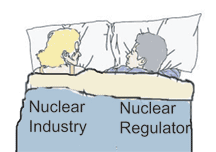 “The regulators are basically being regulated by the corporations that they’re supposedly overseeing,”
GERIATRIC NUCLEAR REACTORS COULD KILL US ALL, VICE NEWS, By Peter Rugh 26 June 13 In America, you need a license to drive an automobile, to operate heavy machinery, to hunt and fish, but apparently not to run a nuclear reactor. Entergy Corp. is slated to become the first company in history to operate a reactor without a license this fall. The Louisiana-based energy corporation’s rogue reactor is located at its Indian Point Energy Center in 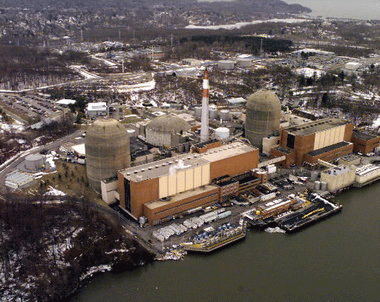 Buchanan, NY—just 24 miles from Manhattan. Entergy Corp’s license to run its Indian Point 2 reactor expires on September 28. The regulations of the Nuclear Regulatory Commission (NRC), which is charged with overseeing the civilian use of nuclear power, says it is prepared to grant the license but its hands are tied by legal challenges mounted by New York State and a federal court ruling last year. The ruling dismissed the agency’s radioactive waste management plans as inadequate.
Most of America’s nuclear plants were built in the 60s and 70s. They were given shelf lives of 40 years. It was assumed by the industry at the time of their construction that when the millennium rolled around there would be new plants up, running, and ready to replace the old fleet. But between then and now interest in nuclear power has waned due to cost and the public’s reaction to Three Mile Island, Chernobyl, and other nuclear calamities. Instead, the energy industry has sought to renew the licenses on the reactors they already operate, while keeping the cost of infrastructure improvements to a bare minimum. They’ve encountered little resistance from the NRC, which has approved 73 separate license renewals and only denied one single application in its history.
Meanwhile, the waste has piled up. The Nuclear Energy Institute, an industry policy group, estimates that US’s 104 commercial reactors have generated 69,720 metric tons of radioactive waste (spent-fuel) over the past four decades, with each plant chipping in approximately 2,000 to 2,300 metric tons each year. Nobody knows what to do with it all. Plant operators are, in a sense, shitting where they eat at the moment by storing nuclear waste onsite at the plants where it is generated. ….. Continue reading
Enewetak coral atoll transformed by US atomic bomb testing
Cactus Dome: A Concrete Cap for a Nuclear Crater http://www.slate.com/blogs/atlas_obscura/2013/06/25/the_cactus_dome_is_enormous_concrete_structure_built_over_a_nuclear_crater.html By Atlas Obscura , June 25, 2013, With its ring of verdant islands surrounding a deep sapphire lagoon, the Enewetak coral atoll was a beautiful place to launch the world’s first hydrogen bomb. After capturing the atoll from the Japanese during World War II, the U.S. evacuated the islands, exhumed its fallen soldiers to send them home for reburial, and conducted a series of nuclear tests.
Between 1948 and 1958, 43 weapons exploded over Enewetak. Among these was Ivy Mike, a world-first hydrogen bomb, 500 times bigger than Hiroshima’s Little Boy, that destroyed the entire island of Elugelab. By the time testing ceased, the entire atoll was highly radioactive, its reefs and islands dotted with craters that each measured several hundred feet in diameter. (Off the coast of Runnit what looks like a natural blue hole is the Lacrosse Crater, the results of an earlier fission test.)
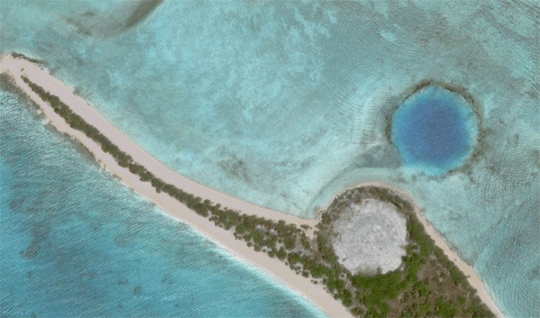
Evacuated residents began returning to Enewetak during the 1970s. It was at this time that the U.S. government determined it ought to decontaminate the islands. In 1979, a military team arrived to gather up contaminated soil and debris, mixing it with cement and piling the sludge into a 350-foot-wide blast crater on Runit Island in the atoll’s east. When the mound reached 25 feet high, army engineers covered it with a saucer-shaped concrete cap. It was dubbed the Cactus Dome, after the Cactus bomb that caused the crater.
The U.S. declared Enewetak safe for habitation in 1980. Currently, about 900 people live on the atoll though none live on the Cactus Dome. A 2008 field survey of the Cactus Dome noted that 219 of its 357 concrete panels contained defects such as cracks, chips, and vegetation taking root in joints.
Japan gets first shipment of highly radioactive MOX fuel
 FIRST MOX NUCLEAR SHIPMENT SINCE FUKUSHIMA ARRIVES IN JAPAN http://au.news.yahoo.com/latest/a/-/latest/17766227/first-mox-nuclear-shipment-since-fukushima-arrives-in-japan/ TAKAHAMA, Japan (AFP) 26 June 13, – The first reprocessed nuclear shipment since the disaster at Fukushima arrived under armed guard near the Takahama nuclear plant in Japan on Thursday, an AFP journalist at the scenereported.
The vessel had travelled for around two months with its cargo of MOX fuel — a blend of uranium and plutonium — after being reprocessed in France. The shipment will now be stored because Japan has no working reactors able to use it.
Angry shareholders demand Japanese nuclear power shutdown
“TEPCO should just shut down,” “If we have another Fukushima, Japan will not survive.”
Japan utility behind nuclear crisis faces angry shareholders at annual meeting, Yahoo 7 Finance By Yuri Kageyama, AP Business Writer | Associated Press TOKYO (AP) 26 June 13, — Shareholders angry at the utility company behind Japan’s nuclear catastrophe peppered executives with questions Wednesday about leaking radioactive water and demanded a phase-out of atomic power. Continue reading
International Energy Agency predicts bright future for solar and wind energy
 Quiz: What You Don’t Know About Solar Power http://environment.nationalgeographic.com/environment/energy/great-energy-challenge/solar-power-quiz/

Global Renewable Energy on Track to Soon Eclipse Natural Gas, Nuclear A new report predicts that renewable power energy generation will exceed that of gas and nuclear by 2016. Ker Than National Geographic June 26, 2013
 The future appears to be bright for renewable energy sources like solar, wind, and water.In fact, power generation from such renewables will exceed that of gas and nuclear by 2016, according to a report published Wednesday by the International Energy Agency (IEA).
“As their costs continue to fall, renewable power sources are increasingly standing on their own merits versus new fossil-fuel generation,” IEA executive director Maria van der Hoeven said in a statement. Continue reading
Indian Point Nuclear plant at risk, as UN downplays Fukushima effects
Critics have dubbed Indian Point, which sits on two fault lines, as “Fukushima on the Hudson”, in reference to the nuclear disaster in Japan that was sparked by an earthquake and a tsunami.
However, there are a few differences between Fukushima and Indian Point. “Fukushima was directly over the ocean, and the winds were favourable. They were blowing most of the radiation out to sea,” said Manna Jo Greene, environmental director for Hudson River Sloop Clearwater, noting that the remaining radiation was still disastrous.
But the winds in New York would blow plumes of radiation from north to south and from east to west. “There are 20 million people living within [100 kilometres], and there are 9 million people between Indian Point and the nearest ocean,” Greene told IPS.
“If there was a problem at Indian Point,” she added, “there’s a very good chance that the radiation could move in a southeasterly direction and expose millions of people to radiation before it blew out to sea.”
U.N. Downplays Health Effects of Nuclear Radiation, IPS, By George Gao, 26 June 13 UNITED NATIONS, – The United Nations has come under criticism from medical experts and members of civil society for what these critics consider inaccurate statements about the effects of lingering radioactivity on local populations. Scientists and doctors met with top U.N. officials last week to discuss the effects of radioactivity in Japan and Ukraine, and the U.N. has enlisted several of its agencies, including the International Atomic Energy Agency (IAEA), the World Health Organisation (WHO) and the U.N. Scientific Committee on the Effects of Atomic Radiation (UNSCEAR), to address the matter.
In May, UNSCEAR stated that radiation exposure following the 2011 Fukushima-Daichii nuclear disaster in Japan poses “no immediate health risks” and that long-term health risks are “unlikely”.
“I think it’s ridiculous,” said Helen Caldicott, an Australian doctor and dissident, in response to the UNSCEAR report.

“There have been health effects. A lot of people have experienced acute radiation illness, including bleeding noses, hair loss, nausea and diarrhoea,” she told IPS……. Asked why UNSCEAR and WHO released such statements if they were medically inaccurate, Caldicott referred to a 1959 WHO-IAEA agreement that gives the IAEA – an organisation that promotes nuclear power – oversight when researching nuclear accidents.
“The WHO is a handmaiden to the IAEA,” said Caldicott, Continue reading
1 This Month
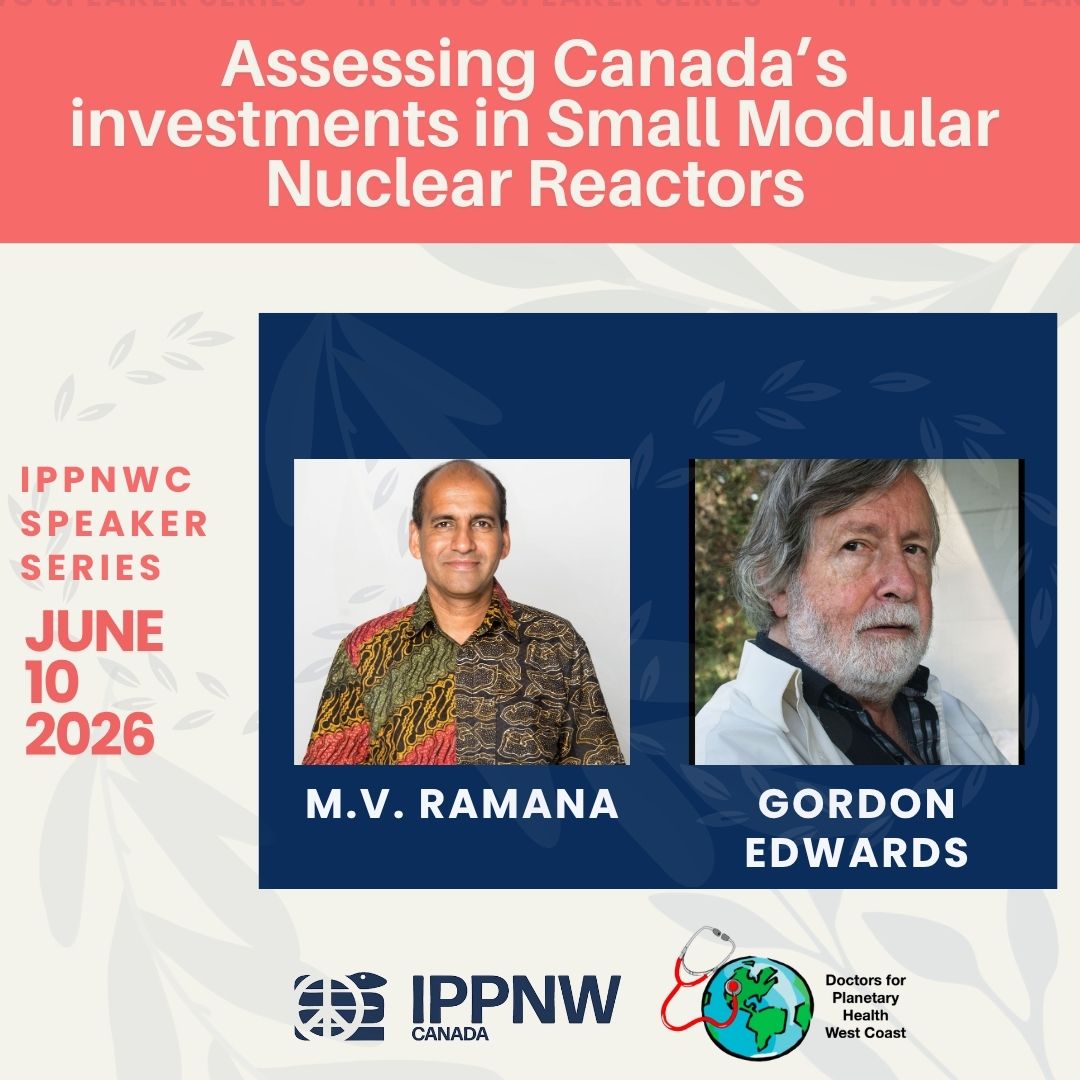
10 June – Assessing Canada’s Investments in Small Modular Nuclear Reactors – https://zoom.us/meeting/register/IiqHA5feRhaEBycOLNTJlA#/registration


Cuba Is Not a Failed State – It Is a Besieged State
PETITION: “Global Appeal to Endorse Palestinian Right of Return of Refugees”
To see nuclear-related stories in greater depth and intensity – go to https://nuclearinformation.wordpress.com
-
Archives
- June 2026 (89)
- May 2026 (306)
- April 2026 (356)
- March 2026 (251)
- February 2026 (268)
- January 2026 (308)
- December 2025 (358)
- November 2025 (359)
- October 2025 (376)
- September 2025 (257)
- August 2025 (319)
- July 2025 (230)
-
Categories
- 1
- 1 NUCLEAR ISSUES
- business and costs
- climate change
- culture and arts
- ENERGY
- environment
- health
- history
- indigenous issues
- Legal
- marketing of nuclear
- media
- opposition to nuclear
- PERSONAL STORIES
- politics
- politics international
- Religion and ethics
- safety
- secrets,lies and civil liberties
- spinbuster
- technology
- Uranium
- wastes
- weapons and war
- Women
- 2 WORLD
- ACTION
- AFRICA
- Atrocities
- AUSTRALIA
- Christina's notes
- Christina's themes
- culture and arts
- Events
- Fuk 2022
- Fuk 2023
- Fukushima 2017
- Fukushima 2018
- fukushima 2019
- Fukushima 2020
- Fukushima 2021
- general
- global warming
- Humour (God we need it)
- Nuclear
- RARE EARTHS
- Reference
- resources – print
- Resources -audiovicual
- Weekly Newsletter
- World
- World Nuclear
- YouTube
-
RSS
Entries RSS
Comments RSS
 nuclear-news