Ten Years Later, U.S. Has Left Iraq With Mass Displacement & Epidemic of Birth Defects, Cancers
democracynow.org
20 March 2012

In part two of our interview, Al Jazeera reporter Dahr Jamail discusses how the U.S. invasion of Iraq has left behind a legacy of cancer and birth defects suspected of being caused by the U.S. military’s extensive use of depleted uranium and white phosphorus. Noting the birth defects in the Iraqi city of Fallujah, Jamail says:
“They’re are extremely hard to bear witness to, but it’s something that we all need to pay attention to …
What this has generated is from 2004 up to this day, we are seeing a rate of congenital malformations in the city of Fallujah that has surpassed even that in the wake of the Japanese cities of Hiroshima and Nagasaki that nuclear bombs were dropped on at the end of World War II.”
Jamail has also reported on the refugee crisis of more than one million displaced Iraqis still inside the country, who are struggling to survive without government aid, a majority of them living in Baghdad. Click here to watch part 1 of the interview. [Transcript to come and part 1 . Check back soon.]
http://www.democracynow.org/2013/3/20/ten_years_later_us_has_left
…….Last year, Indian and Russia had signed a protocol for funding two new units at Kudankulam.
As per the protocol, Russia will extend an export credit of $3.400 billion to Russian organisations to help build the units at four per cent interest…..
I wonder if that has to do with this…?
UPDATE: Raid on Bellona’s St. Petersburg offices casts uncertain shadow over organization’s future
Lyubyanka, headquarters of the Russian FSB, is part of a new assault launched on Russian NGOs.
Coutesy of Thomas Nilsen, the Barents ObserverCharles Digges, 20/03-2013 ……
Bellona’s office in St. Petersburg yesterday got a surprise look at how the Russian government plans to enforce its law requiring NGOs that receive foreign funding to register as “foreign agents” with an unannounced inspection from the general prosecutor and other authorities.
http://www.bellona.org/articles/articles_2013/bellona_ngo_raid
Because of these?
Road to Fukushima fraught with ongoing tragedy and innovations ignored
http://www.bellona.org/articles/articles_2013/fukushima_series_three
Analysis: Fukushima two years later
http://www.bellona.org/articles/articles_2013/Nils_fukushima_comment
New Japanese nuclear regulatory agency must assert its opinion as confusion around Fukushima disaster still lingers
http://www.bellona.org/articles/articles_2013/fuku_series_last
Fukushima power outage to spent nuclear fuel storage ponds partially restored
http://www.bellona.org/articles/articles_2013/fukushima_power_outage

PTI
As engineers race to commission the nuclear power plant at Kudankulam, the government has given its nod to build two more such units of 1,000 MW at the site in Tirunelveli district of Tamil Nadu.
The Cabinet Committee on Security, at a meeting chaired by Prime Minister Manmohan Singh on Tuesday evening, approved the proposal to grant administrative and financial sanction for building units 3&4 at Kudankulam site, officials said.
The decision comes at a time when engineers of Nuclear Power Corporation of India Limited (NPCIL) are working to commission the first 1,000 MW unit of the Kudankulam nuclear power project.
Sources said the estimated cost of building the two plants has been pegged at Rs. 20 crore per megawatt.
The CCS nod paves the way for signing of the general framework agreement (GFA) between NPCIL and Russian suppliers of nuclear equipment.
The GFA will spell…
View original post 161 more words
NATO Advisory Report Urges Against Cyberstrikes on Nuclear Plants

“If you look at the way they must have organized the entire attack, it’s very impressive,” Schouwenberg said. “These guys are absolutely top of the line in terms of sophistication.”
Image source : http://krebsonsecurity.com/2010/09/stuxnet-worm-far-more-sophisticated-than-previously-thought/

March 20, 2013
An advisory report for NATO urges governments against carrying out cyberstrikes on atomic energy plants and other key non-military infrastructure, the London Guardian reported on Monday.
“In order to avoid the release of dangerous forces and consequent severe losses among the civilian population, particular care must be taken during cyberattacks against works and installations containing dangerous forces, namely dams, dykes and nuclear electrical generating stations, as well as installations located in their vicinity,” according to 20 law specialists who collaborated with the International Committee of the Red Cross and the U.S. Cyber Command in writing the NATO handbook.
http://www.nti.org/gsn/article/nato-advisory-report-urges-against-cyberstrikes-nuclear-plants/
BelTA to host online conference on nuclear energy on 22 March
….As arguments against the NPP, the statement lists the threat of an accident or a disaster prompted by an operational failure at the plant, a possible increase in cancer incidence caused by so-called “sanctioned” radiation discharges that a nuclear power plant releases even in the course of routine operation (please see a report on this subject here), the risk of another violent earthquake of the scale of the 1909 disaster (the 7.0 magnitude quake of 1909 was the strongest ever recorded in Belarus), and the dominant western winds, which would carry the radioactive fallout all over the country should an accident in fact take place….. Bellona 2009
20.03.2013 17:40
MINSK, 20 March (BelTA) – An online conference featuring Director of the Nuclear Energy Department of the Energy Ministry of the Republic of Belarus Nikolai Grusha and Advisor to the Executive Vice-President of Rusatom Overseas Sergei Boyarkin will be held on the website of the BelTA News Agency from 12:00 to 13:00 on 22 March. The conference will be titled “Nuclear power: environment, safety, advantages”.

Belarus launched its own nuclear program not so long ago; however the IAEA experts believe that our country can be called one of the most advanced newcomers. The quality of preparation works on the Ostrovets site was hailed by Russian and international experts. As early as the summer of 2013 the concrete will be poured; works on all the 62 objects of the production base and out-of-site facilities, networks and structures will be completed by September. Director General of the Russian state corporation for nuclear energy Rosatom Sergei Kiriyenko has recently visited the construction site. He praised the high quality of works and said that Belarusian construction workers might get licenses to build nuclear power plants in Russia.

Image source ; Belarus, Lithuania, and a nuclear power plant in search of a solution
Environmentalists and scientists say that nuclear power is the most promising, most advanced and the cheapest source of energy. The humankind is unlikely to come up with an alternative to nuclear power in the near future. Leading European countries remain committed to supporting nuclear energy development. Representatives of 12 EU member states, namely Bulgaria, the United Kingdom, Hungary, Spain, Lithuania, Poland, Romania, Slovakia, Finland, the Netherlands, France and Czechoslovakia have confirmed their plans to promote nuclear energy.
Even Japan announced its decision to consider resuming the nuclear power program two years after the Fukushima accident.
What is Belarus’ strategy for developing nuclear energy?
What are the advantages of the Russian NPP design?
How will the Belarusian NPP be protected from external emergencies?
Is there any connection between the NPP and greenhouse effect?
These and other questions will be answered by Nikolai Grusha and Sergei Boyarkin during the online conference.
Questions can be submitted in advance or during the conference on the BelTA website
in the section ONLINE CONFERENCE. Answers will be posted after 12:00 on 22 March real-time.
http://news.belta.by/en/news/society?id=710135
Belarus, Lithuania, and a nuclear power plant in search of a solution
Andrei Ozharovsky, 16/03-2009 – Translated by Maria Kaminskaya
GRODNO REGION, Belarus – Debates are still ongoing on the issue of possible construction of a nuclear power plant in Belarus. The suggested site is in the Ostrovets District in the Grodno Region – or just some fifty kilometres away from neighbouring Lithuania’s capital of Vilnius. Bellona’s regular contributor Andrei Ozharovsky offers a comment on the developing project and the public sentiment it is causing.
Lithuania is worried, Belarus’ Foreign Affairs Ministry is circling the wagons, and Ostrovets residents keep collecting signatures for a petition to stop the project. All the while, the Belarusian KGB – still very much alive in this former Soviet republic, which bore the brunt of the nuclear fallout from the 1986 Chernobyl disaster – is calling activists in for questioning, and the propaganda machine of the country’s nuclear establishment is painting anti-nuclear protesters as members of sex minorities, quite a stigma in a country viewed widely as one of the Eastern European states with the worst human rights record.
The site for future Chernobyl-2?
Initially, several sites were proposed to host the envisioned nuclear power plant (NPP). The choice was between the regions surrounding such Belarusian cities as Mogilyov, Vitebsk, and Grodno.
Last January, reports appeared in Belarus’ official media outlets that the choice had finally been made. The NPP is supposed to be built near the village of Mikhalishki in the Ostrovets District of the Grodno Region. However, as activists with an organisation called The Anti-Nuclear Campaign of Belarus found out, no final decision had actually been settled upon: There was only a recommendation made by a certain unidentified commission, and making a formal decision to place a new nuclear power plant at a particular site is a prerogative afforded only the president of the country.
 |
| A selection of sites were first proposed to host the future NPP: Mogilyov, Vitebsk, and Grodno (shown above is a Russian-language map of suggested NPP sites in Belarus). |
| http://www.naviny.by/ |
No reports, meanwhile, were coming that Belarusian President Alexander Lukashenko had made up his mind on the future location. One guess seems appropriate that the media were either indulging in wishful thinking or simply not quite grasping the situation. It is likewise possible that the government had engaged in a disinformation offensive:
Florida nuclear power industry defends charges for plants that may not be built!
……Legislation is in the pipeline to reverse a 2006 law that has allowed more than $800 million to be collected towards the construction of nuclear power plants that may never get built…..
…..House Speaker Will Weatherford has said that as the state’s energy demands have changed, notably the downward cost of natural gas which is expected to account for 60 percent of Florida’s energy source, he was open to revisiting the law……

Mar 19, 2013, 6:36am EDT
- JIM TURNER, THE NEWS SERVICE OF FLORIDA
Legislation is in the pipeline to reverse a 2006 law that has allowed more than $800 million to be collected towards the construction of nuclear power plants that may never get built.
But industry leaders and representatives for the state’s largest utilities on Monday praised the law, which they say has allowed them to be ready for increased demand.
Florida Power & Light Senior Director of Nuclear Development Steven Scroggs said the 2006 law has allowed the Juno Beach-based utility to acquire advantageous financing rates on projects while planning for new nuclear facilities. It can take more than six years to land federal permits and take a decade before construction begins, he said.
“We don’t really have the luxury of sitting by idly, we have to plan ahead,” Scroggs said. “Just as if we know hurricanes and tornadoes are coming we position crews in position to be able to respond quickly as soon as that weather has passed, similarly we cannot wait to make decisions about new generation investment until our customers need additional power. We have an obligation to plan far in advance.”
The law has allowed FPL to upgrade already-existing nuclear plants in Miami-Dade and St. Lucie counties, while planning for the possible construction of two new reactors.
Honeywell cleans irradiated water at Fukushima nuclear power plant
IONSIV adsorbents are expected to remain in use for the next 10 years to remove cesium and strontium from various contaminated water sources at Fukushima….

Image source : http://www.nyse.com/about/listed/lcddata.html?ticker=HON&fq=D&ezd=1Y&index=5
03/20/2013

Adsorbent materials made by Honeywell (HON) were used to clean nearly 100 million gallons of radiation-contaminated water at the Fukushima Daiichi nuclear power plant in Japan.
Honeywell’s UOP IONSIV Selective Media adsorbents have been used by Toshiba Corp. and Shaw Global Services LLC as part of the Simplified Active Water Retrieve and Recovery System (SARRY), which is being used to treat wastewater that was contaminated after the earthquake and tsunami in Japan in March 2011.
Honeywell’s UOP material has been used in the system since August 2011 and has reduced cesium to below detectable levels.
Honeywell’s UOP IONSIV Selective Media adsorbents are crystalline materials designed to selectively remove radioactive ions, particularly cesium and strontium, from liquids.
Previous generations of these products have been used commercially for more than 30 years to treat radioactive waste streams in commercial nuclear power plants, alkaline tank waste and spent fuel storage pool water. Honeywell’s UOP R9120-B adsorbent and its UOP R9160-G adsorbent were used in the cleanup efforts at the plant.
The SARRY system, developed by Toshiba, the Shaw Group and AVANTech, Inc., has operated at the plant since its installation. Cleanup efforts are still under way and IONSIV adsorbents are expected to remain in use for the next 10 years to remove cesium and strontium from various contaminated water sources at Fukushima.
April 03, 2012
“…”This investment helps us meet the demand for our newest advanced materials, as well as established products that are in demand by customers around the world,” said Mike Millard, senior vice president and general manager for Honeywell’s UOP Catalyst, Adsorbents and Specialties business. “We continue to invest in new technologies that will help meet refiners and petrochemical producers’ needs for materials that offer more flexibility, increase production and lower cost.”
IONSIV Ion Exchanger adsorbents are crystalline materials that can selectively remove radioactive ions from liquids. At Japan’s Fukushima Daiichi nuclear power plant, these adsorbents are successfully being used to reduce radioactive cesium to non-detectable levels in the plant’s contaminated wastewater after the earthquake and tsunami last year. These materials have been used commercially for more than 30 years to remove radioactive ions from liquids, such as radioactive waste streams in commercial nuclear power plants, alkaline tank waste, and spent fuel storage pool water….”
[…]
“….Honeywell UOP is a leading producer of catalysts, used in refining, petrochemical and other applications, to produce products ranging from transportation fuels to biodegradable detergents. It pioneered the adsorbents industry more than 60 years ago with the invention of the first synthetic zeolites for use as molecular sieve adsorbents. Today, in addition to a wide range of molecular sieve and activated alumina products, it offers a broad portfolio of adsorbents for the removal of contaminants such as mercury and sulfur compounds.
In addition to Mobile, Honeywell UOP produces catalysts and adsorbents in Baton Rouge, La.; Shreveport, La.; McCook, Ill..; Shanghai, China; Brimsdown, U.K.; and Reggio Calabria, Italy. The company’s New York Stock Exchange symbol is HON…..”
http://blog.al.com/press-register-business/2012/04/honeywell_company_uop_expandin.html
Strike begins at Chinese uranium mine in Niger
Wed Mar 20, 2013 3:31AM GMT
Press TV

On Tuesday, Boubacar Mamane, a spokesman for the Syntramines labor union, said 680 workers at SinoU have gone on strike to demand better wages and bonus payments, Reuters reported.
“Management refused to pay our allowances and production bonus despite having promised to do so last year. If nothing is done, we will launch an unlimited strike,” Mamane said.
SinoU officials and the Nigerien government, which owns 33 percent of the mine, were not available to comment on the action.
SinoU and its partners have a majority stake in the 700 ton-per-year SOMINA mine. Production at the mine kicked off in 2011 and is expected to increase to 2,500 tons annually in 2015.
SinoU and its partners have a majority stake in the 700 ton-per-year SOMINA mine, whose production kicked off in 2011 and is expected to increase its output to 2,500 tons annually in 2015.
In 2007, SOMINA was established 160 kilometers southwest of Arlit and 150 kilometers northwest of Agadez, in the Agadez region of northern Niger.
Niger is the top supplier of uranium to the nuclear power industry of France.
NT/HGL
http://www.presstv.ir/detail/2013/03/20/294471/strike-at-chinese-uranium-mine-in-niger/
Nuclear security breach – Theft on Savannah River Site of 12,000 workers data !

AIKEN, S.C. (AP) — Federal authorities are investigating a security breach that compromised personal information of thousands of workers at the Savannah River Site near Aiken.
The U.S. Department of Energy says no classified data was part of the information accessed. Officials say the data disclosure involved information from at least 12,000 workers at Savannah River.
The department’s Office of Inspector General is investigating.
The 310-square-mile Savannah River Site once produced plutonium and tritium for atomic bombs. Work there is now focused mostly on research and cleaning up contaminated areas.
Read more: Cherokee Tribune – Feds probing theft of Savannah River Site worker data
The Fukushima Daichi blackout was caused by a mouse/rat or lemming
Update .. slight moustake err meant mistake in headline! 🙂
In this photo released by Tokyo Electric Power Co., the carcass of a small animal lies inside a temporary electric switchboard at the Fukushima Dai-ichi plant in Okuma town, Fukushima Prefecture, northeastern Japan Wednesday, March 20, 2013. Masayuki Ono, spokesman for Tokyo Electric Power Co., the utility that runs the nuclear plant, said a 15-centimeter (6-inch) rat was found dead Wednesday near the switchboard. He said the rat may be linked to this week’s power failure, but that more investigation is needed to be sure. (AP Photo/Tokyo Electric Power Co.) EDITORIAL USE ONLY

http://www.breitbart.com/system/wire/app-471bb9fd-5dbf-44f3-b95a-f65d142633c8
Posted by Mochizuki on March 20th, 2013
The blackout was caused by a mouse in the panel board, the board has been left on the truck since 3/18/2011
According to Tepco, the power blackout of Fukushima plant was caused by a mouse that came in the terminals to have caused a short circuit.
The panel board was provisionally installed on the bed of a truck on 3/18/2011. Knowing the risk, Tepco has been leaving it there.
The panel board was for reactor 3 and 4. There are 6 more provisional panel boards for these reactors.
The terminal and the wall were burnt and the mouse was dead underneath.


🙂 err maybe not that last one but you can see more pics and other fukushima related stories here ; http://fukushima-diary.com/2013/03/the-blackout-was-caused-by-a-mouse-in-the-panel-board-the-board-has-been-left-on-the-truck-since-3182011/?utm_source=feedburner&utm_medium=feed&utm_campaign=Feed%3A+FukushimaDiary+%28Fukushima+Diary%29
Message to TEPCO!
About humane mouse traps
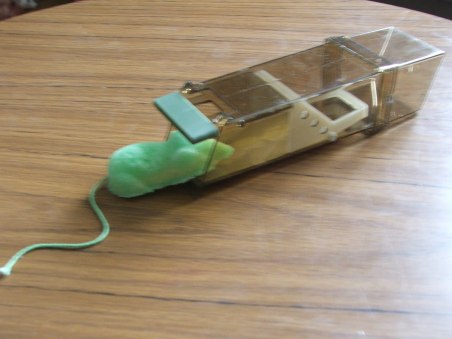
“Mouse causes meltdown!” .. future headline? might be “Rat causes radiation”?
India a market for nuclear power suppliers… if the price is right
“I want to argue with them why i should pay the bribe to you but i couldn’t dare to argue with police because i was single and there were 4 other policemen staring at me.” The myth of an official’s capability to deny or delay services rules the roost in government offices. .. http://www.ipaidabribe.com/
….Sazawal said the United States could play a major role in the development of nuclear power in India….
…But Geoffrey Pyatt, principal deputy assistant secretary of state for South and Central Asian Affairs, speaking at a nuclear expert controls seminar last November, said India’s nuclear liability law “is not in line with the international nuclear liability principles reflected in the Convention on Supplementary Compensation for Nuclear Damage.”…..
[Emphasis added]

He recommended U.S. companies invest in local Indian businesses and learn from local entrepreneurs “who deal with India’s cumbersome bureaucracy and legal system, and still make good money along the way.”
New Delhi (UPI) Mar 19, 2013
Despite concerns about its nuclear liability law, India continues to be “a land of opportunity for global nuclear power suppliers,” said an adviser to the United States.
“It is possibly the only nuclear market where vendors will not be asked to compete against each other to provide the lowest bid,” Vijay Sazawal, a member of the U.S Civil Nuclear Trade Advisory Committee, told Press Trust of India.
Noting that India’s interest in purchasing U.S.-made reactors is genuine, Sazawal said the U.S. government is doing its best to work out administrative and legislative hurdles to help U.S. companies succeed in the Indian market.
China Suspends Nuclear Power Plant Approval – Bad news for uranium shares!
Chai Guohan, chief engineer of nuclear safety and radiation at the MEP, said China’s nuclear power industry is running short on management personnel, and the expansion has made already-scarce human capital even thinner.
He added that legislative framework of nuclear safety practices needs to be improved, with emphasis given to updating laws, not just regulations……
Image source : More Good News For Uranium: China’s Nuclear Energy Build-Out (oops! that didn’t work out then! 🙂 )

By staff reporter Cao Haili
The decision, made during a March 16 State Council meeting, included orders to review safety-related infrastructure in all existing power plants
(Beijing) — China has suspended approvals of new nuclear power plants and plans to launch a thorough inspection on all existing nuclear facilities, in a bid to improve overall nuclear safety standards following Japan’s earthquake-triggered nuclear crisis.
The decision was made on March 16 during a meeting of the State Council presided over by Premier Wen Jiabao. As China’s top nuclear power regulatory body, the Ministry of Environmental Protection (MEP) quickly unveiled a series of guidelines advising civil nuclear power plants to take disaster stress tests on planned and existing projects.
Follow-up efforts will include additional safeguards to bolster nuclear plants against large natural disasters. Such catastrophes are considered rare, and contingency plans against them are said to be weak.
Updating existing nuclear plants to match safety features of newly-built plants are also part of the MEP’s nuclear industry regulation overhaul.
Of all the nuclear plants currently under construction in China, many will be using model reactors, which feature an advanced passive safety system that have faster shutdown systems in times of emergency compared to failed reactor in Japan.
Upgrading safety-related infrastructure is not the only challenge facing China’s nuclear industry. The country’s rapid expansion of its nuclear capacity has put an enormous strain on relevant agencies to keep up with supervision and regulatory work, according to a statement published by the MEP.
Chai Guohan, chief engineer of nuclear safety and radiation at the MEP, said China’s nuclear power industry is running short on management personnel, and the expansion has made already-scarce human capital even thinner.
He added that legislative framework of nuclear safety practices needs to be improved, with emphasis given to updating laws, not just regulations.
More Good News For Uranium: China’s Nuclear Energy Build-Out
By Mike Kapsch, Investment U Research
Thursday, February 14, 2013
It’s no secret uranium prices have plummeted since the Great Recession and Japan’s Fukushima disaster. In 2007, a pound of U3O8 was worth as much as US$136. Today, the same amount sells for just US$43.88.
Yet, of all the places you could invest this year, I’d say one of the best will be the nuclear industry… Especially in miners that export uranium to China. Why?
Power Restored at Fukushima I Nuke Plant, TEPCO Still Don’t Know What Went Wrong
Tuesday, March 19, 2013
EXSKF
http://ex-skf.blogspot.co.uk/2013/03/power-restored-at-fukushima-i-nuke.html
TEPCO still doesn’t know what caused the power failure and how, therefore does not have measures in place to prevent any future power failure. Pressure from the national government was clearly on the operator to just start cooling and not worry about minor details like what caused the failure.
Ad hoc has been the name of the game for the past two years. Why change now?
Asahi Shinbun (3/20/2013; part):
今回の停電は、東日本大震災での事故以降では最大規模。だが原因は特定できていない。東電によると、停電の発端と みられる不具合が起きた3、4号機につながる仮設の配電盤は、目で見て分かる異常は確認できなかったという。当初は原因を突き止め、対策を講じた上で復旧 させる予定だったが、復旧を優先させることにし、仮設配電盤を通さずに、別の配電盤に冷却装置を接続することで電源を確保した。
The power outage this time was the most severe since the start of the accident. However, the cause of the outage hasn’t been identified. According to TEPCO, there was no visible sign of abnormality in the temporary switchboard that is connected to Reactors 3 and 4, where a trouble that led to the power outage was thought to have started. The company had initially planned to identify the cause, install measures to prevent future problems, and then turn the power back on. However, restoring the power was given the priority, and the cooling systems were connected to a different switchboard, circumventing the temporary switchboard.
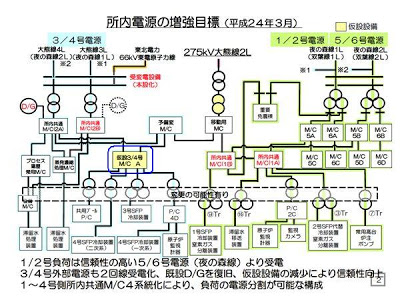
The particular temporary switchboard is “3/4 M/C (A)” (M/C stands for “metal clad”). The location (or connection) of the switchboard in the overall electrical system looks different in the two different diagrams below. Either way, I don’t quite understand why Reactor 1 should be affected by the failure of this switchboard, as the Reactor 1 cooling system does not appear to be connected to this switchboard.
As TEPCO’s spokesman Ono explained it (via Ryuichi Kino),
所内共通M/C」(2A)と(2B)にも波及
[The trouble at “3/4/ M/C (A)”] had the ripple effect on Plant-wide common M/C (2A)(2B)
(I don’t have a clue as to how that could happen.)
3/4 M/C (A) (in blue circle that I added), in the diagram provided by TEPCO in the press conference on March 19, 2013, via Ryuichi Kino:
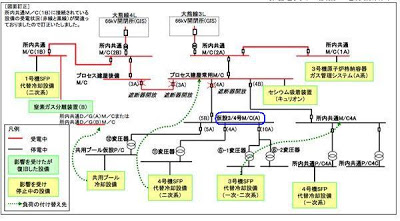
3/4 M/C (A), in the diagram from March 2012, from then-Nuclear and Industrial Safety Agency (NISA, also from Ryuichi Kino:
The USA begins producing plutonium-238 again for the first time in 25 years!
….The U.S. Department of Energy’s plutonium reboot has not yet advanced beyond the test phase, but NASA is confident that production will eventually ramp up enough to power space probes for several decades to come….
Date: 19 March 2013

The United States has begun producing plutonium-238 again for the first time in a quarter century, marking a key step toward averting a feared shortage of this important spacecraft fuel, NASA officials say.
The U.S. Department of Energy’s plutonium reboot has not yet advanced beyond the test phase, but NASA is confident that production will eventually ramp up enough to power space probes for several decades to come.
“That’s going to revive our supply and allow us to be able to complete a number of potential plutonium-necessary missions over this decade, and position us well into the decade after that,” Jim Green, head of NASA’s planetary science division, said Monday (March 18) at the 44th Lunar and Planetary Science Conference in The Woodlands, Texas.
http://www.space.com/20290-plutonium-spacecraft-nasa-fuel.html
…Plutonium-238 is not a bomb making material, unlike its isotopic cousin plutonium-239. But Pu-238 is radioactive, emitting heat that can be converted to electricity using a device called a radioisotope thermoelectric generator (RTG)….

http://sagansense.tumblr.com/post/45794511491/electricspacekoolaid-us-makes-first-plutonium
US Army lieutenant colonel accused of passing nuclear secrets to Chinese mistress
….The defense contractor first met the 27-year-old Chinese national during a conference on international military defense issues in Hawaii. The woman had been living in the US on a student visa. The affidavit notes that the woman “represented to Bishop that she did not want him to disclose classified information to her,” but then “continued over time to question Bishop on matters relating to the subject of his work.” From May 2011 until December 2012, he allegedly relayed classified national defense information to her and became romantically involved with her starting June 2011…..
Image source : (not connected to article but cool picture) http://noirwhale.com/2012/08/27/femme-fatales-anna-may-wong/

Posted on March 19, 2013
A Hawaii-based US defense contractor is facing charges for giving classified defense information, including top secret information about nuclear weapons, to a 27-year-old Chinese woman that he had a romantic interest in.
Benjamin Pierce Bishop, a 59-year-old Army Reserve lieutenant colonel who works as a civilian employee of a defense contractor at the US Pacific Command, was arrested at the command’s headquarters on Friday. He is scheduled to appear in court this week where a judge will decide whether he will remain locked up throughout his case.
The US District Court in Honolulu is prosecuting the man for an email he sent to the Chinese woman, detailing America’s war plans, nuclear weapons stockpile and the country’s relations with foreign partners. The court also alleges that Bishop told the young woman about the deployment of US strategic nuclear systems and the government’s ballistic missiles detection capabilities, according to the complaint.
The transmission of this information to foreign nationals could cause “serious danger to US national security,” the complaint reads.
Bishop is being charged with one count of deliberately relaying national defense information to someone not qualified to receive it, as well as one count of unlawfully retaining national defense documents. If convicted, he faces a maximum penalty of 20 years in prison.
Australian government approves nuclear irradiation of tomatoes

Submitted by kim.stewart on Wed 20 Mar 2013 11:34am
http://brisbane.foe.org.au/content/australian-government-approves-nuclear-irradiation-tomatoes
The irradiation of tomatoes & capsicums (bell peppers) has been approved by Food Standards Australia New Zealand (FSANZ) today.
In Australia, all irradiation is done with nuclear material.
RE: APPROVAL OF IRRADIATION OF TOMATOES & CAPSICUMS (A1069)
Dear Member of the Australia New Zealand Food Ministerial Council,
On March 19, Food Standards Australia New Zealand announced its approval of Application A1069, for the irradiation of tomatoes and capsicums.
As a member of the Ministerial Council you have final decision making power over this approval. I call on you to reject this application as the irradiation of these popular foods is not in the public interest.
The irradiation of food has not been proven safe. I am extremely concerned that FSANZ continues to ignore scientific evidence highlighting the problems with irradiation, including vitamin depletion and the production of radiolytic products – chemicals formed in food when it is exposed to radiation, such as benzene, formaldehyde and cyclobutanones.
In 2009, the irradiation of cat food was outlawed in Australia after up to 100 cats developed neurological disorders after consuming irradiated cat food. There is no science proving this effect to be species specific, however, the irradiation of food for human consumption is still permitted in Australia and New Zealand.
Furthermore, while I applaud the government for its decision to phase out the uses of some pesticides, I vehemently oppose the promotion of irradiation as the “alternative”. Numerous alternatives exist, including other chemical treatments, physical disinfestation, creation of pest-free zones and organic production.
I also am alarmed that FSANZ appears to function as a defacto promoter of irradiation, rather than a judicious adjudicator on the matter. FSANZ continues to ignore scientific modelling and consumer information that challenges its pro-irradiation stance.
As a member of the Ministerial Council, you have responsibility to ensure safe and healthy food for our community and to prioritise that over food corporation interests.
The irradiation of tomatoes and capsicums poses a risk to our community and is not in the public interest. A1069 must be rejected.
I look forward to hearing your response to my concerns,
Yours faithfully,
Name
Australian Government:
Hon Tanya Plibersek MP
Minister for Health and Ageing
150 Broadway, Chippendale NSW 2008 Minister.Plibersek@health.gov.au
The Hon Catherine King, MP
Parliamentary Secretary for Health and Ageing
PO Box 6022, House of Representatives
Parliament House Canberra ACT 2600
1 This Month
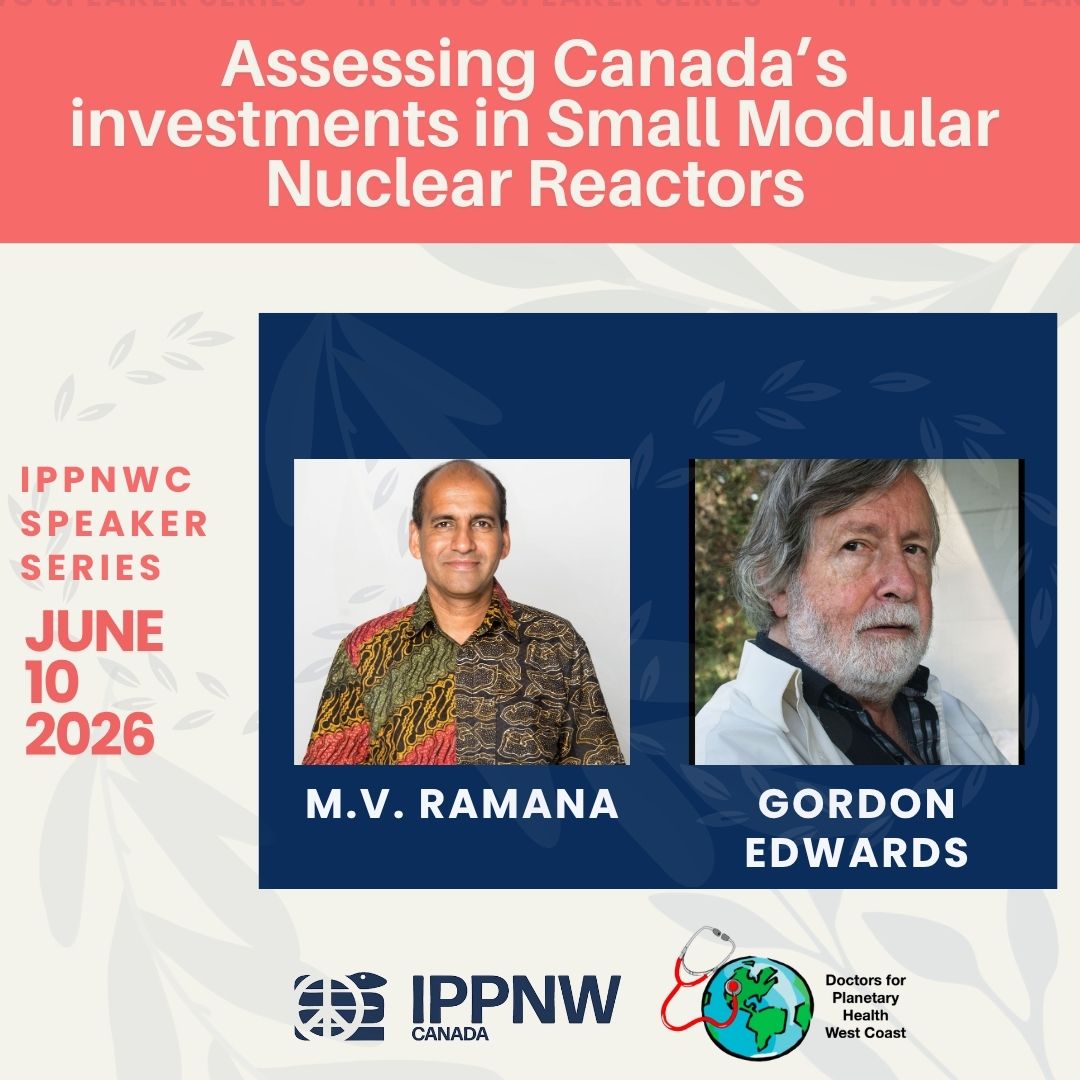
10 June – Assessing Canada’s Investments in Small Modular Nuclear Reactors – https://zoom.us/meeting/register/IiqHA5feRhaEBycOLNTJlA#/registration

Cuba Is Not a Failed State – It Is a Besieged State
PETITION: “Global Appeal to Endorse Palestinian Right of Return of Refugees”
To see nuclear-related stories in greater depth and intensity – go to https://nuclearinformation.wordpress.com
-
Archives
- June 2026 (89)
- May 2026 (306)
- April 2026 (356)
- March 2026 (251)
- February 2026 (268)
- January 2026 (308)
- December 2025 (358)
- November 2025 (359)
- October 2025 (376)
- September 2025 (257)
- August 2025 (319)
- July 2025 (230)
-
Categories
- 1
- 1 NUCLEAR ISSUES
- business and costs
- climate change
- culture and arts
- ENERGY
- environment
- health
- history
- indigenous issues
- Legal
- marketing of nuclear
- media
- opposition to nuclear
- PERSONAL STORIES
- politics
- politics international
- Religion and ethics
- safety
- secrets,lies and civil liberties
- spinbuster
- technology
- Uranium
- wastes
- weapons and war
- Women
- 2 WORLD
- ACTION
- AFRICA
- Atrocities
- AUSTRALIA
- Christina's notes
- Christina's themes
- culture and arts
- Events
- Fuk 2022
- Fuk 2023
- Fukushima 2017
- Fukushima 2018
- fukushima 2019
- Fukushima 2020
- Fukushima 2021
- general
- global warming
- Humour (God we need it)
- Nuclear
- RARE EARTHS
- Reference
- resources – print
- Resources -audiovicual
- Weekly Newsletter
- World
- World Nuclear
- YouTube
-
RSS
Entries RSS
Comments RSS
 nuclear-news