Reassessing the health effects of the Fukushima Daiichi nuclear accident
While the Japanese tsunami of March 2011 was devastating in its own right, the long term health consequences because of the damage to the nuclear reactor at Fukushima Daiichi are also of serious concern.
There are a number of factors that have to be considered when assessing the health effects of radiation exposure: for example land decontamination efforts, size of evacuation area, shielding by buildings and terrain and consumption of contaminated food.
Jan Beyea, from the US expert consulting service Consulting in the Public Interest, together with fellow colleagues has been analysing previous calculations of the subsequent nuclear accident in Japan, and believes that the number of predicted future mortalities from cancer is higher than originally predicted. ‘Health consequences predicted for the Fukushima Daiichi accident are dominated by “groundshine” gamma radiation from the decay over several decades of dispersed radioactive caesium. Although an individual’s risk is small, the mid-range, predicted number of future mortalities from cancer is closer to 1000 than the 125 figure calculated without considering long-term groundshine [gamma radiation emitted from radioactive materials deposited on the ground].’
 What are the long-term consequences for public health following the 2011 disaster in Fukushima?
A critical part of calculating the consequences of a nuclear accident is the treatment of the gamma ray dose from land contaminated with caesium-134 and caesium-137. Radiocaesium isotopes can also be responsible for extra cancers that can be expected years after the initial exposure. It is these long-term doses in the environment that were not included in the original estimations.
Lynn Anspaugh, from the University of Utah, US, who works in the field of radiology and reconstructing radiation doses and who analysed the Chernobyl accident, agrees that Beyea’s research points out several inaccuracies in the previous work. However, he feels that the real question this work raises regards the future of nuclear power itself. ‘Both accidents had a root cause in poor judgments having been made by humans. If nuclear power is to have a future, its proponents must indicate how they can make such reactors fail safe and how they will assure that siting decisions do indeed take account of possible, or even likely, natural events.’
Beyea hopes that this work will help improve models of accident consequences as well as future emergency planning and response. When discussing the future of this type of research he adds: ‘Quantifying the psychological and physical effects of stress following large releases of radioactivity may be the next frontier in consequence analysis.’
From the Enenews article
The last sentence in the Chemistry World article disturbs me.
“Quantifying the psychological and physical effects of stress following large releases of radioactivity may be the next frontier in consequence analysis.”
Those lucky Consequence Analysts
may have new reasons for funding to acquire,
and a new frontier
to fill with scholarly papers adored,
on the topic of stress that’s so deplored,
adding weight to the theme of radiophobes,
those folks here-to-fore mostly ignored,
who need counselling to have their confidence restored,
so that radioactivity need not be abhored,
and with drugs and therapy be happy once more.
Paladin energy (Uranium mining) having some difficulties.. final death throes?
“…I have looked at the numbers for all the big public miners and the average cost to run the businesses is about $106/lb. So at $40/lb they are losing about $66 on every pound they sell. You can’t make that up without the price going up. So, yes, I think we are going to see the price come up. I absolutely think that we’ve seen the bottom. I think $80/lb is not unreasonable and $100+/lb is more likely….”
“…One company I was concerned about was Paladin Energy Ltd. (PDN:TSX; PDN:ASX). I told my readers that they should be very careful. It has some great assets and a long-term supply contract with one of the French utilities, but it’s experienced some problems turning a profit. So going back to acquisitions, it might make sense for a big mining company to take over Paladin. It has a lot of debt. It’s a $712 million ($712M) market value with $830M in debt. In addition, the company has $125M of convertible bonds coming due in two months, which will lead to converting up to 147M shares. That’s a big dilution. This might be something for readers to look at down the road after these bonds convert. If the share price sinks below a significant point where the dilution’s not going to hurt quite as badly, that could be a possibility. It may be that Paladin is worth a flyer for its assets after the dilution happens….”
“…..TER: Any final advice for energy investors?
MB: I’m pretty excited about the developments that are going to happen, but you have to be careful….”
image courtesy http://www.tischendorf.com/2010/04/22/uranium-price-turnaround-some-technical-analysis-thoughts/

For nuclear-news subscribers.. This gentleman loves nuclear i suspect.. i have highlighted some sentences.. .. but i had to add the context..and the odd comment.. oh and an article at the bottom.. now im off for a tea.. to relax… and forget 🙂 interesting article though!
Uranium $100+/Pound Needed to Satisfy Stealth Demand
Commodities / UraniumJan 25, 2013 – 09:35 AM
By: The_Energy_Report
What’s the easiest way to track the ups and downs of energy markets? Watch what governments are doing rather than what they are saying, says S&A Resource Report Editor Matt Badiali. He has been watching behind-the-scenes nuclear energy importing in Germany and Japan and has concluded that the uranium market has hit bottom and is coming back up. What companies could benefit from these gyrations? He has an answer to that one in this Energy Report interview, plus some words of wisdom on U.S. oil and gas bottlenecks.
The Energy Report: In a recent piece for the S&A Resource Report titled “Government Lies and an Emerging Resource Opportunity,” you said that statements by German and Japanese officials that they plan to be nuclear free in the next two decades were a cover-up for what they’re really doing, which is importing nuclear power from other countries and secretly developing uranium supplies in former Soviet countries. How long can they hide these energy sources?
Matt Badiali: It’s not a case of hiding them. In both cases, the governments are playing politics. In Germany, the government was reacting to negative press and in Japan, which had just experienced a serious natural disaster. The Japanese government told people for decades that nothing of that sort could ever happen, that the nuclear reactors were completely impervious to natural disasters. That put them in a position where if they tried to make any improvements, they would lose face. They backed themselves into a corner and the only solution seemed to be to turn off the reactors. But the reality is that Japan needs nuclear energy. Without it, liquefied natural gas (LNG) imports have soared and the country doesn’t have the infrastructure to move it around. The result was a horrendous summer of spiking electricity prices and rolling brownouts; it was bad news.
[????? ARCLIGHT]
Germany used the Fukushima disaster and the negative sentiment that followed to push through a carbon-free agenda. What is really ironic is that Germany is not in a place that gets earthquakes or tsunamis. It is not at any risk for that. It also isn’t a place where solar power works really well. Turning off the nuclear plants leaves the country without adequate energy generation infrastructure, so they increased imports of electricity from France. However, over 75% of France’s electricity is generated by nuclear power plants. So really all they did was outsource their nuclear reactors. At the same time, they brought on an enormous amount of coal power, which is the single-worst contributor of carbon dioxide. It was politics at its finest.
[SEE ARTICLE BELOW i couldnt bear this paragraph.. had to respond !.”French & German Wind Likely Made the Difference during Arctic Cold Spell”…. ARCLIGHT]
TER: Is the German press not reporting on this? Are people not wondering where their energy is coming from?
MB: I don’t read the German press, but what I do see is that the Germans are paying an enormous surcharge for a modest amount of carbon-free electricity. I don’t know why there has not been a massive backlash in Germany. If I lived there, I would be furious about the costs. In France, it costs about €0.14 per kilowatt hour (KWh) of electricity. In Italy it costs about €0.20/KWh. In Germany it costs €0.25/KWh. That’s an 85% increase in the cost of electricity. It’s really amazing, and I haven’t seen any pushback.
India hopes to restart nuclear talks with Japan soon
“…Japanese atomic power companies have been eyeing the huge nuclear market opened up for the world by the Nuclear Suppliers Group’s 2008 waiver for India. Besides, even the US companies, which partnered with Japanese firms, need a deal between Tokyo and Delhi to be able to sell India nuke technology and equipment with components originating from Japan…”
Negotiations were suspended after Fukushima disaster
India is expecting an early restart of the stalled talks for a bilateral civil nuclear cooperation agreement with Japan, with the new government in Tokyo led by Prime Minister Shinzo Abe set to review the erstwhile regime’s decision to move towards bringing down the country’s reliance on atomic energy.

Image from this article http://www.thehindu.com/news/national/article2580648.ece
New Delhi and Tokyo are understood to be exploring the possibility of a visit by Prime Minister Manmohan Singh to Japan for the annual bilateral summit, which was put off in November due to fast-paced political developments that eventually led to an election and Abe took over as the new prime minister of the East Asian country, succeeding Yoshihiko Noda.
Abe’s Liberal Democratic Party’s professed policy on nuclear energy is significantly different from the one pursued by the erstwhile regime of the Democratic Party of Japan in the aftermath of the mishap at Fukushima-Daiichi nuclear plant following an earthquake and tsunami along the country’s east coast on March 11, 2011. This has rekindled New Delhi’s hope for resumption of its nuke talks with Tokyo.
Europe ‘has failed to learn from environmental disasters’
“…In a sharp rebuke to pro-nuclear advocates who have argued that the accident produced very few extra cancers, it argues that it is wrong to focus solely on cancer as an outcome of Chernobyl. “Post-Chernobyl non-cancer impact may be very great, including immunological disorders, and cardiovascular disease – especially among the young,” it says.
Reactor accidents are said to be by far the single largest risk now facing the nuclear industry. According to the study, the probability of a future major nuclear accident has increased 20-fold since Fukushima
An urgent re-appraisal of the way that nuclear power stations are assessed for safety is long overdue, says the study…”
Report says thousands of lives could have been saved and damage to ecosystems avoided if early warnings heeded
- guardian.co.uk, Wednesday 23 January 2013 06.00 GMT
Europe has failed to learn the lessons from many environmental and health disasters like Chernobyl, leaded petrol and DDT insecticides, and is now ignoring warnings about bee deaths, GM food and nanotechnology, according to an 800-page report by the European Environment Agency.

Thousands of lives could have been saved and extensive damage to ecosystems avoided if the “precautionary principle” had been applied on the basis of early warnings, say the authors of the 2013 Late Lessons from Early warnings report published on Wednesday.
They accuse industry of working to corrupt or undermine regulation by spinning and manipulating research and applying pressure on governments for financial benefit. “[It has] deliberately recruited reputable scientists, media experts and politicians to call on if their products were linked to possible hazards. Manufacturing doubt, disregarding scientific evidence of risks and claiming over-regulation appear to be a deliberate strategy for some industry groups and think tanks to undermine precautionary decision-making.”
The peer-reviewed study, which is aimed to improve understanding of scientific information, looks at 18 areas including radiation from mobile phones, birth control pills in the aquatic environment, and invasive species. It found that governments often introduced laws much too late to prevent deaths and massive financial costs, but were highly likely to ignore scientific warnings and resist any regulation. The authors found more than 80 cases where no regulation was introduced when it later turned out that the risk from a technology or chemical was real, or still unproven.
Nuclear power
The study says the Fukushima disaster in 2011 may have released twice as much radiation as the Japanese government admitted. The emissions of radioactive caesium-137 from Fukushima are said to have started earlier than the authorities have claimed, to have lasted longer, and to have spread over a wider area of land than previously believed.
Norway confirms great potential for CO2 storage but is a bit of a climate skeptic?
“…Bellona does however question the Norwegian Government’s reluctance to implement the EU CCS Directive (2009/31/EC). Norway thereby joins a club of only a handful of the EU’s 27 Member States, led by the climate-sceptical Poland. The Directive has been deemed EEA relevant, which adds a clear pressure to move forward in implementing it, but it seems obvious that the Norwegian Government are using unnecessary delaying tactics in order to avoid doing so…”
http://priceofoil.org/2009/07/02/exxon-still-funding-sceptics/

The Norwegian Petroleum Directorate (NPD) states in a new report, released on 25 January, that significant amounts of CO2 can be stored in the Norwegian Sea. The potential for safe storage of CO2 in the Norwegian parts of the North Sea could amount to 5.5 gigatonnes.Sirin Engen, 25/01-2013
Although the potential for storing very large amounts of CO2 in the Norwegian Sea was already well-known, as seen in the “CO2 Storage Atlas” from December 2011 for example, a final confirmation from the NPD qualifying this is very welcome.
The quantified amount of 5.5 gigatonnes is more than 100 times Norway’s total CO2-discharge in 2012.
Potential and opportunities for the EU
Bellona regards this as very good news in a European perspective as well, particularly due to the fact that fears relating to CO2 storage erode public support for CCS. In addition, the EU Energy Roadmap 2050 clearly states that the role of fossil fuels in Europe will be dependent on the implementation of CCS. The positive prospective for storage discovered in the Norwegian Sea could play a vital role in managing CO2 emissions in Europe by offeringstorage space to European countries that are lacking in this capacity.
Norwegian hesitation
Bellona does however question the Norwegian Government’s reluctance to implement the EU CCS Directive (2009/31/EC). Norway thereby joins a club of only a handful of the EU’s 27 Member States, led by the climate-sceptical Poland. The Directive has been deemed EEA relevant, which adds a clear pressure to move forward in implementing it, but it seems obvious that the Norwegian Government are using unnecessary delaying tactics in order to avoid doing so.
A Norway that chooses to take part in the international development of CCS could be proven very positive. The country already has valuable experience from Sleipner relating to the financial responsibility for stored CO2. Such expertise can be of great benefit to the EU, Canada and other countries in the world that are attempting to develop CCS demonstration projects.
The way forward
The NPD plans to map out the entire Norwegian shelf, particularly the Barents Sea, in search of suitable areas for CO2 storage.
http://www.bellona.org/articles/articles_2012/1359128467.64
Read more about CO2 storage on Bellona’s CCS web.
Stop NDAA – Flood the courthouse on February 6th 2012 -Details here!
Please help us get this important information out as far and as wide as possible! The time has come when we need to rally passionate support, and draw more and more attention to what’s taking place in the United States. It will be cold, but so necessary! We hope to see you, and many others there for this!

Please help us get this important information out as far and as wide as possible! The time has come when we need to rally passionate support, and draw more and more attention to what’s taking place in the United States. It will be cold, but so necessary! We hope to see you, and many others there for this!
Can we govern ourselves using digital technology? – Truthloader LIVE with Birgitta Jónsdóttirand -crowd sourced constitution
Fue 31 January 2013 live .. subscribe to this You Tube channel and here is a video explaining the details;
Call to Action! Appeals Court Date – Feb. 6, 2013
Our second circuit court date has been set for Wednesday, February 6, 2013 at 10AM, in the United States Court of Appeals for the Second Circuit – Thurgood Marshall Courthouse, 40 Foley Square, Room 1505 on 15th floor. If you support our efforts to restore your rights and are in the New York area, please publicly show your support by joining us in court this day! Your presence matters. Please share this widely, and invite your friends!
On September 12, 2012 we had one of the biggest victories for civil liberties and against government overreach in a decade. Federal Judge Katherine Forrest granted a permanent injunction against Section 1021(b)(2), the government promptly filed an appeal, and then went further: they requested a stay of execution on the injunction from Judge Forrest, once again providing no evidence and failing to answer all of her questions and concerns, while again claiming that the detention powers of the Authorization for Use of Military Force (AUMF) of 2001, (the law that allows the president to detain those who were involved in the 9/11 attacks and/or are members of Al Qaeda or the Taliban) and the NDAA’s Section 1021 powers are precisely the same.
This is disingenuous. Section 1021 provides sweeping powers of detention through incredibly vague and undefined terms, that are missing in the AUMF. The government is completely contradicting itself. Judge Forrest made it clear that her ruling did not touch the AUMF. And in their request for an emergency stay, the government claimed “irreparable harm” would be incurred if they do not have the powers of Section 1021. On October 2, 2012, a stay against the permanent injunction was granted by a three judge motions panel of the Second District US Court of Appeals, pending appeal on the merits.
http://www.facebook.com/birgitta.jonsdottir.english/posts/589302221084319?notif_t=notify_me
Russia’s nuclear power plants: Cruising planes with no landing in sight
“…Furthermore, Russia’s nuclear authority seems to choose to treat NPP decommissioning as a strictly technical task – one that will ostensibly be solved simply by providing a set of rules and instructions. In fact, decommissioning a nuclear power plant is a process that also implies solving a range of environmental, social, and even moral problems. A serious and thorough approach requires preparing for this process as early as the NPP designing stage…”
ST. PETERSBURG – What can Russia do with the nuclear power reactors that have exhausted their useful life terms? Where will the decommissioning funding come from? What options can be offered to the workforce employed at these power plants? And how can Russia benefit from international experience in decommissioning old reactors? Representatives of environmental NGOs tried to find answers to these questions during a recent international round-table discussion in St. Petersburg.
Yevgeny Usov, 25/01-2013 – Translated by Maria Kaminskaya
Published by Bellona
Nothing lasts forever
When the first nuclear power plants (NPPs) were being built in the Soviet Union, their designers didn’t have a very clear idea about what should happen with the reactors once their engineered life spans were over. If they did, then this issue found no reflection either in the plants’ project documentation or in the country’s long-term development plans. This may be why the Russian nuclear power industry today seeks to employ a variety of “modernizations” to extend the reactors’ life terms for as long as can be allowed – even as half of Russia’s 32 commercial reactors have been operating past their expiration dates, and still they remain in service.
There are also reactor units that have been taken out of operation: Units 1 and 2 of Novovoronezh and Beloyarsk NPPs were shut down over 20 years ago. Spent nuclear fuel has been removed from the reactors, but the actual decommissioning – dismantling the aged equipment, decontamination of the area, and other steps involved in the process – has been postponed indefinitely for lack of a comprehensive decommissioning concept and the needed funding.
“All the while, the time is approaching when dozens of reactors will all be nearing the end of their service life periods. And this process will have a snowball effect,” said Oleg Bodrov, chairman of the board of the St. Petersburg-based Zelyony Mir (Green World). “Russia doesn’t have enough experience decommissioning large nuclear power plants. This could trigger a serious socioeconomic crisis in those regions where the [expiring] NPPs are operated.”
Will anyone fly on a plane that will be unable to land?
This question, when it was sounded at the seminar in St. Petersburg, served as a metaphor hinting at the need to have a developed decommissioning concept as a logical stage in nuclear power plant projects, one that must be well worked out beforehand much like a future NPP’s construction or operation period. But though Russia has a federal nuclear power plant construction program, it never had and still has no program detailing the decommissioning of nuclear power plants.
 |
| This chart (click to enlarge) represents the Final Decommissioning Plan for Lithuania’s Ignalina NPP, where the remaining second unit was shut down on December 31, 2009 (following the closure of the first unit, in December 2004). In 2006, Ignalina NPP had purchased a decommissioning planning tool – Decommissioning Management System and Database (DMSD) – from Germany’s Greifswald NPP. Source: Ignalina NPP official website at http://www.iae.lt |
| Ignalina NPP official website at http://www.iae.lt |
Paladin to cut Malawi Staff at Kayerekera mine.. Running out of money to fulfill promises.
“…not doing enough in as far as social corporate responsibility towards the development of Karonga and the entire Malawi nation at large is concerned…”
Paladin Africa Ltd required to “..fulfill promises it had made to the people of Karonga…”
“..The company has been able to remain in operation only due to the support by the parent company Paladin Energy Ltd..”

Nuclear re-licensing to go ahead, even though no new Waste Confidence Rule yet?
The court disapproved of the NRC’s continued relicensing of nuclear facilities based on the assumption of a long-term geologic repository that in reality did not exist – and the NRC said it was suspending licensing pending a new rule – but now regulators say they don’t anticipate the denial or even the delay of any reactor license application while they await the new waste confidence decision [PDF, pp. 49-50].
In fact, the NRC has continued the review process on pending applications, even though there is now no working Nuclear Waste Confidence Decision (NWCD) – something deemed essential by the courts – against which to evaluate new licenses.
The NRC is looking for a way to permit the continued operation of the US nuclear fleet – and so, the continued manufacture of nuclear waste – without an answer to the bigger, pressing question

 Seventy Years of Nuclear Fission, Thousands of Centuries of Nuclear Waste ,25 January 2013 By Gregg Levine, Truthout Lack of Permanent Spent Fuel Storage Looms Large
“……….When a US Court of Appeals ruled in June that the Nuclear Regulatory Commission (NRC) acted improperly when it failed to consider all the risks of storing spent radioactive fuel onsite at the nation’s nuclear power facilities, it made specific reference to the lack of any real answers to the generations-old question of waste storage:
[The Nuclear Regulatory Commission] apparently has no long-term plan other than hoping for a geologic repository…. If the government continues to fail in its quest to establish one, then SNF (spent nuclear fuel) will seemingly be stored on site at nuclear plants on a permanent basis. The Commission can and must assess the potential environmental effects of such a failure.
The court concluded the current situation – in which spent fuel is stored across the country in what were supposed to be temporary configurations-”poses a dangerous long-term health and environmental risk.”
The decision also harshly criticized regulators for evaluating plant relicensing with the assumption that spent nuclear fuel would be moved to a central long-term waste repository.
A Mountain of Risks Continue reading
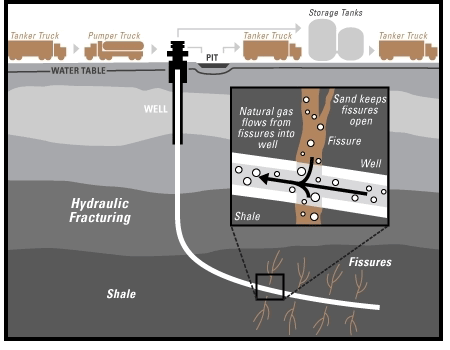
Hydraulic Fracking is a source of radiation pollution, too
“We’ve known for a long time that there is radiation coming back in the wastewater”
Among the radioactive material often found in drilling wastes is radium 226, which can cause cancer, anemia and cataracts, according to the federal Agency for Toxic Substances and Disease Registry
DEP backtracks on radiation issue Times online,January 25, 2013 By Rachel Morgan HARRISBURG — For months, the state Department of Environmental Protection denied that radiation in wastewater from natural gas drilling was an issue. On Thursday night, the state announced plans to study the effects of radiation in natural gas drilling wastewater.
After continued questioning by Shale Reporter regarding radioactivity in wastewater, Gov. Tom Corbett’s announcement of a 12-month DEP study of radioactive wastewater was a surprise. The DEP had consistently denied radiation was even an issue……. In the governor’s unexpected announcement Thursday evening, DEP officials said they will begin sampling and analyzing fracking flowback for radioactivity, testing everything from fracking wastewater, drill cuttings, treatment solids and sediments at well pads and wastewater treatment and disposal facilities.
They also plan to analyze radioactivity in pipes, well casings, storage tanks, treatment systems and trucks. http://www.timesonline.com/news/local_news/dep-backtracks-on-radiation-issue/article_9e5853a5-325b-5f9a-83ed-24aea5811db0.html
An Increase in Radiation Monitoring for Fracking, NYT, Jan 25 13 By JON HURDLE Pennsylvania will step up its monitoring of naturally occurring radiation levels in water, rock cuttings and drilling wastes associated with oil and gas development in a yearlong study that will be peer-reviewed, the state’s environmental agency reports.
The study will also assess radiation levels in the pipes, well casings, storage tanks, treatment systems and trucks used by the natural gas industry, which has drilled thousands of wells in the gas-rich Marcellus Shale over the last five years….
Hydraulic fracturing, which involves injecting chemicals and water under enormous pressure into underground shale formations to extract gas or oil, got under way in Pennsylvania in 2008.
In New York, state officials are currently weighing whether to allow the drilling process to begin. The state’s health commissioner is conducting a review of whether the state’s Department of Environmental Conservation has adequately addressed potential impacts on public health. Continue reading
Nuclear plant operators, not taxpayers, should pay for safety upgrades, says EU Parliament
 “Nuclear operators should bear €25 billion cost of making Europe’s reactors safer“http://www.europarl.europa.eu/news/en/headlines/content/20130121STO05427/html/Nuclear-operators-should-bear-%E2%82%AC25-billion-cost-of-making-EU-reactors-safer 25-01-2013 Nuclear operators,
  not taxpayers, should cover the costs of necessary safety upgrades as well as pay for everything they are liable for in the event of a nuclear accident, according to a resolution approved by the EP’s energy committee on 24 January. Improving Europe’s nuclear power plants so that they can withstand a natural disaster is estimated to cost up to €25 billion.
Threat to the public
Nuclear energy accidents, whether caused by human error or an earthquake, pose a severe risk to public health. The consequences from the explosion in the Chernobyl plant in 1986, the world’s worst nuclear disaster, are still being felt today as discussed in the EuroparlTV video above.
The aftermath of Fukushima
After the Fukushima accident in Japan in March 2011, 145 reactors in 15 EU member states were tested to assess whether nuclear power plants here could withstand a natural disasters. The checks showed that nearly all nuclear power plants need safety improvements. Continue reading
Safety concerns may shut world’s largest nuclear plant, Kashiwarazaki-Kariwa
The Kashiwarazaki-Kariwa plant may be susceptible the same type of
cataclysmic event which led to Fukushima Daiichi nuclear disaster, as
the plant itself is situated in an active fault zone.
Japan may shutter world’s largest nuclear plant over earthquake
threat, RT.com 26 January, 2013, The world’s largest nuclear power
plant may be forced to shut down under stricter rules proposed by
Japan’s new nuclear watchdog. The measures are intended to safeguard
against future natural disasters following the 2011 tsunami.

The Kashiwazaki-Kariwa nuclear power plant in the heart of Japan is
now facing permanent closure following a move by the country’s Nuclear
Regulation Authority (NRA) to expand the definition of an active fault
– a crack in the earth’s crust. The operators of the plant, Tokyo
Electric Power are the same company which powered the stricken
Fukishima plant. Continue reading
Contamination of seafoods, following nuclear and oil spill disasters
Frankenfish Surface in Japan and the Gulf of Mexico Years following some of the world’s worst environmental disasters, marine life remains contaminated, Energy Digital 25 Jan 13, Two years after the catastrophic Fukushima nuclear plant meltdown in Japan, fish with 2,500 times the legal limit for radiation in seafood are turning up near the plant.
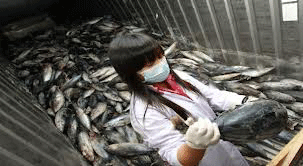 Since the incident, fishing around Fukushima has been banned, along with beef, milk, mushrooms and vegetables produced in surrounding areas. The sale of certain kinds of seafood and produce have resumed, while scientists continue to monitor the spread and impact of radiation from the disaster.
Marine chemist Ken Buesseler, leading the research from the US-based Woods Hole Institution, has warned that Fukushima fish “may be inedible for a decade,” according to the Guardian. They found “elevated levels” of radiation in the marine environment, and cited that 40 percent of the fish caught near the nuclear plant were contaminated with radioactive caesium above government safety limits.
Related Story: Radioactive Japanese Tuna Found off California Coast
Meanwhile, in the US, the debate continues over the safety of seafood from the Gulf of Mexico nearly three years after BP’s offshore rig exploded, dumping some 4.9 million barrels of oil into the ocean. Not to mention the two million gallons of dispersants used to clean up the spill that were up to 52-times more toxic than the oil itself. Read More in Energy Digital’s December/January Issue http://www.energydigital.com/oil_gas/frankenfish-surface-in-japan-and-the-gulf-of-mexico
Japan’s only two operating nuclear reactors to be shut for maintenance in 2013
 Japan faces nuclear shutdown for 2nd time since Fukushima — Expert: They’re trying to protect their nation from diseases, death http://enenews.com/reuters-japan-faces-nuclear-shutdown-for-2nd-time-since-fukushima-expert-trying-to-protect-their-nation-from-diseases-and-death-audio

January 24th, 2013
Title: Japan faces nuclear shutdown for second time since Fukushima
Source: Reuters
Author: Aaron Sheldrick
Date: Jan 24, 2013
Japan may face a total nuclear shutdown in the summer for the second time since the March 2011 Fukushima disaster as the country’s two operating reactors close for maintenance and tough new safety checks keep the rest of the fleet offline. […]
The only two of Japan’s 50 nuclear plants operating are both at Kansai Electric Power’s Ohi plant in western Japan, and must be for shut for maintenance [in mid-September 2013] 13 months after resuming commercial operations, according to Japanese law. […]
Title: Japan Contemplates Complete Nuclear Shutdown
Source: Voice of Russia American Edition
Date: Jan 24, 2013
Full broadcast here
Uranium mining: In situ leaching not the same as fracking
A spokesperson for Uranium Energy disputes the similarities to fracking that is made in the article.
“By contrast, ‘in-situ recovery’ is the process of injected-solution mining that reverses the natural process of deposited uranium in sandstones. On-site groundwater fortified with oxygen is introduced into the ground through a pattern of injection wells. The solution dissolves uranium from the sandstone host rock, and the uranium-bearing solution is brought back to surface through vacuum-suction production wells, where the uranium is concentrated on resin beads for trucking to a nearby processing plant where it is concentrated further and dried into yellowcake.”

Opponents of in situ uranium extraction start throwing around the F word MINING.com Editor | January 25, 2013 A US company is extracting underground uranium reserves in Texas using in situ methods, but opponents are comparing it to another process that is drawing high-profile protests.
Forbes reports that Texas-based Uranium Energy Corp (UEC) uses the in situ method for extracting underground uranium by pumping oxygenated water into porous rock layers via deep-drilled wells.
Forbes notes the process is raising concerns among some in Texas who compare the process to hydraulic fracturing, which has some celebrity opponents.”By design it’s much worse than fracking,” says Houston attorney Jim Blackburn, who is interviewed by Forbes.
“This is intentional contamination of a water aquifer liberating not only uranium but other elements that were bound up with the sand. We know this process will contaminate groundwater; that’s the whole point of it.” Continue reading
1 This Month
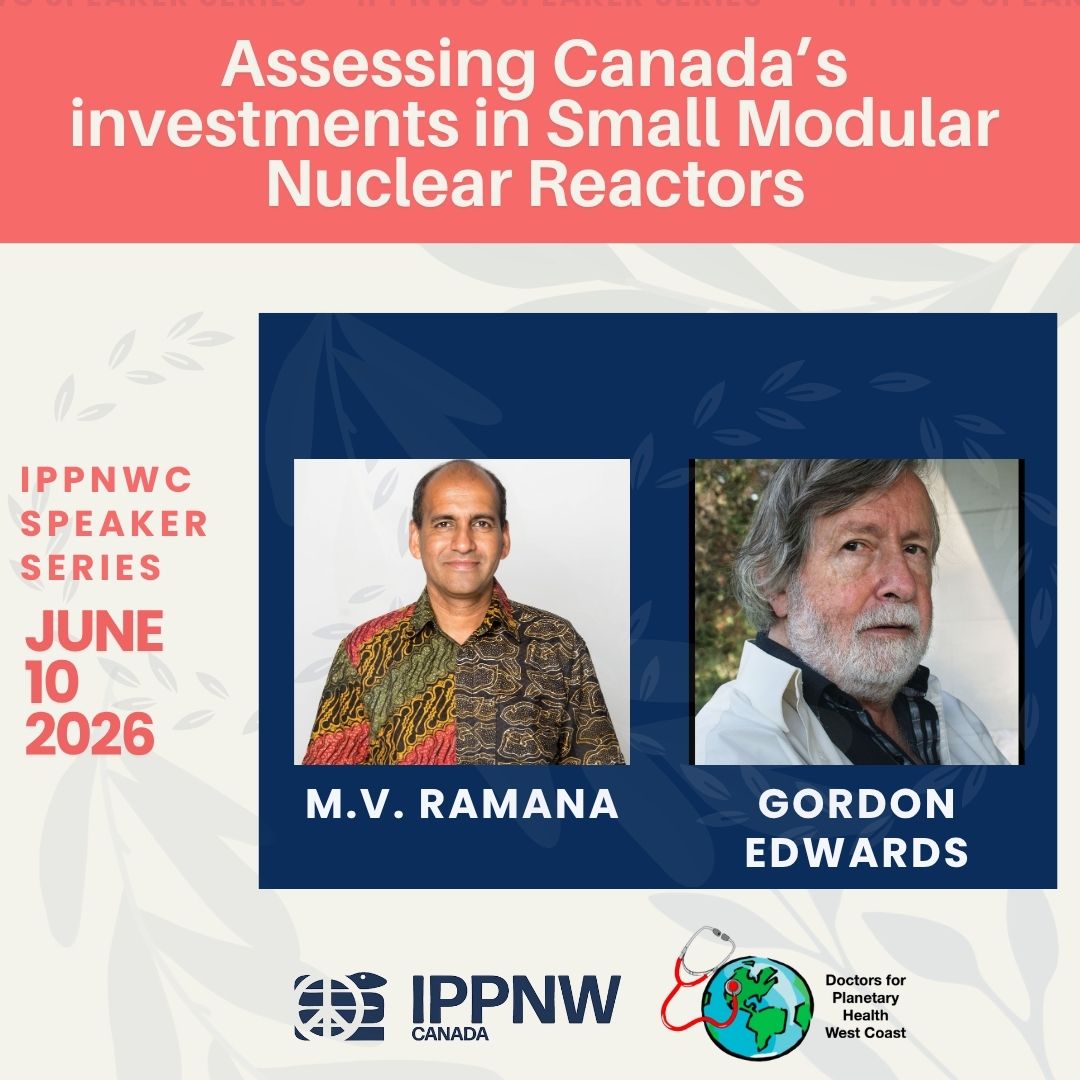
10 June – Assessing Canada’s Investments in Small Modular Nuclear Reactors – https://zoom.us/meeting/register/IiqHA5feRhaEBycOLNTJlA#/registration


Cuba Is Not a Failed State – It Is a Besieged State
PETITION: “Global Appeal to Endorse Palestinian Right of Return of Refugees”
To see nuclear-related stories in greater depth and intensity – go to https://nuclearinformation.wordpress.com
-
Archives
- June 2026 (89)
- May 2026 (306)
- April 2026 (356)
- March 2026 (251)
- February 2026 (268)
- January 2026 (308)
- December 2025 (358)
- November 2025 (359)
- October 2025 (376)
- September 2025 (257)
- August 2025 (319)
- July 2025 (230)
-
Categories
- 1
- 1 NUCLEAR ISSUES
- business and costs
- climate change
- culture and arts
- ENERGY
- environment
- health
- history
- indigenous issues
- Legal
- marketing of nuclear
- media
- opposition to nuclear
- PERSONAL STORIES
- politics
- politics international
- Religion and ethics
- safety
- secrets,lies and civil liberties
- spinbuster
- technology
- Uranium
- wastes
- weapons and war
- Women
- 2 WORLD
- ACTION
- AFRICA
- Atrocities
- AUSTRALIA
- Christina's notes
- Christina's themes
- culture and arts
- Events
- Fuk 2022
- Fuk 2023
- Fukushima 2017
- Fukushima 2018
- fukushima 2019
- Fukushima 2020
- Fukushima 2021
- general
- global warming
- Humour (God we need it)
- Nuclear
- RARE EARTHS
- Reference
- resources – print
- Resources -audiovicual
- Weekly Newsletter
- World
- World Nuclear
- YouTube
-
RSS
Entries RSS
Comments RSS
 nuclear-news