Japan’s new nuclear regulatory body – an uncertain quantity
 Japan Adopts New Law For Nuclear Regulatory Body 6/20/2012 (RTTNews) – Japan’s Diet (Parliament) on Wednesday enacted a law to set up an independent nuclear regulatory body by September.
The new law was adopted following widespread criticism after last year’s accident at the Fukushima Daiichi nuclear power plant. Lawmakers have complained that the existing Nuclear and Industrial Safety Agency is controlled by the Ministry of Economy, Trade and
Industry, which promotes nuclear power.
The proposed nuclear regulatory commission is to be largely independent of the government and will have control over a nuclear regulatory agency. Appointees to the five-member commission will not to be allowed to return to work at their former Ministries or agencies. The legislation also provides for the setting up of a new Cabinet Office council to study nuclear disaster preparedness, Japanese media reported.
The new law limits the Prime Minister’s powers to give orders during emergencies, and tasks the commission with making decisions involving knowledge of reactor technology. It allows the Prime Minister to give instructions only when the commission is too slow in deciding. The commission is to review the current 40-year limit for operating nuclear plants….. http://www.rttnews.com/1909544/japan-adopts-new-law-for-nuclear-regulatory-body.aspx?type=gn&Node=B1
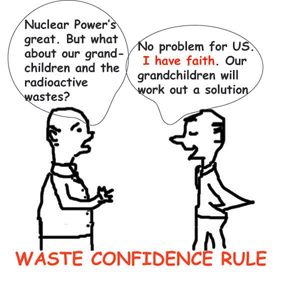
Nuclear Regulatory Commission’s blind faith that nuclear waste is safe
The NRC held that waste storage was safe for at least 60 years after a plant shuts down; they then proposed a rule to allow spent fuel storage at reactor sites for 200-300 years.
Wake Up and Smell the Radioactive Waste, OpEd News, 20 June 12, By Abby Luby Given that 2,000 tons of spent nuclear fuel is produced every year at nuclear reactors in the United States, and over 75,000 metric tons of nuclear waste is being temporarily stored in 39 states, it is surprising that the Nuclear Regulatory Commission (NRC) has emphatically said this amount of waste is safe. What’s even more surprising is that no one has disputed them. Until now.
Last week, in what New York State calls a landmark victory, a U.S. Appeals Court ruled that the NRC violated a federal act by neglecting to run in-depth studies on how storing radioactive waste at nuclear power plants impacts health and the environment. The lawsuit was spearheaded and won by New York Attorney General Eric Schneiderman, who was joined by state attorneys general from Connecticut, Vermont and New Jersey, and the Prairie Island Indian Community.
Court found that USA’s Nuclear Regulatory Commission could not just ignore nuclear wastes
In its ruling the court concluded that the NRC’s standard finding during the relicensing process that permanent nuclear-waste storage will be available “when necessary” did not calculate the environmental effects of failing to secure permanent storage – “a possibility that cannot be ignored.”
The court also found that the NRC’s finding that spent fuel could safely be stored on site at nuclear plants for 60 years after expiration of a plant’s license, “failed to properly examine future dangers and key consequences.”

 Nuclear waste: why environmentalists are pressing NRC on reactor licenses After a US appeals court ruled the NRC had not adequately evaluated nuclear waste provisions when licensing reactors, the groups are seeking to ensure the public has input on the process. Christian Science Monitor, By Mark Clayton, June 20, 2012 The nation’s top nuclear power plant regulator is being petitioned by environmental groups to halt all further license extensions for 35 power reactors nationwide until their on-site nuclear-waste storage systems undergo more in-depth environmental evaluation. The legal petition filed Monday followed a June 8 ruling by the US Circuit Court of Appeals for the District of Columbia, which found that the Nuclear Regulatory Commission (NRC) had failed to adequately evaluate on-site nuclear waste storage prior to granting license extensions. Continue reading
Global citizens’ monitoring of radiation data
Getting these devices out there — especially internationally — is a key to getting access to the world’s local radiation data.
The religious flag behind this project is the idea that this data should be accurate and open. Safecast uses open source and APIs and anyone can use the data to conduct research. For example a health researcher could use their radiation data to compare radiation levels against health information.
Local level radiation data is largely not available currently, or it’s owned by companies and not released.

 Using open source & grassroots to map the world’s radiation data http://gigaom.com/cleantech/using-open-source-grassroots-to-map-the-worlds-radiation-data/ By Katie Fehrenbacher Jun. 20, 2012, Mapping the world’s radiation and air pollution data, using one volunteer with one gadget at a time — that’s the goal of the Safecast project, which this week closed over $100,000 on Kickstarter to deliver a limited run of its open source geiger counters to interested buyers. “I don’t think it’s an unreasonable goal,” to create comprehensive maps of this data from all over the world, says Sean Bonner, co-founder of Safecast, in a phone interview shortly after his team’s project was funded.
Safecast originally focused on mapping radiation data just from Fukushima, Japan, in the wake of the nuclear disaster, and had a larger end goal to map the rest of Japan, too. But they realized that with enough eager volunteers in Japan, that mapping the entire country using geiger counters mounted on cars and held in the hands of regular citizens, was pretty doable. “It’s really only a matter of time before we’ve got all of Japan covered,” Continue reading
Wobbly words from USA, as it has no solution to its nuclear wastes
Solution to nuclear waste remains in limbo, Greenville Online, 20 June 12, “….. The nuclear industry has produced about 65,000 metric tons since its inception, and 2,000 more per year must be stored in deep pools of water and moved above ground to steel containers reinforced with concrete — all at the sites of the country’s 104 nuclear reactors…..
 the Blue Ribbon Commission on America’s Nuclear Future was created and tasked with finding a solution …
In discussions of how to dispose of nuclear waste, terms such as “temporary” and “interim” are defined in timelines extending more than 100 years.
In 1987, Congress dismissed two other options being studied to designate Yucca Mountain as the only site the Department of Energy could consider for a permanent repository. Nevada at the time lacked political clout, and the decision has long been described by the state as the “screw Nevada bill.”
Twenty five years later, the government is back where it started. The Blue Ribbon Commission on America’s Nuclear Future, in its long-anticipated report, said recently that just selecting a new site could take as long as 20 years…..
Two years ago, the Nuclear Regulatory Commission issued a “waste confidence decision” declaring that storage of spent fuel at reactors is safe despite the fact that the country has no place to store it permanently.
The fuel rods must cool in large pools near the reactor for several
years before they can be moved into “dry cask” containers.
Instead, the regulatory commission relies on the notion that a permanent site will be operating by the time it is necessary.
About the Flame computer virus
 Flame FAQ: All you need to know about the virus http://www.washingtonpost.com/blogs/blogpost/post/flame-faq-all-you-need-to-know-about-the-virus/2012/06/20/gJQAAlrTqV_blog.html By Benjamin Gottlieb
What is the Flame computer virus?
Flame is a sophisticated type of malware — short for malicious software — capable of infecting myriad computer networks for the purpose of gathering sensitive data. Once a network is infected by Flame, the virus can relay back massive amounts of information through a computer’s facilities. How does it work? Continue reading
Indian Point nuclear plant has three times the radioactivity of Fukushima’s spent fuel pools.
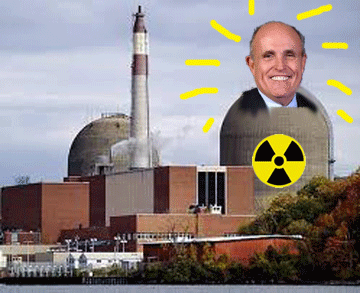 Wake Up and Smell the Radioactive Waste, OpEd News, 20 June 12, By Abby Luby“……Currently at Indian Point, 1,500 tons of high-level irradiated waste is stored in heavy steel and concrete casks on a tarmac a few hundred feet from the Hudson River. The Westchester-based plant produces about 30 tons of radioactive waste every 18 months, which is then crammed into two overcrowded, 40-foot deep spent fuel pools. Each pool holds about 1,000 tons of radioactive waste and has been leaking into the ground and river for years. However, the NRC has maintained that whatever leaches into the river is negligible, reiterating their catch phrase: “Dilution is the solution to pollution.”….
In a study by the Institute for Policy Studies, “Spent Nuclear Fuel Pools in the U.S.: Reducing the Deadly Risks of Storage,” Robert Alvarez, author and senior scholar for nuclear policy, said that Indian Point has three times the radioactivity of Fukushima’s spent fuel pools.
Indian Point is about 30 miles from Manhattan. A 1997 analysis, the Brookhaven National Laboratory [ http://pbadupws.nrc.gov/docs/ML0230/ML023040470.pdf – page 4] estimated a severe fire in a spent-fuel pool would release enough radioactive material to cause as many as 28,000 cancer deaths in a densely populated area and render 188 square miles uninhabitable.
In light of the Fukushima disaster and the potential for future leakage and catastrophic fires, the court ruled that the NRC’s analysis of the impacts of spent fuel storage was insufficient and is now requiring the agency to reassess the environmental impacts of the waste storage. Now it’s up to the NRC to heed the court and truly “protect the health and safety of the public.” http://www.opednews.com/articles/Wake-Up–Smell-the-Radioa-by-Abby-Luby-120614-180.html
Boost for solar power in Japan
Odawara, a city of 200,000 south of Tokyo, is setting up its own power company that will install solar panels at public facilities and sell electricity to Tokyo Electric Power Co
Residents who want to install panels on their homes will also get subsidies..
Japan approves renewable subsidies in shift from nuclear power, Malaysian Insider, TOKYO, June 18 — Japan approved today incentives for renewable energy that  could unleash billions of dollars in clean-energy investment and help the world’s third-biggest economy shift away from a reliance on nuclear power after the Fukushima disaster.
Industry Minister Yukio Edano approved the introduction of feed-in tariffs (FIT), which means higher rates will be paid for renewable energy. The move could expand revenue from renewable generation and related equipment to more than $30 billion (RM90 billion) by 2016, brokerage CLSA estimates. Continue reading
No relicensing of nuclear reactors until a permanent waste solution is found
Anti-nuclear activist Ben Davis Jr. is also pushing to get a proposition placed on the statewide ballot that would force both California facilities to go offline and remain shuttered until such time as a feasible plan for nuclear waste storage was actually developed.
Nuclear Waste Must be Considered in Plant Relicensing, San Diego Reader, Dave Rice, June 19, 2012 A June 8 decision from the U.S. Court of Appeals in Washington, D.C. could impact the Nuclear Regulatory Commission’s decision on re-licensing California’s two nuclear plants, as well as dozens of others across the nation.
In a 2010 Waste Confidence Decision, the Commission ruled that permanent storage for highly radioactive spent fuel used in the reactors would be available “when necessary,” and said that it would be safe to store the spent fuel on the site of various power plants until a long-term repository became available…. Continue reading
National coalition of environmental groups calls for halt in nuclear plant relicensing
The amount of spent fuel in storage might reach 150,000 metric tons by the year 2050, the appeals court noted in its ruling.
The court case challenged a “Waste Confidence Decision” — essentially the NRC’s estimate of how well issues of spent fuel will be handled in the future.
The environmental groups are concerned because political and environmental concerns have prevented a solution to the issue of how to deal with spent fuel. “The continual, ‘We don’t know what we are going to do with it, but we know it will be all right’ is not sufficient,” said Ed Smith, safe energy director for the Missouri Coalition for the Environment…..
Group petitions for nuclear licensing halt, Columbia Daily Tribune By RUDI KELLER, June 19, 2012 A national coalition of environmental groups is asking that all nuclear licensing — including the Ameren Missouri request to extend the Callaway Nuclear Plant’s life for 20 years — be put on hold until a solution is found for storing nuclear waste. Continue reading
Rosatom, Russia’s secretive, Mafia style, nuclear corporation
In 2002, a Russian scientist, well aware of covert activities by Russian authorities, declared to the Boston Globe that Rosatom is a “super-Mafia.” Secrecy is omnipotent within the governmental organization.

 Russia’s Dangerous Nuclear Legacy – Analysis Eurasia Review, By: Richard Rousseau June 18, 2012“……The post-Cold War world has an elusive international structure. Powerful global corporations, as well as international terrorist organizations, can frustrate a search for clarity and efficiency in fighting illicit activities in finance, economy, the organized crime, or smuggling of nuclear material.
In Russia, the main culprit is Rosatom. This relic of the Soviet system still operates largely
without independent oversight, especially since June 23, 2010, when President Dmitry Medvedev signed a decree that stated that Rostekhnadzor (the Federal Service for Ecological, Technological and Nuclear Supervision) would be henceforth under the direct control of
the government. Rosatom reports to no one in justifying how hundreds of millions of dollars are spent. Continue reading
Japan’s nuclear authority did not pass on information on Fukushima radiation
The information was passed to the Nuclear and Industrial Safety Agency (NISA) and the science and technology ministry by Japan’s Foreign Ministry but neither agency passed it to the prime minister’s office, which was overseeing the evacuations.
 thousands fled in the same direction as the radioactive material was drifting.
People fled towards Fukushima radiation Stuff.co.nz, 20 June 12 Japanese authorities failed to disclose US data about the spread of radiation spewing from a crippled nuclear plant last year, leaving some evacuees fleeing in the same direction as the radioactive emissions.
News that Japan’s nuclear watchdog and the science and technology ministry sat on the information collected by US military aircraft – another sign of the chaos at the time – is likely to add to mistrust of nuclear power just days after the government approved the restart
of two idled reactors…
.. US military aircraft gathered radiation data from March 17-19 over a 45km radius and found that people in an area about 25km northwest of the plant – where some people were moving – were exposed to the annual permissible level of radiation within eight hours, Japanese media said.
The information was passed to the Nuclear and Industrial Safety Agency (NISA) and the science and technology ministry by Japan’s Foreign Ministry but neither agency passed it to the prime minister’s office, which was overseeing the evacuations. Continue reading
Progress in renewable energy across Europe
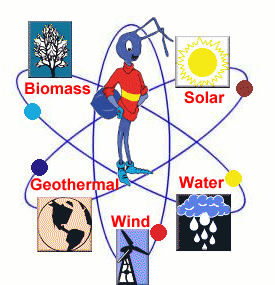 Renewable sources account for nearly 50 percent of energy consumption in Sweden, the overall EU leader in this field.
Latvia, Finland and Austria each use energy that is more than 30 percent renewable, and Portugal’s share is nearly 25 percent,according to Eurostat.
EU Is Embracing Green Energy, Report Shows http://www.courthousenews.com/2012/06/19/47606.htm By WILLIAM DOTINGA (CN) – More than 12 percent of the energy consumed in the European Union comes from renewable sources, a new report shows. The report from Eurostat, the EU’s statistical office, compiles data from 2006 to 2010, the latest year for which data is available.
Three of the EU’s 27 member states – Belgium, France and Hungary – did report 2010 data. Lawmakers passed a directive in 2009 to derive 20 percent of final energy consumption in the EU from renewable sources by 2020. Each member state received a target to reach the aggregate 20 percent target. The individual goals take into account each country’s different
starting points, renewable energy potential and economic performance, according to Eurostat. Continue reading
Uncertainty about the restart of Japan’s other nuclear reactors,
 Uncertain prospects loom for post-Oi reactors, Masayuki Takata / Yomiuri Shimbun 17 June 12, Now that the government has decided to reactivate the Nos. 3 and 4 reactors at the Oi nuclear power plant in Fukui Prefecture, attention has turned to which will be next among the nation’s other 48 idle reactors….
Which reactor will be reactivated next is expected to be left up to a new nuclear regulatory commission to be established in August at the earliest. However, there are no clear prospects for restarting more reactors because it has not been decided how the new organization will
confirm their safety.
At a press conference held Saturday after the four-minister meeting, Economy, Trade and Industry Minister Yukio Edano said the Cabinet would not decide on reactivating the 48 reactors.
“The new regulatory organization will make its own decisions [regarding the safety of the reactors] independently” from the government, Edano said. It is unclear, however, to what extent the nuclear regulatory commission will take the current safety standards into consideration when making its assessments. Continue reading
The “white male effect” – psychologists show that affluent white men are the most accepting of nuclear waste dumps
Where to put nuclear waste? e! science news, , June 19, 2012 Researchers in Finland have found that acceptance of the site of a spent nuclear fuel repository can depend on gender and economic background. Writing in the International Journal of Environmental Technology and Management, the team reports that affluent men more often have a positive opinion on the location of such facilities than women or disadvantaged people.
While the actual quantities of nuclear waste around the globe are relatively small, the disposal or storage of such materials remains a controversial and sensitive issue and one
that is likely to grow if more nuclear power plants are built. Matti Kojo of the University of Tampere and Mika Kari and Tapio Litmanen of the University of Jyväskylä have recently canvassed and analyzed local opinion on the siting of a nuclear waste repository in the
municipality of Eurajoki, Finland. They have demonstrated what they refer to as a “white male effect” associated with acceptance of such facilities close to a residential area…..
http://esciencenews.com/articles/2012/06/19/where.put.nuclear.waste
1 This Month
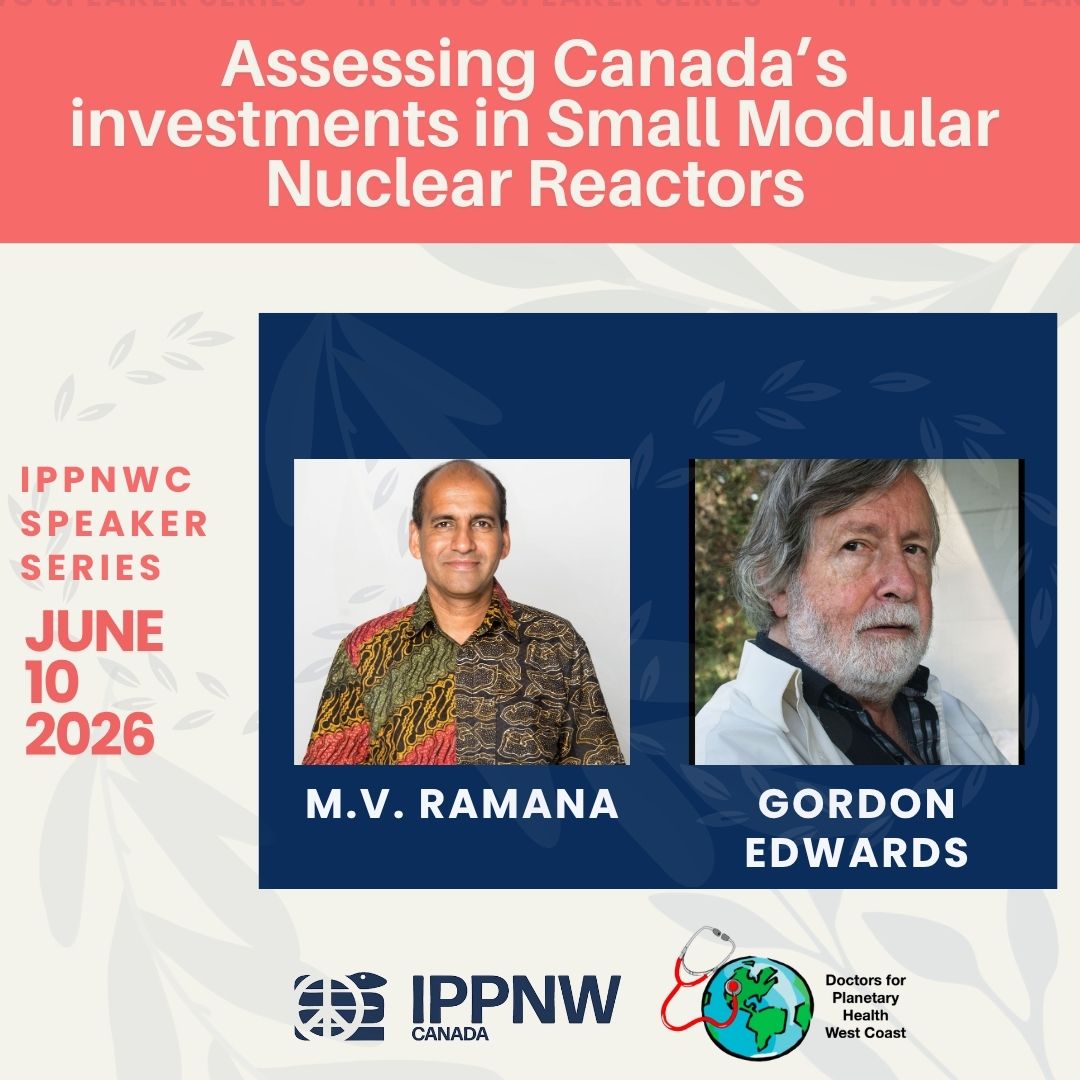
10 June – Assessing Canada’s Investments in Small Modular Nuclear Reactors – https://zoom.us/meeting/register/IiqHA5feRhaEBycOLNTJlA#/registration


Cuba Is Not a Failed State – It Is a Besieged State
PETITION: “Global Appeal to Endorse Palestinian Right of Return of Refugees”
To see nuclear-related stories in greater depth and intensity – go to https://nuclearinformation.wordpress.com
-
Archives
- June 2026 (89)
- May 2026 (306)
- April 2026 (356)
- March 2026 (251)
- February 2026 (268)
- January 2026 (308)
- December 2025 (358)
- November 2025 (359)
- October 2025 (376)
- September 2025 (257)
- August 2025 (319)
- July 2025 (230)
-
Categories
- 1
- 1 NUCLEAR ISSUES
- business and costs
- climate change
- culture and arts
- ENERGY
- environment
- health
- history
- indigenous issues
- Legal
- marketing of nuclear
- media
- opposition to nuclear
- PERSONAL STORIES
- politics
- politics international
- Religion and ethics
- safety
- secrets,lies and civil liberties
- spinbuster
- technology
- Uranium
- wastes
- weapons and war
- Women
- 2 WORLD
- ACTION
- AFRICA
- Atrocities
- AUSTRALIA
- Christina's notes
- Christina's themes
- culture and arts
- Events
- Fuk 2022
- Fuk 2023
- Fukushima 2017
- Fukushima 2018
- fukushima 2019
- Fukushima 2020
- Fukushima 2021
- general
- global warming
- Humour (God we need it)
- Nuclear
- RARE EARTHS
- Reference
- resources – print
- Resources -audiovicual
- Weekly Newsletter
- World
- World Nuclear
- YouTube
-
RSS
Entries RSS
Comments RSS
 nuclear-news