Malaysian govt insists that Lynas might have to take its radioactive wastes back to Australia
The Temporary Operating License will only be issued after Lynas fulfils two new conditions imposed

 AELB: Lynas committed to returning radioactive waste to AustraliaThe Malaysian Insider By Lisa J. Ariffin June 28, DENGKIL, June 28 — Lynas is committed to return all potentially harmful waste from its rare earths plant here to Australia despite its government’s firm refusal to take it in, Malaysia’s radiation regulator said today.
The Atomic Energy Licensing Board (AELB) told reporters today the Australian miner would have to send home all residue that could not be turned into commercial products or if a location for a permanent disposal facility (PDF) here could not be determined or approved.
“Lynas will have 10 months to come up with a permanent disposal facility plan for its radioactive residue upon receiving its temporary operating license (TOL),” said Dr Noor Hasnah Mohamed Khairullah who is special adviser to the AELB director-general.
“If they fail to find a location for the PDF, or if the plan is not approved, then Lynas has to return the residues back to Australia. Continue reading
To save TEPCO Corporation, Japan’s govt plans a big restart of nuclear energy
 Tepco’s Plans Restart of World’s Biggest Nuclear Plant, Bloomberg News By Tsuyoshi Inajima and Yuji Okada June 28, 2012 Tokyo Electric Power Co. (9501), owner of the crippled Fukushima reactors, is committed to restarting another nuclear plant next year that is the world’s largest and itself was damaged in a 2007 earthquake.
Bringing the Kashiwazaki Kariwa power station online, even though it sets up the state-controlled utility for further conflicts with a nuclear-weary public, is part of “Plan A,” President Naomi Hirose, 59, said in an interview. The plan refers to a 10-year business reconstruction that handed control of the power company known as Tepco to Japan’s government. “We have no choice right now but to do our bestto carry out Plan A,” Hirose said on June 18. “We don’t have a Plan B.”

Tepco’s decision runs counter to polls showing the majority of Japanese want less reliance on atomic power after meltdowns at its Fukushima Dai-Ichi reactors last year. The radiation release and cost to the public of as much as $138 billion sparked anti-nuclear sentiment across the world. In Japan, all 50 reactors, including the seven at Kashiwazaki Kariwa, have been required to pass so-called stress tests introduced to improve safety after the Fukushima
disaster. Only two near the western city of Osaka have won permission
to resume operations, leaving 48 offline.
“Tepco’s plan is only wishful thinking” because no more reactors are likely to be approved this year, said Tomoko Murakami, a Tokyo-based nuclear analyst at the Institute of Energy Economics, Japan. “Without the restart, there is not much hope to revive the company.”…… http://www.businessweek.com/news/2012-06-27/tepco-s-new-chief-sees-no-plan-b-to-revive-profitability
France’s nuclear company EDF must meet deadline and spend $12 billion on safety measures

 EDF Gets Six Years to Carry Out $12 Billion Safety Measures, Bloomberg News By Tara Patel on June 28, 2012 Electricite de France SA, operator of the country’s 58 nuclear reactors, has six years to complete about 10 billion euros ($12 billion) of measures to boost safety after Japan’s Fukushima disaster, the regulator said.
Autorite de Surete Nucleaire today published deadlines for employing equipment such as diesel generators, bunkered control rooms, and guards against flooding.
An estimate by state-owned EDF that the measures will cost about 10 billion euros “is not improbable,” Andre-Claude Lacoste, head of the watchdog, told reporters today.,,,, EDF was told today to install “core” safety equipment and procedures at every plant to cope with extreme situations. Emergency diesel generators for backup power have to be deployed between 2016 and the end of 2018 and rapid response teams with specialized equipment by the end of 2014. EDF also has to have bunker-like control rooms….. http://www.businessweek.com/news/2012-06-28/edf-gets-six-years-to-carry-out-12-billion-of-safety-measures
Southern California’s electrical grid might not need nuclear power – ever!

 San Onofre: Do we really need it? UT San Diego, 28 June 12, This summer may be just a test run for operating Southern California’s electrical grid without a nuclear plant.
The latest report on the outage at the San Onofre Nuclear Generating Station shows the replacement of four massive steam generators was accompanied by serious design flaws, with no clear solution in sight.
Both stakeholders in San Onofre and critics of nuclear power say the start of a summer without the twin-reactor plant has forced a new accounting for its costs and benefits.
The utility industry and the state’s main grid operator are “considering a range of existing and new alternatives for mitigating the impacts of a long-term or permanent shutdown at San Onofre,” said Stephanie McCorkle, a spokeswoman for the California Independent System Operator….. the grid operator foresees only the remote chance of rolling outages during hot weather in the next three months — when San Onofre is needed the most.
That assessment alone has changed perceptions of the plant as indispensable, said Dan Sullivan, president of San Diego-based Sullivan Solar Power, which employs 65 workers designing and installing solar arrays.
The plant shutdown — along with California’s aggressive renewable-energy policies and a newly completed transmission line into San Diego — have shifted the conversation about nuclear power. The day is coming, Sullivan said, when “we can just say, ‘We’re done.
We don’t need it anymore.’ ”….
Shock horror for the nuclear lobby, Southern California can get by without San Onofre nuclear energy
Officials urge conservation as California prepares for summer sans San Onofre nuclear plant 89.3 KPCC, By Ed Joyce | Jun 27, 2012 Utility officials in Southern California say conservation is more important than ever as the San Onofre nuclear plant sits dormant, but anti-nuclear activists are insisting that the plant’s energy isn’t needed…… anti-nuclear activists say the summer will show the region can get by without San Onofre.

Gene Stone, with a San Clemente-based anti-nuclear group, says conservation can meet energy demand even with a permanent shutdown of the plant. He says Edison should use the “half-billion dollars” it’s collected from customers for energy conservation to create a useful
substitute.
“That money should be divided up between the appropriate county and city agencies and do some real effective conservation,” said Stone.
The agency which manages the state’s power grid says that, even without the nuclear plant’s energy (enough for 1.4 million homes), Southern California will get by this summer without major blackouts. http://www.scpr.org/news/2012/06/27/33000/officials-urge-conservation-state-prepares-summer-/
No protection for whistleblowers at San Onofre nuclear power station
Paul Diaz is not protected by California’s whistle-blower laws – among the strongest in the nation — because San Onofre sits on federal land ceded to Southern California Edison back in the 1960s. “What’s unusual here is that if Mr. Diaz was working off the actual four corners of the San Onofre property and reported the same acts, he would be protected,” Seversen said. “But because he happens to set foot on the federal enclave, those protections are not available.”
 San Onofre Workers Lack State Whistleblower Protections Safety Complaints High At Crippled Plant June 28, 2012 KPBS, By Amita Sharma For the past four years, San Onofre Nuclear Generating Station has had the highest number of safety complaints of any nuclear plant in the country.
“That’s not the list you want to be on top of,” said nuclear power expert David Lockbaum of theUnion of Concerned Scientists.
“I don’t think there is any doubt whatsoever that right now the workforce at San Onofre doesn’t trust management and when they have safety concerns they’re either not raising them at all or they’re raising them to the Nuclear Regulatory Commission as the only option they have available,” he added. “That’s not the way it’s supposed to work. The workers are basically the canaries in the coal mine. They’re the first ones who see the problems. Their voices need to be heard, not ignored.” Continue reading
Public participation eliminated, as Nuclear Regulatory Commission ‘streamlines’ nuclear licensing
David Lochbaum, director of the Union of Concerned Scientis’s said “The old Soviet system was efficient, too,” arguing that the streamlining sets up a system that approves an entire plan’s construction and operation upfront, a step that happens entirely based on blueprints and that offers fewer opportunities to contest a new project.
“It’s a paper battle – you’re looking at things that are done in cyberspace, and 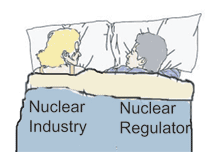 there’s no real evidence to point at,” Lochbaum said. “It has the effect of eliminating public participation.”
Streamlining Nuclear Regs, Energy Biz 28 June 12, AGENCY SEEKS TO
REMOVE IMPEDIMENTS FOR MORE THAN 20 YEARS, the Nuclear Regulatory Commission has been in the process of implementing new, streamlined licensing procedures, and this spring the first new nuclear projects in decades were approved – two new reactors at the SCANA-owned V.C. Summer Plant, and two others at the Southern Company-owned Plant Vogtle. Continue reading
French company GDF Suez moving away from nuclear industry
Ambitions to own and operate new nuclear plants by 2020 and play a role in countries like Brazil and the United States have so far come to nothing. Challenges on GDF Suez’s two home fronts, France and Belgium, are making it even harder.

 GDF Suez’s nuclear business seen moving backstage by Caroline Jacobs and Benjamin Mallet PARIS, June 26 (Reuters) – GDF Suez is expected to significantly trim its 47-year old nuclear business now that its only showroom, Belgium, is gradually wrapping up its reliance on the energy form and with nuclear prospects in the French utility’s home market dimming. Continue reading
France’s 3 nuclear agencies must present safety plans by June 30
French Nuclear Safety Body Imposes Security Works On Industry Fox News By Hugo Passarello June 28, 2012 Nuclear energy industry players in France will have to carry out “considerable” work to strengthen security at nuclear facilities, including sizeable investments in human resources and technical skills, said a report by France’s independent nuclearsafety regulator Thursday.
In a statement, the Autorite de Surete Nucleaire, or ASN, announced 32 decisions, including measures relating to Electricite de France’s SA (EDF.FR) nuclear power stations, French nuclear engineering company Areva’s SA (AREVA.FR) installations, and reactors of the French atomic agency, known as the CEA.
As part of the measures, all nuclear sites will have to have “hard-core” compounds which provide robust premises to be used in event of an serious incident.
The three nuclear players are required to present on June 30 the details of materials needed and deadlines for the compounds, said the ASN.
http://www.foxbusiness.com/news/2012/06/28/french-nuclear-safety-body-imposes-security-works-on-industry/#ixzz1zDlPR48Q
NRC keeping mum about their investigations into Palisades nuclear power plant
Nuclear cops snoop around Palisades, NRC team began investigation this week, Wood 8 TV , 28 Jun 2012, By Henry Erb GRAND RAPIDS, Mich. (WOOD) – When something goes wrong at the Palisades nuclear facility, the Nuclear Regulatory Commission does a technical review. Now, a team of nuclear cops is investigating the nuke plant in Covert Township.
Many of the people in the NRCs Office of Investigations are former agents of the FBI, Secret Service, Drug Enforcement Agency or have backgrounds with other law enforcement agencies. They’re not looking for things that have just gone wrong.
Their job is to look for deliberate wrongdoing, things that could result in criminal prosecution.
In the 2011 annual report from the NRC, the agents investigated 227 cases and turned 77 over to the Justice Department. It’s unclear how many actually ended up in prosecution. ….. This week, the nuclear cops began looking into the year-long leak from an emergency water tank that shut down Palisades on June 12. NRC inspectors at the plant knew about the slow leak since May 2011, and their spokesman said it wasn’t them who turned the case over for special investigation.
The Office of Investigations began the probe on its own this week, but a spokesman at their Chicago office said the agents are not saying why. http://www.woodtv.com/dpp/news/local/sw_mich/Nuclear-cops-snoop-around-Palisades
Affordable solar energy racing ahead in Californian homes and businesses
This list shows undeniable solar growth in a diverse range of cities, debunking the common misconception that solar is only for the wealthy,” notes Stephen Torres, founder and managing director of PV
Solar Report. “Key to this diversification is third-party-owned solar, which makes solar affordable for a wider range of homeowners.”
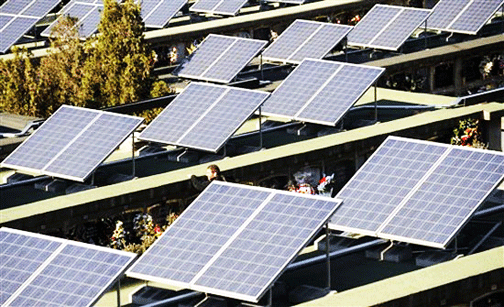
California Residential Solar Market Has Grown 80% So Far This Year http://solarindustrymag.com/e107_plugins/content/content.php?content.10611 27 June 2012 Thirteen cities helped the California residential solar market grow 80% so far this year, according to a new report from SunRun.
According to the report, the top cities reflect solar adoption in median-income communities rather than in the wealthiest areas of the state.
The high-growth cities were evaluated by percent growth through May 31 as compared to the same time frame last year. While solar adoption continues to surge in traditional solar hot beds like Fresno and Bakersfield, new solar leaders like Santa Clarita, Castaic and Palmdale are also leading the charge.
The top California cities for home solar installations were as follows: Continue reading
Fukushima nuclear reactor No.1 cleanup stalled by lethal levels of radiation

 Fukushima radiation at record high RECORD amounts of radiation have been detected at the Fukushima nuclear reactor, further hampering clean-up operations. http://www.heraldsun.com.au/ipad/fukushima-radiation-at-record-high/story-fn6s850w-1226410635366 28 June 12 TEPCO, the operator of Japan’s crippled nuclear plant, took samples from the basement of reactor number 1 after lowering a camera and surveying instruments through a drain hole in the basement ceiling.
Radiation levels above radioactive water in the basement reached up to 10,300 millisievert an hour, a dose that would kill humans within a short time after making them sick within minutes. The annual allowed dose for workers at the stricken site would be reached in only 20 seconds.
“Workers cannot enter the site and we must use robots for the demolition,” said TEPCO.
The Fukushima operator said that radiation levels were 10 times higher than those recorded at the plant’s two other crippled reactors, number two and three. This was due to the poor state of the nuclear fuel in the reactor compared to that in the two others.
The meltdown at the core of three of Fukushima’s six reactors occurred after the March 11, 2011 earthquake and ensuing massive tsunami shut off the power supply and cooling system.
Demolition of the three reactors as well as the plant’s number 4 unit is expected to take 40 years and will need the use of new technologies.
Golden farewell for Fukushima nuclear plant directors and auditors as they leave for other lucrative jobs

 VIDEO : . http://www.radioaustralia.net.au/international/2012-06-27/tepco-directors-quit-with-golden-parachute/968572 TEPCO directors quit with ‘golden parachute’, Radio Australia 28 June 2012, Directors and auditors at the Japanese operator of the Fukushima nuclear plant have used the company’s annual general meeting to resign. In theory, the TEPCO directors and auditors are doing so to take responsibility for last year’s disaster, but the ABC can confirm nearly half of those who have resigned will take up lucrative posts with other TEPCO group companies.
Some of the executives are also facing the biggest lawsuit in Japanese history – a $67 billion compensation claim from shareholders for what they describe as unforgivable negligence. Outside the company’s meeting on Wednesday, activists – most of them middle-aged women – handed out anti-nuclear leaflets to shareholders making their way in.
Among them was Yui Kimura, who bought TEPCO shares so she could attend and vote at meetings. She is one of 42 shareholders suing 27 company directors for failing to heed repeated warnings about the threat of a giant tsunami.
She is fighting for TEPCO to pay compensation for those affected by the Fukushima nuclear meltdowns.
About 100,000 Fukushima residents still cannot return home……
Climate change: global sea level rise is uneven: USA’s East coast to cop it big
 US East Coast a ‘hot spot’ for sea level rise: study http://planetark.org/enviro-news/item/65757 by Deborah Zabarenko, Environment Correspondent 26-Jun-12 Sea levels from Cape Hatteras to Cape Cod are rising at a faster pace
than anywhere on Earth, making coastal cities and wetlands in this densely-populated U.S. corridor possibly more vulnerable to flooding and damage, researchers at the U.S. Geological Survey reported.
Climate change is causing higher sea levels around the world, as land-based glaciers like those on Greenland melt and slide into the oceans and as warming ocean water expands.
But seas don’t rise at the same rate, and for 600 miles along the U.S. Atlantic coast, the water is rising more rapidly than elsewhere on the globe, USGS scientists reported on Sunday in the journal Nature Climate Change. In this “hot spot” of rising sea levels, variations in ocean currents and sea water temperature and salinity push oceans upward along the
coastline, the scientists said.
It could have an impact on some of the biggest urban areas along and near the East Coast, including Boston, Providence, New York City, Philadelphia, Baltimore and Norfolk-Virginia Beach, especially when storm surges push water inland. Continue reading
Japanese seafood products banned in South Korea, due to radiation risks
South Korea Bans Imports of 35 Japanese Seafood Products VOA, June 27th, 2012 South Korea has placed a temporary import ban on 35 Japanese seafood products because of fears of lingering radiation contamination from last year’s devastating nuclear disaster.
Seoul’s Ministry of Food, Agriculture, Forestry, and Fisheries says the ban is a temporary measure meant to protect South Korean citizens from products originating from the waters near the Fukushima nuclear power plant…….. The items banned Wednesday by South Korea include several types of flatfish, clams and sea urchins, products that are already prohibited from sale in Japan. With the latest move, Seoul now prohibits a total of 64 Japanese seafood items from entering South Korea. http://blogs.voanews.com/breaking-news/2012/06/27/south-korea-bans-imports-of-35-japanese-seafood-products/
1 This Month
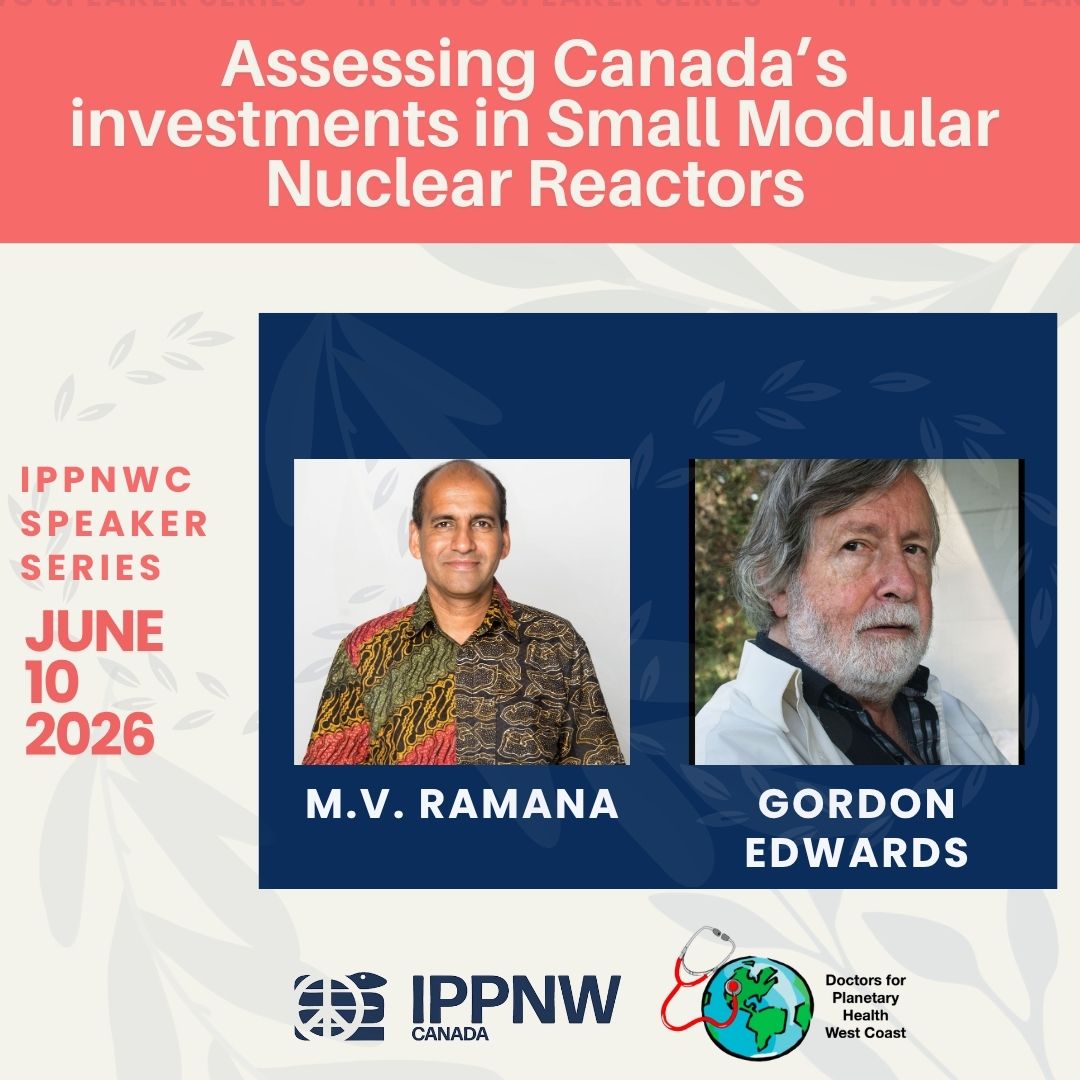
10 June – Assessing Canada’s Investments in Small Modular Nuclear Reactors – https://zoom.us/meeting/register/IiqHA5feRhaEBycOLNTJlA#/registration


Cuba Is Not a Failed State – It Is a Besieged State
PETITION: “Global Appeal to Endorse Palestinian Right of Return of Refugees”
To see nuclear-related stories in greater depth and intensity – go to https://nuclearinformation.wordpress.com
-
Archives
- June 2026 (89)
- May 2026 (306)
- April 2026 (356)
- March 2026 (251)
- February 2026 (268)
- January 2026 (308)
- December 2025 (358)
- November 2025 (359)
- October 2025 (376)
- September 2025 (257)
- August 2025 (319)
- July 2025 (230)
-
Categories
- 1
- 1 NUCLEAR ISSUES
- business and costs
- climate change
- culture and arts
- ENERGY
- environment
- health
- history
- indigenous issues
- Legal
- marketing of nuclear
- media
- opposition to nuclear
- PERSONAL STORIES
- politics
- politics international
- Religion and ethics
- safety
- secrets,lies and civil liberties
- spinbuster
- technology
- Uranium
- wastes
- weapons and war
- Women
- 2 WORLD
- ACTION
- AFRICA
- Atrocities
- AUSTRALIA
- Christina's notes
- Christina's themes
- culture and arts
- Events
- Fuk 2022
- Fuk 2023
- Fukushima 2017
- Fukushima 2018
- fukushima 2019
- Fukushima 2020
- Fukushima 2021
- general
- global warming
- Humour (God we need it)
- Nuclear
- RARE EARTHS
- Reference
- resources – print
- Resources -audiovicual
- Weekly Newsletter
- World
- World Nuclear
- YouTube
-
RSS
Entries RSS
Comments RSS
 nuclear-news