Nuclear capable missile tested by Pakistan

 Pakistan tests nuclear-capable ballistic missile, Daily Times, 11 May 12, ISLAMABAD: Pakistan carried out a successful test firing of a short-range nuclear-capable ballistic missile on Thursday, the military said. The launch of the Hatf III, which has a range of up to 290 kilometres and can also carry conventional warheads, came at the end of a field training exercise, a military statement said. Two weeks ago Pakistan test-fired an intermediate range ballistic missile, seen as a response to India’s launch of its new long-range Agni V, capable of hitting targets anywhere in China……http://www.dailytimes.com.pk/default.asp?page=2012%5C05%5C11%5Cstory_11-5-2012_pg7_7
Unnecessary, expensive and dangerous new NATO nuclear weapons
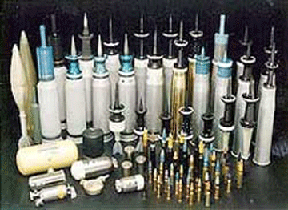 “The planned upgrade of Nato’s tactical nuclear forces in Europe will be expensive and is unnecessary. Nato states are fully secure without this additional capability and should be focused on removing all tactical nuclear weapons from Europe, not on modernising them”.
Nato plans to upgrade nuclear weapons ‘expensive and unnecessary’ http://www.guardian.co.uk/world/2012/may/11/nato-nuclear-weapons-upgrade Proposals to modernise nuclear arsenal will heighten tensions with Russia, warns thinktank backed by ex-ministers, Richard Norton-Taylor guardian.co.uk, Friday 11 May 2012 Nato’s plans to upgrade the US’s estimated 180 tactical nuclear weapons in western Europe are unnecessary, expensive and likely to exacerbate already difficult relations with Russia, according to a report. Continue reading
The history of Germany’s anti nuclear movement
The Germans also had an anti-nuke party as of 1980, namely the Greens, who carried the concerns of the mass movement into the national parliament, the Bundestag. No other country in the world has had a force so determined and influential in taking on the powerful atomic energy lobby.
From Advocates to Enemies: Nuclear Decline in Germany World Policy Blog May 10, 2012 -By Paul Hockenos “……….it wasn’t until the early 1970s when protests broke out in Germany’s southwestern-most corner that Germans began looking twice at the nuclear power facilities and waste repositories in their backyards. The anti-nuclear energy movement was born in the wine-growing region of the Black Forest abutting the borders of Switzerland and France’s Alsace-Loraine. There, in the tiny hamlet of Wyhl, the area’s staunchly conservative farmers, joined by left-wing activists from the nearby university city of Freiburg, as well as concerned French and Swiss citizens, organized to stop the construction of a planned reactor.
The Wyhl coalition bore many of the characteristics that would define the movement for years to follow: It was locally led, politically diverse, and committed to non-violent civil disobedience. Initially, the farmers’ objection was that the steam clouds from the reactor’s cooling towers would block the sun light in their vineyards, not that radioactivity as such was a hazard. This changed as the community learned more about the health effects of low-level radiation, such as that produced by nuclear power plants on pregnant women in their vicinity.
Against all odds, the Wyhl coalition forced the utility giant to back down and scrap its plans. Continue reading
Saudi Arabia’s $109 billion solar energy plan

 Saudi Arabia Plans $109 Billion Boost for Solar Power Bloomberg, By Wael Mahdi and Marc Roca – May 10, 2012 Saudi Arabia is seeking investors for a $109 billion plan to create a solar industry that generates a third of the nation’s electricity by 2032, according to officials at the agency developing the plan….
“We are not only looking for building solar plants,” al- Odan said in an interview in Riyadh yesterday. “We want to run a sustainable solar energy sector that will become a driver for the domestic energy for years to come.”…
Nuclear free Mid East meeting now doubtful
Mideast Nuclear Meeting in Doubt , WSJ, 10 May 12, By JAY SOLOMON, WASHINGTON—Plans for a United Nations-backed conference aimed at ridding the Middle East of nuclear weapons are unraveling because of political upheaval in the region and diplomatic sparring over suspected nuclear-weapons programs in Iran and Israel, said officials involved in the event’s preparations. Continue reading
A new book on a crime against humanity – nuclear warfare
 Taking a stand against nuclear war The Star, Malaysia, By LIM WEY WEN KUALA LUMPUR: Nuclear war is a crime against humanity and it has to be prevented, said Canadian academic Prof Michel Chossudovsky .
That was the reason he wrote a book in an effort to prevent nuclear war.
“Death by radiation is gradual, and the effects could spread,” said the author of Towards a World War III Scenario: The Dangers of Nuclear War. “I am a writer and a researcher, and this book is there to sensitise public opinion (on nuclear warfare).
“(The book) is to present the facts and to point to the fact that in the wake of Sept 11, 2001, there has been a very significant redefinition of nuclear doctrine in terms of the US military.”
He said this after the launch at the Perdana Global Peace Foundation (PGPF) here….. Prof Chossudovsky asserts the world is at a very critical crossroad as the line between nuclear and conventional weapons becomes increasingly blurred.
He warns of the development of “new-generation nuclear weapons” that are touted to be “safe” for the surrounding civilian population.
“The distinction between conventional and nuclear weapons has been totally blurred and the wars of the 21st century are going to be waged with a combination of both,” he said….. http://thestar.com.my/news/story.asp?file=/2012/5/11/nation/11264133&sec=nation
Renewable energy chosen by island nations
 Climate Conversations – Island nations commit to renewable energy Alert Net By Veerle Vandeweerd, 11 May 12, Jamaica is a nation on a mission for sustainable energy for all. The government spent $2.2 billion – or 40 percent – of its foreign exchange earnings on
importing fossil fuels in 2011. So they decided to make a change.
They turned to the nature around them – the sunshine, waterfalls and rivers – investing in renewable energy. By 2030, 30 percent of Jamaica’s energy will come from renewables. Continue reading
More airport radiation scanners for USA
 TSA may buy more controversial scanners, Sun Sentinel, May 08, 2012|By Ken Kaye, Despite the controversy over whether they pose a health risk, the Transportation Security Administration says it may purchase even more airport scanners that emit radiation to check passengers.
TSA spokesman Jonathan Allen said in coming months the agency plans to test software that would allow radiation-emitting scanners, known as backscatter units, to generate generic body images. Currently, these units generate naked images that resemble chalk etchings of passengers.
“When that software meets TSA’s standards and is successfully tested in an airport environment, TSA could purchase and deploy additional backscatter units,” he said…..
http://articles.sun-sentinel.com/2012-05-08/news/fl-tsa-radiation-scanners-20120508_1_airport-scanners-backscatter-tsa-administrator-john-pistole
Nuclear free Japan – the end of an industry
 The end of nuclear, CLIMATE SPECTATOR, Matthew Wright, 8 May 2012 It happened at 5pm on Saturday the 5th of May: Tomari Reactor number 3, operated by Hokkaido electric, ceased production. This means that Japan is now nuclear free for the first time since 1966.
But life is going on. Japan now has 54 mothballed or destroyed nuclear reactors. Prior to the Fukushima disaster there were 47.5GWe of nuclear generation capacity, the equivalent of twice Australia’s entire baseload capacity.
….. Pro nuclear evangelists…. claim that countries like Japan have no option available besides nuclear. But Japan is now operating completely nuclear free. We heard claims that Japan would have widespread blackouts through last summer (they didn’t) and that this will occur this summer (they will not). Continue reading
Japan’s government to nationalise Tepco nuclear company, to save it from bankruptcy
Japan to nationalise nuclear plant operator http://www.abc.net.au/news/2012-05-10/japan-nuclear-plan-to-save-tepco/4002972 By North Asia correspondent Mark Willacy May 10, 2012 Japan’s government will effectively nationalise TEPCO, the operator of the crippled Fukushima nuclear plant, as part of a $12 billion restructuring plan.
TEPCO is facing massive clean-up bills and compensation claims. By injecting the funds into TEPCO to save it from bankruptcy, the Japanese government will also take a controlling stake in the operator of the Fukushima plant.
Announcing the plan, Japan’s industry minister, Yukio Edano, demanded that TEPCO rid itself of its secretive and complacent corporate culture.
The deal will also see TEPCO’s creditor banks extend fresh loans to the company and, effectively, the nationalisation one of the world’s largest utilities companies.
India’s atomic energy chief says fears about nuclear radiation are “irrational”
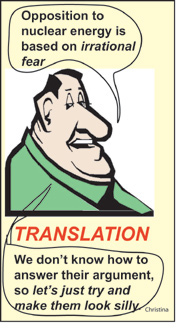
 Priority is to remove irrational fears about radiation: Ratan Kumar Sinha Interview with Chairman, Atomic Energy Commission Business Standard, Sanjay Jog / Mumbai May 10, 2012, Ratan Kumar Sinha, who was director of Bhabha Atomic Research Centre, took over as chairman of Atomic Energy Commission and secretary of Department of Atomic Energy (DAE) last week.
His appointment comes at a time when India’s nuclear sector is facing challenges. Sinha, in an interview with Sanjay Jog, speaks on a number of issues. Edited excerpts:
What are your priorities?
The first is to remove an irrational fear of radiation in the public mind….. We would educate the public and try to remove the unwarranted fear of radiation associated with nuclear plants.
Caution urged on medical radiation for children
Too much radiation from medical testing is a growing concern, especially for children, because it may increase the risk of cancer later in life.
While there’s no generally accepted safe lifetime radiation dose for children, Schulman tells parents to keep a list of their child’s medical scans – and pull it out every time a  doctor considers ordering another one. That’s especially helpful for children with chronic diseases, who truly need more medical scans than the average youngster.
 FDA urges a lower dose of radiation when child undergoes medical scan Boston Globe, By Lauran Neergaard | ASSOCIATED PRESS MAY 10, 2012 WASHINGTON – When your child’s doctor orders a CT scan, X-ray, or similar test, there are two big questions: Is the scan really needed? And if so, will it deliver a child-sized or adult-sized dose of radiation?
That was the message from the Food and Drug Administration on Wednesday as it took steps to help protect children from getting unneeded radiation from these increasingly common tests. Continue reading
Recycling plutonium more dangerous and costly than burying it

 Experts urge Britain to bury plutonium rather than recycling
http://mainichi.jp/english/english/newsselect/news/20120510p2g00m0in010000c.html 10 May 12, WASHINGTON (Kyodo) — Four U.S. nuclear experts urged Britain to bury plutonium rather than recycling for fuel for nuclear reactors as it is more cost-effective, according to the British science journal Nature’s Thursday edition.
Citing an estimate in 2000 that recycling plutonium from spent fuel to make mixed oxide fuel adds $750 million each year to the cost of electric power generation in France, the four said, ”Britain should seriously evaluate the less costly and less risky method of direct
plutonium disposal, and take the opportunity to lead the world towards a better solution for reducing stockpiles.” Continue reading
Offline nuclear reactors still dangerous, need constant cooling
 News Navigator: What danger is still posed by offline nuclear reactors? Answers by Taku Nishikawa, Science & Environment News Department The Mainichi, 8 May 12, As of May 5, all nuclear reactors in Japan were offline. The Mainichi answers common questions readers may have about the safety and dangers of offline nuclear plants.
Question: With the reactors offline, has the danger of nuclear accidents disappeared?
Answer: The danger is likely less than while the reactors are running, but it still exists. Nuclear plants make power by turning turbines with the heat from the chained fission of Uranium-235 in nuclear fuel.
This chained fission is stopped in an offline reactor, but fuel rods continue to release “decay heat” as various unstable nuclei created during the reactors’ operation until now naturally break down. This decay heat has to continually be removed.
Q: What will happen if it is not removed? Continue reading
Brazil ditches nuclear reactor plans, in favour of renewable energy and gas

 Brazil shelves plans to build new nuclear plants Google News 10 May (AFP) BRASILIA — Brazil said Wednesday it has shelved plans to build new nuclear power stations in the coming years in the wake of last year’s Fukushima disaster in Japan.
The previous government led by former president Luiz Inacio Lula da Silva had planned to construct between four and eight new nuclear plants through 2030….. “The last plan, which runs through 2020, does not envisage any (new) nuclear power station because there is no need for it. Demand is met with hydro-electrical power and complementary energy sources such as wind, thermal and natural gas,” Energy ministry’s executive secretary, Marcio Zimmermann said in remarks released by the ministry Wednesday. “The 2021 plan, as far as I know, will not consider nuclear power stations either, ” he added, ….
1 This Month
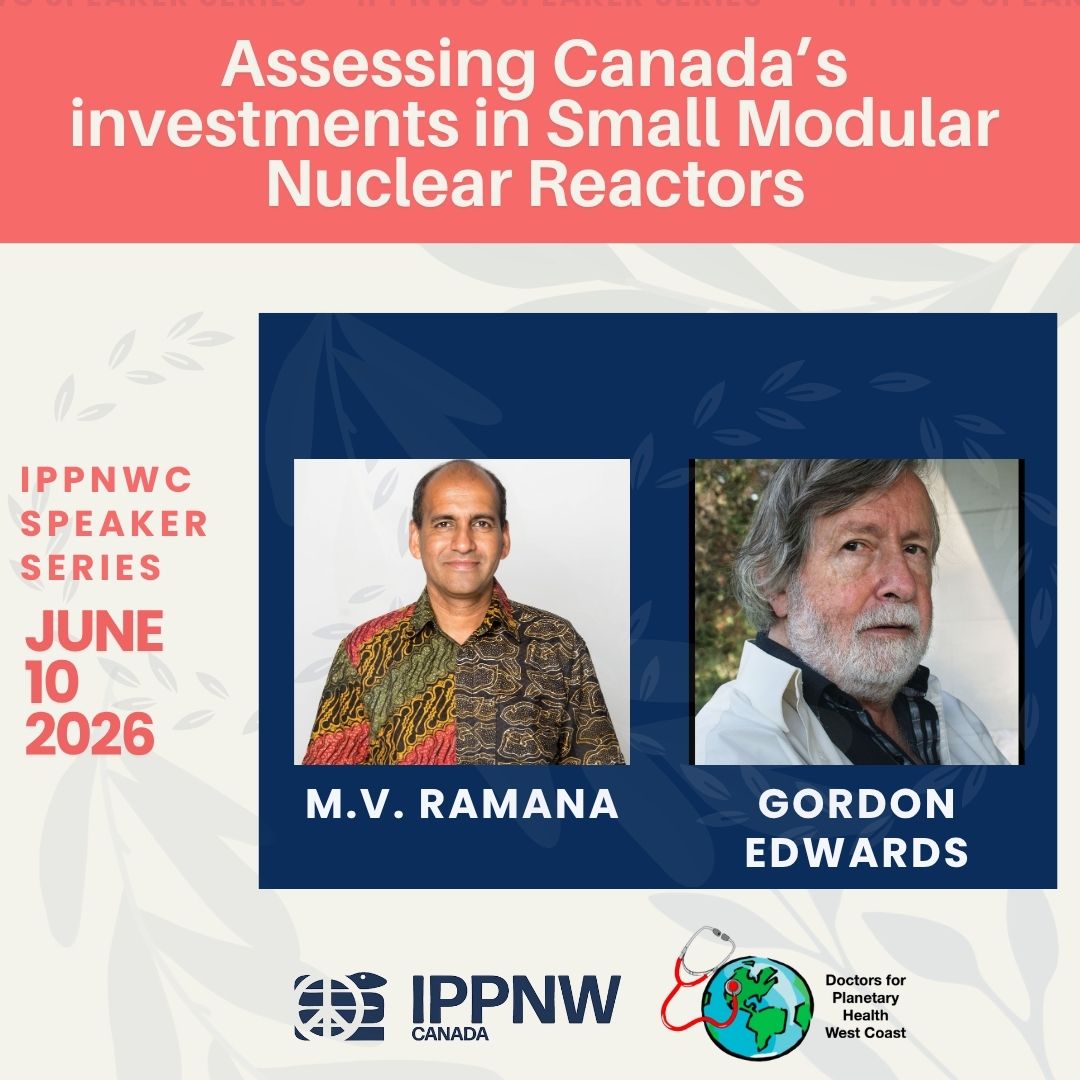
10 June – Assessing Canada’s Investments in Small Modular Nuclear Reactors – https://zoom.us/meeting/register/IiqHA5feRhaEBycOLNTJlA#/registration


Cuba Is Not a Failed State – It Is a Besieged State
PETITION: “Global Appeal to Endorse Palestinian Right of Return of Refugees”
To see nuclear-related stories in greater depth and intensity – go to https://nuclearinformation.wordpress.com
-
Archives
- June 2026 (89)
- May 2026 (306)
- April 2026 (356)
- March 2026 (251)
- February 2026 (268)
- January 2026 (308)
- December 2025 (358)
- November 2025 (359)
- October 2025 (376)
- September 2025 (257)
- August 2025 (319)
- July 2025 (230)
-
Categories
- 1
- 1 NUCLEAR ISSUES
- business and costs
- climate change
- culture and arts
- ENERGY
- environment
- health
- history
- indigenous issues
- Legal
- marketing of nuclear
- media
- opposition to nuclear
- PERSONAL STORIES
- politics
- politics international
- Religion and ethics
- safety
- secrets,lies and civil liberties
- spinbuster
- technology
- Uranium
- wastes
- weapons and war
- Women
- 2 WORLD
- ACTION
- AFRICA
- Atrocities
- AUSTRALIA
- Christina's notes
- Christina's themes
- culture and arts
- Events
- Fuk 2022
- Fuk 2023
- Fukushima 2017
- Fukushima 2018
- fukushima 2019
- Fukushima 2020
- Fukushima 2021
- general
- global warming
- Humour (God we need it)
- Nuclear
- RARE EARTHS
- Reference
- resources – print
- Resources -audiovicual
- Weekly Newsletter
- World
- World Nuclear
- YouTube
-
RSS
Entries RSS
Comments RSS
 nuclear-news