Taxpayers have to take legal action to get the facts on safety of nuclear facilities
 Why Do Taxpayers Have to Sue to Get Oversight of Nuclear Facilities? http://pogoblog.typepad.com/pogo/2012/04/why-do-taxpayers-have-to-sue-to-get-oversight-of-nuclear-facilities.html Project on Government Oversight, (POGO) By ANA LIEBELSON, 13 April 12,
The National Nuclear Security Administration (NNSA) has just released the Performance Evaluation Reports (PER) for its eight nuclear weapons sites. But that’s only thanks to the activist group Nuclear Watch New Mexico, who filed a Freedom of Information Act (FOIA) request for a FY2009 PER for Los Alamos National Laboratory (LANL), and then sued the agency for the report’s release after its request was denied.
The NNSA went ahead and gave Nuke Watch the FY2011 PERs that the group had also asked for through FOIA. These kinds of oversight reports are invaluable to the public, and we shouldn’t have to endure years of litigation to get them. Continue reading
The world’s oldest nuclear reactors
Nuclear Halt in South Korea Seen Boosting Coal: Energy Markets, Bloomberg News, By Sangim Han and Yuriy Humber on April 13, 2012“….World’s Oldest The U.K, India, Japan, Russia, Switzerland and the U.S. have the world’s oldest nuclear plants, with 31 operating reactors aged 40 years or more, according to the London-based World Nuclear Association. No reactor has yet operated 50 years.
The U.S., which has the most nuclear reactors, originally licensed its units to run 40 years. Today, 71 of the 104 U.S. reactors have 60-year permits and 15 more applications are under review, according to the country’s Nuclear Regulatory Commission website.
http://www.businessweek.com/news/2012-04-13/nuclear-halt-in-south-korea-seen-boosting-coal-energy-markets
Wellington set the trend for 105 local nuclear free zones
Wellington: 30 years proudly nuclear-free Capital was a benchmark for other cities The Dominion Post, MICHAEL FORBES 14/04/2012 Wellington became a benchmark for others. By the end of 1984, 40 local authorities had nuclear-free policies and by 1988, 72 per cent of the population was living in 105 locally declared nuclear-weapon-free zones.
“The declaration had repercussions way beyond anything I anticipated at the time,” Ms Ritchie says. “I’m pleased that it has stood the test of time. To have it stop at Wellington would have been insufficient.”
To even be able to put such a motion before council was a privilege, Ms Ritchie says; in today’s climate of local government being told to keep their nose out of non-essential matters, it probably would not have happened.
“It was in the days when we could actually do this sort of thing politically, which was great. We could move a motion that was not related to rubbish, rates or drains. Not even related to the agenda. Now, you can’t do that.”….. http://www.stuff.co.nz/dominion-post/news/6743621/Wellington-30-years-proudly-nuclear-free
Sarkozy said he went to Fukushima – but he lied
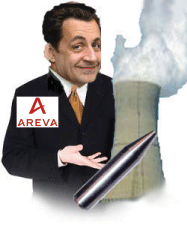 OOPS: Sarkozy’s Lied About Visiting Fukushima After The Japan’s Nuclear Disaster Business Insider, Sanya Khetani | Apr. 13, 2012, French President Nicolas Sarkozy will just not make things easy for himself. He was caught in another embarrassing political gaffe after his claims that he had visited Japan’s Fukushima nuclear plant after the earthquake and tsunami last year were proved false, The Telegraph reports.
“I went to Fukushima [with then ecology minister, Nathalie Kosciusko-Morizet]… and unlike Francois Hollande, I can tell you the disaster was caused by the 42-meter wave from a tsunami. Frankly, I don’t see the immediate risk of a tsunami in Alsace,” Sarkozy told a 5,000-strong crowd in Normandy, according to The Daily Mail. He was referring to Hollande’s promise to close France’s Fessenheim plant in the Alsace region and scale back nuclear activities.
While Sarkozy was the first western leader to visit Japan after the tragedy, records show he did not leave Tokyo. “This is the first time in the history of the French republic that a candidate has told of a voyage he never made,” his rival, Francois Hollande said. Other politicians and even the Japanese media were merciless as well.
Sarkozy was finally forced to accept he had not been to Fukushima, telling I-Tele “I’m not an engineer, I don’t need to stick my nose in the situation at Fukushima…… http://www.businessinsider.com/sarkozy-fukushima-japan-france-2012-4#ixzz1s43ylIzh
Continuing health problems from the atomic bombing in Japan
The Nuclear Bait-and-Switch, Fellowship of Reconciliation, By Mark Meade, April 12, 2012, Dr. Kyoko Iitaka, general secretary of the Japan Fellowship of Reconciliation branch and representative from Asia to the International Fellowship of Reconciliation (IFOR) International Committee, recently visited our Louisville FOR chapter.
Her presentation was a powerful reminder to me that issues involving nuclear weapons and energy will endure into the future whether we remain focused on them or not. Her experience of living in Japan through the Second World War and its aftermath while still championing nonviolence revealed a striking perspective from a country that has
seen too much of the dark side of nuclear power. …..
Dr. Iitaka reminds us that Fukushima is indeed an enduring disaster and will be for generations. More disturbingly, our use of atomic bombs in Hiroshima and Nagasaki are disasters of health in the present, not just for survivors of the bombing. Two generations later, there are continuing health problems that are directly related to the
fallout from those bombings.
She warns us that even though the Japanese people were very wary of nuclear power because of the terrible legacy from our bombs, no dose of caution fully inoculates a
population from the hazards of nuclear energy. A half-century national debate on nuclear power was ultimately unable to prevent this http://forusa.org/blogs/mark-meade/nuclear-bait-switch/10456
Navajo’s continuing cancer danger from uranium mines
 Navajos will continue to be exposed to uranium and its decay products, radon and radium. This means that they are at great risk for bone, liver, breast, and lung cancer, among other health problems….
Uranium Mines Still Pose Serious Health Threat on Navajo Land, Web Wire 12 April 12, In 2010, a Navajo cattle rancher named Larry Gordy discovered an abandoned uranium mine in the middle of his grazing land in Cameron, AZ, according to the New York Times. The Environmental Protection Agency (EPA) visited the site and found dangerously high levels of uranium, but the agency has yet to begin the clean-up.
The EPA found that the radioactivity there measured one million counts per minute, meaning that two days there would expose a person to more external radiation than the Nuclear Regulatory Commission considers safe for an entire year. A dose would lead directly to malignant tumors and other health problems. Continue reading
In the world of birds, radiation is more damaging to females
the tertiary sex ratio (here defined as the proportion of males among adults) was skewed towards an excess of males across 48 different bird species. This finding is in accordance with lower adult survival rates in females compared to males previously reported for barn swallows in contaminated areas around Chernobyl …..
 Female barn swallows suffer differentially from the mortality costs of radiation, with male adult survival being reduced by 24%, while female survival is reduced by 57% in contaminated areas compared to controls
Elevated Mortality among Birds in Chernobyl as Judged from Skewed Age and Sex Ratios PLoS One 13 April 12, “….Radiation has negative effects on survival of animals including humans, although the generality of this claim is poorly documented under low-dose field conditions.
Because females may suffer disproportionately from the effects of radiation on survival due to differences in sex roles during reproduction, radiation-induced mortality may result in
male-skewed adult sex ratios. Continue reading
The bitter history of Malaysia’s Bukit Merah rare earths project.
 Some of the surviving residents of Bukit Merah are still plagued with severe health problems. Until this very day, the Malaysian authorities refuse to acknowledge that the radioactive waste was responsible for the sudden escalation of health problems among the residents
Today, the government is the official custodian of this repository in Bukit Merah. This site in Bukit Merah is declared as a restricted and dangerous dump site for radioactive materials but a curtain of official silence has descended on it. Has the government not learnt from Bukit Merah?
The Lynas project is likely to be a replay of the ARE fiasco but on a much larger scale.
The benefits gained by Malaysia from the Lynas investment are very little relative to the risks involved. Whilst the profits of the project go to Lynas (untaxed) and the few Malaysian companies that are involved in the construction of and the provision of supplies to the Gebeng rare earth plant, the radioactive waste will remain in
Malaysian soil for hundreds of years.
 Lynas issue: Not learning from bitter experience —The Malaysian Insider, Richard Pendragon, April 12, 2012 “……..Bukit Merah The history of the rare earth industry in Malaysia is little known to most Malaysians. Most Malaysians in fact think that the Lynas project in Pahang is the first time Malaysia has been associated with this industry.
Few Malaysians actually know that there was a rare earth plant in Bukit Merah, Perak, which has been closed some 10 or more years ago, following a ruling by the High Court of Malaysia that the company involved was in negligence, and that the radioactive waste generated by the plant was dangerous and had to be removed and secured in a safe
place away from people for hundreds of years.
The evidence of the hazardous legacy of this rare earth plant is still present in our midst as a reminder to every one of the risks involved. Continue reading
Demand for the scrapping of Kudankulam nuclear plant project
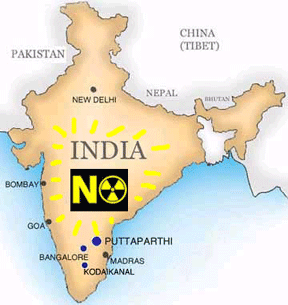 Scrap Kudankulam nuclear plant project: Swami Agnivesh
http://economictimes.indiatimes.com/news/politics/nation/scrap-kudankulam-nuclear-plant-project-swami-agnivesh/articleshow/12641010.cms, 12 APR, 2012, THIRUVANANTHAPURAM: Demanding that the Centre immediately scrap the Kudankulam Nuclear power project, activist Swami Agnivesh today demanded that a high-level panel should visit the KNPP site to address fears of locals there.
“I demand that the government scrap the plant and initiate an
alternative source of clean energy. Continue reading
The danger of nuclear powered drones, and plutonium for spacecraft
 The Deadly Folly of Nuclear Power Overhead HUFFINGTON POST, Karl Grossman: 04/12/2012 The crash last week of a U.S. drone on the Seychelles Islands– the second crash of a U.S. drone on Seychelles in four months — underlines the deadly folly of a plan of U.S. national laboratory scientists and the Northrop Grumman Corp. for nuclear-powered drones. Continue reading
Unacceptable risks of thorium
 Lynas issue: Not learning from bitter experience —The Malaysian Insider, Richard Pendragon, April 12, 2012 “…..Unacceptable risks of thorium “No monetary returns of whatever Foreign Direct Investment and its spinoffs can outweigh possible radiation and/or other health risks,
which can wreak harm on our citizens, perhaps for as long as the half-lives of some of the extremely toxic radionuclide waste products —which in some cases might be ‘forever’!”
Dr David KL Quek, President, Malaysian Medical Association (MMA), May 26, 2011 One of the most contentious issues with the Lynas Advanced Materials Plant is the thorium (Th) by-product. Exposure to Thorium can cause cancer posing serious risks to workers at the LAMP and surrounding communities. Studies have shown that inhaling thorium dust causes an increased risk of developing lung cancer, and cancer of the pancreas. Bone cancer risk is also increased because thorium may be stored in bone. Thorium has a half life of 14 billion years and is easily transported and spread through wind and water.
Lynas will be processing 10 times the amount of ore compared to the ARE. Despite Lynas’ public proclamation of “Zero Harm” commitment there is no foolproof containment measures for such toxic residue for workers onsite at the LAMP. It should be noted that the ores that Chinese miners were exposed to in Bayun Obo Rare-Earth and Iron Mine
contained 400 ppm of thorium. The rare earth oxide concentrates that will be arriving shortly at Kuantan port will have 1600 ppm of thorium. The US Public Health Service (1990) reports that the natural background level in soil is typically 6 ppm of thorium.
http://www.themalaysianinsider.com/sideviews/article/lynas-issue-not-learning-from-bitter-experience-richard-pendragon
The multi $trillion nightmare of ‘nuclear decommissioning’
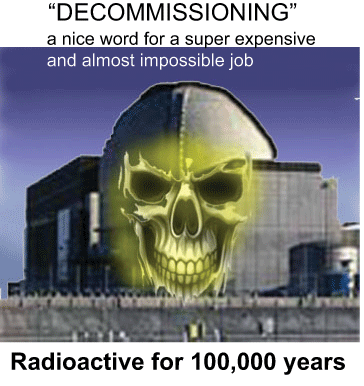 The Nuclear Powers of Japan and United Kingdom Enformable, 13 April 12,”…….so far, the true cost and impact of the Fukushima disaster has been massively and criminally downplayed and delayed.
Fukushima has resulted in vast areas of Japan, including some parts of Tokyo becoming so contaminated that the comparisons of the samples taken would show the Soviets would have evacuated and the Americans would designate the area as a hazardous radiological area if part of any US facility.
The fact of the matter remains, nuclear power is a money pit of an unrivaled parallel; whether building, operating, waiting to be transferred while waiting in spent fuel pools, waiting to be transferred to permanent storage in non-existent facilities, or smoldering as the case at the crippled Fukushima reactors.
Even the rosiest estimates for the decontamination and remediation, if such a thing is even possible, involve a multi-decade, multi-trillion dollar nightmare….. http://enformable.com/2012/04/uk-and-japanese-agree-to-act-in-unison-on-nuclear-interests/
Florida rebellion of ratepayers against “Nuclear Cost Recovery”
Florida AARP joins suit to overturn nuclear fees to utilities, Tampa Bay Times, By Ivan Penn, Times April 13, 2012 Florida’s largest nonpartisan, nonprofit senior organization joined a lawsuit Thursday to overturn a state law that requires utility customers to pay in advance for new nuclear plants.
In opposing the advance nuclear fee, the Florida AARP said many of its members already face difficulty meeting rising utility costs on their low and fixed incomes. To add fees for proposed nuclear plants that might never get built, the organization said, is an undue burden. “During this period of economic hardship, the rising cost to provide current electric utility service is severe enough to raise alarm,” the AARP stated in a brief to the Florida Supreme Court.
The AARP submitted the brief in support of a lawsuit filed by the Southern Alliance for Clean Energy, an advocate for energy efficiency and clean energy…..
http://www.tampabay.com/news/business/energy/florida-aarp-joins-suit-to-overturn-nuclear-fees-to-utilities/1224791

The new Florida reactor projects are clearly in trouble, plagued with cost overruns and expensive delays. This increases the likelihood that the projects will not be completed,
Officials: Backlash Spreading in Florida Against “Nuclear Cost Recovery” Financing Scheme for Proposed Reactors Unlikely to Ever Be Built Market Watch, JACKSONVILLE, Fla., April 12, 2012 /PRNewswire via COMTEX/ — No Refund Rip-off for Consumers: Bipartisan Filings in Legal Challenge Before the Florida Supreme Court and Growing Local Opposition Spells Big Trouble For Tapping Ratepayers for 4 Nuclear Reactors That Are Unneeded, Unaffordable and Unsafe.
Florida ratepayers are not rolling over for the major utilities that want to pick their wallets in advance for new nuclear reactors that may never actually be constructed.
State and local officials made it clear today that bipartisan opposition continues to grow in Florida to the controversial use of so-called “nuclear cost recovery” (NCR) to force ratepayers in the state to pay in advance for costs associated with four Progress Energy
of Florida (PEF) and Florida Power & Light (FPL) nuclear reactors that are increasingly unlikely to ever be built. Continue reading
Iran’s plea for trust in nuclear talks
 In the upcoming talks, we hope that all sides will return to the negotiating table as equals with mutual respect; that all sides will be committed to comprehensive, long-term dialogue aimed at resolving all parties’ outstanding concerns; and, most important, that all sides make genuine efforts to reestablish confidence and trust.
 Iran: We do not want nuclear weapons Washington Post, By Ali Akbar Salehi, April 12 Ali Akbar Salehi is foreign minister of the Islamic Republic of Iran. Forty-five years ago, the United States sold my country a research reactor as well as weapons-grade uranium as its fuel. Not long afterward, America agreed to help Iran set up the full nuclear fuel cycle along with atomic power plants. The U.S. argument was that nuclear power would provide for the growing needs of our economy and free our remaining oil reserves for export or conversion to petrochemicals.
That rationale has not changed. Still, after the Islamic Revolution in our country in 1979, all
understandings with the United States in the nuclear field unraveled. Continue reading
USA States reaping the benefits of renewable energy progress
A spotlight on renewable success, Climate Spectator, 13 Apr 2012, Richard Caperton Center for American Progress New Jersey, Texas, and California have very different energy profiles. They use different types of energy to power their economy. They have
different types of utility systems. And they have different expectations of their energy system.
But these states share one important trait: They’re reaping the benefits of renewable energy. Continue reading
1 This Month
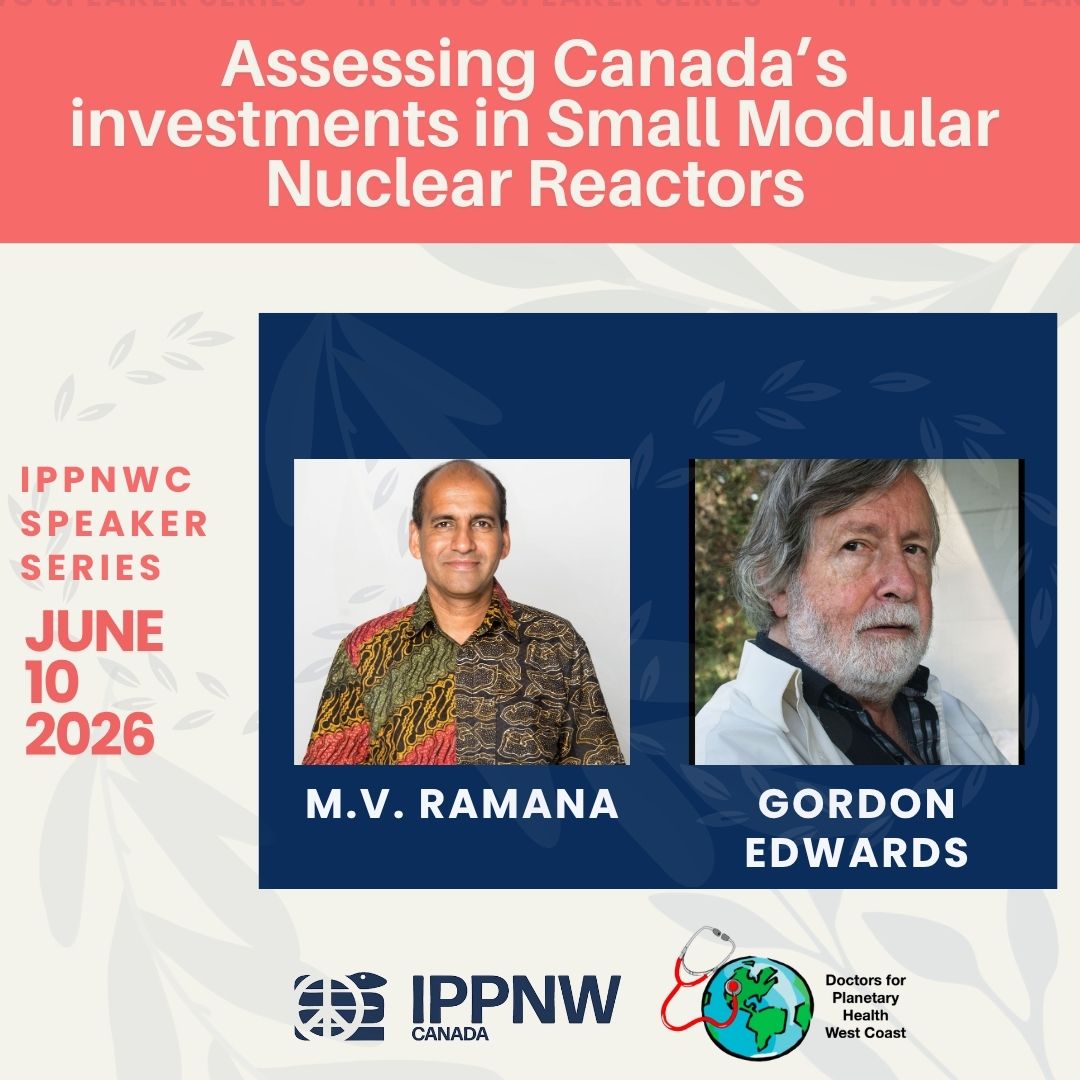
10 June – Assessing Canada’s Investments in Small Modular Nuclear Reactors – https://zoom.us/meeting/register/IiqHA5feRhaEBycOLNTJlA#/registration


Cuba Is Not a Failed State – It Is a Besieged State
PETITION: “Global Appeal to Endorse Palestinian Right of Return of Refugees”
To see nuclear-related stories in greater depth and intensity – go to https://nuclearinformation.wordpress.com
-
Archives
- June 2026 (89)
- May 2026 (306)
- April 2026 (356)
- March 2026 (251)
- February 2026 (268)
- January 2026 (308)
- December 2025 (358)
- November 2025 (359)
- October 2025 (376)
- September 2025 (257)
- August 2025 (319)
- July 2025 (230)
-
Categories
- 1
- 1 NUCLEAR ISSUES
- business and costs
- climate change
- culture and arts
- ENERGY
- environment
- health
- history
- indigenous issues
- Legal
- marketing of nuclear
- media
- opposition to nuclear
- PERSONAL STORIES
- politics
- politics international
- Religion and ethics
- safety
- secrets,lies and civil liberties
- spinbuster
- technology
- Uranium
- wastes
- weapons and war
- Women
- 2 WORLD
- ACTION
- AFRICA
- Atrocities
- AUSTRALIA
- Christina's notes
- Christina's themes
- culture and arts
- Events
- Fuk 2022
- Fuk 2023
- Fukushima 2017
- Fukushima 2018
- fukushima 2019
- Fukushima 2020
- Fukushima 2021
- general
- global warming
- Humour (God we need it)
- Nuclear
- RARE EARTHS
- Reference
- resources – print
- Resources -audiovicual
- Weekly Newsletter
- World
- World Nuclear
- YouTube
-
RSS
Entries RSS
Comments RSS
 nuclear-news