A very long haul to clean up Savannah River’s plutonium wastes
The amount of plutonium in the waste tanks is uncertain. Savannah River was built to make plutonium, and the material in the tanks is what was left over after the material was produced in reactors and scavenged in chemical plants. But a fair amount ended up in the waste tanks
A Very Long Road for Military Nuclear Waste By MATTHEW L. WALD, NYT, March 29, 2012 Slowly, slowly, the Energy Department is moving forward with solidifying the liquid nuclear wastes left over from cold-war weapons production. On Thursday, the department said it had closed two more of the 51 underground tanks at the Savannah River Site in western South Carolina. The high-level waste was mixed with molten glass to keep it chemically locked up for millennia, and the lower-level material was mixed with a kind of cement that is supposed to keep it in place until the radioactivity dies down.
The department has 22 tanks at Savannah River that do not meet Environmental Protection Agency standards , mostly because they are single-wall tanks rather than double-wall. It closed two of them in 1997 but has faced numerous technical problems. Continue reading
CT scans a radiation concern, especially for young patients with gastrointestinal illnesses
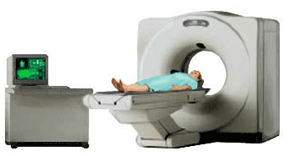 Patients with digestive disorders may receive high levels of X-ray radiation Medical Express, March 29, 2012 Patients with inflammatory bowel disease (IBD) and other gastrointestinal (GI) disorders may be exposed to significant doses of diagnostic radiation, according to a new study in Clinical Gastroenterology and Hepatology, the official journal of the American Gastroenterological Association.
“Our results show that significant increases in radiation exposure in the last decade have paralleled the increased use of computed tomography imaging,” said Alan N. Desmond, MB, BMedSc, MRCPI, of the Cork University Hospital, Ireland, and lead author of this study. “While cumulative exposure is highest in patients with Crohn’s disease, high exposure may also occur in patients with other gastrointestinal disorders.”….
because CT uses higher levels of radiation than other imaging options, more widespread use has led to increases in the amount of radiation to which patients are exposed. This is a cause for concern, because radiation exposure might be associated with increased lifetime risk of
cancer. These risks may be particularly relevant to younger patients.
http://medicalxpress.com/news/2012-03-patients-digestive-disorders-high-x-ray.html
Radiation so high, even robots cannot approach Fukushima No. 1 nuclear reactor

 Reactor 2 radiation too high for access March 29, 2012 73 sieverts laid to low water; level will even cripple robots By MINORU MATSUTANI Radiation inside the reactor 2 containment vessel at the Fukushima No. 1 nuclear plant has reached a lethal 73 sieverts per hour and any attempt to send robots in to accurately gauge the situation will require them to have greater resistance than currently available, experts said Wednesday.
Exposure to 73 sieverts for a minute would cause nausea and seven minutes would cause death within amonth, Tokyo Electric Power Co. said.
The experts said the high radiation level is due to the shallow level of coolant water — 60 cm — in the containment vessel, which Tepco said in January was believed to be 4 meters deep. Tepco has only peeked inside the reactor 2 containment vessel. It has few clues as to the status of reactors 1 and 3, which also suffered meltdowns, because
there is no access to their insides.
The utility said the radiation level in the reactor 2 containment vessel is too high for robots, endoscopes and other devices to function properly. Spokesman Junichi Matsumoto said it will be necessary to develop devices resistant to high radiation.
High radiation can damage the circuitry of computer chips and degrade camera-captured images. For example, a series of Quince tracked robots designed to gather data inside reactors can properly function for only two or three hours during exposure to 73 sieverts, said Eiji Koyanagi, chief developer and vice director of the Future Robotics Technology
Center of Chiba Institute of Technology. That is unlikely to be enough for them to move around and collect
video data and water samples, reactor experts said. ”Two or three hours would be too short. At least five or six hours would be necessary,” said Tsuyoshi Misawa, a reactor physics and engineering professor at Kyoto University’s Research Reactor Institute.
The high radiation level can be explained by the low water level. Water acts to block radiation. ”The shallowness of the water level is a surprise . . . the radiation level is awfully high,” Misawa said. While the water temperature is considered in a safe zone at about 50 degrees, it is unknown if the melted fuel is fully submerged, but Tepco said in November that computer simulations suggested the height of the melted fuel in reactor 2′s containment vessel is probably 20 to
40 cm, Tepco spokeswoman Ai Tanaka said.
Tepco has inserted an endoscope and a radiation meter, but not a robot, in the containment vessel. It is way too early to know how long Tepco will need to operate robots in the vessel because it is unknown what the devices will have to do, Tanaka said.
According to experts, even though high radiation in the containment vessel means additional trouble, it is not expected to further delay the decommissioning the three crippled reactors, a process Tepco said will take 40 years.
The experts noted, however, that removing the melted nuclear fuel from the bottom of the containment vessels will be extremely difficult….
Tepco has not been able to gauge the water depths and radiation levels of the containment vessels for reactors 1 and 3, as, unlike unit 2, there is no access. http://www.japantimes.co.jp/text/nn20120329a1.html
Attack on Iran would not prevent its nuclear development
Iran could recover from attack on its nuclear sites within six months, says U.S. report U.S. congressional report says Israel and U.S. do not know exact location of Iran nuclear facilities, which may be dispersed in such a way that an Israeli attack would not be successful. By Haaretz , 28 March 12, Continue reading
Fukushima nuclear plant is far from safe

 Still critical: radiation levels at Fukushima can kill in minutes Latest readings from tsunami-stricken nuclear plant overturn claims that reactors have been made safe The Independent, DAVID MCNEILL TOKYO THURSDAY 29 MARCH 2012 A lethal level of radiation has been detected inside one of the reactors at the Fukushima nuclear power plant, throwing fresh doubts over the operator’s claims that the disabled complex is under control. Continue reading
In Japan, radiation being tactfully left out of school textbooks
without the appropriate study materials, how well … Japan’s school children will understand how their lives have been and will continue to be impacted by the nuclear disaster is unknown.
 Japanese textbooks whitewashing nuclear disaster Asian Correspondent By Anna Watanabe Mar 29, 2012 There are many of things Japan has done in the past that it tries to erase from public memory by downplaying their events in school textbooks: the Nanking Massacre, medical testing on POWs during WWII, comfort women and territorial disputes.
But all these are atrocities that have happened outside of Japan, to other nationalities and they occurred generations ago. As inexcusable as it is to claim their non-existence, the logic is somehow more understandable.
But now Japan is trying to rewrite its own, modern-history. Continue reading
Lynas rare earths company has to get Australia to agree to take back radioactive wastes
Onus is on Lynas to get nod for waste shipment’, The Malaysian Star Reports by MARTIN CARVALHO, YUEN MEIKENG, RAHIMY RAHIM and TASHNY SUKUMARAN , 29 March 12, THE onus of obtaining permission from the authorities to ship waste from the proposed rare earth plant in Gebeng, Pahang, to Australia lies with operators Lynas Corporation, said Science, Technology and Innovations Minister Datuk Seri Dr Maximux Ongkili.
“There has been no official word from the authorities in Australia over the shipment (of the waste) and I have not received any formal communication,” he said at Parliament lobby.
Though helping facilitate Lynas’ investment in setting up the plant here, he noted there were conditions that the company must fulfil with the onus on them to obtain approval for waste shipment to Australia if the need arose. “We are not here for the purpose of just helping Lynas. We have set conditions and they must follow,” he said.
The Atomic Energy Licensing Board’s (AELB) imposed five conditions for the issuance of a temporary operating licence for the Lynas plant which includes locating a suitable site for a permanent disposal facility. “If Lynas cannot process the wastes here according to our standard or cannot find a permanent disposal site, then they have to seek a site outside this country…..
“Otherwise, I am not giving the licence as they have signed for that,” Ongkili repeatedly said….. Ongkili said Lynas Corporation chose to have its rare earth plant in Malaysia because the cost to operate the facility here was 30% of that in Australia….. http://thestar.com.my/news/story.asp file=/2012/3/28/parliament/11002216&sec=parliament
Nuclear smuggling, mainly by Iranian and Chinese middlemen
 US, European officials probe Iran nuclear smuggling By Mark Hosenball and John Shiffman WASHINGTON, Mar 28, 2012 (Reuters) – A dramatic expansion in nuclear and military smuggling investigations should lead to a flood of new criminal cases, primarily against Iranian and Chinese middlemen, U.S. law enforcement officials said on Wednesday.
U.S. officials said they are investigating 30 percent more cases this year than three years ago. U.S. agencies have deployed agents posing as arms brokers at more than 20 undercover companies targeting smugglers, said the officials, who briefed reporters on condition of anonymity.
Undercover arms smuggling investigations typically take two to four years to unfold, one of the officials said, which is why he expects an increase in indictments soon….
http://www.reuters.com/article/2012/03/28/usa-iran-smuggling-idUSL2E8ERODR20120328
Hypocrisy and racism – Australia’s sorry nuclear history

 Dumping on Traditional Owners: the ugly face of Australian racism The Drum, 29 March 12 The nuclear industry has been responsible for some of the crudest racism in Australia’s history.
This racism dates from the British nuclear bomb tests in the 1950s but it can still be seen today.
The British government conducted 12 nuclear bomb tests in Australia in the 1950s, most of them at Maralinga in South Australia. Permission was not sought from affected Aboriginal groups such as the Pitjantjatjara, Yankunytjatjara, Tjarutja and Kokatha. Thousands of people were adversely affected and the impact on Aboriginal people was particularly profound.
Many Aboriginal people suffered from radiological poisoning. There are tragic accounts of families sleeping in the bomb craters. So-called ‘Native Patrol Officers’ patrolled thousands of square kilometres to try to ensure that Aboriginal people were removed before nuclear tests took place. Signs were erected in some places – written in English, which few in the affected Indigenous communities could understand. The 1985 Royal Commission found that regard for Aboriginal safety was characterised by “ignorance, incompetence and cynicism”. Many Aboriginal people were forcibly removed from their homelands and taken to places such as the Yalata mission in South Australia, which was effectively a prison camp.
In the late-1990s, the Australian government carried out a clean-up of the Maralinga nuclear test site. It was done on the cheap and many tonnes of debris contaminated with kilograms of plutonium remain buried in shallow, unlined pits in totally unsuitable geology. As nuclear engineer and whistleblower Alan Parkinson said of the ‘clean-up’ on ABC radio in August 2002:
“What was done at Maralinga was a cheap and nasty solution that wouldn’t be adopted on white-fellas land.”
Despite the residual contamination, the Federal Government has off-loaded responsibility for the land onto the Maralinga Tjarutja Traditional Owners. The Government portrays this land transfer as an act of reconciliation, but the real agenda was spelt out in a 1996 government document which states that the clean-up was “aimed at reducing Commonwealth liability arising from residual contamination.”….. http://www.abc.net.au/unleashed/3919296.html
The week that was in things nuclear

Christina Macpherson's websites & blogs
Fukushima. disturbing revelations today on the very high radioactivity inside the reactors, and the low level of cooling water within them
Nuclear Security Summit. Despite progress made on reducing the world’s stocks of enriched uranium, the Summit ended with no firm plans for action on nuclear security or on nuclear disarmament. Meanwhile, alongside the Summit, went military and commercial developments. USA to increase its nuclear submarines visiting Australia, and Australia to host USA base for drone aircraft. South Korea pitching nuclear sales talk to India. Nigeria impressing on the safety of its nuclear power program, despite the well known insecurity of its gas and oil industries.
India; after 8 days, anti nuclear protestors stop their hunger strike, seeing that the Tamil Nadu government agrees to their demands to release imprisoned protestors. But the anti nuclear fight will continue
World: global warming getting close to tipping point.
Alarming news about the state of Fukushima’s nuclear reactors today
 Very high radiation, little water in Japan reactor, Sydney Morning Herald, MARI YAMAGUCHI, March 28, 2012 One of Japan’s crippled nuclear reactors still has fatally high radiation levels and much less water to cool it than officials had estimated, according to an internal examination that renews doubts about the plant’s stability.
A tool equipped with a tiny video camera, a thermometer, a dosimeter and a water gauge was used to assess damage inside the No. 2 reactor’s containment chamber for the second time since the tsunami swept into the Fukushima Dai-ichi plant a year ago.
The data collected Tuesday showed the damage from the disaster is so severe, the plant operator will have to develop special equipment and technology to tolerate the harsh environment and decommission the plant, a process expected to last decades. The other two reactors that had meltdowns could be in even worse shape. The No. 2 reactor is the
only one officials have been able to closely examine so far.
Tuesday’s examination with an industrial endoscope detected radiation levels up to 10 times the fatal dose inside the chamber. Plant officials previously said more than half of the melted fuel has breached the core and dropped to the floor of the primary containment vessel, some of it splashing against the wall or the floor.
Particles from melted fuel have probably sent radiation levels up to a dangerously high 70 sieverts per hour inside the container, said Junichi Matsumoto, spokesman for Tokyo Electric Power Co. The figure far exceeds the highest level previously detected, 10 sieverts per hour, which was detected around an exhaust duct shared by No. 1 and 2 units last year.
“It’s extremely high,” he said, adding that an endoscope would last only 14 hours in those conditions. “We have to develop equipment that can tolerate high radiation” when locating and removing melted fuel during the decommissioning.
The probe also found that the containment vessel _ a beaker-shaped container enclosing the core _ had cooling water up to only 60 centimeters (2 feet) from the bottom, far below the 10 meters (yards) estimated when the government declared the plant stable in December.
The plant is continuing to pump water into the reactor……
The exact conditions of the other two reactors, where hydrogen explosions damaged their buildings, are still unknown. Simulations have indicated that more fuel inside No. 1 has breached the core than the other two, but radiation at No. 3 remains the highest.
The high radiation levels inside the No. 2 reactor’s chamber mean it’s inaccessible to the workers, but parts of the reactor building are accessible for a few minutes at a time _ with the workers wearing full protection…. http://news.smh.com.au/breaking-news-technology/very-high-radiation-little-water-in-japan-reactor-20120328-1vxxz.html
Yes, Virginia, a nuclear bomb would effectively destroy our Washington DC

 A nuclear blast of any size would end D.C. as we know it Washington Post, By Mike DeBonis, 27 March 12, Last November, federal researchers issued a report commissioned by the Department of Homeland Security on what would happen if a relatively small nuclear device — the kind a terrorist group would most likely come to possess — were detonated at 16th and K streets NW.
“National Capital Region: Key Response Planning Factors for the Aftermath of Nuclear Terrorism” was little noticed until the Federation of American Scientists posted a copy of the study on its Secrecy News blog. It was then picked up by this newspaper, Gizmodo and others.
Today, the Associated Press wrote up a story on the report, and it’s a good summation of the aftermath of a terrorist nuclear blast in all its awful detail. But it moved across the wire with an unfortunate headline: “Gov’t report: DC nuke blast wouldn’t destroy city.”
Make no mistake, a nuclear blast of any size would destroy D.C. as we know it.
Yes, the loss of life (45,000 dead) and damage to property caused by a 10-kiloton ground blast — approximately Hiroshima-level — would be nowhere as apocalyptic as the multiple, multi-megaton air bursts that the city would absorb during a Cold War-type nuclear exchange.
Most of the city’s residents would survive and most of its residential neighborhoods would remain intact, but any nuclear blast would be an existential dagger for Washington as a center for government and commerce — a death knell for D.C. as a city worthy of that word….. http://www.washingtonpost.com/blogs/mike-debonis/post/a-nuclear-blast-of-any-size-would-end-dc-as-we-know-it/2012/03/27/gIQAieZmeS_blog.html
No definite actions decided on by Nuclear Security Summit
no specific reduction targets [for enriched uranium and plutonium]
The Nuclear Security Summit has no legally binding force to get other countries to reduce nuclear materials. It must rely on the voluntary pledges of participating countries to abide by the communiqué.
Another weakness of the communiqué is that it states no mechanism to verify the commitments made by each country.
Nuclear Security Summit Ends Without Clear Targets, http://english.chosun.com/site/data/html_dir/2012/03/28/2012032800852.html The Chosunilbo, 28 March 12,
The Seoul Nuclear Security Summit ended Tuesday with the leaders of 53 countries unanimously adopting a communiqué that encourages nations to take all possible steps and cooperate to secure vulnerableweapons-grade fissile material by 2014. President Lee Myung-bak, who chaired the summit, told reporters its main achievement was steps to
reduce highly enriched uranium and plutonium, which are key to preventing nuclear terrorism. Continue reading
Tamil Nadu govt agrees to release prisoners, so anti nuclear activists cease hunger strike
Nuclear activists end fast, but say they will continue their protest TNN | Mar 28, 2012, anti-nuclear activist S P Udayakumar, who is spearheading the protest against the Kudankulam Nuclear Power Project, and others on Tuesday ended their fast unto death following assurances by the state government.
The protesters said the government had agreed to their demand of dropping cases and releasing the arrested activists. Udayakumar, convenor of the People’s Movement Against Nuclear Energy (PMANE), and 14 others, including seven women, withdrew their fast around 7pm after Tirunelveli district collector R Selvaraj held several rounds of talks with their representatives.
However, Udayakumar said the protest against the nuclear plant would continue. “We have decided to withdraw the fast respecting the request of Tuticorin bishop Yvonne Ambrose and a number of our well-wishers. But our protest will continue. Continue reading
8 days of Indian anti nuclear protestors’ hunger strike
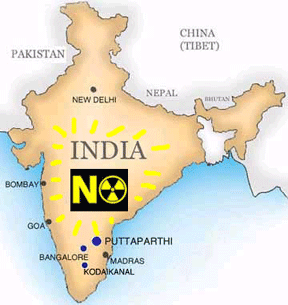 “Idanthikarai reveals how cruel governments can be” On the eighth day of the hunger strike, anti nuclear plant protestors say they continue to wait for the Central and state government to come talk to them Tekelka, Jeemon Jacob, 27 Mar 12 Idanthikarai/ Thiruvananthapuram A woman protester was shifted to hospital even as the anti-nuclear plant protests entered the eighth day. Forty-year-old Melred Raj, was shifted to the local hospital on Sunday 25 March, after she fainted at the protest venue. Her condition is said to be stable now Continue reading
1 This Month
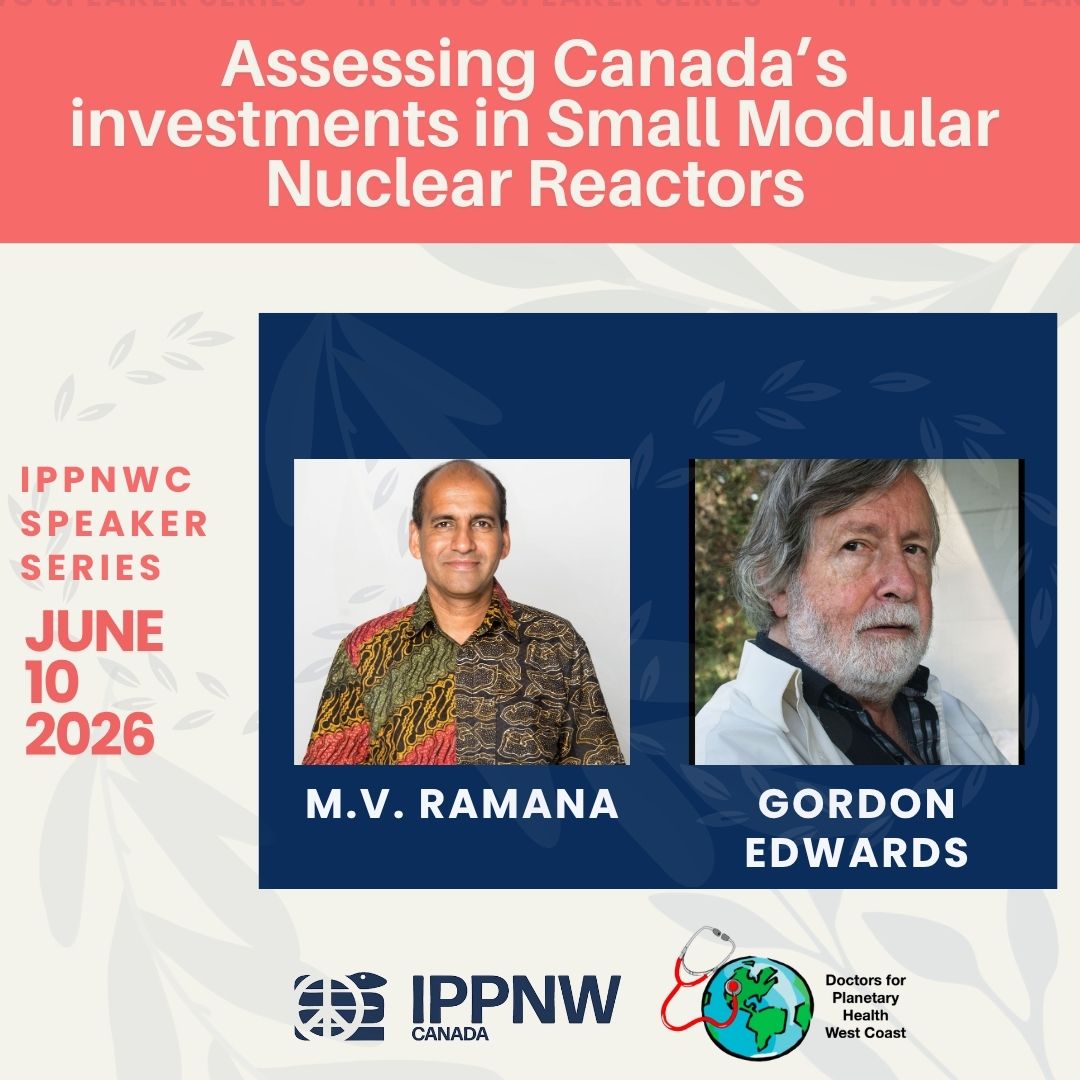
10 June – Assessing Canada’s Investments in Small Modular Nuclear Reactors – https://zoom.us/meeting/register/IiqHA5feRhaEBycOLNTJlA#/registration


Cuba Is Not a Failed State – It Is a Besieged State
PETITION: “Global Appeal to Endorse Palestinian Right of Return of Refugees”
To see nuclear-related stories in greater depth and intensity – go to https://nuclearinformation.wordpress.com
-
Archives
- June 2026 (89)
- May 2026 (306)
- April 2026 (356)
- March 2026 (251)
- February 2026 (268)
- January 2026 (308)
- December 2025 (358)
- November 2025 (359)
- October 2025 (376)
- September 2025 (257)
- August 2025 (319)
- July 2025 (230)
-
Categories
- 1
- 1 NUCLEAR ISSUES
- business and costs
- climate change
- culture and arts
- ENERGY
- environment
- health
- history
- indigenous issues
- Legal
- marketing of nuclear
- media
- opposition to nuclear
- PERSONAL STORIES
- politics
- politics international
- Religion and ethics
- safety
- secrets,lies and civil liberties
- spinbuster
- technology
- Uranium
- wastes
- weapons and war
- Women
- 2 WORLD
- ACTION
- AFRICA
- Atrocities
- AUSTRALIA
- Christina's notes
- Christina's themes
- culture and arts
- Events
- Fuk 2022
- Fuk 2023
- Fukushima 2017
- Fukushima 2018
- fukushima 2019
- Fukushima 2020
- Fukushima 2021
- general
- global warming
- Humour (God we need it)
- Nuclear
- RARE EARTHS
- Reference
- resources – print
- Resources -audiovicual
- Weekly Newsletter
- World
- World Nuclear
- YouTube
-
RSS
Entries RSS
Comments RSS
 nuclear-news