Decentralised renewable energy taking off in Britain’s small businesses
 London Small and Medium Enterprises plan to generate their own renewable energy – and one in eight already do London Loves Business 20 February 2012 A number of London’s SMEs have invested in generating their own energy and even more plan to follow within the next five years, according to a survey.

About 13 per cent of the capital’s small and medium-sized firms now generate at least some of their own energy, higher than the national average of six per cent, Opus Energy’s research found.
The amount of SMEs based in London that could be producing their own energy by 2017 is set to rise to 38 per cent, if they carry out investment plans. One in 10 of London’s firms said they hoped to start generating renewable power on their business’ premises within the next
12 months…. http://www.londonlovesbusiness.com/news/london-firms-plan-to-generate-renewable-power/1737.article
Japan’s nuclear crisis resulting in its record trade deficit
Japan’s trade deficit ballons to record high as nuclear crisis pushes up fuel imports Washington Times, By Associated Press, February 19 TOKYO — Japan posted a record high trade deficit in January after its nuclear crisis shut down nearly all the nation’s reactors for tougher checks, sending fuel imports surging. Exports were hurt by a strong yen and weak demand.
The 1.48 trillion yen ($18.7 billion) deficit reported Monday highlights Japan’s increased dependence on imported fuel after the March 11 earthquake and tsunami sent the Fukushima Dai-ichi nuclear plant into multiple meltdowns…. http://www.washingtonpost.com/business/worldbusiness/japans-trade-deficit-ballons-to-record-high-as-nuclear-crisis-pushes-up-fuel-imports/2012/02/19/gIQABX1HOR_story.html
Britain’s opportunity to lead in exporting marine energy technologies
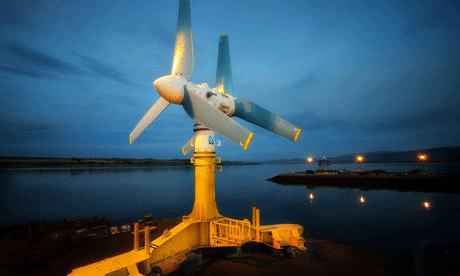
 UK could become leading exporter of wave and tidal power, say MPs New report from Energy and Climate Change Committee calls on government to establish long term goals for marine energy guardian.co.uk, 20 February 2012 The government will today be called on to increase its support for wave and tidal power in a new report from MPs warning the UK is at risk of repeating mistakes which allowed the country to lose its early lead in the developing wind power industry.
MPs on the Commons’ Energy and Climate Change Committee (ECC) on Monday released a report on the future of marine renewables, which will claim the UK could become a leading exporter of wave and tidal power equipment and expertise if the government adopts a more visionary approach to developing marine energy.
Seven of the the eight full-scale prototype devices installed worldwide are in UK waters, making the country the current world leader in the development of wave and tidal energy technologies. Continue reading
Russia’s oil billionaires’ money finances new nuclear submarines
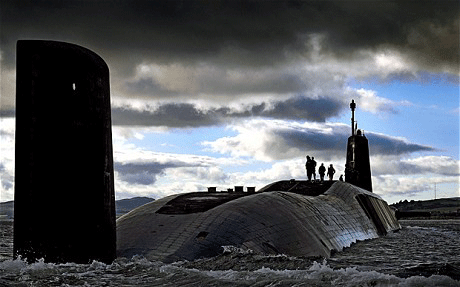
 Putin Thanks Oil Billionaires for Rescuing Nuclear Sub Base, Feb. 20 (Bloomberg) — Prime Minister Vladimir Putin said he owed a debt of gratitude to oil companies TNK and OAO Surgutneftegas for providing the cash needed to keep Russia’s seaborne nuclear forces in the Pacific afloat in 2002.
Then-President Putin asked the non-state companies to fund the Vilyuchinsk base on the Kamchatka Peninsula after the military proposed closing the facility, Putin said in an article published today in government newspaper Rossiiskaya Gazeta.
“Now we have a modern base at Vilyuchinsk that will soon” be home to a new generation of nuclear submarines, he wrote……. http://www.businessweek.com/news/2012-02-20/putin-thanks-oil-billionaires-for-rescuing-nuclear-sub-base.html
Great potential for decentralised solar and wind energy in Kenya
Kenya receives an estimated 4 to 6 kWh per square meter per day of solar insolation, equivalent to about 300 million tonnes of oil according to African Energy Policy Research Network 2004.
Kenya has one of the best wind resources in the world averaging between 3 and 10m/s with northern Kenya recording speeds of up to 11m/s.
 Innovation and Diversification Are Key for Kenya’s Renewable Energy Industry, Renewable Energy World, By Peter Kahare, February 20, 2012 KENYA — Decentralizing and diversifying renewable energy power generation technologies could be the panacea to save Kenyans from unreliable and expensive power supplied by hydro and thermal power generation, a recent study has found.
The new study by Christian Aid, an international agency that seeks solutions to chronic poverty in various nations says that empowering communities in rural areas in Kenya to produce power through renewable, cleaner sources could reduce overreliance on hydropower and fully exploit the renewable energy potential while offering opportunity to unlock economic growth. Participation of local communities in renewable energy technology projects such as
small/micro hydro, wind, solar, bagasse cogeneration and improved stoves could increase energy security and mitigate against climate change effects that badly affect the hydro power generation technology,” says Alison Doig, the report’s lead author and senior climate change advisor at Christian aid. Continue reading
Nuclear energy unaffordable and unwise, for Kenya
Heed UN caution on nuclear energy quest, Business Daily, February 19 2012, The government may have stumbled in its quest for nuclear energy after the United Nations cautioned it last week against entering the venture.The government announced plans to start generating nuclear energy for her electricity needs by 2020. It plans to construct a plant along the Coast and is awaiting approval from the International Atomic Energy Agency.
While we believe it is prudent to look for other alternative and viable energy sources, given that the hydro-electric power that provides around 65 per cent of the country’s needs is not reliable especially during periods of drought, the government should adopt cheaper and renewable sources.
According to the United Nations Environment Programme, Kenya has other sustainable sources of energy that can meet her needs. We believe that the agency has a point as what the government needs to do is to invest more in renewable energy sources like wind and geothermal.
It should also heed the caution from the UN that the cost of decommissioning a power plant is quite prohibitive and that there are no permanent disposal sites form nuclear waste.
The UN says that the cost of decommissioning a nuclear plant would currently cost close to a trillion shillings, which begs the question; can Kenya afford it?… http://www.businessdailyafrica.com/Opinion+++Analysis/Heed+UN+caution+on++nuclear+energy+quest++/-/539548/1330980/-/j8yg5z/-/
“Baseload power” soon to be outmoded by smart grids, flexible energy sources
the concept of baseload and peaking power – the current model for electricity grids worldwide – will be replaced by a system of flexible and inflexible energy sources…… a smart grid system.
The end of baseload? It may come sooner than you think, RENeweconomy, By Giles Parkinson 20 February 2012 One of the principal architects of Germany’s push into renewable energy technologies, Hans-Josef Fell, believes that the country could achieve 100 per cent renewables in its electricity sector by 2030 – and may do it quicker. The rest of the world could follow soon after. Continue reading
Canada denies asylum to Japanese nuclear refugee
“The claimant feared risks of exposure to radiation,” an IRB member said in a ruling. “She was not convinced by the Japanese government’s assurances of safety from radiation.”
The woman was one of hundreds of Japanese citizens who sought refuge in other countries following the March 11, 2011 catastrophe …. A board member said the claimant’s risk “is characterized as being widespread and prevalent in Japan.”
The woman can still appeal her case to the Federal Court of Canada, and that decision can still be appealed. She claimed her life was in danger from radioactive contaminants that spewed into the environment from the Fukushima plant. …..http://cnews.canoe.ca/CNEWS/Canada/2012/02/18/19397881.html
Developing world is losing its faith in nuclear power
 Globally nuclear power is unpopular and has become even more so after Fukushima. A 24 country public opinion study carried out in May 2011 by IPSOS Mori found that 62% of those asked now opposed it, with opposition is some developing countries being very high, and similar to that in much of Europe.
Nuclear power and the developing world, Environmental Research Web, 20 Feb 12, “…….There seems to be a belief in the region, similar to that that existed in the 1970s in Japan, that buying in advanced nuclear technology is the way ahead. It may then have come as a shock when, after the major nuclear disaster at Fukushima in March 2011, Japan decided to abandon its nuclear expansion plans, and high tech Germany launched a nuclear phase out programme- both of them backing renewables instead. So did Switzerland. Italy too backed off nuclear, thus joining Austria, Denmark, Ireland, Norway, Portugal and Greece as non-nuclear states.
China is also reassessing its nuclear programme. It currently gets under 2% of its electricity from nuclear and had planned to expand that to around 4% by 2020. That may be a small percentage, but given the size of the country it represents a very large programme. However it may be cut back to 63 GW, compared to the current official 2020 target of 80 GW. But to put that in perspective, China is aiming to get 15% of its total energy (not just electricity) from renewable and other low carbon options by 2020. Its wind potential is huge – 1000 GW or more. Continue reading
Wind and solar alone provided 70% of new European electricity capacity
 More than 68% of New European Electricity Capacity Came from Wind and Solar in 2011, by Care2 Causes Editors. February 18, 2012 by Stephen Lacey, ThinkProgress As the sovereign debt crisis unfolds in Europe, onlookers have questioned whether the region will stay committed to renewable energy. The answer so far is “yes.”
Even with a few countries pulling back on government support of the industry because of fiscal troubles, 2011 was still a huge year for deployment — with wind and solar alone representing almost 70% of new capacity.That’s almost a 10-fold increase over deployment in 2000, when only 3.5 GW of renewable energy projects were installed. Last year, 32 GW of renewables — mostly wind and solar — were deployed across European countries.
The figures come from the European Wind Energy Association, which just released a report on industry growth.
Growth in Europe has consistently outstripped forecasts. The EU currently has a target of getting 20% of its final energy (heat, electricity and fuels) from renewable energy. Numerous countries have already surpassed their needed targets in the electricity and heating sectors, and it’s likely that the entire region will move past the goal well ahead of schedule.
It’s expected that renewable electricity sources will meet 34% of demand in Europe by 2020, with 25 of 27 countries to surpass their targets beforehand.
In 2011, solar PV accounted for 26.7% of capacity additions, wind power accounted for 21.4% of additions, and natural gas made up 22% of installations. Below that was coal at 4.8%, fuel oil at 1.6%, large hydro at 1.3%, and concentrating solar power at 1.1% of capacity…. http://www.care2.com/causes/more-than-68-of-new-european-electricity-capacity-came-from-wind-and-solar-in-2011.html#ixzz1mxnzejRH
Historical record shows that USA’s Republicans cut nuclear arms
GOP takes lead in nuclear arms cuts, Times Union .com Associated Press, February 18, 2012 WASHINGTON — The Obama administration’s consideration of severe cuts in nuclear weapons generated a flurry of GOP criticism — “reckless lunacy” in the words of Arizona Rep. Trent Franks. But the historical record shows that in the two decades since the Cold War ended, Republicans have been the boldest cutters of the nuclear arsenal.
“Republican presidents seem to have a thing for 50 percent nuclear reductions,” says Hans Kristensen, a nuclear arms specialist with the Federation of American Scientists, a think tank founded by many of the scientists who built the first atomic bombs.
On President George H.W. Bush‘s watch, the number of deployed weapons as well as those held in reserve was nearly cut in half, from 22,217 to 13,708 warheads, according to official government figures. President George W. Bush went further, cutting the total stockpile by 50 percent, from 10,526 to 5,273 warheads.
Democratic President Bill Clinton trimmed just a little more than 2,000 warheads from the stockpile…… Read more: http://www.timesunion.com/news/article/GOP-takes-lead-in-nuclear-arms-cuts-3341848.php#ixzz1mxcZGzul
Vermont appeals court, to keep its right to shut nuclear power plant
Sat Feb 18, 2012 (Reporting By Jonathan Leff and Eileen O’Grady in Houston, editing by Todd Eastham (Reuters) – Vermont’s Attorney General appealed on Saturday a federal judge’s ruling that had prevented the state from shutting down its only nuclear power plant, escalating a two-year battle over state’s rights and atomic energy. Continue reading
New nukes for UK – a desperate effort to save France’s nuclear industry?
the world is experiencing a ‘glut’ of gas according to the IEA
it is now looking increasingly likely that there will be no new nuclear power stations in Britain
 The decision on whether or not new nuclear is actually built in Britain will be taken in Paris, not London. And very possibly by a new French President less in thrall to the nuclear industry.
No More Nukes?, (UK) February 17, 2012 by tomburke It is just David Cameron’s bad luck to have chosen to back a nuclear future for Britain at a moment when it is becoming increasingly unlikely that it will happen. And it is entirely appropriate that he should find himself doing so in Paris since that is where the fate of DECC’s nuclear policy will be determined.
The idea of replacing Britain’s aging AGRs with Areva’s EPR was always inspired by a French government seeking to close an emerging decades long gap in domestic nuclear orders. The justification for British homeowners and businesses being forced to pay for a French industrial policy was a supposed electricity generation gap.
Without French nuclear power stations, Britons would be freezing in the dark by 2015 according to energy ministers. This was always nonsense but has been made totally ridiculous by several recent developments. Continue reading
Vogtle’s nuclear waste pools close to full – where to put new wastes?
 New Plant Vogtle reactors praised despite unresolved nuclear waste plan Augusta Chronicle By Rob Pavey Staff Writer Feb. 17, 2012 Nuclear expansion was touted this week as the answer to America’s energy needs, but there is still a question of what to do with the spent fuel the process creates.
Just a few hundred yards past a Burke County podium where Energy Secretary Steven Chu
cheered the $14 billion expansion of Plant Vogtle, a lesser known construction project is under way to add storage for spent fuel that could be stranded indefinitely here in Georgia.
The waste, part of 2,490 metric tons of the material statewide, has been accumulating in concrete-lined pools since Vogtle’s first two reactors went online in 1987 and 1989. Those pools will be full in 2014, Continue reading
UK government disregards the danger of nuclear reactors
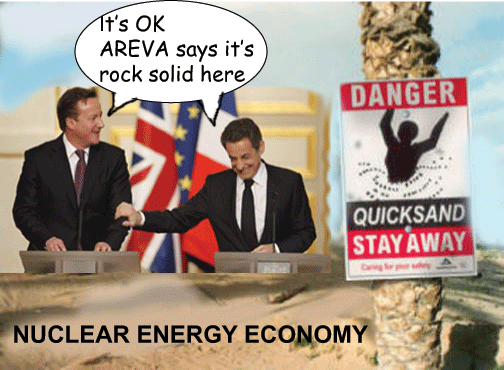 In the UK, the government is determined to push ahead with the development of a new fleet of nuclear reactors, as the partnership announced by David Cameron and Nicholas Sarkozy shows.
The orchestrated effort between coalition officials and the nuclear industry to create a pro-nuclear public information campaign in the days after Fukushima showed that not even a large-scale nuclear incident could halt ministers’ obsession with new nuclear. Officials did not even wait for the results of the government’s own safety review before rushing to assure the British people that a similar disaster is not possible in the UK.
Why we must phase out nuclear power The inherent risk in the use of nuclear energy can and does have disastrous consequences, Guardian UK, Caroline Lucas, Rebecca Harms, Dany Cohn-Bendt, 18 Feb While global attention has long since shifted elsewhere, the nuclear catastrophe in Fukushima is far from over. This is the nature of nuclear accidents: they leave a long-lasting radioactive legacy.
One year on, the situation is not under control. The announcement by the Japanese government that the damaged reactors were in a state of “cold shutdown” was met with scepticism and anger from a concerned public – and with disbelief among nuclear experts. Continue reading
1 This Month
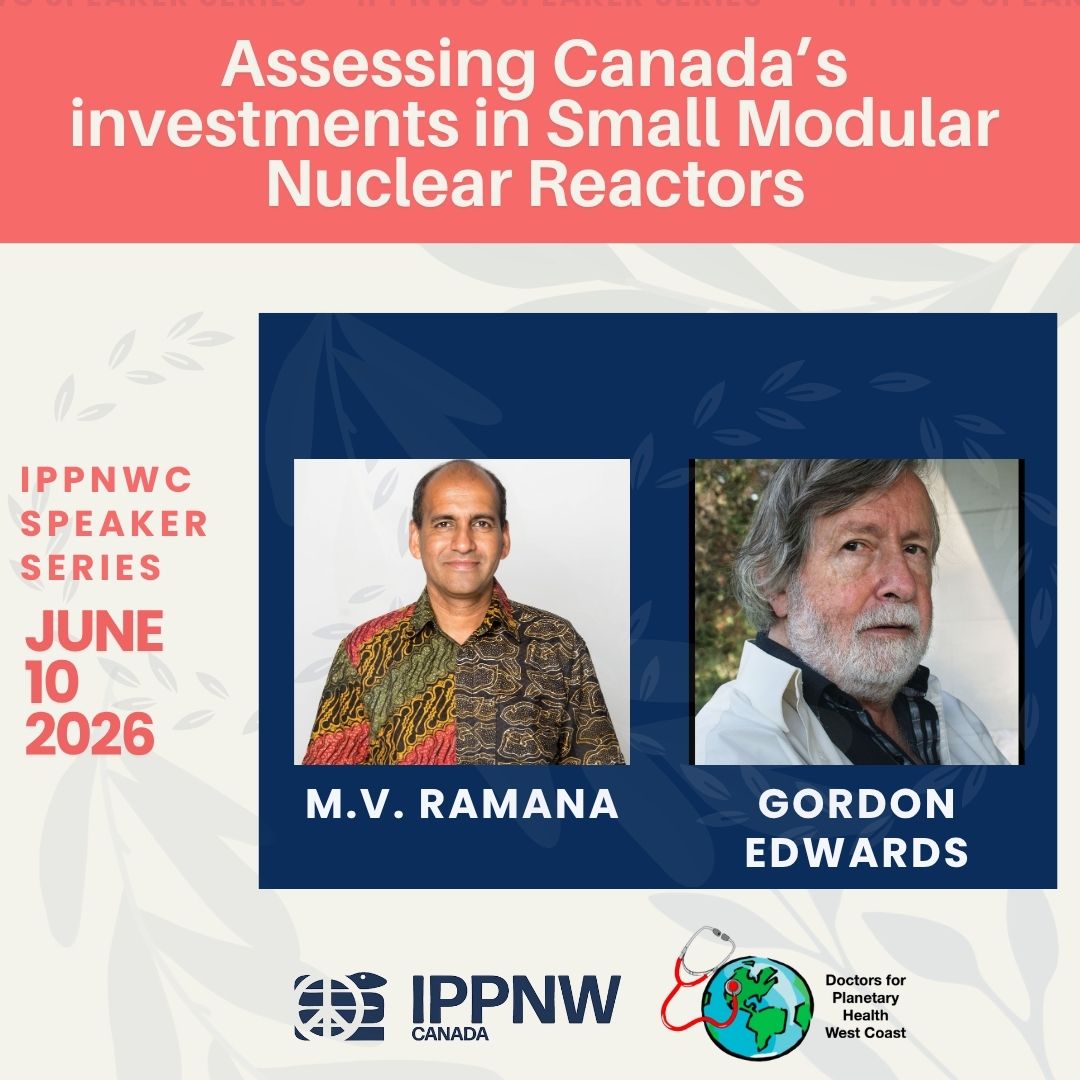
10 June – Assessing Canada’s Investments in Small Modular Nuclear Reactors – https://zoom.us/meeting/register/IiqHA5feRhaEBycOLNTJlA#/registration


Cuba Is Not a Failed State – It Is a Besieged State
PETITION: “Global Appeal to Endorse Palestinian Right of Return of Refugees”
To see nuclear-related stories in greater depth and intensity – go to https://nuclearinformation.wordpress.com
-
Archives
- June 2026 (89)
- May 2026 (306)
- April 2026 (356)
- March 2026 (251)
- February 2026 (268)
- January 2026 (308)
- December 2025 (358)
- November 2025 (359)
- October 2025 (376)
- September 2025 (257)
- August 2025 (319)
- July 2025 (230)
-
Categories
- 1
- 1 NUCLEAR ISSUES
- business and costs
- climate change
- culture and arts
- ENERGY
- environment
- health
- history
- indigenous issues
- Legal
- marketing of nuclear
- media
- opposition to nuclear
- PERSONAL STORIES
- politics
- politics international
- Religion and ethics
- safety
- secrets,lies and civil liberties
- spinbuster
- technology
- Uranium
- wastes
- weapons and war
- Women
- 2 WORLD
- ACTION
- AFRICA
- Atrocities
- AUSTRALIA
- Christina's notes
- Christina's themes
- culture and arts
- Events
- Fuk 2022
- Fuk 2023
- Fukushima 2017
- Fukushima 2018
- fukushima 2019
- Fukushima 2020
- Fukushima 2021
- general
- global warming
- Humour (God we need it)
- Nuclear
- RARE EARTHS
- Reference
- resources – print
- Resources -audiovicual
- Weekly Newsletter
- World
- World Nuclear
- YouTube
-
RSS
Entries RSS
Comments RSS
 nuclear-news