Uranium mining and radioactive water pollution
 The truly frightening part is the sentence that reads, ” Covering tailings material with water during operations …” Where do they imagine all that water will end up? It’s water containing not only radioactive material, but a host of other toxins as well? And how do they know for certain that an earthquake could not crack that containment cell open like an egg or that a hurricane would not dump enough water on Coles Hill to cause those cells to become so saturated that they leak their contents into the groundwater surrounding them?
 Uranium risks far outweigh benefits AltaVista Journal, Jesse Andrews, 25 Jan 12, Virginia Uranium Inc.’s most recent propaganda release, “We’re committed to protecting water quality.” Why does VUI feel the need to continue to explain itself if in fact uranium mining would be as safe and innocuous as they claim? If uranium mining had ever been safe anywhere, which it has not, they wouldn’t feel such a desperate need to explain just how safe their mine would be.
What they have presented is a pretty drawing of a disaster waiting to happen. A containment cell constructed just like your local landfill, only instead of household garbage, it contains radioactive waste. A nice concept, but one whose reliability over the course of 1,000 years is indeed doubtful. Continue reading
Over 2 million Californians risk radioactive water pollution in proximity to nuclear reactors
Nuclear Power Plants Threaten Drinking Water for 2.3 Million Californians
San Diego is the 6th Largest Region in the Country to Have Drinking Water Sources Located Within 50 Miles of a Nuclear Plant YubaNet.com Jan 24, 2012 By: CALPIRG San Diego, CA January 24, 2012 – The drinking water for 2.3 million people in California could be at risk of radioactive contamination from a leak or accident at a local nuclear power plant, says a new study released today by the California Public Interest Research Group Education Fund and Environment California Research and Policy Center.
“The danger of nuclear power is too close to home. Here in California, the drinking water for 2.3 million people is too close to an active nuclear power plant,” said Emily Rusch, CALPIRG Education Fund State Director. “An accident or a leak could spew cancer-causing radioactive waste into our drinking water.” Continue reading
Nuclear personnel asleep at Oak Ridge National Laboratory?
 Vulnerable U.S. Nuclear Weapons Site Faces Allegations of Snoozing Security Guard Potential Pattern of Fatigue Among Wackenhut Nuclear Personnel
Project on Government Oversight (POGO) 25 Jan 12, By MIA STEINLE
The security contractor for the Energy Department’s Oak Ridge National Laboratory in Tennessee is investigating reports that one of its security guards was sleeping and had also been using an unauthorized cell phone while they were supposed to be guarding a sensitive nuclear facility with bomb-grade material.
Photos of the alleged incident were sent to Wackenhut Security Inc.’s (WSI) Oak Ridge unit, the Energy Department, and the Knoxville News Sentinel, which broke the story Tuesday.
The photos were allegedly taken inside Building 3019, which raises “the additional issue of who took photographs inside a high-security nuclear installation,” according to the News Sentinel. Building 3019 stores about a half-ton of uranium-233, which POGO Senior Investigator Peter Stockton said today in a statement is roughly the amount needed for 250 improvised nuclear detonations.
“Perhaps the most egregious part of all this is that the Energy Department is allowing Wackenhut to investigate the latest security lapse itself,” Stockton said. “This is too important to leave up to Wackenhut.” WSI is commonly known as Wackenhut. In 2002, the Florida company was acquired by a Danish corporation and is now officially known in the U.S. as G4S Secure Solutions.
Wackenhut has a history of sleeping security guards. “It was Wackenhut that in 2007 initially denied that its guards at the Peach Bottom nuclear power plant in Pennsylvania were sleeping on the job—that is until the company was confronted with a video of the guards that was leaked to the media,” Stockton said. In the wake of that scandal, Wackenhut lost its contract with Exelon to manage security at ten nuclear power plants, according to a Washington Post article.
POGO called Oak Ridge National Laboratory a “high risk” as early as 2006 for its inadequate security, and also found that Wackenhut security guards at the nearby Y-12 National Security Complex were overworked to the point of severe fatigue. http://pogoblog.typepad.com/pogo/2012/01/vulnerable-us-nuclear-weapons-site-faces-allegations-of-snoozing-security-guard.html
Three Japanese films about Fukushima nuclear disaster
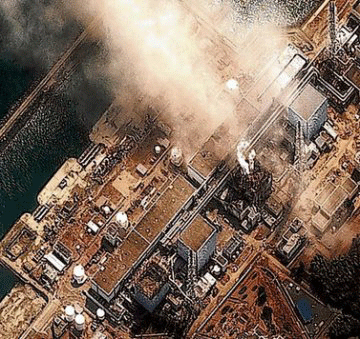
 Japanese filmmakers tackle the 3/11 tragedy, SBS 23 January 2012 – By World Movies Three films focusing on Japan’s nuclear plant meltdown and the aftermath will be unveiled next month. “If one was to be poisoned by radiation, if he or she did so out of their own will and conviction I believe it to be perfectly fine. But you can’t force that onto the children. The children, you must distance them from the poisoned areas.”
Also being unveiled at the festival are two other Japanese films dealing with the March 11, 2011 meltdown at the Fukushima nuclear power station and ensuing tsunami. Continue reading
Japanese govt’s secrecy on nuclear disaster report

 Japan kept silent on worst nuclear crisis, Herald Sun, Tokyo From: AP January 26, 2012 THE Japanese government’s worst-case scenario at the height of the nuclear crisis last year warned that tens of millions of people, including Tokyo residents, might need to leave their homes, according to a report.
But fearing widespread panic, officials kept the report secret. The recent emergence of the 15-page internal document may add to complaints in Japan that the government withheld too much information about the world’s worst nuclear accident since Chernobyl. It also casts doubt about whether the government was sufficiently prepared to cope with what could have been an evacuation of unprecedented scale.
The report was submitted to then-Prime Minister Naoto Kan and his top advisers on March 25, two weeks after the earthquake and tsunami devastated the Fukushima Dai-ichi nuclear power plant, causing three reactors to melt down and generating hydrogen explosions that blew away protective structures…..
After Mr Kan received the report, he and other Japanese officials publicly insisted that there was no need to prepare for wider-scale evacuations.
The government continues to refuse to make the document public. The AP obtained it overnight through a government source, who insisted on anonymity because the document was still categorised as internal……. http://www.heraldsun.com.au/news/breaking-news/japan-kept-silent-on-worst-nuclear-crisis/story-e6frf7jx-1226253974563
Middle East- a nuclear weapon-free zone or allout nuclear arms race?
AP Interview: Saudi warns of Mideast nuclear race, Google News, By EDITH M. LEDERER, Associated Press 26 Jan 12, DAVOS, Switzerland (AP) — An influential member of the Saudi royal family warned Wednesday that unless the Middle East becomes a nuclear weapon-free zone, a nuclear arms race is inevitable and could include his own country, Iraq, Egypt and even Turkey.
Prince Turki Al Faisal said the five permanent U.N. Security Council members should guarantee a nuclear security umbrella for Mideast countries that join a nuclear-free zone — and impose “military sanctions” against countries seen to be developing nuclear weapons. “I think that’s a better way of going at this issue of nuclear enrichment of uranium, or preventing Iran from acquiring weapons of mass destruction,” the former Saudi intelligence chief and ambassador Continue reading
USA backs United Nations on Sustainable Energy
 Investing in Renewable Energy is Good for the United
  States and the World
Statement of United Nations Foundation President Timothy E. Wirth on President Obama’s State of the Union Address We need to raise  sustainable energy to the top of the global agenda and focus our attention, ingenuity, resources, and investments to make it a reality.
Washington, D.C. (PRWEB) January 25, 2012 In his State of the Union address, President Barack Obama highlighted the importance of increased investment in renewable energy and greater energy efficiency. Prioritizing sustainable energy will position the United States and its partners for a stronger economic future, and will help advance global sustainable energy goals. Continue reading
Iowa Utilities Board warns on nuclear power cost burden on ratepayers
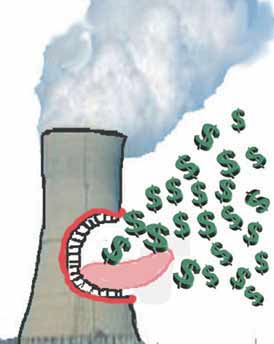 IUB staff raises red flags about nuclear power plant legislation, Bettendorf.com, January 25, 2012 The Iowa Utilities Board (IUB) staff has raised several warning flags about legislation sought by MidAmerican Energy to shift the risk of building a new nuclear power plant to utility ratepayers.
In a memo sent to the IUB and state legislators in December, the IUB staff warns that “some of these (bill) provisions could create incentives for the company to engage in behavior that could be contrary to the public interest in certain situations.”
To illustrate what might happen, the staff report gives this possible scenario: Continue reading
Supergrid or networks of grids for renewable energy in Europe
European Supergrid to Revolutionise Renewable Energy?, Oil Price.com, By James Burgess | , 25 January 2012 Europe is the world leader in renewable energy generation, but as with all renewable energy sources they face the problem of reliability. One way of overcoming this limitation and ensuring that power supply will be constant is to have expensive, traditional, fossil-fuelled power stations to generate electricity whilst conditions are unfavourable for the renewable source; but this almost makes the whole investment in renewable power sources irrelevant. A better way of ensuring consistent power is to link several diverse sources of renewable energy on one electrical grid. So when a wind farm can’t produce much power on a windless day, a solar farm might compensate. Continue reading
There is a diplomatic avenue that would prevent war with Iran
 Now, the West is all but isolated. Most non-Westerners would prefer to see Iran treated like other treaty parties – allowed to enrich uranium in return for intrusive monitoring by IAEA inspectors.
this gathering crisis could be avoided by a deal along the following lines – Iran would accept top-notch IAEA safeguards in return for being allowed to continue enriching uranium. In addition, Iran would volunteer some confidence-building measures to show it has no intention of making nuclear weapons.
Iran deal would allow West to make U-turn on highway to war, The Age, January 25, 2012 There is little realism behind the demand that Tehran give up its capacity to enrich uranium, writes Peter Jenkins.
The Iranian nuclear controversy is reaching a critical juncture. On Monday, the European Union agreed on an oil embargo as part of sanctions against the country. On Sunday, Britain, the US and France sent warships through the Strait of Hormuz. Recent months have seen a big rise in the twin risks of military action and grave damage to the world economy. This is the consequence of what I believe to be a great diplomatic overbid – the West’s demand that Iran surrender its capacity to enrich uranium. Continue reading
The search for bodies near Fukushima can at last begin
Falling radiation permits search for bodies near Fukushima, ABC Radio News, January 24, 2012 Reporter Mark Willacy reports from Fukushima TONY EASTLEY: With radiation levels near the stricken Fukushima nuclear plant slowly falling Japanese police are only now carrying out detailed searches for bodies near the facility. About 200 people from communities around the plant remain missing after a tsunami slammed into that stretch of coastline in March last year. Continue reading
USA’s practically unsolvable dilemma about nuclear wastes
The Blue Ribbon Commission on America’s Nuclear Future’s report is arriving in an election year, a time when Congress has traditionally been unwilling to take decisive action. And the Nuclear Waste Policy Act of 1982, which instructed the Energy Department to pursue a repository, has historically been interpreted to forbid establishment of an interim storage place until a final site is established.
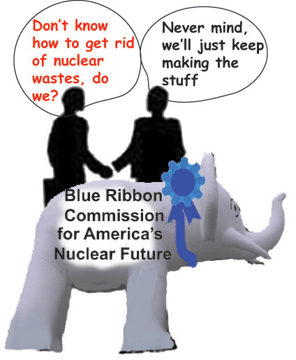
But with a final resting place more elusive than ever, the three groups believe that Congress or the Energy Department should be moving in that direction.
Wanted: Parking Space for Nuclear Waste http://green.blogs.nytimes com/2012/01/24/wanted-parking-space-for-nuclear-waste/ NYT, By MATTHEW L. WALD, January 24, 2012, When the Obama administration killed a plan to create a nuclear waste repository at Yucca Mountain in Nevada, the government established a “blue-ribbon commission” to study what to do next. Its final report is due on Sunday, and this week three organizations began a public lobbying campaign for several of the recommendations that they assume the commission will make. Yucca was supposed to store nuclear waste, but the emphasis now is on “managing” it, especially the waste at scattered locations where reactors no longer operate.
At places like Maine Yankee, Connecticut Yankee andRancho Seco in California, reactors have been torn down, but the fuel remains in small concrete-and-steel silos that require maintenance and monitoring by a guard force. Sometimes the presence of nuclear waste prevents re-use of the sites by industry. Continue reading
Florida lawsuit challenges upfront payments for nuclear power reactors
 Energy advocates: State nuclear cost recovery bill is unconstitutional, Miami Herald, 24 Jan 12, The state law that has allowed Florida Power & Light and ProgressEnergy to charge customers $1 billion so far for speculative nuclear power plants is unconstitutional, a group of energy advocates claims in a lawsuit before the state’s highest court.
The Southern Alliance for Clean Energy is asking the Florida Supreme Court to throw out the 2006 law and reverse a decision by state regulators who have allowed the companies to charge customers for upgrading existing nuclear power plants and for the pre-construction
costs of building new nuclear power plants that may never be built. Continue reading
A decision with vision – ban on uranium minng near Grand Canyon
the 20-year ban is supported by an unprecedented coalition of tribal leaders; hunting, fishing, ranching and conservation groups; municipal water suppliers; wildlife advocates; and nearly 300,000 individuals who commented favorably on the proposed moratorium. Chambers of commerce, community leaders and elected officials are also among those mainstream voices speaking out against a handful of politicians now defending industrialists’ demand to exploit our treasured landscape.
At risk are the Grand Canyon’s watersheds. These interconnected surface and groundwater systems extend many miles beyond the park’s boundary.
 Uranium-mining ban was a grand decision, The Arizona Republic, by Roger Clark – Jan. 22, 2012 Arizonans and all Americans won a major victory on Jan. 9 when Interior Secretary Ken Salazar signed a “record of decision” for a 20-year ban on new uranium claims on 1.1 million acres of public land surrounding Grand Canyon National Park.
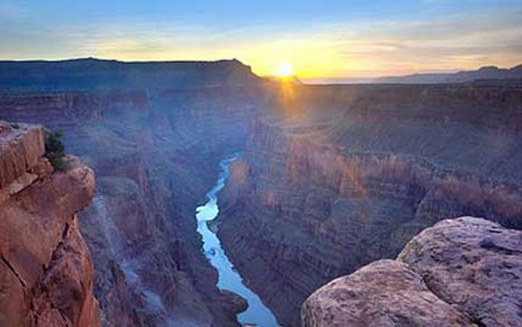
The decision reduces the risk of permanent harm to wildlife, water, our economy and sites sacred to Havasupai and all native people in ourregion. It also best serves our nation’s interests. Continue reading
Cameco uranium company talks big, but future is doubtful
 Uranium miners still waiting on that rebound, TIM KILADZE, Globe and Mail , January 24, 2012 When stocks of uranium miners plummeted after last March’s traumatizing Japanese earthquake, some people expected a rebound once the market’s initial shocks and fears subsided.
They’re still waiting.
Close to a year after the earthquake, shares of Cameco Corp. (CCO-T23.54-0.25-1.05%) are still down 40 per cent and smaller rivals are faring just as badly, with Denison Mines (DML-T1.89-0.12-5.97%) down about 50 per cent. The death knell apparently came when Germany declared a retreat from nuclear energy.
Are these miners doomed for good? Depends on who you ask. Investors are clearly too scared to go near the industry, considering the stocks have moved very little since their initial free fall. (Check out a stock chart for the past year.
Quite scary.) But the companies themselves keep saying that everyone has it wrong.
Cameco chief financial officer Grant Isaac repeated this view when he sat down at CIBC World Market’s Whistler conference last week….. there’s still a major problem. Even if Cameco is bullish over the next decade, its consumers, particularly utilities, like to secure long-term supply contracts, and Cameco can’t talk long-term contracts when they would have to lock-in at today’s prices.
So for now, Cameco is touting plans to increase production. Mr. Isaac said Cameco is sitting on 1 billion pounds of reserves and resources, and the firm wants to bump production from 2 per cent of this a year to 4 per cent.
On this front, investors are cautious. Much of this growth centres on developing the second shaft of Cameco’s Cigar Lake project in northern Saskatchewan, and it’s been plagued with problems…..
http://www.theglobeandmail.com/globe-investor/investment-ideas/streetwise/uranium-miners-still-waiting-on-that-rebound/article2313513/
1 This Month
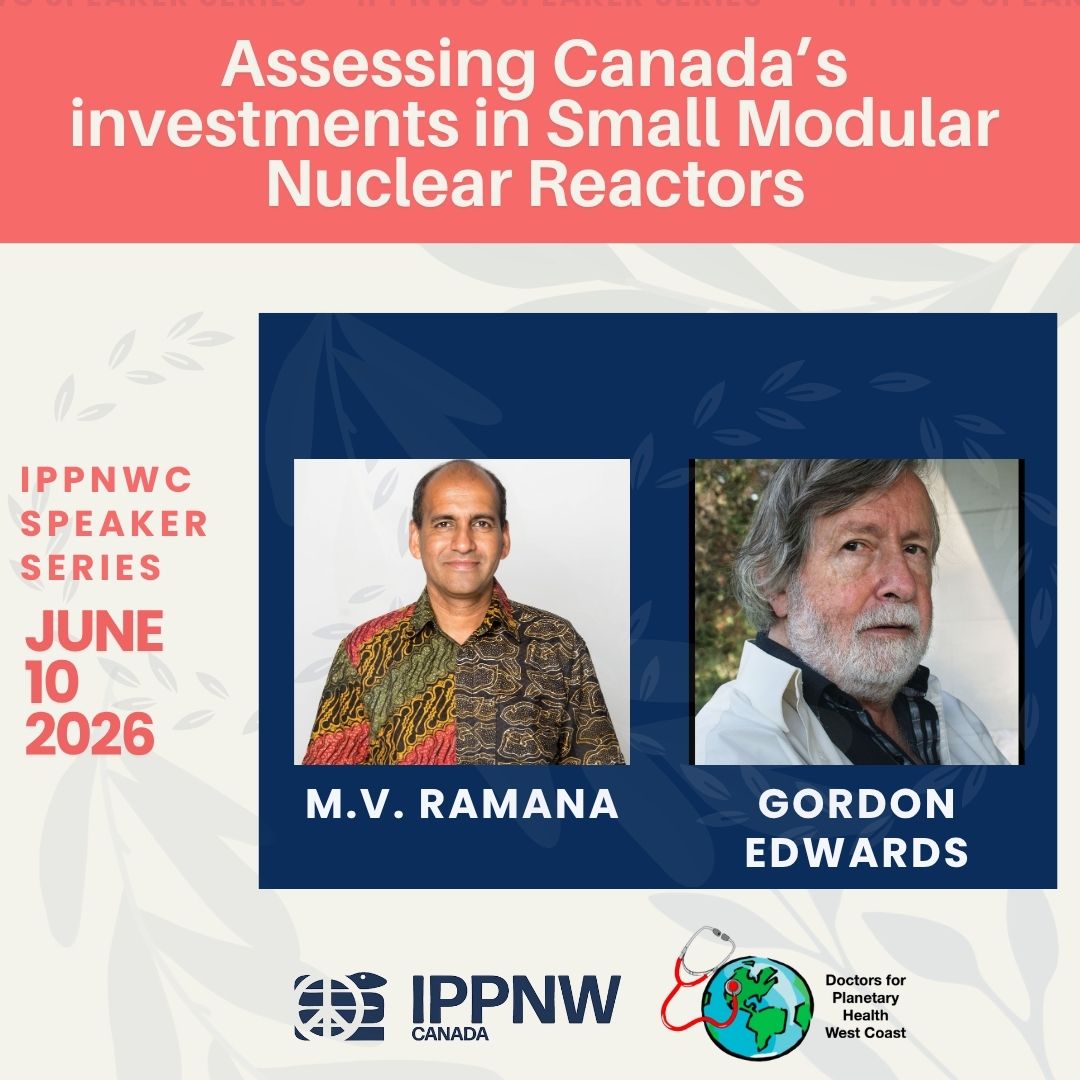
10 June – Assessing Canada’s Investments in Small Modular Nuclear Reactors – https://zoom.us/meeting/register/IiqHA5feRhaEBycOLNTJlA#/registration

Cuba Is Not a Failed State – It Is a Besieged State
PETITION: “Global Appeal to Endorse Palestinian Right of Return of Refugees”
To see nuclear-related stories in greater depth and intensity – go to https://nuclearinformation.wordpress.com
-
Archives
- June 2026 (89)
- May 2026 (306)
- April 2026 (356)
- March 2026 (251)
- February 2026 (268)
- January 2026 (308)
- December 2025 (358)
- November 2025 (359)
- October 2025 (376)
- September 2025 (257)
- August 2025 (319)
- July 2025 (230)
-
Categories
- 1
- 1 NUCLEAR ISSUES
- business and costs
- climate change
- culture and arts
- ENERGY
- environment
- health
- history
- indigenous issues
- Legal
- marketing of nuclear
- media
- opposition to nuclear
- PERSONAL STORIES
- politics
- politics international
- Religion and ethics
- safety
- secrets,lies and civil liberties
- spinbuster
- technology
- Uranium
- wastes
- weapons and war
- Women
- 2 WORLD
- ACTION
- AFRICA
- Atrocities
- AUSTRALIA
- Christina's notes
- Christina's themes
- culture and arts
- Events
- Fuk 2022
- Fuk 2023
- Fukushima 2017
- Fukushima 2018
- fukushima 2019
- Fukushima 2020
- Fukushima 2021
- general
- global warming
- Humour (God we need it)
- Nuclear
- RARE EARTHS
- Reference
- resources – print
- Resources -audiovicual
- Weekly Newsletter
- World
- World Nuclear
- YouTube
-
RSS
Entries RSS
Comments RSS
 nuclear-news