Second meltdown in No 3 Nuclear reactor caused Fukushima cleanup problems
 Report suggests second meltdown at reactor at Fukushima plant, Asahi.com, BY TOMOOKI YASUDA STAFF WRITER, 2011/08/09, A second meltdown likely occurred in the No. 3 reactor at the Fukushima No. 1 nuclear power plant, a scenario that could hinder the current strategy to end the crisis, a scientist said. Continue reading
Death of feisty anti-nuclear fighter
Notable deaths around the nation, 14 Aug 11, “….Jackie Hudson, 76, of Bremerton, Wash., a nun and longtime nuclear weapons protester, died Aug. 3 of cancer. The Michigan native moved to Washington in 1993 but remained with the Dominican Sisters of Grand Rapids. She was released in June from a Georgia jail after demonstrating at an Oak Ridge, Tenn., nuclear facility. She was among three convicted in 2003 of damaging a Weld County, Colo., missile silo….” http://blog.oregonlive.com/lifestories/2011/08/notable_deaths_around_nation_w_22.html
Even with the recession, renewable energy performing well across the globe
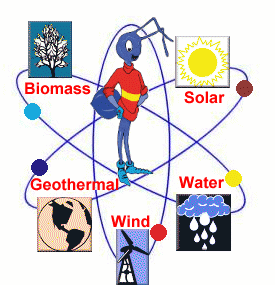 Special report:Renewable energy sector grows despite recession, The Citizen, 13 August 2011, Paris. The renewable energy (RE) sector continues to perform well despite continuing economic recession, incentive cuts, and low natural-gas prices, the Renewables 2011 Global Status Report (GSR) released last month has shown.
In 2010, existing solar water and space heating capacity increased by an estimated 25 gigawatts-thermal (GWth), or about 16 per cent. The report was commissioned by the Renewable Energy Policy Network for the 21st Century (REN21) and produced in collaboration with a global network of research partners.
“The global performance of renewable energy despite headwinds has been a positive constant in turbulent times”, says Mr Mohamed El-Ashry, chairman of REN21’s Steering Committee. “Today, more people than ever before derive energy from renewables as capacity continues to grow, prices continue to fall, and shares of global energy from renewable energy continue to increase.” …..http://thecitizen.co.tz/sunday-citizen/40-sunday-citizen-news/13743-special-reportrenewable-energy-sector-grows-despite-recession.htm
—
The Public Counsel’s case against Progress Energy’s plan for nuclear plant costing
Doubts cloud nuclear pay plan, Utility Products, Power Industry News, BY IVAN PENN, 14 Aug 11, “……The Public Counsel’s case rests on the opinion of William Jacobs, a former nuclear plant site manager for Westinghouse. His 35 years of experience in electric power generation and doctoral degree in nuclear engineering have made him a go-to expert for power companies and public utility commissions around the country.
Jacobs makes six points to support his argument that Progress plans to delay construction of the Levy plant until 2027:
* Progress is diverting the attention of key Levy project managers to other activities. Among them: Jeff Lyash, former president and CEO of Progress Energy Florida, whom Jacobs describes as the Progress officer responsible for the Levy project.
* Progress’ own analysis shows that trends in fuel costs are making nuclear power relatively less cost effective than other sources.
* The trend in natural gas prices and lack of progress toward legislation regulating greenhouse gases increase the utility’s “enterprise risk.”
* Progress had hoped to find a partner to share ownership (and financial risk) of the project, but that has become less likely because of cost increases and regulatory delays.
* Public support for nuclear plants has diminished since the meltdown at Japan’s Fukushima plant.
* Finally, Progress, having considered all those factors, seems to be planning for the possibility of delaying the plant opening until 2027.
Jacobs based that last conclusion on the redacted “Scenario Analysis” Progress gave to the Public Counsel’s Office.
In written testimony to the PSC, Jacobs wrote that Progress Energy’s “actions continue to demonstrate doubt as to the likelihood of completion of the project on the current schedule – if at all.” Jacobs uses “if at all” three times in his report referring to the possibility of the plant never getting built.
Progress turned over an unredacted version of the “Scenario Analysis” only after Jacobs completed his report. But the Public Counsel’s office had to agree to keep it secret……. http://www.utilityproducts.com/news/2011/08/1478674934/doubts-cloud-nuclear-pay-plan.html
Volunteers risk health in radiation cleanup outside Fukushima area
 “The area itself is relatively highly contaminated,” Kodama says. “Many small children playing around the ground might touch some mud or in some case, eat some sand, which would result in internal radiation..”
 Volunteers Take on Dangerous Job of Scrubbing Nuke Contamination, ABC News International. By AKIKO FUJITA (@akikofujita), Aug. 12, 2011 Tatsuhiko Kodama’s voice shakes as he addresses volunteers at Ishigami Daini Kindergarten in the city of Minamisoma, 15 miles from the troubled Fukushima Daiichi Nuclear Plant.
The director of the University of Tokyo’s Radioisotope Center is training people how to decontaminate a school filled with radiation spewed from the nuclear reactors. He has explained the process a dozen times before, yet tears well up every time Kodama sees mothers donning masks, fathers taking notes with dosimeters in hand. Continue reading
Palo Verde Nuclear Plant – emergency plans found wanting
 planning only for a 10-mile evacuation zone around reactors is inadequate because it doesn’t take into consideration the possibility of having to evacuate a larger area and the consequences of civil disorder that might ensue from gridlocked roads in the scramble to flee…… emergency plans wrongly assume that a severe problem at a nuclear facility would not be accompanied by other emergencies.
Palo Verde nuclear response a worry, Palo Verde’s plans for evacuations debated, by Ryan Randazzo – Aug. 14, 2011, The Arizona Republic, People living within 10 miles of the Palo Verde Nuclear Generating Station west of Phoenix are well-aware they are in the evacuation zone of Arizona’s only nuclear power plant.
Those 11,545 residents get an annual calendar from the plant’s owners with instructions on what to do in the remote event of a disaster….. Continue reading
Nuclear fuels regulators in Colorado under the thumb of weapons maker General Atomics
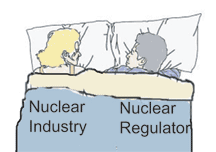 “Basically, the judgment of the nuclear fuels industry and its captive regulators in Colorado is not to be trusted when it comes to matters of health, safety, and a clean environment,”
General Atomics subsidiary wants to stop toxic pond tests, By David O. Williams, Real Aspen – August 14, 2011 Rather than seek an appropriate technological solution, managers of a decommissioned uranium processing mill near Cañon City want the state to let them stop testing a radioactive holding pond Continue reading
Cost of nuclear test refugees from Micronesia, the Marshall Islands, and Palau
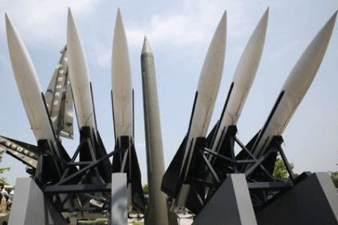
 Hawaii demanding assistance from the federal government, ETN News, Aug 14, 2011, The cost of providing Hawaii government services to Pacific island migrants has more than tripled over the last eight years, according to a state report completed this week.
Retired cook Calvin Nelson says that when he came to Hawaii from Kwajalein, after the United States had seized his home for a new missile range, he was told, “everything will be covered.” Him and thousands of other Micronesian immigrants need the kidney dialysis that kept him alive.
State government expenses to pay for services to migrants from Micronesia, the Marshall Islands, and Palau rose to US$115 million last year from US$32 million in 2002, the report said……..
Micronesia, the Marshall Islands, and Palau are beneficiaries of the Compact of Free Association. After the US used the Pacific islands for nuclear weapons testing from 1946 to 1958, it agreed in the 1986 pact to provide financial assistance and migration rights in exchange for the right to use defense sites.
People from the areas included in the compact suffer from higher rates of cancer and kidney disease, which come with expensive treatments such as chemotherapy and dialysis.
The federal government provides the state with only US$11 million each year to help the state cover the costs of the US treaty….http://www.eturbonews.com/24598/hawaii-demanding-assistance-federal-government
USA to cut funding for research on low level radiation and health?
many more people may have incurred fatal cancers from low doses, simply based on the statistical probably of those fatalities occurring across very large populations.
Budget Deal Could Crush Low-Dose Radiation Research, Forbes, by Jeff McMahon, 15 Aug 11, “…..The nation’s only Low-Dose Radiation Research program is likely to suffer a severe cut in funding not long after the United States was blanketed with low doses of radioactive fallout from the Fukushima nuclear disaster in Japan…….Dr. David J. Brenner, a professor in the Columbia University medical school’s Center for Radiological Research, in a recent editorial in The Bulletin of the Atomic Scientists. Continue reading
Delay for India’s Jaitapur nuclear power project
First phase of Jaitapur nuclear project may be delayed by 1 year, Business Standard, 15 Aug 11, Sanjay Jog / Mumbai August 15, 2011, The commissioning of the first phase of the 9,900-Mw Jaitapur nuclear power project in Maharashtra is likely to be delayed by a year, since the developer, Nuclear Power Corporation (NPC), would first have to upgrade and strengthen the safety applications in the wake of the Fukushima disaster.
The first evolutionary pressurised reactor (EPR) of 1,650 Mw would be operational in 2018-19 instead of the originally planned 2017-18. French nuclear energy firm Areva was asked by the country’s nuclear safety regulatory authority ASN to conduct a safety audit after the Fukushima disaster. The audit is expected to be completes by September….
TVA’s multi billion nuclear reactor dollar gamble in Alabama
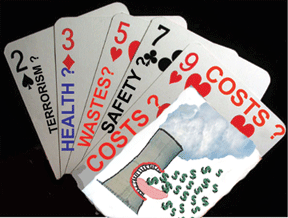 TVA gambles on Bellefonte nuclear reactors, Footprints, August 11th, 2011 › Nuclear, SACE Reports › Dr. Stephen A. Smith › Southern Alliance for Clean Energy has long been concerned with the Tennessee Valley Authority’s (TVA) push to add more nuclear reactors to their energy mix in spite of readily available energy efficiency and renewable energy alternatives. But TVA’s dogged pursuit to complete the nearly forty-year-old, antiquated Bellefonte site in Alabama is a unique and especially risky proposition. Simply put, finishing these two abandoned and degraded reactors is a multi-billion dollar bet TVA should not place. The risks to public health and safety, potential financial impacts to TVA ratepayers and U.S. taxpayers are too significant to ignore. Continue reading
Film exposes the scandal of depleted uranium weapons

Uranio 238 on Youtube:
 Part 1: http://www.youtube.com/watch?v=3EUp5j1481g
Part 2: http://www.youtube.com/watch?v=lNgZs1lyuGQ
Part 3: http://www.youtube.com/watch?v=AZ4h6IeCalo
Part 4: http://www.youtube.com/watch?v=9uodiHzrefI
Depleted uranium documentary wins best short at International Uranium Film Festival, International Coalition to Ban Uranium Weapons, 12 Aug 11, Costa Rican production: URANIUM 238 – The Pentagon´s Dirty Pool wins best short film category of the First International Uranium Film Festival 2011 in Rio de Janeiro, Brazil. Continue reading
Need to rewrite U.S. President’s guidance for use of nuclear weapons

Although the administration’s Nuclear Posture Review is widely said to reduce the role of nuclear weapons, it doesn’t actually reduce the role that nuclear weapons have today because all the adversaries in the current strategic nuclear war plan are exempt from the reduction. They are either nuclear weapon states, not members of the nuclear Non-Proliferation Treaty, or are in violation of their NPT obligations and have chemical or biological weapons. The new guidance would have to remove some of these adversaries from the war plan to reduce the role, or reduce the role that nuclear weapons are required to play against each of them. There are many ways this could be done:
- Reduce the numer of target categories that are held at risk with nuclear weapons.
- Reduce the damage expectancy to be a achieved against individual targets.
- Reduce the number of adversaries in the plan.
- Reduce the number and types of strike options against each adversary.
- Remove the requirement to plan for prompt launch of nuclear forces.
- Remove any requirement to plan for damage limitation strikes.
- End counterforce nuclear planning.
- End the requirement to maintain standing fully operational strike plans…….
we have a new op-ed in the Bulletin of the Atomic Scientists that describes what a new presidential directive could look like: A Presidential Policy Directive for a new nuclear path. http://www.fas.org/blog/ssp/2011/08/nuclearguidance.php
Outrage in Japan over the nuclear industry’s crooked “AstroTurf” manipulations of public opinion
 Japanese government investigations that have uncovered a nationwide pattern of attempts to manipulate the public’s opinion about nuclear power by Japan’s biggest electric utilities. Some of those power companies then pointed the finger back at regulators for having covertly urged such efforts in the first place.
The “AstroTurf”—or fake-grass-roots—campaigns, which ranged from packing events with supporters to planting questions and orchestrating email drives, have now badly backfired, sparking public outrage
 Scandal Taints Japan Nuclear Sector, WSJ By CHESTER DAWSON, AUGUST 13, 2011 SAGA, Japan—The Fukushima Daiichi accident was a big setback for nuclear power in Japan. But the industry’s hamfisted efforts to maintain support in the aftermath of that disaster may have an even bigger impact in eroding the public’s confidence in the sector.
After a series of disclosures in recent weeks painting government regulators and electric utilities as collaborating to stage-manage public community forums on local nuclear power, efforts to restart idled Japanese nuclear reactors have screeched to a halt. Continue reading
Japan doing well with energy conservation – nuclear power not necessary?
 Saving electricity has become a sort of national religion. With many air conditioners set at 82 degrees, businessmen have shed their usual suits in favor of “super cool biz” short-sleeve shirts. Car makers have been forced to operate on weekends to avoid sucking up electricity during peak weekday hours.
Peak electricity usage for the Tokyo area so far this summer was nearly 23% below the peak last summer.
The drop in electrical consumption is shaking Japan’s decades-old commitment to nuclear power
Summer Power Success Raises Heat in Energy Debate, WSJ AUGUST 12, 2011, By Peter Landers It looks as if Japan has just about survived the peak of summer electricity demand without power outages, although the Tohoku region had some close calls…..
Japan’s success at avoiding outages even with most of its nuclear reactors out of service is taking on a more strategic importance, influencing the broader debate over nuclear power’s future. Whether to phase out nuclear power will be a big issue when the Democratic Party of Japan chooses a successor to Prime Minister Naoto Kan later this month or next month……http://blogs.wsj.com/japanrealtime/2011/08/12/summer-power-success-raises-heat-in-energy-debate/
Japan Snaps Back With Less Power, Economy Survives Reactor Shutdowns, and Tokyo Rethinks Nuclear Policy, WSJ, Peter Landers. JULY 29, 2011 TOKYO—When the March 11 tsunami knocked out more than half of the nuclear power plants serving the Tokyo area, it set off one of the biggest unplanned experiments in a modern society: Could a metropolis of 30 million people get by after losing about a fifth of its power supply?
After a steaming July in Japan filled with 90-degree-plus days, the preliminary answer is in, and it is yes. Continue reading
1 This Month
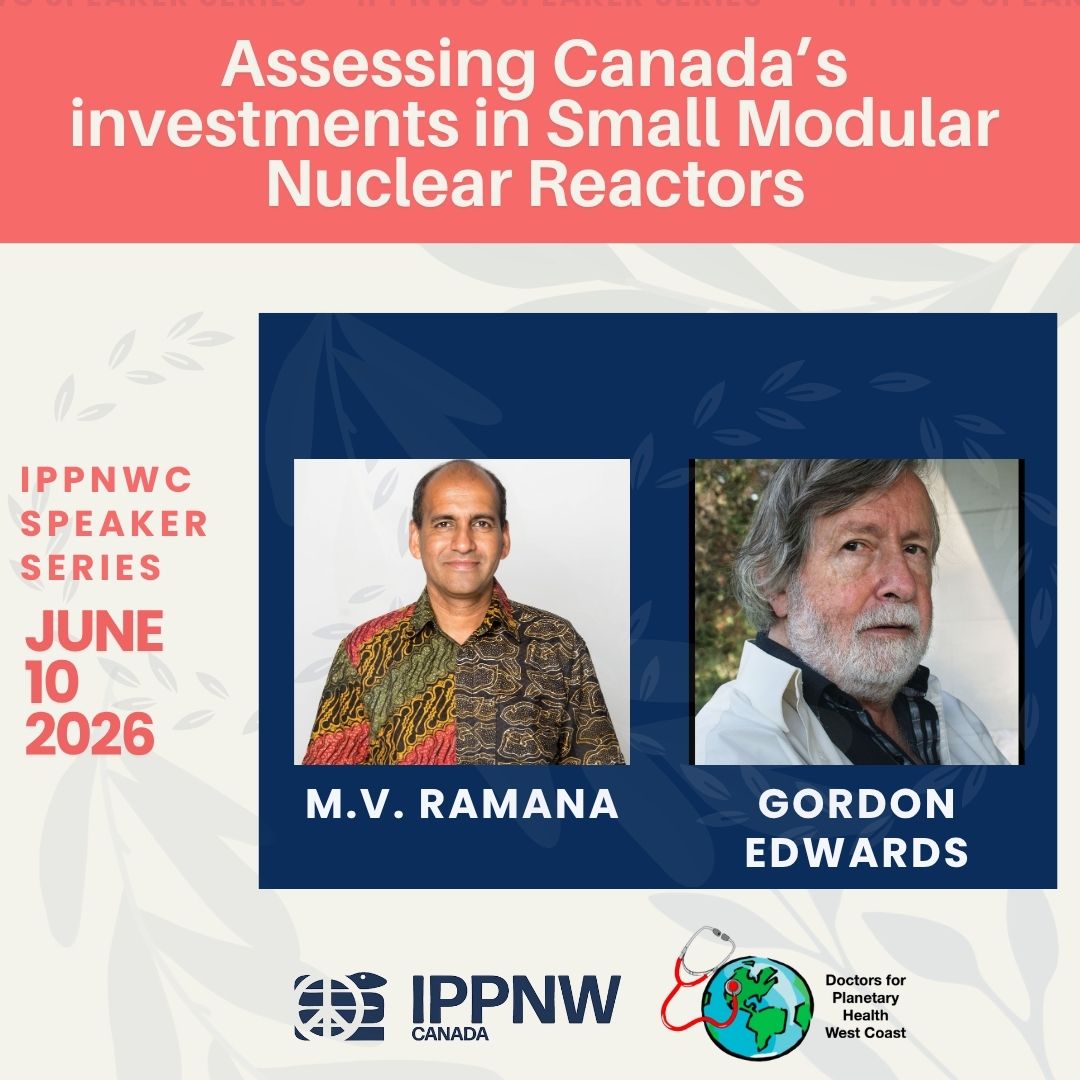
10 June – Assessing Canada’s Investments in Small Modular Nuclear Reactors – https://zoom.us/meeting/register/IiqHA5feRhaEBycOLNTJlA#/registration


Cuba Is Not a Failed State – It Is a Besieged State
PETITION: “Global Appeal to Endorse Palestinian Right of Return of Refugees”
To see nuclear-related stories in greater depth and intensity – go to https://nuclearinformation.wordpress.com
-
Archives
- June 2026 (89)
- May 2026 (306)
- April 2026 (356)
- March 2026 (251)
- February 2026 (268)
- January 2026 (308)
- December 2025 (358)
- November 2025 (359)
- October 2025 (376)
- September 2025 (257)
- August 2025 (319)
- July 2025 (230)
-
Categories
- 1
- 1 NUCLEAR ISSUES
- business and costs
- climate change
- culture and arts
- ENERGY
- environment
- health
- history
- indigenous issues
- Legal
- marketing of nuclear
- media
- opposition to nuclear
- PERSONAL STORIES
- politics
- politics international
- Religion and ethics
- safety
- secrets,lies and civil liberties
- spinbuster
- technology
- Uranium
- wastes
- weapons and war
- Women
- 2 WORLD
- ACTION
- AFRICA
- Atrocities
- AUSTRALIA
- Christina's notes
- Christina's themes
- culture and arts
- Events
- Fuk 2022
- Fuk 2023
- Fukushima 2017
- Fukushima 2018
- fukushima 2019
- Fukushima 2020
- Fukushima 2021
- general
- global warming
- Humour (God we need it)
- Nuclear
- RARE EARTHS
- Reference
- resources – print
- Resources -audiovicual
- Weekly Newsletter
- World
- World Nuclear
- YouTube
-
RSS
Entries RSS
Comments RSS
 nuclear-news