“Blue Ribbon” Panel wants a powerful new govt agency to set up a nuclear waste dump
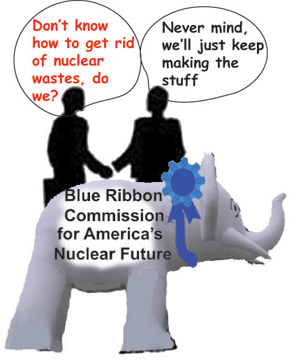 the commission also urged creation of a new government agency with the sole purpose of selecting the locations of the proposed interim storage and repository facilities. The proposed agency should be given the necessary financial and institutional resources, as well as sufficient authority, to make its policies stick……
Panel urges centralized storage facility and permanent repository for nuclear waste , David KramerBy Physics Today on May 17, 2011, A recommendation has been made by the commission formed to advise the Obama administration on what to do with the spent nuclear fuel from the nation’s commercial reactors: The material should be consolidated at an above-ground storage facility while a new search is carried out to find a permanent geological repository. Continue reading
Uranium mining could poison Roanoke River for generations
“This uranium operation would generate millions of tons of toxic, cancer-causing waste,” said Peter Raabe of American Rivers. “We’re talking about a radioactive legacy that would last for generations.”
The General Assembly banned uranium mining soon after the uranium was discovered more than 25 years ago.
Possible uranium mining puts Roanoke River on nation’s ‘most endangered’ list, The Washington Post, By Anita Kuma, 18 May, The mere threat of possible uranium mining in Southside Virginia has landed the Roanoke River on a list of the nation’s most endangered waterways.The conservation organization American Rivers said the possibility of lifting a statewide ban on uranium mining would threaten the river and other rivers as well as drinking water supplies in the region. Continue reading
USA ratepayers have already paid $billions for nuclear waste discussions
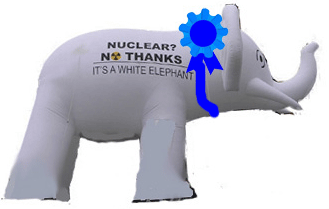 Controversy Surrounds Plans For Spent Nuclear Fuel, KTVU San Francisco, May 17, 2011 SAN LUIS OBISPO, Calif. — A political, legal and environmental fight is brewing over what to do with spent nuclear fuel. The final decision made by the federal government it may change the direction of the nation’s energy policy.Last week a Presidential commission recommended in a preliminary draft report that the United States should build one or more above ground storage sites for high level nuclear waste. Lawmakers and environmentalists are already sparring over what to do next. But KTVU has learned the controversy has already cost ratepayers billions of dollars. Continue reading
Germany to set harsh nuclear safety rules
Germany tightens nuclear rules, FT.com By Gerrit Wiesmann in Berlin May 18 2011 The German government on Tuesday signalled it will set harsh safety requirements for the country’s 17 nuclear power stations as it searches for ways to bring forward the final phase-out of the power source from 2036……FT.com / Europe – Germany tightens nuclear rules
For Hanford -a football field, 7 feet deep, of highly radioactive waste?
The projected amount of waste is relatively low, enough to cover a football field 7 feet deep. But the radioactivity is high: 160 million curies, more than three-quarters of the radiation contained in 177 leak-prone underground tanks at Hanford. Those tanks are the focus of the nation’s largest nuclear cleanup project. …
Opponents, including Heart of America Northwest and the state of Oregon, say Hanford is the wrong place to bring the waste given the ongoing cleanup and the potential for radioactive contamination of the Columbia.
Permanent storage of highly radioactive nuclear waste at Hanford to be debated , May 17, 2011, By Scott Learn, The Oregonian A Department of Energy proposal that could bring more radioactive waste to the Hanford Nuclear Reservation, including contaminated metal from decommissioned U.S. nuclear power plants, gets a public airing in Portland Thursday night. Continue reading
Childhood leakaemias near nuclear plants – NOT caused by “virus”
 Across Europe a number of studies have reported increased rates of childhood leukaemia around other nuclear facilities. In 1992, the German Childhood Cancer Registry found a statistically significant increased incidence rate for leukaemias among children below five years of age within the 5-km-zone around nuclear sites. A second study was published in 1997, and again found increased childhood leukaemias near nuclear plants….
Further analysis of the KiKK study by the German Expert Group went on to state that childhood cancer near to nuclear power plant sites was actually underestimated by the KiKK researchers – and so the risks are considerably above those reported.
Why UK nuclear power plants may cause childhood cancer and leukaemia, The Ecologist, Dr Paul Dorfman, 16th May, 2011You won’t hear the UK government admit it but after decades of research there is now evidence of real excesses of childhood cancer and leukaemia near some nuclear facilities, argues Dr Paul Dorfman Continue reading
Japan: collusion of govt, nuclear regulators, plant operators, courts

 The lawsuits reveal a disturbing pattern in which operators underestimated or hid seismic dangers to avoid costly upgrades and keep operating. And the fact that virtually all these suits were unsuccessful reinforces the widespread belief in Japan that a culture of collusion supporting nuclear power, including the government, nuclear regulators and plant operators, extends to the courts as well.
 Japanese Officials Ignored or Concealed Dangers, New York Times, By NORIMITSU ONISHI and MARTIN FACKLER, May 16, 2011 OMAEZAKI, Japan — The nuclear power plant, lawyers argued, could not withstand the kind of major earthquake that new seismic research now suggested was likely.
If such a quake struck, electrical power could fail, along with backup generators, crippling the cooling system, the lawyers predicted. The reactors would then suffer a meltdown and start spewing radiation into the air and sea. Tens of thousands in the area would be forced to flee.
Although the predictions sound eerily like the sequence of events at the Fukushima Daiichi plant following the March 11 earthquake and tsunami, the lawsuit was filed nearly a decade ago to shut down another plant, long considered the most dangerous in Japan — the Hamaoka station. Continue reading
Draining 4,000 tonnes of highly radioactive water from Fukushima reactor
 Radioactive water to be drained from Fukushima reactor, ABC News (Australian Broadcasting Corporation), By North Asia correspondent Mark Willacy, 17 May 11, he operator of the crippled Fukushima nuclear plant will today begin pumping out thousands of tonnes of highly radioactive water from one of the reactors.
The Tokyo Electric Power company will use hoses to pump 4,000 tonnes of highly contaminated water from No. 3 reactor.
The radioactive water will then be shifted to a waste disposal facility to stop it from leaking into the environment….Radioactive water to be drained from Fukushima reactor – ABC News (Australian Broadcasting Corporation)
USA’s Blue Ribbon Commission floundering in the dark over nuclear wastes
Lessons of Fukushima remain unknown……..critical details of what happened to the spent fuel held in elevated water pools in reactor buildings remain a mystery to U.S. regulators and the Blue Ribbon Commission members.
Fukushima Disaster Deepens U.S. Turmoil Over Nuclear Waste Storage, NYTimes.com, By PETER BEHR of ClimateWire May 16, 2011 Japan’s nuclear disaster and the abandoned Yucca Mountain repository are combining to create a more complex puzzle for U.S. policymakers wrestling with the future of nuclear power in the United States.
On Friday, a Blue Ribbon Commission (BRC) of experts appointed by the Obama administration presented subcommittee reports calling for the “expedited” creation of one or more consolidated interim sites for storing spent fuel from commercial U.S. reactors.
More than 70,000 tons of spent fuel with varying levels of remaining radioactivity are currently in “wet” or “dry” storage at the reactor sites, with nowhere else to go.
The subcommittee also recommended that the United States develop one or more permanent underground repositories for spent fuel in place of the proposed Yucca Mountain repository that has been shelved by the Obama administration. Both interim and permanent sites should only be located where local communities welcome them, and not imposed on a location, as Yucca Mountain was in Nevada, commissioners said. A new federal agency should be created to manage both interim and permanent site development, commissioners said.
A consolidated interim storage facility could take 20 years to locate, fund, license and build, according to the Government Accountability Office. A future permanent repository is even further in the future, the GAO said…..
Lessons of Fukushima remain unknown
More than two months after the start of the Fukushima crisis, critical details of what happened to the spent fuel held in elevated water pools in reactor buildings remain a mystery to U.S. regulators and the Blue Ribbon Commission members. Technicians had to wait several years after the 1979 nuclear accident at Three Mile Island before it was safe enough to directly assess the damage to the reactor. Crews at the Fukushima plant are in a daily struggle to control damaged reactors, and there is no guarantee that the accident details will become clear by the time the commission is planning to publish its draft final report, in July…….
In another two decades, many of the first U.S. commercial reactors will be coming to the end of an extended 60-year license term. It far from settled whether they could qualify for a new relicensing for another 20 years, or whether their owners would choose that course, experts say. That could mean that a growing line of reactors will be headed for decommissioning and more reactor sites will be closed with only their legacy of spent fuel containers, expanding the case for centralized storage, Meserve said…..
Fukushima Disaster Deepens U.S. Turmoil Over Nuclear Waste Storage – NYTimes.com
Courage of doctors in Fukushima nuclear zone

“Doctors are there to work in this kind of adversity,” he said. “This is my mission — maybe it’s the last chapter of my medical career.”……
Doctors defy radiation woes in Japan’s Fukushima – Channel NewsAsia, 17 May, 11, FUKUSHIMA CITY, Japan: When other doctors fled, 72-year old Kyohei Takahashi stayed, and hundreds of patients in the tsunami-hit Japanese town of Minamisoma near a crippled nuclear plant will never forget.Dr. Takahashi has defied radiation fears and worked gruelling hours for the past nine weeks to do what he considers his duty.”As a doctor, I thought, I shouldn’t retreat,” he said. “I told myself: who will do it if I don’t?” Continue reading
Nuclear Regulatory Commission Complacent About Safety of US Nuclear Reactors
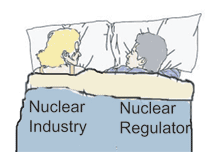 Eric Leeds, director of the NRC’s Office of Nuclear Reactor Regulation, said, “Our inspectors found all reactors would be kept safe ..”
Florida nuclear reactors pass inspection in wake of Japan disaster By Susan Salisbury, Palm Beach Post , May 16, 2011,The U.S. Nuclear Regulatory Commission has completed inspections of the nation’s 104 nuclear reactors, including those in Florida, to examine the plants’ abilities to deal with power losses or other issues following extreme events, such as floods, fires or terrorist attacks. Continue reading
Poor safety record of Browns Ferry Nuclear Plant
 How safe is the Browns Ferry Nuclear Plant? , Richard W. Jobe, 17 May 11, A Nuke hazard?Reading Brian Lawson’s excellent article in The Times on May 11, I asked: Could Brown’s Ferry Nuclear Plant have a meltdown like Fukushima in Japan? Judge for yourself with these facts: Continue reading
Dead radioactive nuclear reactors will NOT be transported through Great Lakes
the controversial shipment,..would have essentially seen 1,600 tonnes of radioactive waste transported across the lakes for the first time..…
 Bruce Power scraps plans to ship generators through Great Lakes, Vancouver Sun, By Mark Iype, Postmedia News May 16, 2011 Ontario utility company Bruce Power has withdrawn its request for approval from the U.S. to transport 16 decommissioned nuclear reactors across the Great Lakes for recycling, despite permission from Canadian regulators, according to a Michigan state lawmaker. Continue reading
Australian uranium company does some deceptive spinning about nuclear power
Any increase on safety or design regulations for reactors developed in response to Fukushima will of course increase the already enormous cost of new reactors, which typically require government subsidies or loan guarantees to fund the on-average nine year-long construction phase.
 BHP and the new maths of nuclear reactors, by Bernard Keane, Crikey,17 may 11, Yesterday Robert Gottliebsen of Business Spectator spruiked the glories of BHP’s Olympic Dam uranium mine, including BHP’s claim that within 20 years the number of nuclear reactors around the world would nearly double from 439 to 793. BHP got the 439 right. It’s 793 appears to be rather more mysterious. The number of operational reactors has actually fallen since 2002 Continue reading
Medical radiation has hidden dangers
Children, he says, face a lifetime of radiation procedures, and many studies suggest that the adverse effects of radiation are cumulative. So limiting radiation exposure, particularly if it’s not absolutely necessary, is a good idea.
 AUDIO Reporting On Hidden Dangers Of Medical Radiation, NPR 17 May 11, “…..On Monday’s Fresh Air, Bogdanich discusses his ongoing Times seriesabout the medical and regulatory issues that have arisen as radiation therapies have become more ubiquitous in both dental and doctors’ offices.
“I think we made it clear [in the series] that these are wonderful devices [for treatment] that save countless lives, and people need to get it when they need them, but they need to ask questions,” he says. “People were not asking questions, and, frankly, doctors who were treating the patients were not giving the patients the information they needed.”…… Continue reading
1 This Month
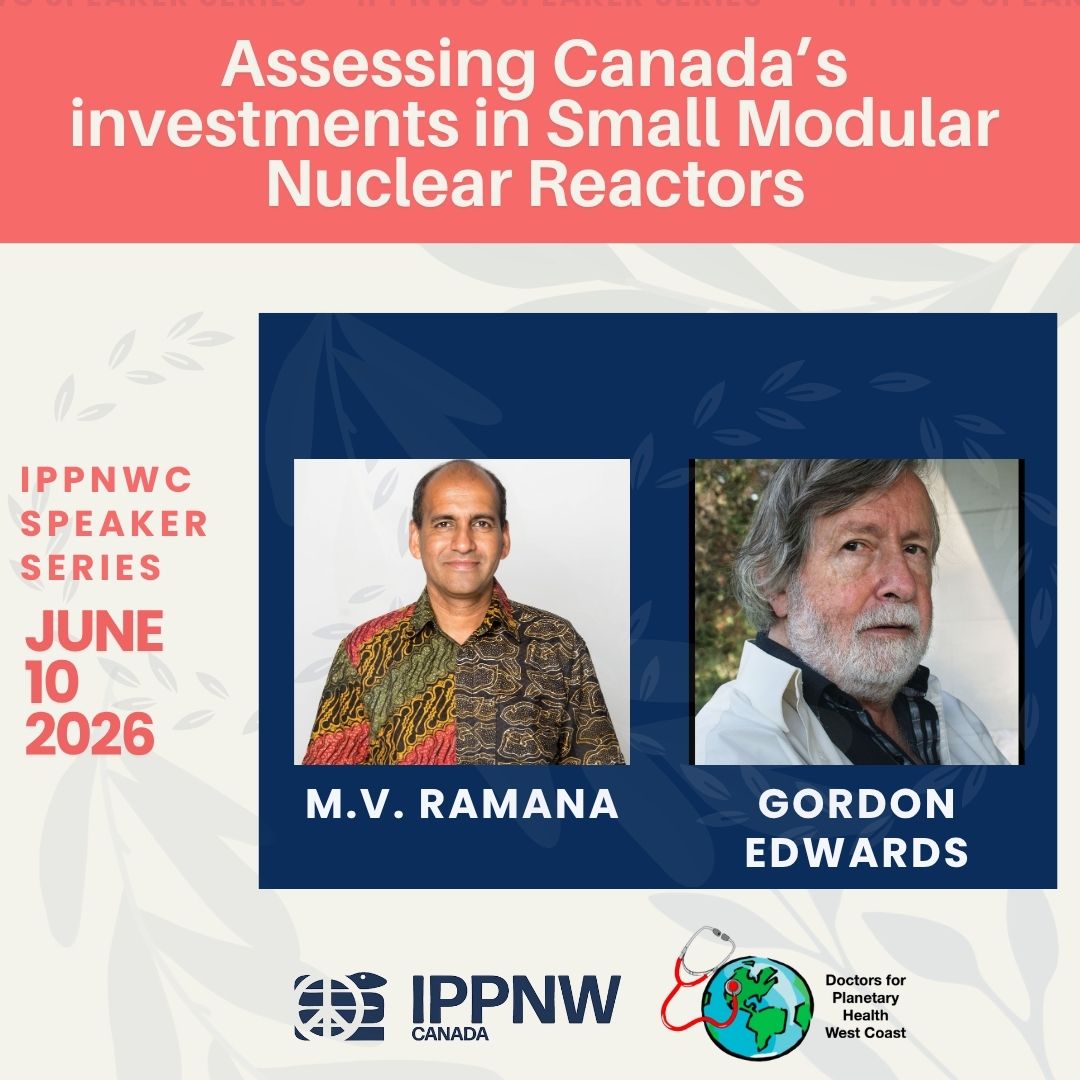
10 June – Assessing Canada’s Investments in Small Modular Nuclear Reactors – https://zoom.us/meeting/register/IiqHA5feRhaEBycOLNTJlA#/registration


Cuba Is Not a Failed State – It Is a Besieged State
PETITION: “Global Appeal to Endorse Palestinian Right of Return of Refugees”
To see nuclear-related stories in greater depth and intensity – go to https://nuclearinformation.wordpress.com
-
Archives
- June 2026 (89)
- May 2026 (306)
- April 2026 (356)
- March 2026 (251)
- February 2026 (268)
- January 2026 (308)
- December 2025 (358)
- November 2025 (359)
- October 2025 (376)
- September 2025 (257)
- August 2025 (319)
- July 2025 (230)
-
Categories
- 1
- 1 NUCLEAR ISSUES
- business and costs
- climate change
- culture and arts
- ENERGY
- environment
- health
- history
- indigenous issues
- Legal
- marketing of nuclear
- media
- opposition to nuclear
- PERSONAL STORIES
- politics
- politics international
- Religion and ethics
- safety
- secrets,lies and civil liberties
- spinbuster
- technology
- Uranium
- wastes
- weapons and war
- Women
- 2 WORLD
- ACTION
- AFRICA
- Atrocities
- AUSTRALIA
- Christina's notes
- Christina's themes
- culture and arts
- Events
- Fuk 2022
- Fuk 2023
- Fukushima 2017
- Fukushima 2018
- fukushima 2019
- Fukushima 2020
- Fukushima 2021
- general
- global warming
- Humour (God we need it)
- Nuclear
- RARE EARTHS
- Reference
- resources – print
- Resources -audiovicual
- Weekly Newsletter
- World
- World Nuclear
- YouTube
-
RSS
Entries RSS
Comments RSS
 nuclear-news