Ottawa to spend $6M seeking medical isotope alternatives
Approval for alternative types of medical isotopes such as thallium for cardiac scans and sodium fluoride for bone scans has also been been sped up, Aglukkaq said.”Although the next month is going to be challenging with Petten down as well, I believe that the increasing use of those two alternatives really does give us a significant step up in coping with the need to help our patients,” said Dr. Sandy McEwan, the federal government’s new special adviser on medical isotopes.Also on Tuesday, Ontario’s Health Ministry announced it will pay $1.4 million in one-time funding to produce sodium fluoride as an alternative diagnostic procedure for about 2,000 cancer patients.
Help assured for big polluters
Help assured for big polluters The Age Tom Arup, CanberraJune 17, 2009THE Federal Government will offer some assistance to energy-intensive industries even if exemptions in its renewable energy target are delayed.The renewable energy target legislation, which will enter Parliament tomorrow, has angered the Opposition and clean energy groups because it has linked industry exemptions to the passing of the Government’s unpopular emissions trading scheme.
Proposed Rio, BHP tie-up has ‘strong monopolistic color’
Proposed Rio, BHP tie-up has ‘strong monopolistic color'(Xinhua) China Daily 2009-06-16 ANSHAN – An official with the Ministry of Industry and Information Technology (MIIT) said Tuesday that the proposed alliance of Rio Tinto and BHP Billiton had a “strong monopolistic color” and Chinese firms would watch it closely and find ways to cope with it……………………………
On Monday, spokesman of the Ministry of Commerce Yao Jian said if the revenue of the joint venture reached “a certain amount,” China’s anti-monopoly law would apply.
That law requires a company to get government approval before consolidation if its global revenue exceeds 10 billion yuan (US$1.47 billion) and its revenue in China exceeds 2 billion yuan.
An anti-monopoly review is also necessary if two or more parties in the company had more than 400 million yuan of revenue in China in the previous fiscal year.
In the year ended 30 June, BHP Billiton’s revenue in China was US$11.7 billion, while that for Rio Tinto was US$10.8 billion, according to the companies’ websites.
It was unclear what actions China would take if the case was determined to be covered by the Chinese anti-monopoly law.
“New” Nuclear Reactors, Same Old Story
“New” Nuclear Reactors, Same Old Story Peak Energy 16 June 09 AMory Lovins has a look at various new forms of nuclear power being touted as the next big thing – “…………
…………on closer examination, the two kinds most often promoted—Integral Fast Reactors (IFRs) and thorium reactors4—reveal no economic, environmental, or security rationale,…………………………
Integrated Fast Reactors (IFRs) – ……………Fast reactors were first offered as a way to make more plutonium to augment and ultimately replace scarce uranium. Now that uranium and enrichment are known to get cheaper while reprocessing, cleanup, and nonproliferation get costlier—destroying the economic rationale—IFRs have been rebranded as a way to destroy the plutonium (and similar transuranic elements) in long-lived radioactive waste. Two or three redesigned IFRs could in principle fission the plutonium produced by each four LWRs without making more net plutonium. However, most LWRs will have retired before even one commercial-size IFR could be built; LWRs won’t be replaced with more LWRs because they’re grossly uncompetitive; and IFRs with their fuel cycle would cost even more and probably be less reliable………………………..
Thorium reactors………………..thorium can’t fuel a reactor by itself: rather, a uranium- or plutoniumfueled reactor can convert thorium-232 into fissionable (and plutonium-like, highly bomb-usable) uranium-233. Thorium’s proliferation,9 waste, safety, and cost problems differ only in detail from uranium’s…………
any new type of reactor would probably cost even more than today’s models: even if the nuclear part of a new plant were free, the rest—two-thirds of its capital cost—would still be grossly uncompetitive with any efficiency and most renewables, sending out a kilowatt-hour for ~9–13¢/kWh instead of new LWRs’ ~12–18+¢. In contrast, the average U.S. windfarm completed in 2007 sold its power (net of a 1¢/ kWh subsidy that’s a small fraction of nuclear subsidies) for 4.5¢/kWh. Add ~0.4¢ to make it dispatchable whether the wind is blowing or not and you get under a nickel delivered to the grid.Most other renewables also beat new thermal power plants too, cogeneration is often comparable or cheaper, and efficiency is cheaper than just running any nuclear- or fossil-fueled plant. Obviously these options would also easily beat proposed fusion reactors that are sometimes claimed to be comparable to today’s fission reactors in size and cost……………………….
Small reactors……………………….the whole nuclear business will complete its slow death of an incurable attack of market forces. Meanwhile, the rest of us shouldn’t be distracted from getting on with the winning investments that make sense, make money, and really do solve the energy, climate, and proliferation problems, led by business for profit.
Going Nuclear: Is France Really the Example to Follow?
* June 15, 2009, 2:20 PM ETGoing Nuclear: Is France Really the Example to Follow? The Wall Street Journal, by Keith johnson “…………………..
One of the biggest potential hurdles to the Republican Party’s newfound love of nuclear power is that in France, the government is nearly inseparable from its energy industry. The biggest power company, Electricite de France, is state-owned. Nuclear-engineering groups like Areva are extensions of government industrial policy.
That cozy relationship clears away many of the obstacles facing nuclear power—especially financing—
Going Nuclear: Is France Really the Example to Follow? – Environmental Capital – WSJ
International Agreement on Climate Treaty Seems Unlikely in 2009
International Agreement on Climate Treaty Seems Unlikely in 2009 REUTERS Jun 14, 2009
By Mridul Chadha
It seems unlikely that an agreement on the terms of the next climate treaty could be reached at the December-scheduled Copenhagen talks………………..Many lawmakers are pushing for nuclear power to be included in the climate bill ……………However, they are at conflict of ideas with the environmentalists who argue that the nuclear waste that would be generated from these nuclear plants will pose serious management issues given the fact that President Obama wants to close the Yucca Mountain storage facility. Furthermore, the increase in number of nuclear power plants would also poses national security issues.
International Agreement on Climate Treaty Seems Unlikely in 2009 | Green Business | Reuters
Russia postpones Iran nuclear plant operation again – paper
Russia postpones Iran nuclear plant operation again Power Engineering June 15, 2009)Jun 14, 2009 (BBC Monitoring via COMTEX) — On the threshold of commissioning of the Bushehr nuclear power station, Russia has prevented the power plant to begin operation with new excuses. In an announcement on the issue, the Russian company Atomstroyexport said that there were financial impediments in the way of constructing the first unit of the Bushehr nuclear power station. On this basis, Russian experts have quoted Atomstroyexport Company saying that the timing of the commissioning of the Bushehr nuclear power station will be confidential.
Power Engineering International – Russia postpones Iran nuclear plant operation again – paper
Swans Commentary: Dreams Of Social Responsibility: Rio Tinto, Capitalism, and Indigenous Rights, by Michael Barker – barker22
Dreams Of Social ResponsibilityRio Tinto, Capitalism, and Indigenous Rights
Swans Commentary by Michael Barker 15 June 09
Despite the existence of such environmental connections, which may be better described as greenwash, Rio Tinto remains strongly committed to a nuclear powered (and weaponized) future, and it maintains two of the largest uranium mines in the world (one in Australia that is run by Energy Resources of Australia and the other in Namibia). (2) Chris Salisbury, the chief operating officer with the Bauxite and Alumina division of Rio Tinto Alcan, is the former chair of the pro-nuclear lobby group, the Australian Uranium Association (and a board member of Energy Resources of Australia). This connection to the nuclear lobby group is particularly relevant to this article as in February 2009 the Australian Uranium Association established an Indigenous Dialogue Group, which included Professor Marcia Langton as one of their founding members. Langton was a fitting choice as an indigenous representative chosen to sit alongside mining CEOs, as Langton chairs the pro-corporate Cape York Institute, a “public policy organization that champions reform in Indigenous economic and social policies,” that is headed by the neoliberal indigenous rights activist, Noel Pearson.
Contrary to its demonstrated willingness to abuse human rights in developing countries, Rio Tinto has adopted an alternative strategy in Australia (since 1996) and it has actively sought to establish working — rather than exploiting — relationships with indigenous peoples. The foundation of this strategy was marked by the creation of the Rio Tinto Aboriginal Fund, which is described on the Rio Tinto Web site as being part of a “strategy of working in active partnership with Aboriginal people in Australia.” No doubt such efforts are necessitated by the desire to be seen to be acting as a socially responsible corporation (in an imperial homeland); something which is not necessary in far flung countries where the ongoing abuse of indigenous populations and landscapes rarely makes the headlines of the mainstream media.
The chair of the Rio Tinto Aboriginal Fund, Chris Renwick, is the chairman of Coal and Allied Industries (which is managed by Rio Tinto Coal Australia), and amongst his other corporate connections he is a board member of Downer-EDI, where he sits alongside Michael Harding, the chairman of the Army Project Governance Board of the Australian Department of Defence. Here it should be highlighted that Rio Tinto has always maintained direct military ties and Paul Skinner, the former chair of Rio Tinto (2003-09), was and still is a “member of the Defence Management Board (DMB) at the Ministry of Defence, a high-level committee whose role is to deliver the aims set by the UK’s defence policy, including to ‘achieve success in the military tasks we undertake, at home and abroad’.”…………………………..Finally, having listed some of the types of projects that the Rio Tinto Aboriginal Fund has financed, it is critical to put Rio Tinto’s philanthropic efforts into perspective. This is because since the founding of its Aboriginal Fund (in 1996) they have only distributed around A$20 million (or US$16 million) in funding to groups across Australia. This is only a drop in the ocean when compared with the immense profits Rio Tinto has reaped from destroying the environment and trampling roughshod over human rights. Indeed, according to the Fortune 500 global company ranking for 2005, Rio Tinto ranked as the 10th most profitable company in the world, and while their net earnings were US$5.2 billion in 2005, the following year their earnings had grown to a massive US$7.4 billion. To try to put Rio Tinto’s minor support for indigenous Australians into further relief, John Pilger noted that “When John Howard came to office in 1996, his first act was to cut $A400 million from the Aboriginal affairs budget.
In Mortal Hands – Review
In Mortal Hands – Review Palestine Chronicle By Jim Miles In Mortal Hands – A Cautionary History of the Nuclear Age. Stephanie Cooke. Bloomsbury, New York, 2009.In an era when the corporate media and the corporate politicians and the corporate military men gang up together and denounce and threaten other countries because of their nuclear related activities, they should spend much of that rhetorical energy by cross-examining themselves in a mirror………………………..The real issue as reiterated constantly and perceptively by Stephanie Cooke is that of an industry whose central purpose is to create fissile material for weapons production regardless of and in spite of all other attempts to equate nuclear energy with peaceful purposes and with the ‘greening’ of the energy industry. It is a trillion dollar industry, supported by governments of all genres as no private developer is able to cover the costs of development, the insurance liabilities in case of accident (highly likely, already highly significant), and the huge timelines and costs of decommissioning the radioactive waste from the reactor’s fuel as well as the radioactive hulks of the reactors themselves.
In short, it is an economically unfeasible and environmentally dangerous business that is supported by public officials and the media in order to keep making weapons.
That statement will of course lead to derision by spokespeople for the nuclear industry, whether they are within the industry or members of the political and media propaganda that supports them. As we head into a future with the advertised benefits of nuclear power in an era of ‘green’ energy, In Mortal Hands is indeed a cautionary tale that all those involved and everyone in the public should be reading.
Media, Propaganda, and Secrecy All of the themes are necessarily related and with significant overlaps, but they can be examined through various different foci. Media and its entanglement with propaganda receive a large share of the commentary in the book, as the nuclear industry tried – mostly successfully – to convince the public (the taxpayers supporting it all) that there was a peaceful side to nuclear power and that it was clean and safe. On the other side, the politically provoked fears of communism then and militant Islam now are to convince those same taxpayers that nuclear weapons could be used to act pre-emptively and win a nuclear war with whatever opponent is chosen. ……………………..Once under way, the peaceful use of nuclear fuel and the resulting “uranium boom was really started to ensure the country had enough fuel for the rapid build-up of its nuclear weapons stockpile.” It was supported by “spin-doctoring in Washington, D.C. [reaching] down through the corporate sphere to local people.” …………………………….
Perhaps the current situation has not been clear with all the secrecy, lies, deceit and hypocrisy surrounding the nuclear industry, but after reading this excellent work, there remains a clear and present danger.
As highlighted by Cooke, the nuclear industry is not saf
The Palestine Chronicle: A Leading Online Newspaper on Palestine, Israel and the Middle East
Foes of Comanche Peak expansion present their case
Foes of Comanche Peak expansion present their case Star Telegram 15 june 09
By JACK Z. SMITH
GRANBURY “……………….
Luminant Generation, a subsidiary of Dallas-based Energy Future Holdings (the former TXU Corp.), is applying to the federal Nuclear Regulatory Commission for a construction and operating license for two new 1,700-megawatt generating units at Comanche Peak.
Plant-expansion opponents have raised 19 issues, or “contentions,” that express alarm about the potential environmental, public safety and economic effects of adding two units.
With the two-day hearing concluded, the panel headed by Ann Marshall Young will consider the oral arguments in deciding whether to grant plant opponents status as an intervener in the licensing process.
Gaining that status would give opponents a greater say in the licensing process, including participation in a full public hearing on any of the 19 contentions that the panel might judge worthy of additional inquiry…………………..Plant-expansion opponent Karen Hadden, in comments to the Star-Telegram, cited a 1982 study done by Sandia National Laboratories for the NRC that raised the possibility of large-scale fatalities in the event of major radiation leaks from Comanche Peak or other nuclear plants……………………………One issue: cost Luminant Generation estimates that it will spend $15 billion to build two 1,700-megawatt units. A study commissioned by Public Citizen estimated the cost at between $23.8 billion and $27.6 billion.
Foes of Comanche Peak expansion present their case | Business | Star-Telegram.com
A cloud lifts
A cloud lifts The Age Nic Maclellan. 15 June 09 “……………..
On June 5, Fijians like Paul Ah Poy joined British and New Zealand veterans of Britain’s nuclear tests to celebrate an important victory. The High Court in London ruled that their case seeking compensation for health effects from the nuclear tests of the 1950s could proceed against Britain’s Ministry of Defence.
Many soldiers and sailors who witnessed the tests believe they were used as guinea pigs, being exposed to hazardous levels of ionising radiation. Their claim has been ridiculed by the British authorities, who have long played down possible health impacts from the 1950s tests.
Between 1952 and 1957, with the consent of Australian prime minister Robert Menzies, the British government held
12 atomic tests in Australia at the Monte Bello islands, Maralinga and Emu Field.
Then in 1957-58, the tests moved to the central Pacific to develop the British hydrogen bomb……………………………….
While the June 5 High Court ruling was an important victory for the veterans, there is still a long way to go before Britain accepts its responsibility to the survivors of the tests. The Ministry of Defence may appeal against the ruling to delay proceedings further.
High Court Justice David Foskett noted that the claimants were men in their 70s and that further delay would make the trial even more difficult — the ageing cohort of witnesses are slowly dying………………………Justice Foskett’s ruling affects thousands of survivors……………………….documents from the British archives show that one of the purposes of the tests in Australia and the Pacific was to study the human effects of nuclear detonations……………….governments are continually seeking more time to study the matter. For men who were exposed to ionising radiation in the 1950s, time is the one thing that they don’t have……………………..1955-63: Seven major nuclear tests are performed at Maralinga, with yields ranging from one to 27 kilotons.
■ Maralinga site was inhabited by the Pitjantjatjara and Yankunytjatjara before testing.
Is This Uranium Bull Market For Real?
Zoonon June 14, 2009in Evil Energy. n light of Toshiba’s recent proposed acquisition of Westinghouse Electric from the government-owned British Nuclear Fuels (BNFL), historians may be reminded of former Westinghouse Chairman Robert Kirby’s litigious international outcry and prolonged battle over secretive and illegal price manipulation by a global uranium cartel…………………………..Today, Toshiba aims its sights on the lucrative Chinese nuclear energy market, which on the surface appears more ambitious than the U.S. civilian nuclear program of the 1970’s…………………………….According to a special report in the Pittsburgh Post-Gazette, Kirby’s “suspicions heightened when, in late 1976, he received copies of documents suggesting Gulf and 28 other suppliers had conspired to form a cartel to keep Westinghouse out of the uranium business.” The documents were the minutes of a private meeting of uranium suppliers held in Australia………………………………….News reports suggest a number of uranium-heavy countries held an initial meeting in Paris in February 1972 to establish a uranium-producer’s alliance, in essence a de facto uranium cartel…………………….Canadian author Gordon Edwards (Canada’s Nuclear History) bluntly wrote, “The purpose of the cartel was to secretly manipulate world uranium prices using a phony bidding system. Hidden quotas were established by representatives from Canada, France, Australia, South Africa and Rio Tinto Zinc (London Stock Exchange: RIO).” Namibia and Niger were also included in the alliance,…………………………Why is today’s uranium bull market different? Is the current and spectacular rise in spot uranium prices different today than it was in the early to mid 1970’s, when an alleged uranium cartel reportedly bid up prices to an artificial level? Is that same factor occurring during the current steep rise in the spot price of uranium? Will Toshiba sink into the same quicksand, during the balance of this decade, as Westinghouse Electric once did?
THE ‘CLOUD’ CHAMBER PROJECT – UP-MARKETING URANIUM ‘END PRODUCTS’ «
Posted on June 14, 2009 by Coober Pedy Regional TimesArkaroola Sanctuary: Uranium Mining OK, but not in our backyard!
See The Mining and Milling Process and IEER Factsheet | Uranium (below)
Doug and Margaret Sprigg involved in the ongoing saga, in trying to prevent Marathon Resources mining uranium on their lease on traditional Adnyamathanha land at Arkaroola in the Flinders Ranges, have joined with Professor Ian and Mrs Maja Sainaish-Plimer in donating private funding to support and promote uranium on traditional aboriginal lands and sacred sites, in conjuntion with sponsorship from Arkaroola Wilderness Sanctuary, Heathgate Resouces, Areva, Pepinini and Petratherm.
The name chosen for the marketing gadget is The Cloud Chamber Project . The device portrays that uranium is harmless and clean particulary as an end product……………………………………..
Arkaroola Wilderness Sanctuary proudly supports this innovative project at the South Australian Museum“. www.arkaroola.com.au
THE ‘CLOUD’ CHAMBER PROJECT – UP-MARKETING URANIUM ‘END PRODUCTS’ «
Green Left – AUSTRALIA: Aboriginal MP: ALP fails on land rights
Aboriginal MP: ALP fails on land rights Peter Robson13 June 2009 – “Marion Scrymgour — the highest ranking Aboriginal member of any government in Australia — quit the Northern Territory Labor Party over its Aboriginal policy on June 4. As an independent, she now holds the balance of power. .The former Indigenous affairs minister quit the party due to disagreements on the proposed “outstations” policy, which would provide priority infrastructure funding to only 20 of the roughly 600 remote Aboriginal homeland communities.
She opposed the policy, saying it was not what the ALP had taken to the August 2008 election. “I feel strongly because we have lied to Aboriginal people”,………………..“You’re allowing a vibrant movement in those homelands to wither and to just be left out there with no government support. There is this fear that, you know, we’re going to just totally walk away from homelands, not put any extra funding in that they need, but to allow them to be abandoned and they have no choice out of necessity to move back to the main community.”
Aboriginal homelands represent some of the earliest forms of native title recognised by Australian law. Their beginnings date back to the Gurindji strike in 1966, when Aboriginal workers fought and won the right to return to their traditional homelands and build communities.
This right was granted in 1975 and today about 10,000 Aboriginal people in the NT live on their ancestral lands. Forty-three of these communities are in Scrymgour’s seat of Arafura. ………………………. As National Indigenous Times editor Chris Graham wrote on Crikey.com on June 5: “Marion Scrymgour just changed black politics forever. In politics you can justify almost anything. But being an Aboriginal member of the Labor or Liberal Party is no longer one of them.”
Green Left – AUSTRALIA: Aboriginal MP: ALP fails on land rights
Why Nuclear Energy is Still a Really Bad Idea
Why Nuclear Energy is Still a Really Bad Idea
Jonathan Cloud
After all the literature and public policy discussion and decision-making of the past 50+ years, it is hard to believe that there is still an industry – and a lobby – advocating for the expenditure of vast sums of money for the use of “controlled” nuclear reactions anywhere on this planet, let alone in the densely-populated Northeast.
But nuclear advocates have found new hope in the argument that nuclear power is “carbon-free.” New organizations have been formed to promote nuclear as “clean, affordable, and safe.” As Environment NJ’s Matt Elliott has noted, “Recently, Exelon Corp. funded the creation of a group with the misleading name of Affordable, Clean, Reliable Energy (ACRE) Coalition. The group is little more than a front for the nuclear industry.” (Philadelphia Inquirer – 2007-09-17)………………………………..As John Busby points out,
The claim for the carbon-free status of nuclear power proves to be false. Carbon dioxide is released in every component of the nuclear fuel cycle except the actual fission in the reactor. Fossil fuels are involved in the mining, milling, conversion and enrichment of the ore, in the handling of the mill tailings, in the fuel can preparation, in the construction of the station and in its de-commissioning and demolition, in the handling of the spent waste, in its processing and vitrification and in digging the hole in rock for its deposition.
1 This Month
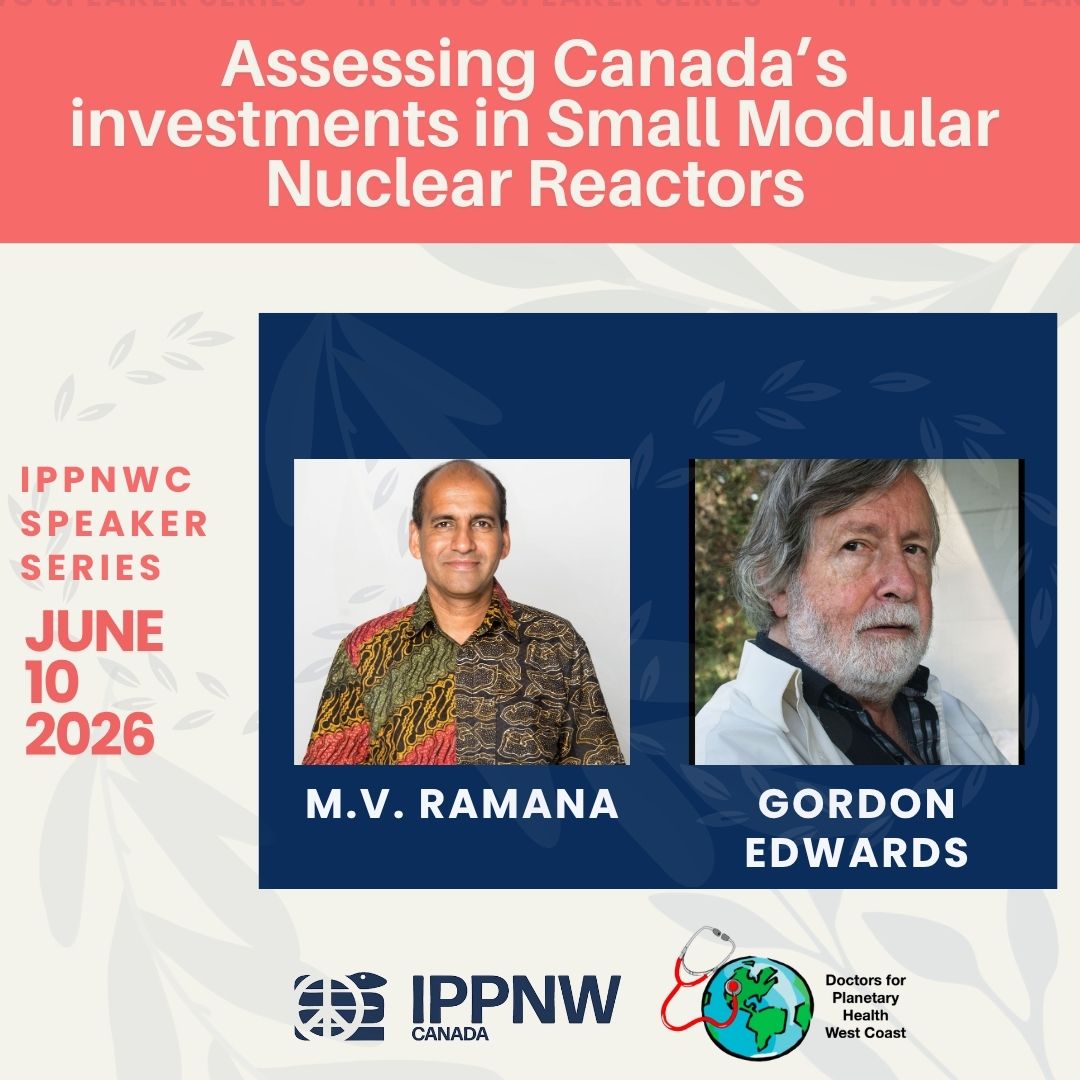
10 June – Assessing Canada’s Investments in Small Modular Nuclear Reactors – https://zoom.us/meeting/register/IiqHA5feRhaEBycOLNTJlA#/registration


Cuba Is Not a Failed State – It Is a Besieged State
PETITION: “Global Appeal to Endorse Palestinian Right of Return of Refugees”
To see nuclear-related stories in greater depth and intensity – go to https://nuclearinformation.wordpress.com
-
Archives
- June 2026 (89)
- May 2026 (306)
- April 2026 (356)
- March 2026 (251)
- February 2026 (268)
- January 2026 (308)
- December 2025 (358)
- November 2025 (359)
- October 2025 (376)
- September 2025 (257)
- August 2025 (319)
- July 2025 (230)
-
Categories
- 1
- 1 NUCLEAR ISSUES
- business and costs
- climate change
- culture and arts
- ENERGY
- environment
- health
- history
- indigenous issues
- Legal
- marketing of nuclear
- media
- opposition to nuclear
- PERSONAL STORIES
- politics
- politics international
- Religion and ethics
- safety
- secrets,lies and civil liberties
- spinbuster
- technology
- Uranium
- wastes
- weapons and war
- Women
- 2 WORLD
- ACTION
- AFRICA
- Atrocities
- AUSTRALIA
- Christina's notes
- Christina's themes
- culture and arts
- Events
- Fuk 2022
- Fuk 2023
- Fukushima 2017
- Fukushima 2018
- fukushima 2019
- Fukushima 2020
- Fukushima 2021
- general
- global warming
- Humour (God we need it)
- Nuclear
- RARE EARTHS
- Reference
- resources – print
- Resources -audiovicual
- Weekly Newsletter
- World
- World Nuclear
- YouTube
-
RSS
Entries RSS
Comments RSS
 nuclear-news