BRADWELL: Radioactive leak at nuclear plant
BRADWELL: Radioactive leak at nuclear plant
Essex Chroinic le January 08, 2009, 11:25RADIOACTIVE waste seeped into the ground beneath Bradwell’s Magnox nuclear power station for at least 14 years, a jury heard.The radioactive cocktail of tritium, caesium, cobalt and americium that leaked from a decontamination unit was not discovered until the twin reactors were decommissioned five years ago.The Environment Agency accused Magnox Electric Ltd at Chelmsford Crown Court of unlawfully allowing the leak to occur and failing to maintain its waste disposal system between 1990 and 2004.
BRADWELL: Radioactive leak at nuclear plant
Tags: nuclear, antinuclear, uranium, radioactive
Entergy: Yankee leaked radioactive water:
Entergy: Yankee leaked radioactive water
Rutland Herald By Susan Smallheer Herald Staff – Published: January 8, 2009
BRATTLEBORO — A valve leaking radioactive water inside Vermont Yankee’s reactor building was undergoing emergency repairs Wednesday, Entergy Nuclear said…………………News of the leak prompted a longtime Vermont Yankee critic to say the leak was just the latest in a long line of leaks at the 37-year-old reactor and another indication that Entergy and the NRC was not managing the aging problems at the plant.
“Sounds like another Bondo and duct-tape job,” said Raymond Shadis, senior technical adviser to the New England Coalition, who noted that nuclear power plants had thousands of valves.
“They’ve had many problems at Vermont Yankee with leaky valves,” said Shadis, noting the portion of the system that sprung a leak in the reactor building wasn’t in the crucial safety systems at the plant.
But Shadis said that any leak at a nuclear plant was cause for concern.
“It’s an indication of a declining, deteriorating situation,” he said.
Entergy: Yankee leaked radioactive water: Rutland Herald Online
Tags: nuclear, antinuclear, uranium, radioactive
Philippines and its white elephant nuclear plant
Philippines revisits nuclear energy option at ‘white elephant’ plant
MORONG, Philippines (AFP) 9 Jan 09 — The Bataan nuclear power plant stands as a monument to the greed and corruption of the years the Philippines spent under strongman president Ferdinand Marcos.It was originally meant to cost around 500 million dollars, but the final price tag of 2.3 billion dollars was only paid off in April 2007.A huge slice of the inflated balance was allegedly stolen by Marcos and his cronies.And it has never powered so much as a light bulb…..
….by 2011, the Philippines is expected to produce less electricity than it needs, and so now there’s a plan afoot to bring the gigantic, chipped and rusted white elephant to life…………….
The Philippines is a geologically volatile country and the land near the plant is particularly vulnerable to seismic activity, much of it caused by the huge Manila Trench fault in the South China Sea to the west of the plant.
In 1991 Mount Pinatubo, a volcano to the north of the plant that was once thought to be dormant, exploded, killing 300 people. Seismologists say Mount Natib nearby is “potentially active”.
Bishop Socrates Villegas, the prelate for the nearby city of Balanga, sees Mount Pinatubo as a warning against commissioning Bataan.
“The nuclear power plant stands at the foot of Mount Natib, which is a volcano. Now, can you imagine a volcano erupting and at the foot of it is a nuclear power plant that did not meet safety standards? Can you imagine the devastation?”
The area is also frequently battered by typhoons.
Tags: nuclear, antinuclear, uranium, radioactive
Obama Calls for Doubling Renewable Energy in Three Years
Obama Calls for Doubling Renewable Energy in Three Years
GreenTech Media 8 Jan 09 President-elect Barack Obama called for doubling the nation’s renewable energy production in three years in a Thursday speech asking Congress to support his economic stimulus plan. He also wants funding for energy efficiency improvements to federal buildings and millions of homes.by: Jeff St. JohnBullet Arrow January 8, 2009
President-elect Barack Obama on Thursday called for doubling the nation’s renewable energy production over the next three years, setting a timeline to one green piece of his economic stimulus plan.Obama also called for funding to modernize the nation’s electricity grid and make 75 percent of all federal buildings and up to 2 million American homes more energy efficient.
“In the process, we will put Americans to work in new jobs that pay well and can’t be outsourced – jobs building solar panels and wind turbines; constructing fuel-efficient cars and buildings; and developing the new energy technologies that will lead to even more jobs, more savings, and a cleaner, safer planet in the bargain,” Obama said Thursday in a speech at George Mason University.
Greentech Media | Obama Calls for Doubling Renewable Energy in Three Years
Tags: renewables
Uranium Mining foes dominate hearing
Mining foes dominate hearing
The News Record 9 Jan 09 All sides in Southside Virginia’s raging uranium debate had a chance Tuesday night to weigh in on a pending scientific study of uranium mining, but they were also cautioned that a decision on the fate of the Coles Hill project in Pittsylvania County is a long ways off……………The meeting at Chatham High School was held to gather citizen input on a scientific study of uranium mining that the Coal and Energy Commission will oversee……………………The capacity crowd was dominated by opponents of uranium mining at the Coles Hill site near Chatham, which is believed to contain one of the largest deposits of uranium in the nation.
More than sixty residents spoke to the subcommittee, mostly living in Chatham, Danville, Halifax and Mecklenburg counties, along with several residents of the Smith Mountain Lake community. Also addressing the committee members were several employees of Virginia Uranium Company.
Many speakers said they were concerned with health problems emanating from radioactive tailings left behind from the mining; others worried about the quality of downstream water and air quality…………………………….Gregg Vickrey, chairman of the Chatham/Pittsylvania County chapter of SCC, asked members how they could convince citizens that the study would be unbiased in light of the political contributions they have received from Virginia Uranium. “There’s been no referendum on this — only a request from a private for-profit corporation,” said Vickery. “Who are you representing, the people who you are elected to represent or the interests of a corporation that has contributed to your campaigns?”
Said Shireen Parsons, an organizer with the Community Environmental Legal Defense Fund, which is advising SCC: “It is we, the people, who decide. This is a travesty and mockery of democracy.”
Tags: nuclear, antinuclear, uranium, radioactive
Radiologists see overuse of patient scans; specialists see turf battle
Radiologists see overuse of patient scans; specialists see turf battle
Stesman.com 9 Jan 09 Lawmakers expected to be asked to referee dispute between radiologists and other doctors investing in own scanning equipment.By Mary Ann RoserAMERICAN-STATESMAN STAFFThursday, January 08, 2009Are you being overexposed?Some Texas radiologists — the doctors who use scans such as CT and MRI to see inside the body — say yes. And they want the Legislature to consider regulating who can scan, where the scanning is done and who reads the tests.Once lawmakers convene for a new session Tuesday, radiologists plan to ask them to order a study of who owns scanning equipment, hoping to curb what they say is a growing problem: a rising number of scans being done by specialists who are not radiologists but who own advanced imaging equipment.
They say this is a conflict of interest that is driving up health care costs and exposing some patients to unnecessary radiation………..
……………….At issue is the use of CT, or computed tomography, and MRI, or magnetic resonance imaging, both of which scan organs inside the body, and PET, or positron emission tomography, which uses a radioactive substance to show the functioning of organs and tissues. With a CT scan, patients are exposed to 100 times more radiation than with a standard X-ray, Perkins said. MRI does not use radiation…………
…….A November 2007 study in the New England Journal of Medicine said…..
….with rising CT use about 1.5 percent to 2 percent of all cancers could be attributed to CT scans in future decades, based on scans received today, the study said. CT scans increased from 3 million in 1980 to 62 million per year in the mid-2000s.
Radiologists see overuse of patient scans; specialists see turf battle
Tags: nuclear, antinuclear, uranium, radioactive
The Uncertain Business of Building New Nuclear
The Uncertain Business of Building New Nuclear BNET industries By Chris Morrison | January 7th, 2009
A new study on Climate Progress has some surprising conclusions for nuclear power. Final costs for generating power at new plants, the study says, will be 25 to 30 cents per kilowatt-hour, which is some three times the cost of today’s energy.
Nuclear is a major part of some plans to move away from fossil fuels like coal and gas, so numbers like this should be extremely worrying to advocates of atomic power……………..
…………….. Historical costs have exceeded initial estimates, and current costs are risingSeverance points to a Cambridge Energy Research Associates report that shows a 131 percent increase in the cost of power plants from 2000 – 2008. That’s is a particular problem for nuclear, because plants can take 10 years or more to build, meaning initial estimates have to factor in future cost increases (or be wrong).
This is a vicious circle, because the long time frame involved increases the business risks of the project, risk that in turn increases expenses. Furthermore, the length of time it takes to build plants means that utilities must pay interest on any debt they took out for construction (usually running in the the billions of dollars) for years before seeing any income.
These might appear to be problems that can be overcome with good planning. Unfortunately, most current designs for nuclear plants haven’t been proven in the field, meaning there’s an element of learn-as-you-go for the people who are building. On a $10 billion project, that’s not a good thing………………..For any cost overruns that do occur, it will likely be the utility or ratepayers that foot the bill, as nuclear plant construction firms are wising up and adding contract provisions that mandate profits for them……………………………One potential side-affect of cost-overruns and delays is outright abandonment of projects. That happened with the Washington Public Power Supply System, which defaulted on $2.25 billion in loans when it walked away from a nuclear project.
Utilities constructing nuclear plants may find their credit ratings dropping……………………..Higher electricity rates from nuclear may destroy demand for the energy
If the above issues come to a head and ratepayers end up eating the costs, they may simply choose to use less power, or tap into sources like home solar and wind, which may well become cheaper than energy from the utility.
The Uncertain Business of Building New Nuclear | BNET Energy Blog | BNET
Tags: nuclear, antinuclear, uranium, radioactive
The dark side of nuclear
The dark side of nuclear
Fairview Post K. Norman Dyck 7 Jan 09 – “……………….. The dead, but once pristine lakes of the Blind and Serpent River communities of Ontario, spilling their toxic contents into Lake Huron, by-products of the milling process that turns uranium ore into yellow cake reactor fuel while the uninitiated are exposed to the radioactive dust live and die with compromised health.– The abandoned salt mines of Germany’s Asse 11 site, that documents what had been undisclosed until recently, that radioactive waste has leached out of the supposedly secure waste canisters and is now leaking radioactive tritium into aquifers.
– The mounting evidence as documented in the April 23, 2008 issue of the New Scientist citing 17 separate research papers from 136 nuclear facilities from around the world — namely Canada, the U.S., Germany, Japan and Spain — that confirm elevated cases of leukemia for children living next to nuclear facilities, because releases of tritium are routinely emitted from reactors.
– The truth that lamb from once productive sheep farms in regions of the northern U.K. is still unsafe to eat, years after the radioactive fall-out from Chernobyl………………….
………the irradiated battle fields of Iraq. U.S. military shells laced with depleted uranium have now contaminated once productive soils for centuries. The effects of that depleted uranium will haunt the lives of innocent children yet unborn with genetic defects attributable to radioactive isotopes of uranium as it ravages their bodies. This depleted uranium originated from stockpiles of spent reactor fuel from around the U.S., and possibly Canada………………….
………the hundreds of thousands of tonnes of radioactive waste worldwide and the mounting security risk which that bomb making material presents?
Paying in advance for a nuclear plant is unthinkable
Paying in advance for a nuclear plant is unthinkable
In TampaBay.com January 7, 2009 – “…………………..o charge consumers in advance for the cost of construction of a power plant is unheard of. What were the legislators thinking when they allowed this? These nuclear plants may not go on line for eight to 10 years or longer. Furthermore, no nuclear power plant has ever come in on budget, therefore the monthly billing cost to the consumer will definitely increase.Lastly, all the people who will be paying for the plant and have died or moved away will never reap the benefits of the supposedly lower electricity rates. Will they get a rebate?
The status of our current economy would welcome a bond issue to cover the cost of these plants and be a much better and safer investment than other corporate stocks.
Robert Furletti, Clearwater
Paying in advance for a nuclear plant is unthinkable – St. Petersburg Times
Yucca budget facing big cuts over 2009-10, Reid says
Jan. 06, 2009Copyright © Las Vegas Review-Journa
Yucca budget facing big cuts over 2009-10,
Reid saysBy STEVE TETREAULTSTEPHENS WASHINGTON BUREAU A few weeks after Sen. Harry Reid declared that the Yucca Mountain project was going to “bleed real hard” in the coming year, he said Monday that the already reduced budget for the controversial nuclear waste plan will be cut “significantly” for the remainder of 2009, and that a 2010 White House spending request will contain “little if anything at all.”The Nevada Democrat made the declaration after he brought up Yucca Mountain in a meeting with President-elect Barack Obama earlier in the day.
The two have spoken about the project on several occasions since the election. After Monday’s meeting, Reid said Obama reiterated his opposition to the project, which he campaigned against during the presidential race.
Afterward, the Senate majority leader disclosed plans for what he characterized as a crippling attack on the proposal to store nuclear waste at the site, 100 miles northwest of Las Vegas
ReviewJournal.com – News – Yucca budget facing big cuts over 2009-10, Reid says
Arbitration over delays in nuclear build
Arbitration over delays in nuclear build
World Nuclear News 05 January 2009The row over delays at the Olkiluoto 3 new-build project has grown more serious after constructing consortium Areva-Siemens took their customer Teollisuuden Voima Oyj (TVO) to arbitration…………………
……In the first half of last year, TVO submitted a claim to Areva-Siemens for compensation for “losses and costs incurred due to the delay” in completing the construction project. TVO has also rejected a claim presented to it by Areva-Siemens, and it is this claim for which the consortium has filed a request for arbitration with the International Chamber of Commerce. Areva said that it initiated the proceedings on 5 December 2008; TVO announced that it had received notification on 30 December 2008.
The Credit Crisis and Nuclear Markets
The Credit Crisis and Nuclear Markets
UX Weekly 7 Jan 09 The news that is currently gripping the United States and the world at large is the credit crisis in the U.S. Financial institutions have failed in the U.S. and Europe, and there is concern that more will fail. Things will likely get worse before getting better now that the U.S. House of Representatives voted 228-205 against the financial bailout plan. However, even if this legislation were passed and signed into law, it is not seen as a panacea for the crisis, the effects of which will likely be felt for some time. Pretty much all parts of the world economy have been or will be impacted by it, even the uranium market and nuclear power.
Below we look at both the near-term and the long-term implications for the nuclear industry.Recently, the uranium market has experienced a great amount of activity as sellers have adopted a more aggressive posture to the market. These sellers have included hedge funds and companies owned by funds or financial interests, and companies facing cash flow issues. One of the major changes in the spot uranium market over the past several years has been a greater involvement of hedge funds and other financial entities in the market. This makes the market more subject to the vicissitudes of the financial sector……………………………. The credit crisis has longer-term effects as well, as it certainly does not bode well for the future of nuclear power. Nuclear power plants are extremely capital intensive and thus require a great deal of financing, which will now be even more expensive and difficult to obtain. The other aspect of the crisis is that economic growth will likely be much slower in the future, and thus there will be less need for new electricity generating capacity, including that based on nuclear power………………………………….
Similar to financing new nuclear power plants, it will be more difficult and more expensive to finance new mines, if they are financed at all. Uranium mining costs, as is the case with all mining costs, have greatly exceeded the general inflation rate even before the recent crisis, and this relationship will likely be maintained or exacerbated in the aftermath of the credit crisis.
The rate of uranium production expansion will be cut back due to both the recent fall in price and higher production costs. Because of this, many prospective projects which were questionable at recent price levels are even more problematic now. Further, the dimmer prospect for a nuclear renaissance in the wake of the credit crisis makes it that much less likely that investments in uranium production infrastructure will be made…………………………….
Finally, the credit crisis reminds us of the very real possibility that markets can fail. We have discussed the concept of market failure as it pertains to the uranium market a number of times in this publication. It is revealing, if certainly not heartening, to see a market failure scenario being played out on such a grand scale, with the government again right in the middle of things.
UxC: UxW – The Credit Crisis and Nuclear Markets
Tags: nuclear, antinuclear, radioactive, uranium
You are being lied to about pirates
Johann Hari: You are being lied to about pirates
Some are clearly just gangsters. But others are trying to stop illegal dumping and trawling
THE INDEPENDENT Johann Hari, Monday, 5 January 2009
“………………………………..In 1991, the government of Somalia collapsed. Its nine million people have been teetering on starvation ever since – and the ugliest forces in the Western world have seen this as a great opportunity to steal the country’s food supply and dump our nuclear waste in their seas.
Yes: nuclear waste. As soon as the government was gone, mysterious European ships started appearing off the coast of Somalia, dumping vast barrels into the ocean. The coastal population began to sicken. At first they suffered strange rashes, nausea and malformed babies. Then, after the 2005 tsunami, hundreds of the dumped and leaking barrels washed up on shore. People began to suffer from radiation sickness, and more than 300 died.
Ahmedou Ould-Abdallah, the UN envoy to Somalia, tells me: “Somebody is dumping nuclear material here. There is also lead, and heavy metals such as cadmium and mercury – you name it.” Much of it can be traced back to European hospitals and factories, who seem to be passing it on to the Italian mafia to “dispose” of cheaply. When I asked Mr Ould-Abdallah what European governments were doing about it, he said with a sigh: “Nothing. There has been no clean-up, no compensation, and no prevention.”
At the same time, other European ships have been looting Somalia’s seas of their greatest resource: seafood. We have destroyed our own fish stocks by overexploitation – and now we have moved on to theirs. More than $300m-worth of tuna, shrimp, and lobster are being stolen every year by illegal trawlers……………………………”.
Johann Hari: You are being lied to about pirates – Johann Hari, Commentators – The Independent
Bradwell nuclear leak trial begins (From Maldon and Burnham Standard)
Bradwell nuclear leak trial begins
(From Maldon and Burnham Standard)5th January 2009
BOSSES at Bradwell nuclear power station have gone on trial over the disposal of radioactive waste at the site.
Magnox Electric Ltd, formerly Nuclear Electric Ltd, denied a total of 11 charges brought by the Environmental Agency when the firm’s representatives appeared at Chelmsford Crown Court on Monday January 5.
The charges concern the disposal of radioactive waste otherwise than in accordance with authorisation granted by the Environmental Agency.
The court heard the charges span a time period between March 1990 and February 2004.
Bradwell nuclear leak trial begins (From Maldon and Burnham Standard)
No New Coal or Nuclear Plants!
No New Coal or Nuclear Plants!
gather.com by Ethan G.January 05, 2009 “……………………Advocates for clean coal and nuclear always say that we need to invest in those technologies, however risky, because it’s the American way to solve large-scale technological challenges. Yet somehow they never seem to advocate this vision for the far cleaner and more certain alternatives of wind and solar power.Instead, solar and wind advocates are laughed off as foggy headed idealists and those alternative energies are dismissed as too far from ready. What these skeptics—often lobbyists for the coal, oil, and nuclear industries—fail to account for is the interaction between various kinds of alternative energy and systems that deliver them. If built right, the whole will greatly enhance the sum of the parts.
In fact solar and wind, with appropriate stimulus to encourage their growth, are ready to go a great way toward solving our energy problems. To maximize their potential will take major new investment in the electrical grid, both to move alternative energy to where it’s most needed, and to create a “smart” grid that can deliver the energy at the best times.
Solar and wind are often criticized as having an intermittency problem—they can’t be counted on all the time and we don’t have good storage systems. Yet solar thermal systems don’t have this problem: they store the energy they generate.True wind and the more familiar photovoltaic solar do have an intermittency problem; yet for these sources the “smart” grid will allow us to use energy far more efficiently. Computer systems will charge more when energy is less available, allowing people to do, say, laundry and dishes, when excess energy is available.
The development of electric cars promises even more out of alternative energy. People will plug in their cars at night, and the “smart” grid will deliver energy as available. The automobiles will act as a kind of widespread storage system. In cases where electrical energy is not available, these cars would then use old-fashioned gasoline. Still, overall, our dependence on foreign oil would be greatly reduced.
1 This Month
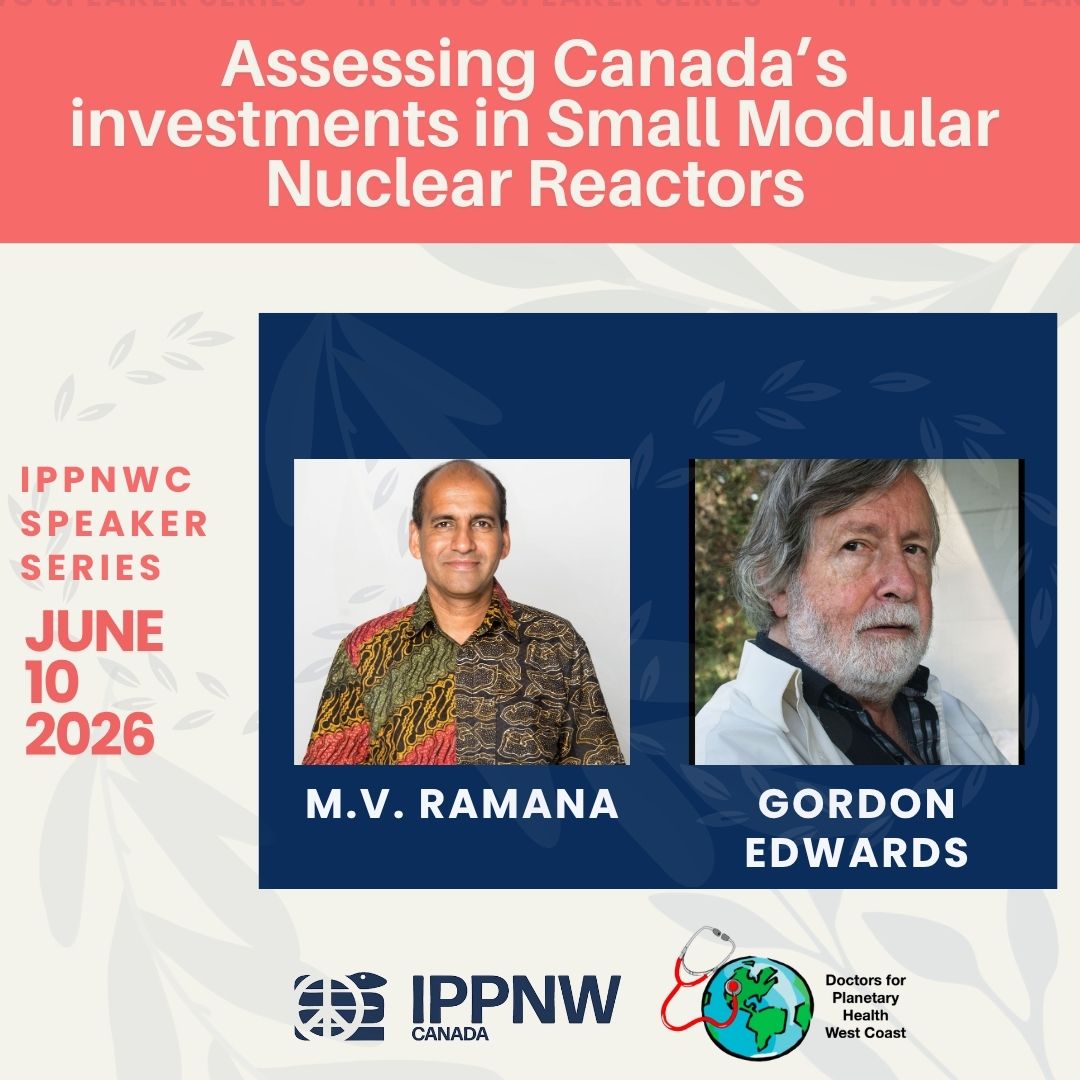
10 June – Assessing Canada’s Investments in Small Modular Nuclear Reactors – https://zoom.us/meeting/register/IiqHA5feRhaEBycOLNTJlA#/registration


Cuba Is Not a Failed State – It Is a Besieged State
PETITION: “Global Appeal to Endorse Palestinian Right of Return of Refugees”
To see nuclear-related stories in greater depth and intensity – go to https://nuclearinformation.wordpress.com
-
Archives
- June 2026 (89)
- May 2026 (306)
- April 2026 (356)
- March 2026 (251)
- February 2026 (268)
- January 2026 (308)
- December 2025 (358)
- November 2025 (359)
- October 2025 (376)
- September 2025 (257)
- August 2025 (319)
- July 2025 (230)
-
Categories
- 1
- 1 NUCLEAR ISSUES
- business and costs
- climate change
- culture and arts
- ENERGY
- environment
- health
- history
- indigenous issues
- Legal
- marketing of nuclear
- media
- opposition to nuclear
- PERSONAL STORIES
- politics
- politics international
- Religion and ethics
- safety
- secrets,lies and civil liberties
- spinbuster
- technology
- Uranium
- wastes
- weapons and war
- Women
- 2 WORLD
- ACTION
- AFRICA
- Atrocities
- AUSTRALIA
- Christina's notes
- Christina's themes
- culture and arts
- Events
- Fuk 2022
- Fuk 2023
- Fukushima 2017
- Fukushima 2018
- fukushima 2019
- Fukushima 2020
- Fukushima 2021
- general
- global warming
- Humour (God we need it)
- Nuclear
- RARE EARTHS
- Reference
- resources – print
- Resources -audiovicual
- Weekly Newsletter
- World
- World Nuclear
- YouTube
-
RSS
Entries RSS
Comments RSS
 nuclear-news