Revealed: USAID, National Endowment for Democracy & Open Society Quietly Bankroll Cuba’s “Independent” Media In Push for Regime Change

All this, however, pales in comparison to the resources the U.S. has dedicated to Radio and TV Martí. Founded in 1985 by the Reagan administration, the Miami-based network boasts dozens of full-time employees and receives tens of millions of dollars from Washington annually.
Anti-government media are only a small portion of the huge array of groups Washington secretly funds and supports. From musicians and academics, to civil society, educational, and religious groups, to think tanks, charities and NGOs, there exists a vast nexus of organizations receiving vast sums of money from the U.S. government.
Alan Macleod, 6 June 26, https://www.mintpressnews.com/revealed-usaid-ned-open-society-quietly-bankroll-cubas-independent-media-in-push-for-regime-change/290942/
Amid escalating U.S. aggression towards the Cuban island through a maximum pressure campaign and the threat of military intervention, the United States government has been covertly funding a huge network of Cuban media outlets that claim to be independent in a push for regime change against the independent socialist government.
These outlets present themselves as unbiased investigative journalism, but are quietly being financed by Washington through USAID, the National Endowment for Democracy and the Open Society Foundation in order to sow discontent across the Caribbean nation, softening it up for a potentially “imminent” invasion by the Trump administration.
Cuba faces some of its worst energy blackouts in its history, thanks to the U.S. blockade, which is attempting to strange the island into submission. As a Communist state defying U.S. orders, Cuba has, since 1959, been in the crosshairs of Washington, who are attempting to overthrow the government. MintPress sheds light on this shady regime change nexus.
CubaNet is one of the most influential and well-established news outlets covering affairs on the Caribbean island. Founded by anti-government activists in 1994, the site has become the go-to source of information for corporate media, who regularly cite it, and present it as an objective and unbiased independent media (e.g., The Washington Post, The Wall Street Journal, Fox News, and The Los Angeles Times). CubaNet reporters have written op-eds in major U.S. newspapers such as USA Today, calling for an immediate change in government on the island.
‘Independent Journalism,’ Brought To You By The U.S. State Department
But CubaNet is not as independent as it seems. The outlet is bankrolled by the U.S. national security state. CubaNet has received millions of dollars in funding from USAID and the National Endowment for Democracy, as well as the Open Society Foundation.
One currently active $500,000 USAID grant, for instance, was awarded to CubaNet to “engage on-island young Cubans through objective and uncensored multimedia journalism.” While ostensibly a laudable goal, even the grant’s own one-sentence description hints that its purpose is to undermine and attack the Cuban government. It states that it will (emphasis added) “increase the free flow of information to and from Cuba in order to offset the regime’s disinformation campaigns.”
Another news organization receiving huge sums of money from Washington is ADN Cuba. Literally meaning “Cuba’s DNA,” the outlet has amassed a significant following online, boasting over 100,000 subscribers on YouTube, over 200,000 on Instagram, and over 1.3 million on Facebook. It describes itself as “an independent media outlet committed to freedom and democracy in Cuba.” Yet it is actually based in Spain. And it does not seem particularly committed to transparency about its funding.
What is clear, however, is that ADN Cuba has received millions of dollars from the U.S. national security state. In September 2024, USAID approved a $1.1 million grant to ADN Cuba – a gigantic amount of money for an organization that publishes barely one story per day on its website. This was on top of a $1.5 million allocation for the 2022-2024 period. Indeed, since 2020, ADN Cuba has received in excess of $3 million from USAID alone. This relationship is not disclosed to readers– even in stories directly covering USAID funding Cuban media– and is relegated to the footnotes of obscure U.S. government funding databases.
Diario de Cuba is another Spanish-based news outlet that publishes a wide variety of stories, all with one thing in common: a deep aversion to the Cuban government. The BBC describes it and CubaNet as key sources for impartial news, run by journalists who “report without censorship and to paint a broader picture on the country’s reality.”
And just like CubaNet, Diario de Cuba has received seven-figure funding from Washington. Between 2016 and 2020, Diario de Cuba received $1.3 million in USAID cash – almost as much as CubaNet over the same period. This generous funding has allowed it to reach a global audience, with over 600,000 followers on Facebook alone.
Regime Change Networks
Read more: Revealed: USAID, National Endowment for Democracy & Open Society Quietly Bankroll Cuba’s “Independent” Media In Push for Regime ChangeThe Central Intelligence Agency used to directly (and secretly) sponsor hundreds of media outlets across the world. However, after a series of scandals and more information about its nefarious activities came to public attention, Washington decided to outsource many of its most controversial foreign operations to organizations such as the National Endowment for Democracy and the U.S. Agency for International Development.
“It would be terrible for democratic groups around the world to be seen as subsidized by the CIA,” Carl Gershman, the NED’s longtime president, said, explaining the 1983 decision to create his organization. NED co-founder Allen Weinstein agreed: “A lot of what we do today was done covertly 25 years ago by the CIA,” he told The Washington Post.
Under the guise of democracy promotion and human rights, the U.S. government channels money to political and social groups across the world in order to maximize its strategic goals, including regime change.
In recent years, the U.S. has used the twin organizations of the NED and USAID to bankroll anti-government protests in Hong Kong, to attempt a color revolution in Belarus, to overthrow the government of Ukraine in 2014, and to organize riots across Iran earlier this year.
In Cuba, the NED and USAID played a critical role in organizing a (failed) uprising against the government in 2021. USAID in particular spent millions of dollars funding, organizing and promoting the San Isidro Movement – a collective of musicians, artists, and journalists– to lead a counter-revolution on the island.
San Isidro members were at the forefront of a wave of nationwide protests that July. The demonstrations were immediately signal boosted by Western corporate media, top celebrities, and U.S. politicians, including President Biden. Neitzens were flooded with the astroturfed “SOS Cuba” campaign, that trended across the Internet for days.
In the end, however, the coordinated efforts of the U.S. failed to convince ordinary Cubans to take to the streets, and the movement quickly petered out.
Esteban Rodríguez, a key member of the San Isidro movement, is a producer at ADN Cuba.
When U.S. Money Is Paused, “Independent” Media Immediately Collapse
The importance of U.S. government money to the survival and operations of these outlets was underlined early last year when the Trump administration chose to freeze funding to USAID and the NED. Announcing the decision, Elon Musk, then head of the Department of Government Efficiency, described USAID in particular as a “viper’s nest of radical-left Marxists who hate America.”
The effect on Cuban media was immediate. As soon as the money stopped flowing, dozens of organizations faced immediate liquidation. CubaNet published an emergency editorial asking readers to make up the shortfall. “We are facing an unexpected challenge: the suspension of key funding that sustained part of our work.” they wrote; “If you value our work and believe in keeping the truth alive, we ask for your support.” “Without [USAID] funds, it will be extremely difficult to continue,” CubaNet director Roberto Hechavarría Pilia added.
Diario de Cuba was in similarly dire straits. Its director, Pablo Díaz Espí, noted that “aid to independent journalism from the government of the United States has been suspended, which makes our work more difficult,” asking readers to donate.
Musk’s decision accidentally revealed a sprawling network of over 6,200 reporters and nearly 1,000 outlets worldwide that were quietly being trained, supported, and bankrolled by the CIA front, all under the banner of promoting “independent” media and freedom of information.
Another supposedly independent Cuban outlet plunged into crisis was El Toque (The Touch). Founded in 2014 and receiving hundreds of thousands of dollars from the NED, El Toque publishes in Spanish and English, and attempts to manipulate the exchange rates in Cuba.
The funding cut hit them badly, with editors announcing that they would immediately have to lay off half their staff (15 people) and stop working with dozens of freelancers, while looking for alternative funding sources.
El Estornudo (The Sneeze), is also generously financed by NED. In 2021 alone, the endowment awarded the investigative journalism outlet $180,000. It also receives copious support from the Open Society Foundation, although it insists that none of this U.S. money comes with any strings attached or affects its output.
While Western media often portray the Cuban media landscape as a David-and-Goliath fight between plucky independent media facing repression, and a sprawling state-sponsored propaganda apparatus, the gigantic sums handed out to these “underdogs” make them by far and away the best funded outlets on the island. A 2023 Guardian article, for instance, profiled 24-year-old photojournalist Pedro Sosa, who worked for both El Toque and El Estornudo. It presented the pair as “offer[ing] real reporting over stodgy state media” and journalists as poor and vulnerable truth tellers standing up for “freedom,” and facing a “crackdown” from the state.
But it also let slip that working for U.S.-backed media is not as bad a career move as portrayed, and is, in fact, an extremely lucrative profession. It casually mentions that salaries at tiny El Toque are ten times that of even the most senior journalists working in Cuban state media. In reality, then, these oppressed free speech warriors are actually some of the richest individuals on the entire island, thanks to the power of the U.S. dollar, which pays them handsomely to produce a constant stream of anti-government news.
In the end, the U.S.-backed outlets need not have worried, and NED and USAID funding resumed after some restructuring.
Jobs For the Boys
All this, however, pales in comparison to the resources the U.S. has dedicated to Radio and TV Martí. Founded in 1985 by the Reagan administration, the Miami-based network boasts dozens of full-time employees and receives tens of millions of dollars from Washington annually.
Unlike the rest of the journalism industry, workers at Radio and TV Martí enjoy strong job security and six-figure wages, despite the fact that the Cuban government is able to jam and block many of their broadcasts from reaching Cuba, meaning precious few people consume its content.
Since its creation, Washington has spent at least $800 million on Radio and TV Martí.
The outlets profiled make up only a small portion of the network of anti-government media being funded by the United States. Most of the recipients of American money remain anonymous – a decision taken in part to hide their identities and preserve their credibility inside Cuba.
The National Endowment for Democracy considers Cuba a “long-standing priority,” and is currently officially funding 32 separate projects on the island.
Media related grants include one $80,000 project titled “Strengthening Access to Information,” which promises to:
“[E]nhance access to information and promote critical thinking, the organization will produce daily reporting and analysis across various formats, providing independent perspectives on issues affecting citizens’ daily lives, including freedom of expression, public safety, human rights, and other pressing social concerns.”
Another $115,000 grant, titled “Expanding Access to Uncensored Media” notes that it will:
“[P]romote independent information, the organization will provide narrative journalism on censored topics, conduct investigations, and produce in-depth articles, photo essays, and opinion pieces while strengthening the media’s operational capacity.”
Thirty-one of the thirty-two projects hide the recipient’s name and identification, meaning that those groups working with the CIA cutout organization are generally only ever identified if they advertise this relationship, or, like when U.S. money was temporarily halted in 2025, they call for help.
Anti-government media are only a small portion of the huge array of groups Washington secretly funds and supports. From musicians and academics, to civil society, educational, and religious groups, to think tanks, charities and NGOs, there exists a vast nexus of organizations receiving vast sums of money from the U.S. government.
Two of these bodies include The Observatorio Cubano de Derechos Humanos (Cuban Observatory of Human Rights, or OCDH) and lawyers’ group, Cubalex.
Both groups produce reports denouncing the Cuban government, and are regularly cited as impartial authorities on human rights on the island in Western outlets, such as The New York Times, CNN, and The Washington Post. But what readers are not told is that both organizations are bankrolled by the U.S. national security state.
Records show that USAID has given almost $1.5 million to the OCDH. NED support, meanwhile, was crucial to Cubalex’s inception in 2010, and Washington continues to pay its staff wages to this day. As the company’s executive director, Laritza Diversent said last year,
“Without the support of National Endowment for Democracy, Cubalex would not have existed; to do the work we do requires resources. For 14 years, NED has been supporting us. Last October, after trying a lot of times, we [also] achieved a state Department grant.”
Thus, there is barely a corner of the anti-government Cuban opposition that has not been reached by U.S. money, either through government organizations such as the NED or USAID, or through institutions such as the Ford Foundation and Open Societies Foundation, which have historically performed a similar role in promoting American interests abroad.
Many of these groups are headquartered in South Florida, where U.S. government money is helping to subsidize thousands of jobs for the Cuban-American community. It is therefore no exaggeration to say that a significant part of Miami economy is propped by taxpayer money funding counter-revolutionary forces. Ironic, considering that conservative Cubans often vehemently object to government welfare programs in both the U.S. and Cuba.
Digital Bombardment
In 2010, a new social media and messaging app, Zunzuneo, took Cuba by storm. From nowhere, it went viral, picking up tens of thousands of users – a very large number for the time on such an internet-sparse island.
None of its users, however, were aware that the platform had been secretly created by USAID in order to promote regime change. Their plan was to first provide an excellent service that would capture the market, then to slowly drip feed Cubans anti-government messaging, and finally to direct them to join “smart mobs”, aimed at triggering a color revolution.
In an effort to hide its ownership of the project, the U.S. government held a secret meeting with Twitter founder Jack Dorsey, aimed at getting him to invest in the project. It is unclear to what extent, if any, Dorsey helped, as he has declined to speak on the matter.
Zunzuneo was abruptly shut down in 2012, perhaps because the Office of Cuba Broadcasting (which oversees TV and Radio Marti) had already created a new program called Piramideo.
Piramideo marketed itself as an app that allowed Cubans to receive world news for free, and without censorship. Almost immediately, however, locals reported being deluged with fake news about anti-government protests that never happened. Piramideo was shut down in 2015, after reporting on U.S. government meddling in Cuba caused a scandal and diplomatic embarrassment.
Today, however, with Cubans increasingly using American social media apps, this kind of subterfuge is largely unnecessary, as it can be done out in the open. During the 2021 San Isidro protests, apps such as Instagram and Twitter were openly participating in the attempt to overthrow the government, taking no action against a massive boom of clearly fake bot accounts parroting the exact same messages (down to the typos) and using the same astroturfed hashtag. Twitter’s editorial team even placed the protests – which drew barely a few thousand people into the streets nationwide – at the top of its “What’s Happening” for over 24 hours, meaning that every user worldwide would be notified. The failed putsch has come to be known as the “Bay of Tweets.”
Unending War on Cuba
In October, for the 33rd consecutive year, the United Nations voted overwhelmingly (165-7) to call for an end to the American blockade against Cuba. This economic war was established by the Eisenhower administration, in response to the Cuban Revolution of 1959, which overthrew the U.S.-backed dictator, Fulgencio Batista.
These illegal unilateral coercive measures, which an internal U.S. government memo states are designed to “decrease monetary and real wages, to bring about hunger, desperation and overthrow of government,” cost Cuba billions every year, and severely impede its development.
The U.S. attempted to invade Cuba in 1961, and brought the world to the brink of annihilation during the subsequent Cuban missile crisis. It reportedly attempted to kill its leader Fidel Castro hundreds of times, and carried out waves of terror attacks against the country, including using biological weapons on the island.
Successive administrations continued the economic war against Cuba, which was ramped up after the fall of the Soviet Union. But the Trump State Department, run by Cuban-American Marco Rubio, has taken it to a new level, declaring the island to be one of its top priorities.
Trump himself has declared that Cuba is “next” on the list of countries being targeted for regime change. “We may stop by Cuba after we’re finished” with Iran he said last month.
In response, Cuban president Miguel Díaz-Canel said his country was ready to repel any U.S. invasion, as it did during the Bay of Pigs, stating:
“The moment is extremely challenging and calls upon us once again, as on April 16, 1961, to be ready to confront serious threats, including military aggression. We do not want it, but it is our duty to prepare to avoid it and, if it becomes inevitable, to defeat it.”
It is in this context that the U.S. government’s funding of a vast array of media outlets targeting Cuba should be seen; the media attack is just one facet of Washington’s multipronged approach to regime change.
Many of the organizations profiled here publish in English, and nearly all are used as supposedly credible sources of information on Cuba for Western corporate media, meaning that U.S. State Department narratives are laundered into the public consciousness through this network.
Many Cubans and Americans are completely unaware that their news about the island comes largely through a matrix of shady outlets quietly funded by the U.S. national security state via the NED and USAID. Their purpose is to keep up the flow of negative stories in order to soften the public up into accepting regime change on the island. After all, in war, truth is always the first casualty.
Alan MacLeod is Senior Staff Writer for MintPress News. He completed his PhD in 2017 and has since authored two acclaimed books: Bad News From Venezuela: Twenty Years of Fake News and Misreporting and Propaganda in the Information Age: Still Manufacturing Consent, as well as a number of academic articles. He has also contributed to FAIR.org, The Guardian, Salon, The Grayzone, Jacobin Magazine, and Common Dreams. Follow Alan on Twitter for more of his work and commentary: @AlanRMacLeod.
 Republish our stories! MintPress News is licensed under a Creative Commons Attribution-NonCommercial-ShareAlike 3.0 International License.
3 CommentsMay 15th, 2026

Alan Macleod
What’s Hot
Hezbollah’s Cheap FPV Drones Are Making Israel’s High-Tech Military Obsolete
The Battle for Bint Jbeil: Israel Revisits A Symbolic Defeat As Resistance Holds The Line
Iranian Jewish Association Describe Israel as “Ominous Zionist Regime” After Israeli Strikes Destroy Historic Synagogue on Passover
US & Israel Bomb 307+ Medical Facilities in Iran Carrying on Long Tradition of Targeting Medical Workers
Hezbollah Destroys 50 Israeli Merkava Tanks in Three Weeks As Israel Fails to Occupy South Lebanon
The Israelization of the United States Military Is Proceeding. “Where and How Will it All End? Ask Donald Trump!”

A persistently pro-Zionist Congress has accomplished this shift in the relationship quietly, almost secretly. Though it has been done clearly channeling through the White House and Netanyahu’s leadership, it has been obtained without the knowledge and consent of the American people to whom the US government is allegedly responsible. And, of course, all the integration expenses will be borne by the US taxpayer.
By Philip Giraldi, Global Research, June 02, 2026, https://www.globalresearch.ca/israelization-united-states-military/5928401
Thank You Congress and President Trump!
Few Americans know the history of how Israel’s “wag the dog” relationship with the United States developed.
Israel’s 1967 successful war against its neighbors demonstrated to military planners in Washington how a qualitative edge in weapons could enable a small country to resist much larger and seemingly more powerful adversaries. Israel was largely supplied with French weapons at the time that reportedly out-performed the Russian equipment in the hands of Syria and Egypt.
As a consequence, in 1968, with strong support from a heavily lobbied Congress, Zionist influenced US President Lyndon B Johnson approved the hitherto blocked sale of F-4 Phantom fighters to Israel, establishing the precedent for continuing US support of Israel’s Qualitative Military Edge, generally referred to by the acronym QME, over its Arab and Christian neighbors.
Five years later, in the aftermath of the 1973 Yom Kippur War, the United States and Israel came to an understanding whereby they tacitly adopted the doctrine of active US maintenance of Israel’s QME. After that war, the United States also quadrupled its foreign aid to Israel, effectively replacing France as Israel’s largest arms supplier.
This de facto commitment to maintaining Israel’s qualitative edge was subsequently made explicit by President Ronald Reagan and has been confirmed by every US administration since that time. Substantial supplementary weapons shipments under Presidents Barack Obama, Joe Biden and Donald Trump have even supported Israel’s genocide in Gaza and its attacks on non-threatening Syria and Lebanon. This policy was in part justified initially based on a US adoption of the Cold War strategy of opposing Arab client states of the Soviet Union and was also due to the growing power of Israel’s US Lobby. Today, Israel is by far the largest recipient of US foreign military aid, receiving $3 billion per year guaranteed plus many extra weapons in support of specific needs and initiatives which many have linked to the enablement of a policy of systematic aggression by Israel and the commission of war crimes.
So what was once seen as a form of security guarantee for Israel has now become a monster, with Israel using the support provided by the relationship to initiate wars against its neighbors, to include most recently Lebanon, Syria and Iran. The White House and Congress have invariably supplied Israel with all the weapons it seeks as well as providing money for its economy and political support in international organizations like the United Nations. Israel’s Lobby, regarded as the most powerful foreign policy lobby deployed against Congress and the White House, has used its access to power to constantly expand its role in weapons development to satisfy what Israel sees as threats against it. And Prime Minister Benjamin Netanyahu has become the dominant partner in the relationship, including regarding the decision making about war and peace.
Currently Israel and its friends in Washington are moving to complete integration of many aspects of how our military operates at various levels with Israeli counterparts. No other US “ally,” which the Jewish state is not technically, including NATO members, has anything like this access and ability to influence developments.
Those who think Israel has too much power have a point as it is even strong enough to shut down First Amendment Freedom of Speech, both by suppressing or even criminalizing what it regards as criticism of itself. Few Americans are aware that even though Israel is widely known to be a major nuclear weapons power, members of the US government are not allowed to state that that is the case because it would embarrass the Jewish state and plausibly trigger legal restrictions on the weapons that the US could supply it with. And the irony is that Israel only has the weapons because it stole the nuclear fuel and timers from the United States. President John F Kennedy tried to stop the nuclear weapons program and many believe he was assassinated by Israel as a result!
And the one-way street benefitting Israel gets worse! Per the story that I reported recently, Congress is considering passing a bill that will give Americans serving in the Israeli army US government provided full benefits like education, jobs and medical care just as if they had been serving in the United States military. Indeed, the legislation currently working its way through Congress would, for the first time in American history, treat service in a foreign army both legally and in practice as equivalent to service in the US armed forces — but only where that foreign army is Israeli. House Resolution 8445, sponsored by Republican Congressmen Guy Reschenthaler of Pennsylvania and Max Miller of Ohio, would amend existing legislation so that Americans who enlist in the Israel Defense Force (IDF) are treated “in the same manner as service in the uniformed services” of the US. Not surprisingly, many of the “Americans” involved are also dual national Israeli citizens. If the changes come into effect the result will be to considerably and uniquely narrow the gap between Israel and the US in terms of rights and benefits but with benefits going only in one direction, i.e. to serve Israeli interests and with the US taxpayer paying the bill!
In addition to that, the most recent US government gift to Israel sponsored by the United States House of Representatives, a misnomer as the House is actually the Knesset West, is the national Defense Authorization Act (NDAA) for 2027 released on May 13th. Section 224 of the House version of the Act entitled “United States-Israel Defense Technology Cooperation Initiative” integrates “US-Israeli military research and development, co-production of weapons systems, licensing agreements, AI, directed energy, data integration, and missile defense.” It creates the framework for “bilateral research and development, co-production of weapons, joint ventures, licensing agreements, and seemingly every manner of US-Israeli military-industrial complex cooperation.”
The result is to completely connect the functionality of the US military with that of the Israeli military. The implementation of the agreement would arguably do more to irreversibly link the US military to the Israeli military than the $200 billion in military assistance Israel has received from the United States since its founding in 1948.
Critics note how Section 224 would combine the US and Israeli defense sectors in many areas particularly vital to the battlefields of the future, including autonomous systems and cyberwarfare. It would also greatly increase Israeli influence over the US beyond what it already has through the Israel Lobby and its dominance of the mainstream media. It would enable Israel to expand or start new co-production facilities like it already has in a number of states, giving the Israeli government additional leverage through providing jobs in the US, thereby securing friends in Congress whose districts are affected. The result could well be a White House backed by Congress that is even more prone to go to war based on the Eretz “Greater” Israel fantasies of people like Netanyahu and his insane Security Chief Itamar Ben-Gvir.
A persistently pro-Zionist Congress has accomplished this shift in the relationship quietly, almost secretly. Though it has been done clearly channeling through the White House and Netanyahu’s leadership, it has been obtained without the knowledge and consent of the American people to whom the US government is allegedly responsible. And, of course, all the integration expenses will be borne by the US taxpayer. Interestingly, of course, it should also be noted that the integration of the US military with that of Israel comes at a time when the American public is expressing unprecedented levels of distrust in and dislike of the Israeli government. That is perhaps no coincidence as Netanyahu seeks to create unbreakable legal and administrative ties between the two countries though with little in the way of obligations on the part of Israel.
Ben Freeman at the Quincy Institute observes how
“The shift will strip away the political and diplomatic oversight mechanisms that make the relationship publicly accountable, moving it from a visible annual aid vote into the opaque machinery of defense acquisition, where oversight is limited and political accountability is minimal. The result would be a defense relationship that is simultaneously deeper and less transparent. And this all comes at a time when the Israeli military has repeatedly used U.S. weapons in strikes that have violated international humanitarian laws in Gaza, and as Israel has repeatedly violated ceasefires (as has the US itself) in the Trump administration’s unnecessary war with Iran.”
So there you have it. The United States is on a downward spiral engineered by its own government in collusion with a tiny apartheid state that specializes in crimes including torture, genocide and assorted other offenses against humanity.
Where and how will it all end?
Ask Donald Trump!
Starve, Strangle, Invade: How Washington’s Siege of Cuba Is Pushing a Nation to the Brink
What makes the situation particularly tragic, Benjamin argued, is Cuba’s long history of providing medical assistance to the world. She recalled being treated by Cuban doctors while working in Africa and noted that Cuba has trained physicians and deployed medical missions across dozens of countries. Even under severe economic constraints, Cuba has maintained a reputation for international medical solidarity that far exceeds what might be expected from a small island nation.
Yet today, she says, the country that has helped save lives around the globe is struggling to obtain the fuel and medical supplies needed to care for its own people.
June 3, 2026, Joshua Scheer, https://scheerpost.com/2026/06/03/starve-strangle-invade-how-washingtons-siege-of-cuba-is-pushing-a-nation-to-the-brink/
Medea Benjamin warns that a decades-long economic war against Cuba has escalated into what she calls a “medieval siege,” as fuel shortages cripple hospitals, food systems and daily life while U.S. officials openly discuss military options.
For more than six decades, Washington has tried to force Cuba to its knees. Today, according to peace activist Medea Benjamin, that campaign has reached a new and dangerous stage. Fuel shipments have been blocked, foreign companies threatened, humanitarian aid obstructed and military rhetoric intensified, creating what Benjamin describes as a modern-day siege designed to break the Cuban economy and the Cuban people alike.
In this wide-ranging conversation with Dr. Margaret Flowers, Benjamin argues that the crisis unfolding on the island is not the result of natural disaster or governmental incompetence, but of deliberate U.S. policy. She details how shortages of fuel have crippled transportation, disrupted hospitals, spoiled food supplies and contributed to worsening public health conditions. The goal, she says, remains largely unchanged from the earliest days of the Cold War: create enough hardship that Cubans turn against their government.
But the discussion goes beyond Cuba. Benjamin places the escalating pressure on Havana within a broader pattern of U.S. foreign policy — one that relies on sanctions, coercion and military power to maintain global influence even as that influence declines. From Venezuela and Iran to Palestine and beyond, she argues that economic warfare has become a preferred tool of empire, inflicting immense humanitarian costs while remaining largely invisible to the American public.
At a moment when reports of possible military action against Cuba are once again circulating, Benjamin issues a stark warning: what is happening in Cuba today is not simply a foreign policy dispute. It is a test of whether the United States will continue down a path of punishment, intervention and regime change, or whether ordinary people can build enough pressure to choose diplomacy, solidarity and peace instead.
For more than sixty years, the United States has sought to isolate, punish and ultimately reshape Cuba through economic warfare. Yet according to longtime peace activist and CODEPINK co-founder Medea Benjamin, what is happening today goes far beyond the familiar story of sanctions and diplomatic hostility. Speaking with Margaret Flowers on Clearing the FOG, Benjamin described a rapidly escalating campaign that she says has pushed Cuba into a humanitarian emergency while raising fears that Washington could be laying the groundwork for direct military intervention.
Benjamin did not mince words when describing current U.S. policy.
“I struggle to find the correct adjective,” she said. “It is so horrific that there’s almost no words.” What began decades ago as an attempt to create economic pressure on Cuba has, in her view, evolved into something far more extreme: a policy designed to systematically cut off every possible source of fuel, trade, investment and survival.
The consequences are visible throughout Cuban society.
According to Benjamin, the island is facing severe fuel shortages that have crippled transportation, disrupted industrial production and created rolling blackouts that affect nearly every aspect of daily life. Hospitals struggle to maintain services. Refrigerators stop working, causing food to spoil. Public transportation becomes unreliable or nonexistent. Families living in apartment buildings face interruptions in water supplies because pumps cannot operate consistently without electricity.
Perhaps most alarming, Benjamin pointed to rising infant mortality rates as evidence of a public health crisis that she believes is directly connected to the tightening blockade. Cuba once boasted one of the lowest infant mortality rates in the Western Hemisphere, often outperforming wealthier nations including the United States. That achievement, she warned, is now being undermined by shortages of medicine, medical equipment and basic necessities.
What makes the situation particularly tragic, Benjamin argued, is Cuba’s long history of providing medical assistance to the world. She recalled being treated by Cuban doctors while working in Africa and noted that Cuba has trained physicians and deployed medical missions across dozens of countries. Even under severe economic constraints, Cuba has maintained a reputation for international medical solidarity that far exceeds what might be expected from a small island nation.
Yet today, she says, the country that has helped save lives around the globe is struggling to obtain the fuel and medical supplies needed to care for its own people.
At the center of the crisis is oil.
Benjamin explained that the Trump administration has effectively declared that “not one drop of oil” should reach Cuba. Since January, she said, only a single Russian tanker has successfully delivered oil to the island, while other shipments have reportedly been pressured, delayed or canceled. Countries that might normally assist Cuba have faced threats of sanctions, tariffs or other forms of retaliation from Washington.
The blockade’s reach extends beyond governments. New sanctions target foreign companies operating in key Cuban sectors such as energy and mining. Benjamin cited the example of a Canadian company that had worked in Cuba for decades but is now severing ties under mounting U.S. pressure. The strategy, she argued, is designed not merely to isolate Cuba economically but to make normal commerce virtually impossible.
China has attempted to provide assistance, sending rice and helping construct solar energy projects, while solidarity groups continue delivering humanitarian aid. But Benjamin stressed that food aid alone cannot solve the crisis. Without sufficient fuel, transportation networks collapse, power grids remain unstable and basic economic activity becomes impossible.
The contradiction at the heart of U.S. policy became especially clear when Flowers asked about Washington’s proposal to provide roughly $100 million in assistance to Cuba through selected organizations.
Benjamin called the offer deeply hypocritical.
The economic damage caused by sanctions, she argued, amounts to billions of dollars annually. Offering a fraction of that amount while continuing the policies responsible for the suffering is akin to creating a crisis and then presenting oneself as the rescuer. She noted that Cuban officials estimated the proposed aid represented only a tiny portion of what sanctions cost the country.
While humanitarian groups continue delivering food and medicine under limited exemptions to U.S. sanctions, Benjamin warned that aid alone cannot address the scale of the crisis. Organizations including CODEPINK, Global Exchange, Global Health Partners and others have mobilized delegations and donations, but they are attempting to fill a gap created by a policy that deliberately restricts Cuba’s access to international trade and finance.
More troubling still is the growing discussion of military action.
Benjamin pointed to reports that U.S. military assets have been repositioned in the Caribbean and that officials connected to Southern Command have indicated preparations exist for a possible operation against Cuba. While she acknowledged uncertainty about whether Washington intends a full-scale invasion, targeted regime-change operation or continued economic strangulation, she argued that the rhetoric itself creates instability and fear.
She believes advocates of regime change are hoping that worsening conditions will eventually provoke unrest and political upheaval on the island.
The recent U.S. indictment of Raul Castro, now 94 years old, further fuels those concerns. Benjamin argued that reviving a decades-old case involving the “Brothers to the Rescue” aircraft serves less as a legal action than as a political pretext. She compared it to earlier efforts to criminalize leaders in other targeted countries before pursuing broader interventionist objectives.
The larger issue, however, extends far beyond Cuba.
Throughout the interview, Benjamin repeatedly returned to a theme that has defined much of her activism: the connection between U.S. foreign policy and domestic inequality.
America’s military spending, she argued, continues to grow even as political leaders claim there is insufficient money for healthcare, affordable housing, education and other public needs. She pointed to a Pentagon budget that now exceeds one trillion dollars annually and questioned why basic social investments remain politically impossible while military expenditures expand almost without debate.
Benjamin also linked foreign intervention to migration, surveillance, policing and the erosion of civil liberties at home. The consequences of empire, she suggested, do not remain overseas. They eventually return to shape life inside the United States itself.
Yet despite her grim assessment of current events, Benjamin ended on a note of cautious optimism.
She argued that the global balance of power is shifting. Countries across the Global South are developing alternatives to U.S. dominance through new economic partnerships and institutions. China, BRICS nations and other emerging centers of influence are creating a world that is increasingly multipolar, reducing Washington’s ability to dictate outcomes unilaterally.
At home, Benjamin believes ordinary people must build new forms of solidarity and political engagement. She highlighted the “Summer of Peace and Love” initiative, which seeks to create community spaces for organizing, education, mutual aid and antiwar activism. Drawing inspiration from movements such as Occupy Wall Street, she argued that people need opportunities not only to protest existing systems but to model alternatives rooted in cooperation and democracy.
As the interview concluded, Benjamin delivered a straightforward message: Americans who oppose military escalation should pressure Congress to support measures that would block any invasion of Cuba and reject another chapter of interventionist foreign policy.
Whether one agrees with her analysis or not, the warning she offers is unmistakable. Cuba is not simply facing another round of sanctions. According to Benjamin, the island is confronting a coordinated campaign of economic suffocation whose human costs are already being measured in shortages, blackouts, deteriorating health conditions and growing uncertainty about what comes next. In a world already scarred by war and confrontation, she argues that the last thing the Caribbean needs is another conflict manufactured in Washington.
Nuclear Startups Are in “Advanced Negotiations” to Buy Cold War Plutonium
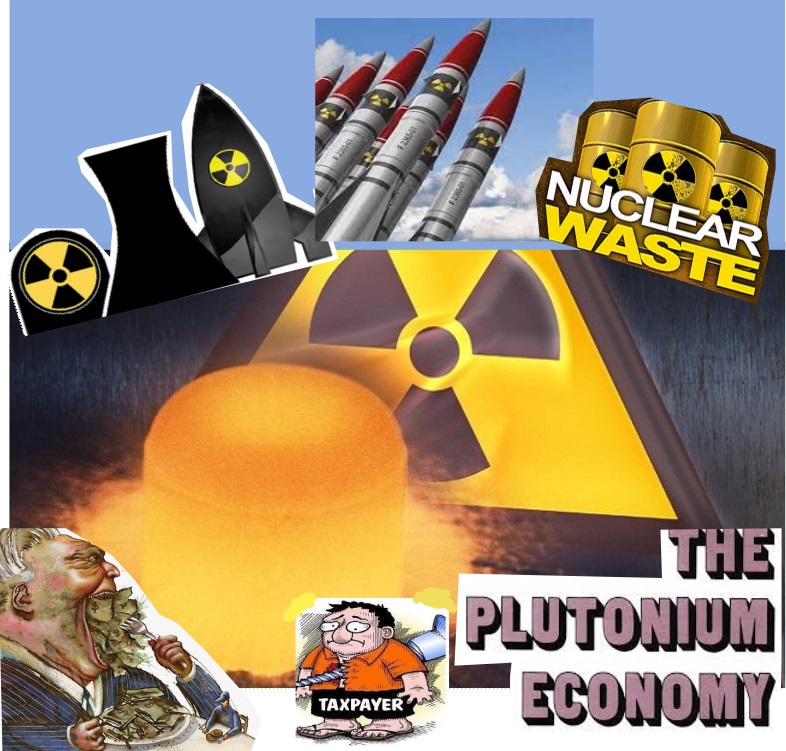
While it seems like a win-win for nuclear waste cleanup and clean energy development in the United States, some critics are concerned about safety and security implications of the deal. Currently, this highly dangerous, weapons-grade material is kept in a highly regulated and secure environment. Selling it to energy companies would significantly compromise oversight. “The plan has generated debate and some unease among nonproliferation experts,” the New York Times reports. “If finalized, it would mark the first time the U.S. government has made weapons-grade plutonium available to private companies.”
By Haley Zaremba – Jun 03, 2026, https://oilprice.com/Alternative-Energy/Nuclear-Power/Nuclear-Startups-Are-in-Advanced-Negotiations-to-Buy-Cold-War-Plutonium.html
- The Trump administration is in “advanced negotiations” with nuclear startups, including Oklo, to convert more than 50 tons of weapons-grade plutonium into commercial reactor fuel — the first time the U.S. government would make such material available to private companies.
- The move is framed as a fix for a critical nuclear fuel supply chain bottleneck, with Russia controlling roughly half of global uranium conversion capacity and squeezing Western reactor development.
- Nonproliferation experts are raising safety and security concerns, warning that moving weapons-grade material out of tightly controlled government facilities significantly reduces oversight.
As nuclear energy regains favor around the globe, competition for nuclear fuel is heating up. In an era of multiple and compounding energy crises driven by conflict, climate, and the power-hungry artificial intelligence boom, nuclear has resurfaced as a highly strategic option for building up energy security and independence for many nations around the world. But nuclear fuels supply chains are highly concentrated, and many of them are controlled by Russia, presenting critical geopolitical tradeoffs.
Today, there are only five plants in the world that operate large-scale uranium conversion, and half of that capacity is in the hands of the Kremlin, resulting in a critical resource bottleneck and geopolitical pain points. Accordingly, “U.S. nuclear energy faces fuel supply chain vulnerabilities, with tight uranium supplies, geopolitical risks, and rising costs threatening both existing reactors costs and advanced reactor development,” according to a January report from Stanford Energy.
It is therefore in the United States’ strategic interest to build up alternative nuclear fuel supply chains, preferably home- and friend-shored ones. But it’s a little late for the United States to get a foothold in alternative uranium markets, as Russia and China, which never saw a decline in their respective nuclear sectors, have already been cornering them for years.
“Russian and Chinese players have been very keen to secure access to resources in central Asia and Africa, creating a very aggressive competitive environment,” Benjamin Godwin at Prism Strategic Intelligence told the Financial Times last year.
The United States is taking steps to build up its own uranium supply chains, as the country is home to plentiful natural reserves of the 92nd element. But the country is also home to another vast reserve of nuclear fuel that is far more readily accessible — decades of stockpiled nuclear waste. Research into recycling spent nuclear fuel indicates that resource utilization could be boosted by a jaw-dropping 95 percent.
“Used nuclear fuel is an incredible untapped resource in the United States,” Assistant Secretary for Nuclear Energy Ted Garrish told World Nuclear News back in February. “The Trump Administration is taking a common-sense approach to making sure we’re using our resources in the most efficient ways possible to secure American energy independence and fuel our economic growth.”
And now the Trump administration is looking to a new, and significantly more controversial, source of recycled nuclear fuel — cold-war era nuclear warheads. The government wants to convert weapons-grade plutonium into viable nuclear fuel as part of the Trump administration’s aim to “reestablish the United States as the global leader in nuclear energy.
The United States is sitting on more than 50 tons of plutonium left behind by nuclear weapons programs. The Department of Energy had previously planned to dilute and bury the hazardous material, but the Trump administration wants to give it new life in nuclear reactors and has entered into “advanced negotiations” with a handful of nuclear startups to begin the process of selling the plutonium for use as nuclear fuel.
“A lack of fuel is one of the biggest choke points in expanding nuclear power right now,” said Jacob DeWitte, the chief executive of Oklo, one of the companies in conversation with the Trump administration about acquiring plutonium to power its next-gen small nuclear reactors. “This will help us get more nuclear power online faster.”
While it seems like a win-win for nuclear waste cleanup and clean energy development in the United States, some critics are concerned about safety and security implications of the deal. Currently, this highly dangerous, weapons-grade material is kept in a highly regulated and secure environment. Selling it to energy companies would significantly compromise oversight. “The plan has generated debate and some unease among nonproliferation experts,” the New York Times reports. “If finalized, it would mark the first time the U.S. government has made weapons-grade plutonium available to private companies.”
The Disappearing Aid Check: The Future of US–Israel Defense Support
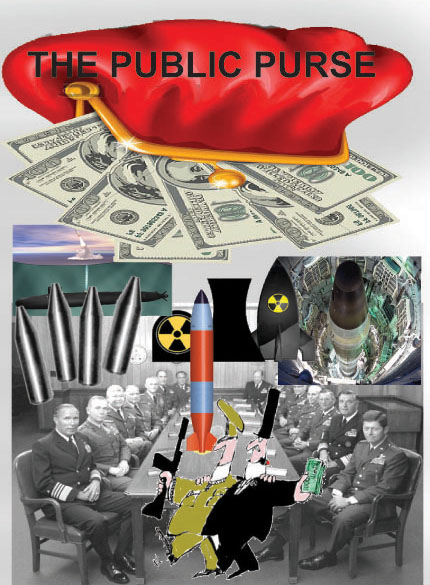
What top Israeli officials — including Prime Minister Benjamin Netanyahu — are quietly backing is not a reduction in American support, but a reorganization of it: shifting billions in resources from State Department–administered foreign aid grants into general Pentagon procurement accounts, industrial partnerships, and sustainment pipelines. The shift will strip away the political and diplomatic oversight mechanisms that make the relationship publicly accountable, moving it from a visible annual aid vote into the opaque machinery of defense acquisition, where oversight is limited and political accountability is minimal. The result would be a defense relationship that is simultaneously deeper and less transparent.
Quincy Institute for Responsible Statecraft, Steven Simon, May 26, 2026
Executive Summary
The United States and Israel are now approaching the renegotiation of their 10-year defense Memorandum of Understanding, or MOU. Israeli officials have said they want to phase out US military grant aid — a position that sounds like a step toward ending US military assistance to Israel. It is not.
What top Israeli officials — including Prime Minister Benjamin Netanyahu — are quietly backing is not a reduction in American support, but a reorganization of it: shifting billions in resources from State Department–administered foreign aid grants into general Pentagon procurement accounts, industrial partnerships, and sustainment pipelines. The shift will strip away the political and diplomatic oversight mechanisms that make the relationship publicly accountable, moving it from a visible annual aid vote into the opaque machinery of defense acquisition, where oversight is limited and political accountability is minimal. The result would be a defense relationship that is simultaneously deeper and less transparent.
Since fiscal year 2019, the United States has provided $3.3 billion per year in Foreign Military Financing, or FMF, grants to Israel, plus an additional $500 million per year for missile defense cooperation. About 25 percent of this FMF grant money has gone toward offshore procurement, or OSP, funds allocated to Israel to spend domestically on its own defense industry and military equipment. Effectively, it is a US subsidy for Israel’s military industrial complex.
This OSP precedent is slated to end with the expiration of the current MOU. This has fueled Israeli proposals to phase out FMF grants altogether, replacing them with a relationship centered on US–Israeli defense integration. This would embed Israeli firms and Israeli–origin intellectual property inside larger Pentagon programs and production. Unlike the foreign assistance process, the military procurement framework would not be subject to the political scrutiny of Congress and the State Department, but would be evaluated on bureaucratic criteria such as cost, readiness, and capability. This shift would likely be justified by reframing US support not as a handout to Israel, but as an investment in American military readiness, industrial capacity, and jobs.
At a time when the US–Israel relationship should be scrutinized in light of Israeli actions that run counter to US interests, such a structural shift would be counterproductive. To avoid this outcome, any procurement-centered relationship should meet these three basic requirements:
- Clear metrics to assess whether Israeli participation in Pentagon programs serves US defense requirements.
- Program-level transparency regarding the existence, scale, cost, and rationale of each procurement program.
- Cross-committee coordination in Congress to ensure visibility and accountability to non-military congressional oversight committees.
The current deal — and why it is running out of road
This brief explains what the shift in US aid for Israel means: where the money actually goes, who controls it, who benefits, and why the standard debate about ending aid misses the consequential change.1……………………………………………………………………………………………………………………………………………………………………
What “ending aid” actually means
…………………………………. ending aid in this context does not mean ending US financial support for Israel’s military and defense sector. It means changing the institutional form through which that support is delivered. The concept, in effect, is not to reduce support for Israel’s military; it is to shift it from the foreign-operations budget and the State Department’s oversight to the Pentagon’s procurement, research and development, industrial base, and sustainment machinery…………………………………………………………………………………………………………………
The new architecture — how money moves in a defense-industrial model
To understand what replaces the grant, it helps to understand how the Pentagon actually spends money on defense cooperation, and why that process looks so different from foreign aid…………………………………………………………………………………………………………………………………………………………………………………………………………………………………………………………………………….
Conclusion — quieter does not mean smaller
The post-2028 US–Israel defense relationship will likely be recast to reduce its political profile. The annual aid vote, one of the most predictably contentious moments in future US foreign-policy debates, may fade away, replaced by procurement decisions that attract little public attention and even less organized opposition. Israeli officials will be able to claim, accurately in formal terms, that Israel no longer receives American aid. American officials will be able to defend the spending as investment in US readiness rather than largesse to a foreign partner…………………………………………………….
For observers trying to understand US–Israel relations, the practical implication is methodological. The aid vote is no longer the right place to look. Instead, the key data will be located in the procurement budget, industrial-base investments, sustainment pipeline, IP licensing arrangements, and workshare provisions. The consequential decisions will be made in those domains.
Annex: Key terms and reference figures………………………………https://quincyinst.org/research/the-disappearing-aid-check-the-future-of-us-israel-defense-support/?ct=t(EMAIL_CAMPAIGN_1_21_2025_13_26_COPY_01)&mc_cid=3131e3a216#h-annex-key-terms-and-reference-figures
Trump blasts Netanyahu as Iran Talks Stall over Beirut
Juan Cole, 06/02/2026, https://www.juancole.com/2026/06/blasts-netanyahu-beirut.html
Ann Arbor (Informed Comment) – Monday began with a statement issued by the Iranian Ministry of Foreign Affairs cautioning that the United States and Israel, by their egregious violations of the ceasefire concluded on April 8, are jeopardizing the ongoing talks aimed at achieving an armistice. The ministry, which is headed by Abbas Araghchi, underlined that the ceasefire involved a cessation of hostilities on all fronts.
The ministry accused the United States of repeatedly violating the ceasefire by its attacks on commercial Iranian shipping. Moreover, it said, Israel has grossly violated the ceasefire by launching a vicious attack on Lebanon, violating its sovereignty and killing or wounding thousands of Lebanese and displacing two million, while destroying essential infrastructure.
The ministry said that the US has a direct responsibility to cease attacking Iranian shipping and an indirect responsibility to rein in the Israel atrocities, warning that Iran will take measures to act in self-defense to ensure its interests.
The Tasnim news agency, which is close to the Iranian Revolutionary Guards Corps, reported that these violations of the ceasefire, especially the Israeli invasion and devastation of south Lebanon, had led the Iranian side to cease all talks and the exchange of texts through mediators.
The agency said that the Iranian government insists on the end of Israeli operations in Gaza and Lebanon and its complete withdrawal from Lebanon. Otherwise there will be no further dialogue with the United States.
Moreover, the report said, Iran is determined to block the Strait of Hormuz completely, and to activate further fronts, including the Bab al-Mandeb or “Strait of Tears” at the mouth of the Red Sea. The Red Sea has been an alternative route for shipping, including of oil and gas, given the closure of the Persian Gulf.
The official status of these threats is unclear, according to BBC Monitoring .
Israel has sent troops deep into Lebanon and has expelled some 275,000 people from the metropolitan area of the coastal city of Tyre in the south, making threats to level the suburbs of Beirut where Shia Muslims predominate and to bomb the Lebanese capital. Hezbollah has continued to fight back against the Israeli invasion, showering northern Israel with rockets and sometimes managing to kill or wound Israeli troops and to take out Merkava tanks.
Asked about these reports of a halt to negotiations by CNBC’s Eamon Javers, President Donald J. Trump replied , “I don’t care if they’re over, honestly.” In case the message wasn’t clear, he repeated, “I really don’t care. I couldn’t care less.” He complained that the talks had “started to get very boring.”
Trump attempted to intervene in reality by Tweet, saying he would ask Israeli Prime Minister Benjamin Netanyahu “what’s going on with Lebanon.” He thundered, “There will be no Troops going to Beirut, and any Troops that are on their way, have already been turned back.”
He claimed to have spoken to Hezbollah indirectly, saying, “they agreed that all shooting will stop — That Israel will not attack them, and they will not attack Israel.”
Netanyahu remained defiant, boasting of having taken the Crusader castle Beaufort and threatening, “if Hezbollah does not cease attacking our cities and citizens—Israel will attack terror targets in Beirut. This stance of ours remains unchanged. In parallel, the IDF will continue to operate as planned in southern Lebanon.”
Barak Ravid at Axios reported that according to a US official, Trump’s phone call to Netanyahu was explosive, with the American president “pissed off” about Netanyahu’s threat to bomb Beirut. Ravid reports that his source alleged Trump told the prime minister, “You’re fucking crazy. You’d be in prison if it weren’t for me. I’m saving your ass. Everybody hates you now. Everybody hates Israel because of this.”
Trump for his part insisted that the negotiations with Iran were continuing “at a rapid pace.”
Many energy analysts believe that if the closure of the Strait of Hormuz continues through the summer, by September we could see $200 a barrel petroleum and a severe global economic recession. The consequent economic crisis domestically could produce a blue wave, i.e. a big Democratic victory in the midterms, which would hobble Trump in his final two years in the White House.
Trump Finally Admits Aloud: “We Shouldn’t Have Been in Iran”
June 1, 2026 Joshua Scheer, https://scheerpost.com/2026/06/01/trump-finally-admits-aloud-we-shouldnt-have-been-in-iran/
Donald Trump may have delivered the most honest assessment of the Iran War yet — entirely by accident.
In an interview conducted not by a journalist but by his daughter-in-law on Fox News, Trump stumbled into a confession that cuts through months of White House triumphalism, media cheerleading, and endless declarations of victory. After boasting that Iran’s navy was “100% gone,” its air force was “100% gone,” and that the United States had effectively defeated the country militarily, Trump casually admitted something extraordinary:
“We should not have been in Iran.”
There it was. Buried beneath the bluster, threats, and self-congratulation was the truth opponents of the war have been shouting since the first bombs fell.
The problem is that Trump wasn’t offering a reckoning. He wasn’t acknowledging the thousands killed, the billions spent, the global economic disruption, or the dangerous precedent of launching another war based on claims that Iran was racing toward a nuclear weapon despite years of intelligence assessments saying otherwise. Instead, he delivered the admission while simultaneously threatening to “finish it off militarily” if negotiations fail.
This is the defining contradiction of American empire. Leaders admit the wars were mistakes only after they’ve launched them. They acknowledge the disasters while preparing the next escalation. Iraq was a mistake. Afghanistan was a mistake. Libya was a mistake. Yet the machinery that produced those catastrophes continues to operate exactly as designed.
Trump’s interview wasn’t merely a display of contradiction. It was a rare glimpse into a political system so detached from accountability that a president can openly admit a war should never have happened while still insisting it was necessary, successful, and ready to resume at any moment.
For the families burying loved ones, for Americans paying the bill, and for a region left smoldering in the wake of another U.S. intervention, that isn’t leadership.
It’s a confession.
Will Trump sideline Israel in order to make a deal with Iran?
Donald Trump reportedly has a deal on the table to suspend fighting and begin negotiations to end the Iran war and the resulting global economic crisis. But Israel and Iran hawks see it as a disaster and are working to undermine it. Who will win out?
Mondoweiss, By Mitchell Plitnick May 31, 2026
According to available reports, the purported agreement on a Memorandum of Understanding (MOU) between the United States and Iran to entrench the current ceasefire was ready to be signed and presented to the public, and Trump was going to retire to his “situation room” to confer with his people and announce it.
If that seemed too good to be true, it turns out it was, at least for the moment.
Eventually, Trump is going to have to decide whether to accept an MOU that will be harshly attacked by Israel and Iran hawks or resume the fighting. Choosing the former is out of character for the beleaguered president, but resuming the fighting will bury him deeper in this quagmire and will intensify the global economic crisis.
This mistrust is why Iran wants this MOU rather than a comprehensive deal. They want to move slowly, confirming American sincerity with actions, not words, every step of the way.
Trump, on the other hand, is struggling to decide what to do amid conflicting, powerful political pressures. His team has, apparently, negotiated the terms of the MOU, but he is indecisive about implementing it. These are the consequences of a weak, unqualified person in the White House.
This political quicksand that Trump continues to sink into is another in the long list of reasons why other presidents have refused to let Israel draw them into a war with Iran. Now that Iran has the upper hand, it is dictating the framework of ending the war.
Trump wanted to end it with a comprehensive deal, a grand bargain. That has been completely thwarted by Iran, which insists on a staged process to confirm American intentions after two surprise attacks. Trump’s absurd idea of expanding the Abraham Accords was a last, desperate attempt to try to come out of this debacle with a win big enough for him to claim that it was all worth it.
He made that desperate grab because the MOU, although not addressing some of the biggest issues, would include some immediate concessions to Iran that will be viewed by Trump’s allies as significant setbacks.
The concessions that have been rumored—which include funding Iran’s reconstruction, sanctions relief, and releasing frozen Iranian funds, for which he will be accused of “sending pallets of cash” to Iran, just as Trump once accused Barack Obama—are going to be attacked by Iran hawks. But for Trump, the immediate priority is reopening the Strait of Hormuz quickly and doing as much damage control as he can before the congressional elections in November.
The MOU would, according to the reports, accomplish that. Iran would allow ships to move through the Strait and would start removing impediments, such as mines, from the area, while concurrently, the U.S. would gradually lift its blockade of Iranian ports. The fighting would stop, including in Lebanon, although the specific terms of that and whether Israel would be forced to completely withdraw from southern Lebanon have not been mentioned. Iran would reiterate its long-standing pledge not to create a nuclear weapon.
Beyond that, the MOU would outline the topics for further talks that would, it is hoped, lead to a permanent peace deal. 60 days would be allotted for those talks, which would include Iran’s nuclear program, a proposed $300 billion reconstruction fund for Iran, a permanent system for managing the Strait, the lifting of sanctions, and the release of frozen Iranian assets.
Trump unintentionally confirmed much of the rumored content and limitations of the MOU:
“Iran must agree that they will never have a Nuclear Weapon or Bomb. The Hormuz Strait must be immediately open, no tolls, for unrestricted shipping traffic, in both directions. All water mines (bombs), if any, will be terminated (we have removed, through detonation, numerous such mines with our great underwater mine sweepers. Iran will complete the immediate removal and/or detonation of any mines that are left, which will not be many!). … The enriched material, sometimes referred to as “Nuclear Dust,” … will be unearthed by the United States (which, it is agreed, is the only Country, along with China, with the mechanical capability of doing so!), in close coordination and conjunction with the Islamic Republic of Iran, plus the International Atomic Energy Agency, and DESTROYED. No money will be exchanged, until further notice.”
Though the language is Trumpian, there is much to read into this message, both in its contents and its omissions.
Trump’s demand about destroying the so-called “nuclear dust” leaves open the option of Iran diluting its highly enriched uranium and agreeing to IAEA inspections going forward. That’s an Iranian proposal, which Trump is trying to own. Doubtless, Iran would be fine with him making that claim for his own political purposes.
Dilution, however, would not be good enough for Israel or its allies in Washington. Nor are they going to be happy about Trump even mentioning money. His declaration that no money will change hands “until further notice” implies that there will, eventually, be such “further notice” if the process of the MOU is followed.
It is worth noting that nowhere in any of the talk of either the immediate terms of the MOU or the framework for negotiations going forward that it would imply is there any mention at all of Iran’s missile and drone programs or its support of regional allies, which are often termed “proxies” by the media.
A disaster for Netanyahu and Iran hawks
Israeli reporter Ben Caspit, citing a “senior Israeli political source,” reports that Benjamin Netanyahu faces a political disaster if Trump ends the war.
“This time, the prime minister’s hands are tied. He is completely paralyzed and knows that he will not be able to do anything, even if the agreement signed between the United States and Iran remains the disaster he now defines it as,” an anonymous Netanyahu associate told Caspit.
That same insider also said that Netanyahu now longs for the days of Joe Biden. It is a classic case of being careful what you wish for……………………………………………………………………………………………………………………………………………………………………………………….
The next president, whomever that might be, will have the same opportunity. The terms for a permanent agreement with Iran will be clear: a workable agreement on the Strait, IAEA inspections ensuring Iran doesn’t develop a nuclear weapon, and a path forward that includes a resuscitation of the Iranian economy, and regional agreements to ensure the security of the Gulf states, including Iran.
In other words, the JCPOA, in all the dimensions Obama envisioned. All we need to get there is the same resolute determination to do the sensible thing that Obama showed when he too froze Israel out of the process so he could do something wise. https://mondoweiss.net/2026/05/will-trump-sideline-israel-is-order-to-make-a-deal-with-iran/
Congress quietly moves to integrate US and Israeli militaries

In the first step towards shifting aid further into the shadows, the House’s 2027 NDAA would all but fuse the two countries’ armed forces together
Ben Freeman, Responsible Statecraft, Fri, 29 May 2026, https://responsiblestatecraft.org/israel-us-military/
At a time when the American public is expressing unprecedented levels of distrust in the Israeli government, Congress just proposed tying the U.S. to the Israeli military more than ever before.
Buried in the House’s version of the 2027 National Defense Authorization Act (NDAA) released on Tuesday, is section 224, entitled “United States-Israel Defense Technology Cooperation Initiative.” The provision would arguably do more to intertwine the U.S. military with the Israeli military than the more than $200 billion (inflation adjusted) in military assistance Israel has received from the U.S. since its founding in 1948.
Section 224 lays the groundwork for bilateral research and development, co-production of weapons, joint ventures, licensing agreements, and seemingly every manner of U.S.-Israeli military-industrial complex cooperation. The U.S. and Israel already work together heavily on missile defense, but this provision would greatly expand coordination to seemingly every area of defense tech, including AI, quantum, autonomous systems, directed energy, cyber, biotech, and many more. It also proposes “network integration” and “data fusion.” In other words, the U.S. military’s data could soon be the Israeli military’s data.
If fully enacted, this proposal would provide a higher level of military-industrial integration than the U.S. has with any other country in the world. To be sure, the U.S. has worked closely with its NATO partners on co-production and shared supply chains, most notably via the Defence Production Action Plan. And, as the number one arms dealer in the world, the U.S. provides weapons to militaries across the globe. But that is mostly a one-way street, with the U.S. providing weapons to foreign buyers who only occasionally make parts for those weapons themselves, as in the case of the F-35’s global supply chain.
Section 224 would be a different beast entirely. It would fuse the U.S. and Israeli defense sectors in multiple areas vital to the battlefields of the future, like autonomous systems and cyber. It would also bring extraordinary Israeli influence to the U.S. beyond what it already has through the Israel lobby and its robust network of social media influencers. It would give the Israeli government the opportunity to greatly expand one of the most powerful levers of influence in U.S. politics: jobs in the U.S. By expanding or starting new co-production facilities like it already has in Mississippi and Arkansas, the Israeli government could boast of providing jobs on U.S. soil, thereby securing allies among members of Congress who represent the districts where those jobs lie.
The result could well be a U.S. political system even more susceptible to the whims of an Israeli government that seemingly has no qualms about drawing the U.S. into military conflicts in the Middle East.
This unprecedented level of U.S.-Israeli military integration stands in stark contrast to the traditional aid model of defense cooperation, in which Israel already stood out as the top recipient of U.S. military assistance. As laid out in a recent Quincy Institute brief, authored by Steven Simon, this shift from an aid model to a military integration model has troubling implications, namely:
The shift will strip away the political and diplomatic oversight mechanisms that make the relationship publicly accountable, moving it from a visible annual aid vote into the opaque machinery of defense acquisition, where oversight is limited and political accountability is minimal. The result would be a defense relationship that is simultaneously deeper and less transparent.
This all comes at a time when the Israeli military has repeatedly used U.S. weapons in strikes that have violated international humanitarian laws in Gaza, and as Israel has repeatedly violated ceasefires (as has the U.S. itself) in the Trump administration’s unnecessary war with Iran.
The enormous gulf between what most Americans want and what the president is doing when it comes to Israel and what Congress is proposing here should not be ignored. Just 30% of respondents to a New York Times/Sienna poll from mid-May believe Trump made “the right decision” to go to war with Iran, with 64% saying it was wrong. An Institute for Global Affairs poll released earlier this week dove even deeper into the American psyche when it comes to arming Israel, finding that “Just 16 percent say the United States should keep supplying Israel with weapons without new restrictions. Thirty-eight percent want to stop supplying weapons entirely, and another 24 percent want weapons conditioned on how they’re used.”
Yet, mainstream leadership in both parties remains largely pro-Israel and continues to shape the base legislative text before amendments and broader congressional debate open it to the full body, as is the case with this NDAA provision.
Though slowly, tides within both parties are shifting as more and more members speak out against the growing divide between Israel’s actions and America’s interests. For example, Sen. Chris Van Hollen (D-Md.) wrote in The New York Times on Tuesday that, “The Democratic Party has provided reflexive and unconditional support to Israeli governments, even as their actions have increasingly undermined American interests and values.” On the Republican side of the aisle, Rep. Thomas Massie (R-Ky.) and former Rep. Marjorie Taylor Green (R-Ga.) have openly decried the Israel lobby’s corrosive influence — a stance that may have, at least partially, cost both of them their seats in Congress.
What can other members of Congress who are concerned about Israel’s destabilizing actions do right now? Stop the Israeli-U.S. military-industrial merger in its tracks. Lawmakers should reject Section 224 from the NDAA to avoid deep integration with Israel’s military at a time when a growing number of Americans oppose Israel’s actions in the region.
Trump’s failed Iran war may prevent war with China
1 June 2026 AIMN Editorial, By Walt Zlotow West Suburban Peace Coalition Glen Ellyn IL, https://theaimn.net/trumps-failed-iran-war-may-prevent-war-with-china/
One possible blessing from Trump’s criminal, failed war on Iran? Trump squandered so many offensive and defensive missiles in 39 futile bombing days, he’s doesn’t have enough left to provoke war with China over Taiwan.
At his recent Chinese summit, Chinese President Xi Jinping warned Trump that a war with the US over Taiwan could erupt if the US does not tone down endless provocations over Taiwan.
But Taiwan is not the only issue provoking possible war with China. Ever since President Obama announced his ‘Pivot to Asia’ in 2011, the US national security state and military have been beating the drums about China’s growth making them America’s biggest potential enemy. Many in this cabal warn that war with China would be likely, possibly inevitable. They urged that US policy be prepared for war and build up US offensive and defensive capability for such eventuality.
But while Trump never officially pivoted back from Asia to the Middle East, his foreign policy did. By senselessly attacking Iran February 28, he set in motion the diminution of US missile stocks making war with China virtually impossible.
How diminished?
Trump squandered over 1,000 Tomahawk missiles on Iran in 39 days. It will take over 1,800 days to replace those Tomahawks in Trump’s over hyped trillion dollar weapons industry.
There’s more. Trump wasted roughly 300 THAAD interceptors and 1,000 Patriot interceptor to defend against Iranian missiles. It will take over 1,000 days to replace those at the current annual production rate for both.
More still. The US supplies Patriots to Ukraine and 17 other countries. We’ve not only run out of Patriots to supply them, we’ve had to claw some back. This will speed up Ukraine’s inevitable collapse and cause those other 17 nations to reexamine their reliance on the US for their defense.
Sensible folks in the administration and military looking at the near empty missile cupboard are telling Trump regarding possible war with China… ‘Faggedaboudit.’ That may be the only ray of hope for peace emanating from Trump’s criminal and failed Iran war.
The Big Tech Campaign to Fast Track Nuke Energy. Senators Whitehouse and Booker Take the Lead in Congress

The ADVANCE Act passed 393-13 in the House and 88-2 in the Senate, where only Markey and Sanders voted no. Both senators have repeatedly opposed building new nuclear plants due to environmental concerns, such as the ongoing absence of a long-term solution to the nation’s roughly 100,000 tons of radioactive waste.
Last May, Trump signed a series of executive orders to radically overhaul nuclear safety oversight, citing the ADVANCE Act as justification for transforming the NRC’s culture, directing the agency to approve new reactors within 18 months, and consult with DOGE on a wholesale revision of its regulations. Since then, the administration has secretly overhauled nuclear safety rules, proposed to severely cut inspections and radiation standards, exempted new reactors from environmental reviews, and triggered an exodus of 400 NRC employees since Trump took office.
CAPITOL HILL CITIZEN, By Peter Castagno, May 2026
In September 2014, a Google engineer hosted a private meeting at the company’s Mountain View headquarters. The guests included a nuclear energy investor and staff from the influential think tank Third Way.
By the end of the meeting, the small group agreed to “fund a bit of work in DC” to influence policy in favor of nuclear energy. That meeting set in motion a decade-long campaign that would transform Democratic politics on nuclear energy – and leave the regulatory framework governing atomic safety vulnerable to the most aggressive deregulatory assault in its history.
The Trump administration leveraged the bipartisan legislative architecture that Democrats helped build to gut the Nuclear Regulatory Commission. Ross Koningstein – Google’s former director emeritus of nuclear energy R&D – hosted the Mountain View gathering.
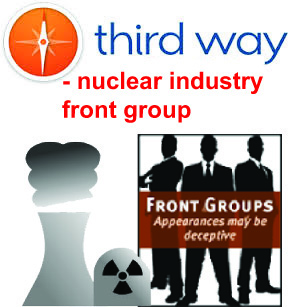
As he explained in a 2024 article, the tech giant quietly supported Third Way, the Clean Air Task Force, ClearPath and other advocacy groups for over a decade, helping lawmakers craft pro-nuclear legislation.
Third Way and its partners have since taken credit for “creating an entirely new policy discussion around advanced nuclear energy,” helping draft overhauls to nuclear policy, and working “behind the scenes” to shift Democrats’ nuclear views.
In the early years of this effort, public support for nuclear energy was at a low point. In 2016, Gallup found a majority of Americans opposed nuclear energy for the first time since it began surveying the issue in 1994. Only 34% of Democrats favored it. By 2025, that figure climbed to 46% of Democrats – a 12-point change in less than a decade.
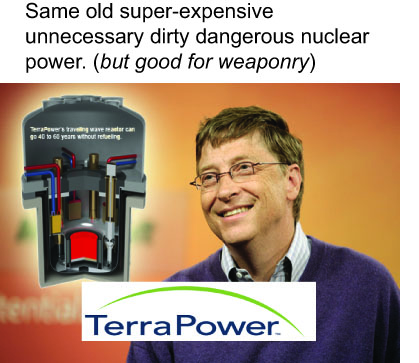
That shift coincided with a surge of Silicon Valley nuclear investment and advocacy. Jeff Navin, a lobbyist for Bill Gates’ small modular reactor (SMR) startup TerraPower, described 2015 as a pivotal year for nuclear support in Capitol Hill.
At that year’s Paris Climate Talks, Gates announced the Breakthrough Energy Coalition with co-investors including Jeff Bezos, Mark Zuckerberg and Richard Branson. Peter Thiel, another top Silicon Valley nuclear investor, published – The New Atomic Age We Need – a New York Times op-ed within the same 48-hour window.
Breakthrough Energy has since grown into a $4 billion juggernaut spanning venture capital, philanthropy, and policy advocacy, with $7.9 million in direct lobbying expenditures since 2020
Breakthrough Energy has since grown into a $4 billion juggernaut spanning venture capital, philanthropy, and policy advocacy, with $7.9 million in direct lobbying expenditures since 2020.
Taken together, Breakthrough entities and the Gates Foundation have given more than $60 million to the key pro-nuclear groups that reshaped policy, the majority since 2022.
This includes more than $20 million to Third Way, over $10 million to the Clean Air Task Force, more than $9 million to ClearPath, and nearly $4 million to the Breakthrough Institute. Laying the groundwork for Trump Third Way’s ties to Gates go beyond receiving more than $20 million from his philanthropies.
The think tank’s most recent 2024 tax filing lists lobby firm Boundary Stone Partners as its top contractor for ‘strategic consulting.’ Third Way has paid Boundary Stone Partners over $2 million since 2020, while the lobby group was simultaneously providing “comprehensive legislative and strategic support” to Gates’ nuclear firm TerraPower, which paid it $900,000 in lobby fees over the same period.
Former Office of Nuclear Energy chief of staff Andrew Richards, who led Boundary Stone Partners’ nuclear practice until March 2025, is now TerraPower’s vice president of government affairs. Jeff Navin, Boundary Stone Partner’s co-founder, has long helped coordinate Third Way’s nuclear strategy. He was Terra- Power’s director of external affairs until last April.
Navin and Josh Freed, Third Way’s energy and climate chief, approached the White House together to set up its first nuclear energy summit. Before joining Third Way, Freed was a senior advisor to the Gates Foundation. Gates has also exerted influence directly. He told Bloomberg in 2022 he had quietly lobbied elected officials including former Senator Joe Manchin, for years on federal climate policy, helping secure tax incentives for nuclear energy in the Inflation Reduction Act.
The billionaire told the former West Virginia senator that coal workers could potentially transition into building reactors for TerraPower – he donated $2,900 to Manchin in May 2022, months before the IRA’s passage. Manchin would later lead the ouster of Democrat NRC commissioner Jeff Baran, who frequently raised concerns about safety issues of experimental SMRs like TerraPower.
TerraPower’s client case study for Boundary Stone Partners notes it successfully lobbied for bills, including the 2024 ADVANCE Act. The law required the Nuclear Regulatory Commission to rewrite the language of its mission statement to promote the benefits of civilian nuclear expansion.
Victor Gilinsky, who served as a NRC commissioner in the Ford, Carter, and Reagan administrations, observed the bill showed “every sign of having been written by interested parties and with little vetting” in a 2024 Bulletin of the Atomic Scientists op-ed. He warned the subtle shift in language could open the door to severe consequences, eroding the agency’s independence to expedite licensing of experimental reactors.
“TerraPower foresees selling hundreds of such reactors for domestic use and export,” Gilinsky wrote in a 2024 analysis. “The new law is largely directed at clearing the way for the rapid licensing of such reactors by the Nuclear Regulatory Commission (NRC). It does so in part by providing additional resources but also—more ominously – by weakening the agency’s safety reviews and inspections in the name of efficiency.”
The ADVANCE Act passed 393-13 in the House and 88-2 in the Senate, where only Markey and Sanders voted no. Both senators have repeatedly opposed building new nuclear plants due to environmental concerns, such as the ongoing absence of a long-term solution to the nation’s roughly 100,000 tons of radioactive waste.
During his floor speech, Markey expressed skepticism that rapidly licensing experimental nuclear reactors was justified on climate grounds.
“It’s shortsighted to me to make such a herculean effort to promote new nuclear technologies when we’re yet to solve the longstanding problems resulting from our existing nuclear fleet,” Markey said in his floor speech. “To this day, the Navajo Nation is dealing with the legacy of uranium contamination, including more than 500 abandoned uranium mines and homes and water sources polluted with elevated levels of radiation.”
TerraPower-linked groups were heavily involved in pushing the ADVANCE Act through Congress and celebrated its passage, including the nation’s most prominent industry group, the Nuclear Energy Institute (NEI).
The NEI and Silicon Valley have deepened their relationship in recent years. Amazon is now a dues-paying member. The CEO of X-Energy, backed by $500 million in Amazon investment, sits on NEI’s board, alongside TerraPower CEO Chris Levesque and Oklo CEO Jacob DeWitte – whose firm was seeded by Sam Altman and Peter Thiel. NEI’s PAC has donated hundreds of thousands to the ADVANCE Act’s Democratic champions, including a total of $66,000 to Congressman Frank Pallone (D-New Jersey), Ranking Member of the House Energy and Commerce Committee.
Pallone and several other pro-nuclear Democrats have since expressed alarm at the Trump administration’s interpretation of the law they enacted.
Last May, Trump signed a series of executive orders to radically overhaul nuclear safety oversight, citing the ADVANCE Act as justification for transforming the NRC’s culture, directing the agency to approve new reactors within 18 months, and consult with DOGE on a wholesale revision of its regulations. Since then, the administration has secretly overhauled nuclear safety rules, proposed to severely cut inspections and radiation standards, exempted new reactors from environmental reviews, and triggered an exodus of 400 NRC employees since Trump took office.
Senators Sheldon Whitehouse (D-Rhode Island) and Cory Booker (D-New Jersey) each gave closing remarks at a nuclear energy summit in 2016. Third Way partnered with the Nuclear Energy Institute to host the Washington event.
In Third Way’s telling, the summit marked the beginning of a years-long partnership with lawmakers who “continued to champion” the nuclear legislation it helped write.
In 2020, the Democratic Party included support for nuclear energy in its national platform for the first time since 1972. That year, the Democratic National Committee paid digital consulting firm Bully Pulpit International more than $30 million.
From 2017 to 2023, the Nuclear Energy Institute paid the same firm $6.4 million to frame nuclear energy as “critical in the effort to lower carbon emissions” – achieving, according to Bully Pulpit, “consistent positive attitudinal shifts among DC elites and policy influencers.” Bully Pulpit was co-founded by former Obama campaign staffers.
The firm that helped elect Democrats was simultaneously taking millions from the nuclear industry to shift Democratic opinion. Booker became the face of Democrats’ nuclear shift during his 2020 presidential campaign.
He disparaged anti-nuclear Democrats, which a Gallup poll found made up 57% of the party at the time, during a 2019 interview: “As much as we say the Republicans when it comes to climate change must listen to science, our party has the same obligation to listen to scientists.” Booker’s framing is inaccurate.
On whether decarbonization requires nuclear energy, expert opinion is deeply divided – with leading experts including Daniel Kammen, Arjun Makhijani, and MV Ramana contending that 100% renewable pathways are viable. Yet this framing – disputed by leading experts – nonetheless became the political rationale for a sweeping legislative agenda Booker and Whitehouse would champion for the next half decade.
The senators were primary architects of the legislative architecture that the Trump administration has since used for maximal deregulation. This includes The ADVANCE Act and the 2019 Nuclear Energy Innovation and Modernization Act (NEIMA), which directed the NRC to create a new licensing pathway – called “Part 53” – for experimental reactors.
The Trump administration issued its Part 53 rule in March. It allows applicants to propose reactors in densely populated areas and use fast-tracked reviews from the Department of Defense and Department of Energy as evidence for their safety, and lacks specific guidance for carrying out systematic risk analyses.
As ranking member of the Senate Environment and Public Works committee, Whitehouse has repeatedly lambasted Trump administration officials for gutting nuclear safety standards.
“Despite so much commonsense, bipartisan work, the Trump Administration has upended progress in a flamingly partisan manner,” he said at a June 2025 hearing. “In this case, by DOGE-ing the NRC in flagrant disregard for nuclear safety, for the bipartisan direction of Congress, and for the law.”
The purpose of the hearing was to consider two Trump nominees, Energy Secretary Chris Wright and EPA assistant administrator Usha-Maria Turner. Whitehouse voted against the EPA nominee due to her history of working in the fossil fuel industry: “The corruption and conflicts of interest are happening in plain view. For that reason, I will not support this nomination.”
However, Whitehouse voted in favor of Wright, a former fossil fuel executive and board member of nuclear startup Oklo. He withdrew his support a month later in protest of the Department of Energy’s “hostile takeover” of the Nuclear Regulatory Commission.
Yet despite his vocal concerns about the dangers of ongoing nuclear safety rollbacks, Whitehouse introduced the Nuclear Refuel Act in June 2025 and voted to move it to the Senate floor in October 2025.
The bill would streamline new nuclear reprocessing facilities, which separate fissile material from spent fuel. The extracted materials are then repurposed for use as reactor fuel, but also can be used to create nuclear weapons.
As over a dozen experts explained in a July 2025 letter to elected officials, security and economic concerns have long prevented the U.S. from using plutonium for civilian nuclear fuel. Experts warned a U.S. reprocessing program could lead to the spread of nuclear weapons technology – President Carter banned the practice after India used it to make a bomb in 1974 – and weaken U.S. diplomats’ ability to discourage other countries from similarly extracting weapons-grade plutonium from their fuel.

The Senate EPW press release for the Nuclear Refuel Act featured a celebratory statement from Oklo CEO Jacob DeWitte, who plans to use plutonium-bearing fuel for his breeder reactor. This comes as the Trump administration aims to transfer 20 tons of plutonium to private industry while cutting security standards meant to safeguard against the theft of nuclear materials.
Unlike Whitehouse, Markey has opposed this effort: “Oklo Inc., a nuclear technology start-up, is the main company interested in receiving plutonium from [the Department of Energy],” Markey wrote in a September letter to Trump. “Oklo is also, with DOE’s support, building a $1.7 billion reprocessing plant in Tennessee. Your Secretary of Energy, Chris Wright, served on the Board of Directors of Oklo until his confirmation in February.
In 2024, Wright and his wife also made contributions to your presidential campaign totaling about $458,000 and made contributions to the Republican National Committee of about $330,400.” Whitehouse and, to a greater extent, Booker have also received generous support from nuclear interests, including at least $200,000 from Breakthrough Energy and Google leaders.

Holtec executives donated $68,100 to Booker’s committees in 2022, while the New Jersey firm was under a state criminal investigation for defrauding tax credit applications and under national scrutiny for safety violations.
That year, Booker helped pass IRA nuclear subsidies Holtec is now using to restart its Palisades plant. Whitehouse’s most recent financial disclosure reports holdings of at least $1.8 million in tech giants invested in nuclear expansion, including Google, Amazon, and Meta.
Whitehouse invests up to $5 million in Nvidia, which recently announced a partnership with Oklo for the AI-assisted fabrication of plutonium- bearing fuel.
Whitehouse and Booker also received donations from nuclear policy lobbyists, including $13,500 from KDCR Partners, a firm paid more than $4 million since 2020 by TerraPower, Breakthrough Energy, NEI, and Google to lobby on nuclear policy.

KDCR’s founder was President Clinton’s deputy assistant for legislative affairs, one of multiple veterans of Democratic administrations recruited by the nuclear industry to shepherd its agenda through the party. In the mid-2010s, the Nuclear Energy Institute retained consulting firm Kivvit – co-founded by David Axelrod, Obama’s chief campaign strategist and senior advisor – to help create the “Nuclear Matters” front group. As the Climate Investigations Center noted in 2016, Kivvit explained how its Nuclear Matters operation implemented a robust public affairs campaign, which includes advertising, sponsored event series, media relations, grasstops recruitment, third-party advocacy, and targeted social media engagement.”
Nuclear Matters is funded almost entirely by NEI, but it describes itself as “a national coalition of grassroots advocates, working to inform the public and policymakers about the clear benefits of nuclear energy.”
But the shell group transfers nearly its entire revenue to PR firm APCO Worldwide, which has received more than $20 million from Nuclear Matters and its parent nonprofit since 2016.
Nuclear Matters’ first president Neal Cohen was the former president of APCO, where he helped develop Phillip Morris’ PR playbook. Carol Browner – former Clinton EPA administrator and Obama climate advisor – is Nuclear Matters’ most prominent third-party recruit. The group has paid her at least $850,000 since 2018.
Browner recanted her formerly anti-nuclear views in a 2014 Forbes op-ed and announced she was joining a bipartisan “public education campaign” alongside former Senators Evan Bayh and Judd Gregg, to whom Nuclear Matters has paid $345,000.
Bayh received $1.95 million from a lobby group that represents nuclear clients during the same period. Nuclear Matters lists Third Way among its partners and the groups frequently collaborate.
Browner represented Nuclear Matters at the 2016 Third Way summit where Whitehouse and Booker gave closing remarks – in a room that also included Google’s Koningstein, Oklo’s future CEO, and TerraPower – a meeting Third Way later described as the milestone that launched a decade of successful bipartisan nuclear advocacy.
When Gates announced Breakthrough Energy at the 2015 Paris Climate Talks, he asserted the impending climate catastrophe brought an urgent need for “high risk” investments in clean energy technologies.
The billionaire struck a different tone a decade later in a public memo ahead of the 2025 UN Climate Change Conference.
Gates explained he still views climate change as serious, but not a “doomsday” level threat, and advocated a different approach to address it – one that benefits his nuclear company.
The first priority in Gates’ memo is to lower the “Green Premium” – “the cost difference between the clean and dirty way of doing things.”
Gates wrote he was hopeful he could bring down TerraPower’s 50% Green Premium, before advocating government leaders promote policies to fund and support Green Premium technologies.
Amazon-backed SMR startup X-Energy similarly noted its reliance on government support in its recent IPO filing. Yet while its technology is supported by more than a billion in public funding, X-Energy has an “Intellectual Property-driven business model” to generate “attractive free cash flow” from the use of its complex proprietary technology.
Gates built his fortune on Microsoft’s copyright and patent protections. He co-founded TerraPower with former Microsoft CTO Nathan Myhrvold in 2008, as the first spinout company of Myhrvold’s patent portfolio firm Intellectual Ventures. TerraPower – which has so far received more than $2.5 billion in government funding – already has more than 500 patents.
The Trump administration greenlit TerraPower to begin construction of its first plant in March, nine months ahead of schedule. The company credited Trump’s May executive orders and bipartisan reforms that Third Way and its partners helped create for the rapid timeline.
Experts, such as Union of Concerned Scientists director of nuclear power safety Edwin Lyman, excoriated TerraPower’s rapid approval, noting the NRC itself conceded the reactor had unresolved safety issues in its reviews.
Why Congress and senior officials must deny Trump a ‘nuclear escape’ in Iran
Bulletin, By Paul Slovic, Rose McDermott | Analysis | May 26, 2026
The most frightening possibility in the ongoing Iran war is not simply that the United States could deepen its involvement. It is that a US president whose own decisions helped create the crisis could come to see nuclear escalation as the clearest path out of humiliation, stalemate, and existential loss.
That risk should not be dismissed as fanciful.
Early in the war, Axios reported that the Pentagon was developing options for a “final blow” against Iran that could include a massive bombing campaign, the use of ground forces, and even deep operations to open the Strait of Hormuz and possibly secure highly enriched uranium buried deeply underground. The same report said some officials believed a crushing show of force might create leverage in talks or simply give President Donald Trump something with which to declare victory. The scenario under discussion is not a narrow raid but a wider escalatory pathway in which troop exposure, political embarrassment, and the desire for a dramatic concluding act could converge. That is precisely the type of setting in which nuclear danger can grow.
Recent events underscore the urgency of this concern. In late March and early April 2026, President Trump threatened strikes against Iranian energy and nuclear infrastructure if Tehran did not accept US terms, at one point warning that “a whole civilization will die tonight, never to be brought back again.” Later that month, he posted an AI-generated image of himself holding an assault rifle under the words “NO MORE MR. NICE GUY!” while again pressing Iran to “get smart soon” in negotiations.
These threats illustrate how readily catastrophic violence can be recast as justified leverage, necessary for demonstrating resolve, or framed as a moral necessity rather than as an unthinkable humanitarian disaster.
Putin in Ukraine, Trump in Iran. The parallel to an earlier analysis of Vladimir Putin, threatening to use his nuclear weapons in Ukraine, is uncomfortable but real. As we have argued in Foreign Affairs, the central question is not whether a struggling Putin is rational in some abstract sense, but how known psychological forces could shape his perception of losses, humiliation, and escape routes.
Nuclear escalation becomes more likely when a leader feels backed into a corner, when military efforts are failing, and when the line between preserving personal power and preserving the state begins to blur.
The same pattern could arise for Trump in Iran: Nuclear escalation becomes more likely when a leader’s personal standing becomes fused with a nuclear objective—when retreat begins to look like humiliation. Trump has recently framed the Iran conflict in such absolute terms. Asked about Americans’ financial hardship amid rising prices, he said, “The only thing that matters, when I’m talking about Iran: They can’t have a nuclear weapon. I don’t think about Americans’ financial situation.”
Yet the military picture appears far less decisive than that rhetoric suggests. IAEA Director General Rafael Mariano Grossi reportedly said that much of Iran’s near-bomb-grade uranium may remain buried in surviving tunnels at Isfahan, despite Trump’s earlier claims that US strikes had “obliterated” Iran’s nuclear program. The Strait of Hormuz has become a continuing strategic and economic crisis; Iran’s missile and nuclear assets, as well as its geographic control of oil transport, remain central to its bargaining position; and US forces have already suffered casualties. In such conditions, Trump may see further escalation not as reckless, but as necessary to rescue a failing policy, protect his image of dominance, and reclaim the appearance of control and alleged victory.
This, of course, does not mean Trump will use nuclear weapons. But it shows that the pathway of nuclear escape deserves sober attention now, before events narrow choices.
Psychology of bad choices. The danger is not only deliberate evil but the ordinary psychology of bad trade-offs under stress. Research with an Iran war scenario eerily similar to the one Trump may create shows[1] that support for nuclear strikes can rise when projected US troop casualties rise. This research also shows that psychic numbing weakens sensitivity to mass suffering, that comparative framing can make one horrific option look relatively better than others and therefore more acceptable, and that punitive dispositions are associated with greater support for nuclear use. These findings identify the psychological levers that can distort our leaders’ judgments in a crisis……………………………………………………………………………………………………………………………………………………………………………………..https://thebulletin.org/2026/05/why-congress-and-senior-officials-must-deny-trump-a-nuclear-escape-in-iran/?utm_source=ActiveCampaign&utm_medium=email&utm_content=The%20Trump%20admin%20s%20attack%20on%20radiation%20protection&utm_campaign=20260528%20Thursday%20Newsletter
“Our Hands Are Dirty”: Jeffrey Wernick on America’s Founding Principles, Foreign Entanglements and the Moral Cost of Empire
Invoking George Washington, John Quincy Adams and the American abolitionist tradition, Jeffrey Wernick argues that permanent foreign attachments and endless war have pushed the United States far from the values it claims to defend.
XCNEERPOST, May 28, 2026, Joshua Scheer
Jeffrey Wernick delivers a sweeping and deeply provocative meditation on American foreign policy, arguing that the United States has abandoned the very principles its founders warned were essential to preserving the republic. Drawing on George Washington’s farewell address and John Quincy Adams’ warning that America “goes not abroad in search of monsters to destroy,” Wernick contends that modern U.S. policy has become defined by permanent alliances, military entanglements and moral contradictions that the founders would have viewed as dangerous to both liberty and republican government.
At the center of the speech is a sharp critique of America’s relationship with Israel and the broader logic of interventionist foreign policy. Wernick argues that U.S. support for occupation, military domination and endless regional conflict cannot be reconciled with the founding ideals of consent of the governed and universal human equality. At the same time, he rejects the cynical argument that America’s own historical crimes somehow excuse present injustices. Instead, he insists that the nation’s history of slavery, colonialism and war should deepen the obligation to resist repeating those patterns — not normalize them.
Moving between constitutional argument, moral philosophy and historical reflection, Wernick frames the current moment as a crisis of American identity itself: whether the country will continue down a path of empire and permanent war, or recover what he describes as the original American tradition of diplomacy without domination, commerce without conquest and principles applied universally rather than selectively.
Transcript
Our Hands Are Dirty: A Question of American Values
Jeffrey Wernick
In 1796, George Washington gave a farewell address to the American people. In it, he gave one specific warning: avoid permanent alliances with any portion of the foreign world.
He didn’t say avoid trade.
He didn’t say avoid diplomacy.
He said avoid the permanent attachments — the standing commitments that would entangle America in disputes that weren’t its own, generate domestic factions whose loyalties divided, and corrupt republican judgment with what he called:
“Sympathy for the favorite nation, facilitating the illusion of an imaginary common interest in cases where no real common interest exists.”
That sentence was written 230 years ago. Read it again. It describes our present moment with uncomfortable precision.
Twenty-five years after Washington’s address, John Quincy Adams stood as Secretary of State and faced calls for America to intervene on behalf of the Greek War of Independence against the Ottoman Empire. The Greeks were a sympathetic cause. They were fighting for freedom. They wanted American support.
Adams refused.
And the words he used to refuse have come down through American history:
“She goes not abroad in search of monsters to destroy. She is the well-wisher to the freedom and independence of all. She is the champion and vindicator only of her own.”
He went further. If America went abroad in search of monsters, he warned:
“She might become the dictatress of the world. She would be no longer the ruler of her own spirit.”
This was the American foreign policy tradition at its founding.
Not isolationism.
Commerce with all nations.
Diplomacy with all nations.
Temporary cooperation when American interests required it.But no permanent attachments.
No going abroad to fight other people’s wars.
No identification of American interests with the interests of any particular foreign country.That tradition has been almost entirely abandoned in modern American foreign policy.
And it wasn’t abandoned through democratic deliberation. It was set aside quietly through executive arrangements and political pressure until departing from it required explanation, while maintaining it became invisible.
When we accept the modern framework as the natural baseline, certain questions become almost impossible to ask — the very questions Washington and Adams considered foundational.
Should the United States maintain treaty-equivalent commitments to foreign countries without ratified treaties?
Under the founders’ framework, the answer is obviously no. The Treaty Clause exists precisely to prevent permanent attachments from forming without Senate deliberation.
When such attachments form anyway through executive agreements, lobbying pressure and political momentum, they bypass the constitutional architecture designed to prevent them.
Should American military resources be expended defending another nation’s territory when that nation has chosen not to enter a treaty that would create reciprocal obligations?
Again, under the founders’ framework, no……………………………………………………………………………………………………………………………………………………………………………………………………………………………………
American forces have expended more strategic missile defense ordnance defending Israel than Israel itself has expended defending itself.
This is in service of a war Israeli leadership reportedly pushed the United States to join.
Iran is not invading the United States.
Iran has no capability to invade the United States.Iran signed the Nuclear Non-Proliferation Treaty in 1968 and accepted the most intrusive nuclear inspections regime ever applied to any country under the JCPOA.
Israel has not signed the NPT, has no IAEA inspections, and maintains an undeclared nuclear arsenal.
The state that accepted inspections is treated as the proliferation threat.
The state that refused inspections is treated as the legitimate party demanding constraints on the inspected one……………………………………………………………………………………..Permanent military rule over millions of people who have no voting rights in the government controlling their lives, no freedom of movement, no citizenship and no realistic political path to acquiring any of these — that is government without consent of the governed.
Exactly the kind of illegitimate rule the founders identified when they applied the analysis to themselves………………………………………………………………………………………………………………………….
So let me ask the question plainly:
Is it an American value to conquer, occupy and permanently subjugate another people?
Is it an American value to treat some human beings as less than fully human?
No…………………………………………………………………………………………………………………………………………………………………….
Donald Trump Is Going Nuclear
He envisions hundreds of reactors rolling off Valar’s assembly line every year, populating huge groupings of reactors that Valar calls “gigasites,” and possibly, at some point in the future, being installed on Martian soil. The primary obstacle standing in the way of such a future, he explained to me, was the “regulatory matrix.”
Valar has company hats that read “Make Nuclear Great Again,”
“It’s one thing to challenge the status quo and try to innovate,” said Scott Morris, the former number two at the Nuclear Regulatory Commission. “It’s another to try to go behind closed doors and blow the whole thing up.”
Valar has company hats that read “Make Nuclear Great Again,”
significant piece of Valar’s safety case is its choice of fuel. Called TRISO (for “tristructural isotopic”), the fuel is fabricated so that every uranium particle is encased in a ceramic coating that can withstand extremely high heat and will contain within it nearly all the radioactive fission products that are created as the uranium starts splitting. ………….. The big downsides are that TRISO is expensive to make, and there is very little available. Valar was planning to manufacture its own on-site, but that facility was nothing more than a patch of concrete when I saw it.
As the president explodes the nuclear energy regulatory landscape, hungry startups like Valar Atomics are racing to build new reactors as quickly as possible. But speed comes at what cost?
Colin Jones, The New Republic, May 26, 2026
At 27 years old, with a baby face and a receding hairline, Isaiah Taylor looks like nothing so much as a very large cherub. After dropping out of high school, he launched into entrepreneurship; he has described himself in his professional bio as a “self-taught engineer and 3x founder.” The first two companies were an auto repair shop in northern Idaho and a software system to allow auto repair shops to track the condition of their customers’ vehicles. The third was a nuclear energy startup, Valar Atomics, with hundreds of millions in capital, a factory in El Segundo, California, and a very active social media presence. (Taylor tweets regularly: pictures of him smiling next to the red Tesla that Trump bought from Elon Musk before their falling-out; paeans to God, “the empire,” and “Western civilization”; and more scattered thoughts, like gratitude for a national nuclear laboratory: “Fizz fizz. Fizz fizz. Uranium so good! Thank you Oak Ridge!”)
Taylor founded Valar in 2023. He has said he pitched his company to some 80 different venture capital firms before Stephen Marcus of Riot Ventures gave him his first investment. That was, frankly, a crazy bet: Taylor was only 24 years old and had no real connection to the nuclear industry, apart from a paper brief on his vision. Last year, the bet paid off. In February, Valar announced it had raised $19 million in seed funding and unveiled its first reactor prototype. Then, on May 23, Donald Trump issued four executive orders that have transformed the U.S. nuclear industry. These called for new public subsidies across the entire sector—from enrichment to plant construction to the disposal of radioactive waste. Crucially for startups like Valar, the executive orders also outlined regulatory transformations that would allow companies to build small reactors, load them with fuel, and turn them on without having to go through the painstaking licensing process of the Nuclear Regulatory Commission.
As news of Trump’s orders broke, Taylor published a manifesto heaping praise on them. (“There’s a new arm to national nuclear security: Dominance. Dominance in civilian nuclear technology development, dominance in nuclear energy infrastructure deployment, dominance in shaping global development.”) The same day, Taylor went live on Bloomberg TV. Alongside Utah Governor Spencer Cox, the young CEO announced that Valar had signed a deal with the state to build an advanced reactor there that would be operational by July 4, 2026. “That’s what the president has asked for,” said Cox. “It’s absolutely possible that we can do that.”
The timeline is immensely ambitious. In a 2021 study (from Oak Ridge National Laboratory, actually), researchers looked at how long it took to build over 500 advanced research reactors “from first concrete pour to criticality” with appropriate safeguards. They found that a majority had taken at least a year to build, with the average time being 32 months. Valar, as well as a handful of other companies selected for the Department of Energy’s Reactor Pilot Program, are attempting to do the same thing in a fraction of the time. The DOE maintains that three companies are on track to turn something on by the president’s deadline, although it is cagey about which companies exactly. Valar is gunning to be one of them.
Some critics have questioned the wisdom and purpose of this breakneck sprint. Paul Dickman, a retired senior policy fellow at Argonne National Laboratory and an adviser to the Japanese government on the decommissioning of the Fukushima Daiichi reactor complex, called it “bullshit” when I spoke with him. “I always tell people I don’t need to wait until July Fourth. I can do it tomorrow. I’m gonna go down to PetSmart and get myself a fish tank. I get myself a California source and a piece of fuel and I’ll have criticality tomorrow,” he said. “Of course I have a lot of dead fish floating around my fish tank, but that’s OK, you know.”
Others have pointed out that the United States has no long-term solution for waste disposal. Or that major questions hang over the economic viability of the small modular reactors most of these companies are building. Or that the reforms Trump has enacted at the Nuclear Regulatory Commission look like regulatory capture. Even further afield, there are those who view the current bipartisan enthusiasm for nuclear energy as a pernicious distraction, given that almost none of these reactors will come online soon enough to service the data-center boom or affect global carbon output in time to evade catastrophic climate change. “The first thing to understand is there isn’t much of a there there,” Allison Macfarlane, director of the University of British Columbia’s School of Public Policy and Global Affairs and former chair of the NRC, told me. “None of these things exist, OK. You can’t go and buy one and have it built tomorrow or even probably 10 years from now. So that’s the reality.”
Thus far these voices have been little more than a distant chorus to the forward march of industry. Asked recently what success looks like for the NRC, Ho Nieh, whom Trump appointed as NRC chair in January, replied, “Shovels in the ground.”
I first spoke with Taylor in summer 2025, a few weeks after Trump’s executive orders were announced. He popped up on my computer screen seated in a rattan chair and ready to give me his pitch. “Most of the time when we’re talking about building reactors, these are like five- to 10-year research projects, which maybe happen, maybe don’t,” he said. “And my whole philosophy in starting the company was like, we have to start moving faster as a country.” China, which had started building out a major domestic nuclear industry only this century, was on pace to overtake the United States in nuclear energy generation within a matter of years. It would require “a massive leap” to catch up. He thought Valar could do it.
Part of the reason I had been interested in Taylor and Valar was that they were such outliers in the field. Taylor has a great-grandfather who worked on the Manhattan Project, but his childhood was spent following his own dad from state to state as he chased white-collar sales work and the like. He says he grew up on food stamps. Their car was once stolen by a family friend, whom they confronted and forgave. I found these details immensely sympathetic when I heard Taylor relate them in an unusually personal interview he gave to the podcaster Shawn Ryan. I felt the same way hearing Taylor speak about his mother’s intelligence and how she used to discuss physics with him when he was a child.
All this cut against some other salient facts of Taylor’s life, which reporters in Salt Lake had been writing about of late, after his company announced it would build a nuclear reactor in their state. Like our secretary of war, Pete Hegseth, Taylor is a member of Christ Church, an institution that was founded and is still run by a pastor named Doug Wilson. Wilson wants an America in which non-Christians would be barred from public office. In a tweet about Wilson, Taylor said he appreciates the pastor’s teaching on “Christian wealth.” For Taylor, that not only means money, but also friends and family and other forms of wealth, although money is a big piece of it. (“Certain exceptions aside, participating in the system of wealth creation is simply blessing your neighbor at scale.”)
More directly related to what Valar was attempting, Taylor had erroneously claimed in a press release posted to X that you could hold spent fuel from his reactor after it had been removed. (“Nuclear engineer here. This statement cannot possibly be true,” Nick Touran, a prominent nuclear commentator and indeed a nuclear engineer, replied to the tweet. Fuel from the kind of reactor Taylor was talking about “would give a person a fatal dose within a few seconds if they were to hold a handful.”) And there was the unfortunate fact that in 2023, months after Taylor founded Valar, his friend and director of business operations, Elijah Froh, had sued Taylor’s other friend and head of operations, Kip Mock, for pouring diesel in a wood-burning stove and inadvertently setting Elijah on fire.
When Taylor and I talked, we focused on his criticisms of the Nuclear Regulatory Commission. Like most leading nuclear startups today, Valar is pursuing a small modular reactor, or SMR. Its chosen design is cooled with helium gas, and Taylor has called it “the Toyota Camry” of nuclear reactors. (That has to be understood as a proleptic description, as there is currently only one commercial version of such a reactor in operation in the world, and it is in Shandong, China). Also like most of its competitors, Valar has a business model that leans heavily on the notion that it will build its reactors in a factory. For years now, analysts have suggested that bringing construction inside a factory could help avoid the cost and schedule overruns for which the nuclear industry has become notorious. There is the tantalizing likelihood, too, that repeated construction will yield major efficiency gains, as mass production has tended to do for most products. Taylor is particularly captivated by these prospects. He envisions hundreds of reactors rolling off Valar’s assembly line every year, populating huge groupings of reactors that Valar calls “gigasites,” and possibly, at some point in the future, being installed on Martian soil. The primary obstacle standing in the way of such a future, he explained to me, was the “regulatory matrix.”
In April 2025, Valar had joined two other nuclear startups and the states of Texas, Utah, Louisiana, Arizona, and Florida as a plaintiff in a complaint against the NRC. Their case hinged on the claim that the small modular reactors that Valar and other companies planned to build posed “no meaningful risk to ‘the health and safety of the public.’” Because of that, the plaintiff’s lawyer argued, these reactors did not fall under NRC oversight. There was some exegesis of the Atomic Energy Act of 1954 involved, but in the main, the suit was asking a judge to adjudicate the basic safety of a broad category of nuclear reactors. To me, the whole thing seemed insane on its face. A report from New York University’s Institute for Policy Integrity also points out the risk of a “fifty-state patchwork of separate licensing regimes” if regulatory authority were taken from the federal government. But working on the rough heuristic that the Supreme Court had systematically undercut the authority of federal regulators over the past half decade, and that the suit against the NRC was being heard by a member of the Federalist Society, I reckoned Valar and its co-plaintiffs had a reasonable chance of success.
Early in our call, Taylor wanted to show me a chart. “So this is the cumulative U.S. nuclear construction permits over time with Three Mile Island drawn in,” he said. What that looked like on the page was a yellow line ramping upward at a healthy rate from 1955 until 1979, where it was bisected by a vertical red line marking what for Taylor was a diluvian event. That year, in March, a broken valve in the Unit 2 reactor at the Three Mile Island nuclear power plant precipitated a partial meltdown of the core and the release of a plume of radioactive fission products into the surrounding area. No deaths were directly linked to the disaster, but the U.S. nuclear industry never recovered. On Taylor’s chart, the yellow line effectively flatlined after this point.
There are a host of competing interpretations of exactly what went wrong with the nuclear industry over the 1970s. ……………………………………………………………………………………………………………………………………………….
In the past decade or so, though, it has become more common to see arguments that lay the blame at the foot of the NRC. Take, for example, “It’s the Regulation, Stupid,” a 2024 essay from Ted Nordhaus of the Breakthrough Institute……………………………………………………………………
Taylor shares the deregulatory impulse that lately goes under the slogan of abundance. His lawsuit against the NRC originated with the Abundance Institute and a former Chicago University law professor who, with financial support from the Koch brothers, had created an investment firm dedicated to “regulatory entrepreneurship.”…………………………………………………………………..
The bedrock of all this is his conviction that he should be able to build a reactor and test it without significant interference from the government……………………………………………………………………………………..
“I’ve said to people, an awful lot of what’s currently happening at the NRC feels like an Oklo revenge tour,” one former government official with knowledge of these events said to me. In 2020, Oklo Inc. was the first company to apply to the NRC for a construction permit to build an advanced reactor, or one that is not cooled with water. After two years of acrimonious back and forth, during which Oklo’s application never moved beyond the preliminary review, the NRC sent the company a letter informing it that its application had been rejected. The agency cited Oklo’s failure to provide “detailed technical information responsive to the staff’s requests for details about the safety of [Oklo’s] design.” Oklo’s CEO, Jacob DeWitte, has accused the NRC of screwing up. The executive orders that Trump signed on May 23 last year took Oklo’s side. “Instead of efficiently promoting safe, abundant nuclear energy, the NRC has instead tried to insulate Americans from the most remote risks without appropriate regard for the severe domestic and geopolitical costs of such risk aversion,” reads the second of the four. The same order goes on to call for a “wholesale revision” of the NRC……………………………………………………………….
Beginning in June, DOGE staff and the president also began implementing more direct forms of control. On the 16th, Trump fired Christopher Hanson, a Democratic appointee and the former chair of the NRC’s five-person commission. A steering committee was then stood up and staffed with DOGE affiliates to implement Trump’s executive orders, including the rewriting of the agency’s rules.
So far, their recommendations have suggested changing environmental-impact reviews, cutting the number of inspections for operating plants, allowing nuclear workers to sustain higher doses of radiation, and sunsetting the NRC’s aircraft impact assessment, which requires nuclear power plants to demonstrate that a large plane crashing into the reactor would not produce to a major release of radioactivity. ………………………………………………… . In a recent ProPublica article, a young DOE lawyer who had entered government through DOGE, Seth Cohen, is reported to have commented during an internal meeting: “Assume the NRC is going to do whatever we tell the NRC to do.”…………………………………………………….
“It’s one thing to challenge the status quo and try to innovate,” said Scott Morris, the former number two at the Nuclear Regulatory Commission. “It’s another to try to go behind closed doors and blow the whole thing up.”
…………………………………………………………………………………………………………………………………………………………………. Securing a plot at San Rafael let Taylor announce plans to build a test reactor on the same day that the executive orders were announced. From there, things just kept falling into place for him and his company. In August, Valar was selected as one of 10 companies to take part in the DOE’s Reactor Pilot Program. That gave it preference for fuel allotment and a fast track to regulatory approval for its test reactor through the DOE.
All companies in the pilot program benefited from the same structure, but Valar appears to have enjoyed a particularly close relationship with the former DOGE staffers who were spearheading reforms at the NRC. Valar has company hats that read “Make Nuclear Great Again,”
…………………………………………………………………………………….. The real lift for Valar came in November, however, with a Series A funding round led by Snowpoint Ventures, Dream Ventures, and Day One Ventures. (Snowpoint is a major firm founded by a former head of global defense at Palantir. Dream Ventures is a bit of a cypher; it has a website with a logo in one corner and the words “Investing in Extraordinary Dreamers” displayed prominently, with no other information.
Day One Ventures was founded by Masha Drokova, an émigré who was a high-ranking member of Russia’s nationalist youth movement, Nashi, before becoming disenchanted with Vladimir Putin. In the States, she got her start in venture capital while working as Jeffrey Epstein’s publicist from 2017 to 2019. When I asked Valar’s director of communication about Drokova, I was told that she’s not on the board.) The funding round brought in $130 million, much of it from Shyam Sankar, Palantir’s chief technology officer and executive vice president, as well as from Palmer Luckey, the founder and head of the defense company Anduril Industries. (I wrote to both of them asking to speak about their choice to invest in Valar and received a polite no from each.) With that money, Valar had more than enough to build its experimental reactor in Utah. As a first step, it brought its reactor core critical at Los Alamos. Taylor claimed that Valar was the first startup to “split the atom,” rowing that back after it was pointed out that other venture-backed companies had done it years earlier.
Work at the San Rafael Energy Lab moved quickly. ………………………………………………………………………………………………………………………………………………………………………………………………………..
significant piece of Valar’s safety case is its choice of fuel. Called TRISO (for “tristructural isotopic”), the fuel is fabricated so that every uranium particle is encased in a ceramic coating that can withstand extremely high heat and will contain within it nearly all the radioactive fission products that are created as the uranium starts splitting. ………….. The big downsides are that TRISO is expensive to make, and there is very little available. Valar was planning to manufacture its own on-site, but that facility was nothing more than a patch of concrete when I saw it.
Finally, we entered the reactor building. A large U.S. flag had been stuck to the wall, and the ground was a vast pad of exposed concrete that ran several feet deep. Near the center of this pad, looking somewhat small within the hangar’s voluminous interior, the reactor vessel stood upright, a rounded steel cylinder maybe 15 feet high and painted black. In Valar’s design, helium will draw the heat off the reactor core through a U-shaped pipe that runs through a trench and up again into an Escheresque complex of what looked like off-the-shelf steel ducts. These contained a heat exchanger, a purification system for the helium, and a squat red vessel, studded with steel bolts, that will pump the helium through the system……………………………………………………………………………………………………………………………………………………………………………………………………………………………………………… https://newrepublic.com/article/210095/donald-trump-nuclear-energy-regulations-valar-atomics?utm_source=newsletter&utm_medium=email&utm_campaign=tnr_daily
Energy Department takes steps toward allowing plutonium, historically used in weapons, in nuclear fuel

by Rachel Frazin – 05/26/26, https://thehill.com/policy/energy-environment/5896154-energy-department-plutonium-nuclear-power/
The Energy Department may allow up to five companies to use its surplus plutonium — which it has historically been used in nuclear warheads — as fuel.
The department has selected the firms for “advanced negotiations regarding the potential allocation of surplus plutonium materials,” a spokesperson for its nuclear energy office said Tuesday.
The five companies entering advanced negotiations are: Oklo, Exodys Energy, Shine Technologies, Standard Nuclear and Flibe Energy, Inc.
The Energy Department has historically used plutonium in nuclear warheads. It produced a significant amount of it during the Cold War.
In March, the White House issued an executive order directing the department to halt a prior program that sought to dilute and dispose of the plutonium. The order also directed the department to instead set up a program making surplus plutonium available to the nuclear energy industry.
In October, the Energy Department said that the available surplus for the program includes weapons-grade, fuel-grade, reactor-grade or mixed plutonium.
According to the department, the plan to give plutonium to energy companies “is anticipated to help companies unlock the next level of private funding to broaden domestic nuclear fuel supplies, spur innovation on American recycling technologies, and unlock private sector funding to fuel the nation’s nuclear renaissance.”
However, critics argue that repurposing plutonium for civilian energy could have security and other risks.
“Plutonium-based fuels and reprocessing have a poor track record when introduced in civilian nuclear energy programs,” Ernest Moniz, who was energy secretary under former President Obama, wrote last year, adding that it could lead to “the creation of additional stocks of weapons-usable materials.”
Meanwhile, Oklo cofounder and CEO Jacob DeWitte said in a written statement on Tuesday that the Energy Department program could help speed up the development of nuclear energy.
“Fuel supply constraints are a key throttle to advanced reactor development,” DeWitte said. “This program creates a pathway to use existing surplus material as bridge fuel for advanced reactors to bring more reactors online sooner.”
1 This Month
10 June – Assessing Canada’s Investments in Small Modular Nuclear Reactors – https://zoom.us/meeting/register/IiqHA5feRhaEBycOLNTJlA#/registration


Cuba Is Not a Failed State – It Is a Besieged State
PETITION: “Global Appeal to Endorse Palestinian Right of Return of Refugees”
To see nuclear-related stories in greater depth and intensity – go to https://nuclearinformation.wordpress.com
-
Archives
- June 2026 (79)
- May 2026 (306)
- April 2026 (356)
- March 2026 (251)
- February 2026 (268)
- January 2026 (308)
- December 2025 (358)
- November 2025 (359)
- October 2025 (376)
- September 2025 (257)
- August 2025 (319)
- July 2025 (230)
-
Categories
- 1
- 1 NUCLEAR ISSUES
- business and costs
- climate change
- culture and arts
- ENERGY
- environment
- health
- history
- indigenous issues
- Legal
- marketing of nuclear
- media
- opposition to nuclear
- PERSONAL STORIES
- politics
- politics international
- Religion and ethics
- safety
- secrets,lies and civil liberties
- spinbuster
- technology
- Uranium
- wastes
- weapons and war
- Women
- 2 WORLD
- ACTION
- AFRICA
- Atrocities
- AUSTRALIA
- Christina's notes
- Christina's themes
- culture and arts
- Events
- Fuk 2022
- Fuk 2023
- Fukushima 2017
- Fukushima 2018
- fukushima 2019
- Fukushima 2020
- Fukushima 2021
- general
- global warming
- Humour (God we need it)
- Nuclear
- RARE EARTHS
- Reference
- resources – print
- Resources -audiovicual
- Weekly Newsletter
- World
- World Nuclear
- YouTube
-
RSS
Entries RSS
Comments RSS
 nuclear-news