Is Israel planning to reoccupy the Gaza Strip? This is what’s happening behind the ‘yellow line
an occupying power must preserve the demographic composition of the territory it controls. In this specific case, international law prohibits the removal of a population (the Palestinians) and the transfer of another population (Israeli settlers) onto occupied land.
Michelle Burgis-Kasthala, Professor of International Law, La Trobe University, 4 June 26, https://theconversation.com/is-israel-planning-to-reoccupy-the-gaza-strip-this-is-whats-happening-behind-the-yellow-line-284086?utm_medium=email&utm_campaign=Latest%20from%20The%20Conversation%20for%20June%204%202026%20-%203792338838&utm_content=Latest%20from%20The%20Conversation%20for%20June%204%202026%20-%203792338838+CID_84a191247b774c7af7d936d593de2bdf&utm_source=campaign_monitor&utm_term=Is%20Israel%20planning%20to%20reoccupy%20the%20Gaza%20Strip%20This%20is%20whats%20happening%20behind%20the%20yellow%20line
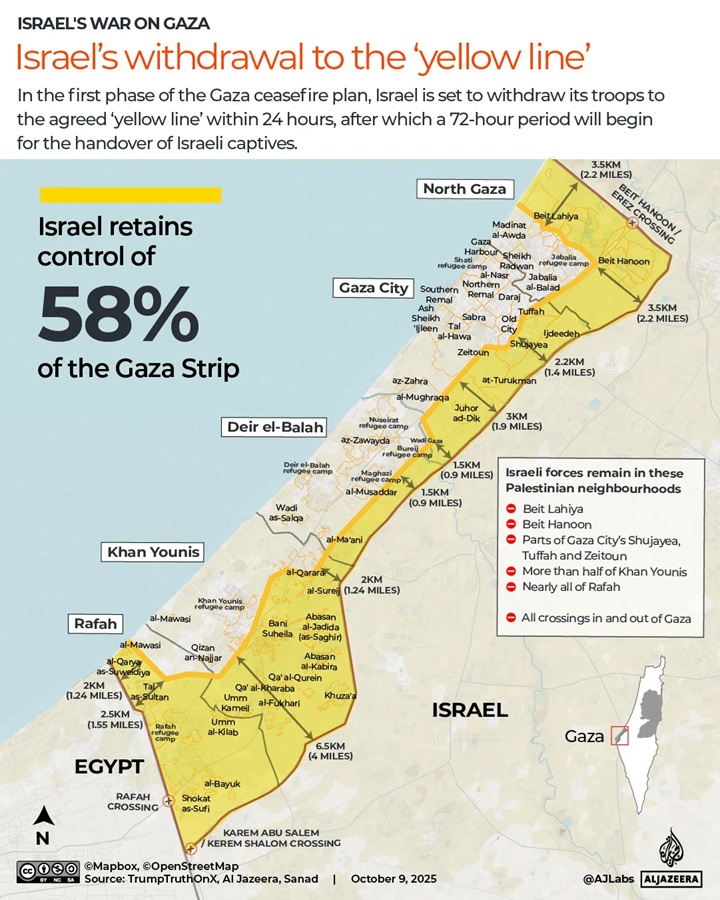
In recent days, Israeli Prime Minister Benjamin Netanyahu has ordered the Israeli army to seize 70% of Gaza – a sizeable increase from the 60% it currently controls.
This follows an updated map sent to aid agencies in Gaza in late March featuring a new “orange line” demarcating the restricted area under military control – about 11% larger than the area agreed to with the “yellow line” in the October ceasefire with Hamas.
Israel’s defence minister has also confirmed in recent days the government’s intention to move large numbers of Palestinians out of Gaza “at the right time and in the right manner”.
All of this is happening in a charged political environment in Israel: the Knesset dissolved itself on May 20, creating the possibility of an early election in September.
Israel’s actions are in clear violation of the 20-point Gaza peace plan, which called for a staged withdrawal of Israeli troops and actively “encouraged” residents to stay. It reads:
No one will be forced to leave Gaza, and those who wish to leave will be free to do so and free to return. We will encourage people to stay and offer them the opportunity to build a better Gaza.
US Secretary of State Marco Rubio has acknowledged as much, telling a congressional hearing this week that the peace plan “doesn’t call for” expanded military control of the strip.
The 2.1 million Palestinians in Gaza are being squeezed into an ever-smaller pocket of the decimated, overcrowded territory. And it appears the international community is doing little to stop it.
Laws against conquering territory
International law permits militaries to occupy foreign territory in pursuit of war aims, but there are two key limitations here.
First, an occupying force cannot pursue a legal claim to the territory it holds. The UN Charter has clearly outlawed the right to conquest under Article 2(4). Breaches of this article are treated very seriously, as the world’s reaction to Russia’s invasion of Ukraine has shown. This can be considered a war crime – the crime of aggression.
For Israel, this means its control of Gaza cannot result in a claim to sovereignty over any part of the strip. The International Court of Justice (ICJ) underscored this in its 2024 advisory opinion on Israel’s actions in the occupied Palestinian territories.
Second, any occupying military power must comply with international humanitarian law and international human rights law in a conflict. This means ensuring the welfare of the population under its control.
This has been the case in Gaza since Israel captured it from Egypt in the Six-Day War in 1967, beginning a decades-long occupation of the strip.
In fact, Israel’s obligations as an occupying power continued even after it pulled out its troops and dismantled its settlements in 2005.
As part of these obligations, an occupying power must preserve the demographic composition of the territory it controls. In this specific case, international law prohibits the removal of a population (the Palestinians) and the transfer of another population (Israeli settlers) onto occupied land.
A flawed peace plan
Despite these clear legal principles, enforcement of Israel’s obligations will be at best difficult, slow and piecemeal.
In its 2024 advisory opinion, for instance, the ICJ ordered Israel to withdraw fully from the occupied Palestinian territories, saying its presence is in breach of two key legal principles – self-determination and the prohibition against conquest. The UN General Assembly endorsed the findings and set a deadline of September 14 2025 for the withdrawal. Israel ignored the deadline.
The general assembly can’t enforce an ICJ ruling, only the security council can. And this avenue is blocked due to the US veto power.
More worrying is that the clarity provided by international law – prohibiting conquest, genocide, settlements and forced displacement – is being blurred by the 20-point peace plan mediated by US President Donald Trump and the so-called Board of Peace overseeing the process.
Last November, the UN Security Council endorsed Trump’s plan to end the conflict, disarm Hamas and establish a new transitional government system under the auspices of the Board of Peace and an International Stabilisation Force to keep the peace.
But the ceasefire agreement was flawed from the start. The text, for instance, did not include any specifications about Israel’s presence in the strip, accountability for alleged crimes or demilitarisation of Palestinian groups.
Since the ceasefire, the entire process has predictably stalled. Israeli strikes have continued, killing more than 900 Palestinians. Aid delivery is far below the needs of a desperate population. And Hamas refuses to disarm without firm guarantees on future Palestinian self-determination.
Behind the ‘yellow line’
This stalemate suits Israel perfectly. Under the map of the ceasefire agreement, Israel was permitted to keep its troops in areas behind a “yellow line” encircling the majority of the population along the coast. This gave Israel military control of just over half of Gaza.
Then, in the area under its control, Israel began two activities that speak to its longer-term political aspirations.
First, it levelled entire neighbourhoods and hundreds of buildings, turning this part of Gaza into a wasteland devoid of inhabitants and any recognisable landmarks.
Second, on this blank canvas, it constructed an impressive array of military roads, outposts and barriers, including permanent earthen berms (walls).
This gives Israel the possibility of perpetual control of a territory devoid of Palestinians. If this status quo continues, it would amount to forced displacement and conquest.
Day by day, Palestinian Gaza is shrinking and a new Gaza is being forged through bulldozers and barriers. Netanyahu has indicated Israel may not stop at 70% depopulation and control. It may seek to preserve a large “buffer” zone in Gaza – as it is doing in Lebanon and Syria – or perhaps revive the project of Israeli settlement of the strip, which is in full swing across the West Bank.
All of this is happening in violation of international law and a “peace” plan that has no clear vision for a long-term solution for the Palestinian people.
Repetitive Folly: Israel’s Futile War in Lebanon Deepens
4 June 2026 Dr Binoy Kampmark, https://theaimn.net/repetitive-folly-israels-futile-war-in-lebanon-deepens/
Call it a repeating script, a rusty template, or simply a creaky model to emulate time and again. The structural and homicidal destruction of Gaza undertaken by Israeli forces is now finding full expression in southern Lebanon, a cause of concern even for those in Washington. The war’s increasing savagery is a reminder of how hollow the exhortations by the Netanyahu government seem following the official cessation of hostilities against Hezbollah in November 2024.
Israel’s pre-emptive war on Iran, commencing on February 28 with the full and criminal connivance of the United States, took place alongside an incursion into southern Lebanon that has become a burgeoning invasion ostensibly to create a chunky buffer against Hezbollah’s attacks. Presumably, the wishful thinking here was to eliminate Iran as a threat, thereby removing Hezbollah’s most ardent patron and sponsor. At the time, coteries of commentators and Israeli leaders lavished praise on the country’s technical and military achievements, forgetting the central point that Hezbollah remains an idea as much as a physical movement, a deep well rather than defined, terminable cul-de-sac. Ideas, which can only really be battled by better ones, prove sleekly stubborn before tanks, missiles and jets.
From March, the southern part of Lebanon was subjected to infrastructural degradation, population displacement and the wholesale destruction of villages, all on the spurious premise that the security of Israeli settlements near the border will be somehow improved. In April, in the long cast shadow of the Iran War, another ceasefire was brokered between Israel and Lebanon, with another extension to the truce for another 45 days agreed to mid-May. This farcical theatre has taken place amidst ongoing IDF operations which have, as of June 1, displaced over a million Lebanese and seen more than 3,300 deaths. Israel has lost 24 soldiers and 4 civilians during that time.
With Iran resiliently stubborn in diplomacy, collaterally backed by its continued blocking of the Strait of Hormuz, and Hezbollah showing signs of renewed martial vigour, the two-pronged plan has been defanged. Hezbollah’s revivified hunger for battle has taken the form of lethal attacks on the IDF with drones resistant to electronic jamming. These explosive-laden fibre-optic First-Person View drones, connected to their operators with a bare yet lengthy optical wire, permit visibility and manoeuvrability for miles. Israeli soldiers, long seen as having immune breastplates against Hezbollah’s attacks, are now dying.
Former Israeli national security official Orna Mizrahi, who heads the Lebanon program at Tel Aviv’s Institute for National Studies, accepts that “the drones made for some confusion, because it was a surprise. The IDF didn’t think that it would be such a dangerous weapon.In Israel, they looked at it as a toy.” Remarks from the IDF reported in the Times of Israel show that the military has been disabused of this notion. The FPV drones posed “a dynamic and evolving threat, characterized by inexpensive, readily made tools with a high rate of variability.”
The BBC reports the troubled account of a council chief from the northern Israeli town of Shomera, Sami Zanetti: “The problem is you don’t feel them coming. You’re sitting there, and suddenly it arrives. And if you run away, it follows you.” Prime Minister Benjamin Netanyahu, acknowledging the dangers posed by these economical, effective packages of death, promises that a “special team” is labouring away to “solve this.”
Despite the increasingly attritive toll on its forces, the propaganda channels on Israeli triumphs continue to prove thick and hefty, attempting to justify a campaign described by Michael Koplow of the Israeli Policy Forum as “a political imperative in search of a strategy.” The May 31 seizure of the Beaufort Castle area and the Ali al-Taher Ridge was celebrated by the Israeli Alma Research and Education Center as one of “operational significance, as it constitutes a strategic zone in southern Lebanon and psychological significance for all parties involved in the conflict.” The “loss of control over the Beaufort area” was deemed “a direct operational setback for” Hezbollah.
These ground operations, false heralds of decisiveness, barely conceal the increasing desperation within the Netanyahu government, culminating in threats made on June 1 to attack the Lebanese capital. On June 2, the Israeli Minister of Defence, Israel Katz, told a gathering at the Defense Export Conference that the bombing of certain neighbourhoods of Beirut with alleged ties with Hezbollah was in the offing. “The proof of this policy in protecting the settlements [near the border] will be simple and will become clear in the coming days: if the shooting against the settlements ceases, or if it continues and we attack Dahiyé in Beirut, this equation will become a reality.”
Currently, another counterfeit, jejune ceasefire is in play, one that was only reached after a ranting call of colour and invective between US President Donald Trump and Netanyahu on June 1. (According to a US official quoted by Axios, Trump is said to have bellowed the following: “You’re fucking crazy. You’d be in prison if it weren’t for me. I’m saving your ass. Everybody hates you now. Everybody hates Israel because of this.”) While Trump finds himself held in an Iranian lock, tightened by Tehran’s insistence on tying a halt of Israeli hostilities in Lebanon with a broader cessation of conflict, Israel has been ensnared by its own too-clever-by-half logic in Lebanon. The un-snaring will be sanguinary and ugly.
The Disappearing Aid Check: The Future of US–Israel Defense Support
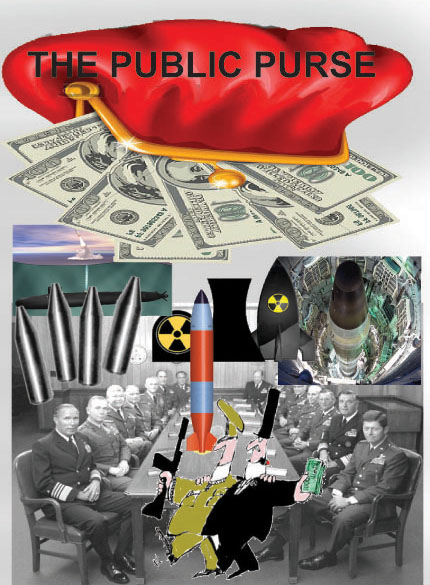
What top Israeli officials — including Prime Minister Benjamin Netanyahu — are quietly backing is not a reduction in American support, but a reorganization of it: shifting billions in resources from State Department–administered foreign aid grants into general Pentagon procurement accounts, industrial partnerships, and sustainment pipelines. The shift will strip away the political and diplomatic oversight mechanisms that make the relationship publicly accountable, moving it from a visible annual aid vote into the opaque machinery of defense acquisition, where oversight is limited and political accountability is minimal. The result would be a defense relationship that is simultaneously deeper and less transparent.
Quincy Institute for Responsible Statecraft, Steven Simon, May 26, 2026
Executive Summary
The United States and Israel are now approaching the renegotiation of their 10-year defense Memorandum of Understanding, or MOU. Israeli officials have said they want to phase out US military grant aid — a position that sounds like a step toward ending US military assistance to Israel. It is not.
What top Israeli officials — including Prime Minister Benjamin Netanyahu — are quietly backing is not a reduction in American support, but a reorganization of it: shifting billions in resources from State Department–administered foreign aid grants into general Pentagon procurement accounts, industrial partnerships, and sustainment pipelines. The shift will strip away the political and diplomatic oversight mechanisms that make the relationship publicly accountable, moving it from a visible annual aid vote into the opaque machinery of defense acquisition, where oversight is limited and political accountability is minimal. The result would be a defense relationship that is simultaneously deeper and less transparent.
Since fiscal year 2019, the United States has provided $3.3 billion per year in Foreign Military Financing, or FMF, grants to Israel, plus an additional $500 million per year for missile defense cooperation. About 25 percent of this FMF grant money has gone toward offshore procurement, or OSP, funds allocated to Israel to spend domestically on its own defense industry and military equipment. Effectively, it is a US subsidy for Israel’s military industrial complex.
This OSP precedent is slated to end with the expiration of the current MOU. This has fueled Israeli proposals to phase out FMF grants altogether, replacing them with a relationship centered on US–Israeli defense integration. This would embed Israeli firms and Israeli–origin intellectual property inside larger Pentagon programs and production. Unlike the foreign assistance process, the military procurement framework would not be subject to the political scrutiny of Congress and the State Department, but would be evaluated on bureaucratic criteria such as cost, readiness, and capability. This shift would likely be justified by reframing US support not as a handout to Israel, but as an investment in American military readiness, industrial capacity, and jobs.
At a time when the US–Israel relationship should be scrutinized in light of Israeli actions that run counter to US interests, such a structural shift would be counterproductive. To avoid this outcome, any procurement-centered relationship should meet these three basic requirements:
- Clear metrics to assess whether Israeli participation in Pentagon programs serves US defense requirements.
- Program-level transparency regarding the existence, scale, cost, and rationale of each procurement program.
- Cross-committee coordination in Congress to ensure visibility and accountability to non-military congressional oversight committees.
The current deal — and why it is running out of road
This brief explains what the shift in US aid for Israel means: where the money actually goes, who controls it, who benefits, and why the standard debate about ending aid misses the consequential change.1……………………………………………………………………………………………………………………………………………………………………
What “ending aid” actually means
…………………………………. ending aid in this context does not mean ending US financial support for Israel’s military and defense sector. It means changing the institutional form through which that support is delivered. The concept, in effect, is not to reduce support for Israel’s military; it is to shift it from the foreign-operations budget and the State Department’s oversight to the Pentagon’s procurement, research and development, industrial base, and sustainment machinery…………………………………………………………………………………………………………………
The new architecture — how money moves in a defense-industrial model
To understand what replaces the grant, it helps to understand how the Pentagon actually spends money on defense cooperation, and why that process looks so different from foreign aid…………………………………………………………………………………………………………………………………………………………………………………………………………………………………………………………………………….
Conclusion — quieter does not mean smaller
The post-2028 US–Israel defense relationship will likely be recast to reduce its political profile. The annual aid vote, one of the most predictably contentious moments in future US foreign-policy debates, may fade away, replaced by procurement decisions that attract little public attention and even less organized opposition. Israeli officials will be able to claim, accurately in formal terms, that Israel no longer receives American aid. American officials will be able to defend the spending as investment in US readiness rather than largesse to a foreign partner…………………………………………………….
For observers trying to understand US–Israel relations, the practical implication is methodological. The aid vote is no longer the right place to look. Instead, the key data will be located in the procurement budget, industrial-base investments, sustainment pipeline, IP licensing arrangements, and workshare provisions. The consequential decisions will be made in those domains.
Annex: Key terms and reference figures………………………………https://quincyinst.org/research/the-disappearing-aid-check-the-future-of-us-israel-defense-support/?ct=t(EMAIL_CAMPAIGN_1_21_2025_13_26_COPY_01)&mc_cid=3131e3a216#h-annex-key-terms-and-reference-figures
Trump blasts Netanyahu as Iran Talks Stall over Beirut
Juan Cole, 06/02/2026, https://www.juancole.com/2026/06/blasts-netanyahu-beirut.html
Ann Arbor (Informed Comment) – Monday began with a statement issued by the Iranian Ministry of Foreign Affairs cautioning that the United States and Israel, by their egregious violations of the ceasefire concluded on April 8, are jeopardizing the ongoing talks aimed at achieving an armistice. The ministry, which is headed by Abbas Araghchi, underlined that the ceasefire involved a cessation of hostilities on all fronts.
The ministry accused the United States of repeatedly violating the ceasefire by its attacks on commercial Iranian shipping. Moreover, it said, Israel has grossly violated the ceasefire by launching a vicious attack on Lebanon, violating its sovereignty and killing or wounding thousands of Lebanese and displacing two million, while destroying essential infrastructure.
The ministry said that the US has a direct responsibility to cease attacking Iranian shipping and an indirect responsibility to rein in the Israel atrocities, warning that Iran will take measures to act in self-defense to ensure its interests.
The Tasnim news agency, which is close to the Iranian Revolutionary Guards Corps, reported that these violations of the ceasefire, especially the Israeli invasion and devastation of south Lebanon, had led the Iranian side to cease all talks and the exchange of texts through mediators.
The agency said that the Iranian government insists on the end of Israeli operations in Gaza and Lebanon and its complete withdrawal from Lebanon. Otherwise there will be no further dialogue with the United States.
Moreover, the report said, Iran is determined to block the Strait of Hormuz completely, and to activate further fronts, including the Bab al-Mandeb or “Strait of Tears” at the mouth of the Red Sea. The Red Sea has been an alternative route for shipping, including of oil and gas, given the closure of the Persian Gulf.
The official status of these threats is unclear, according to BBC Monitoring .
Israel has sent troops deep into Lebanon and has expelled some 275,000 people from the metropolitan area of the coastal city of Tyre in the south, making threats to level the suburbs of Beirut where Shia Muslims predominate and to bomb the Lebanese capital. Hezbollah has continued to fight back against the Israeli invasion, showering northern Israel with rockets and sometimes managing to kill or wound Israeli troops and to take out Merkava tanks.
Asked about these reports of a halt to negotiations by CNBC’s Eamon Javers, President Donald J. Trump replied , “I don’t care if they’re over, honestly.” In case the message wasn’t clear, he repeated, “I really don’t care. I couldn’t care less.” He complained that the talks had “started to get very boring.”
Trump attempted to intervene in reality by Tweet, saying he would ask Israeli Prime Minister Benjamin Netanyahu “what’s going on with Lebanon.” He thundered, “There will be no Troops going to Beirut, and any Troops that are on their way, have already been turned back.”
He claimed to have spoken to Hezbollah indirectly, saying, “they agreed that all shooting will stop — That Israel will not attack them, and they will not attack Israel.”
Netanyahu remained defiant, boasting of having taken the Crusader castle Beaufort and threatening, “if Hezbollah does not cease attacking our cities and citizens—Israel will attack terror targets in Beirut. This stance of ours remains unchanged. In parallel, the IDF will continue to operate as planned in southern Lebanon.”
Barak Ravid at Axios reported that according to a US official, Trump’s phone call to Netanyahu was explosive, with the American president “pissed off” about Netanyahu’s threat to bomb Beirut. Ravid reports that his source alleged Trump told the prime minister, “You’re fucking crazy. You’d be in prison if it weren’t for me. I’m saving your ass. Everybody hates you now. Everybody hates Israel because of this.”
Trump for his part insisted that the negotiations with Iran were continuing “at a rapid pace.”
Many energy analysts believe that if the closure of the Strait of Hormuz continues through the summer, by September we could see $200 a barrel petroleum and a severe global economic recession. The consequent economic crisis domestically could produce a blue wave, i.e. a big Democratic victory in the midterms, which would hobble Trump in his final two years in the White House.
Israeli Authorities Refuse To Return Massive Trove Of Oct 7 Video. What Are They Hiding?

June 1, 2026, Michelle Witte· The Grayzone, https://scheerpost.com/2026/06/01/israeli-authorities-refuse-to-return-massive-trove-of-oct-7-video-what-are-they-hiding/
Israeli citizens wonder why the state won’t return October 7 footage it confiscated from them. The mother of an Israeli victim says authorities deleted video of her son’s death. Others complain “someone is hiding” the videos.
The Israeli government is still holding a massive trove of video documentation of the Oct. 7 attack captured by individuals and communities caught up in the fighting. One bereaved parent even accuses Israeli authorities of deleting a video of her son’s last moments before returning his phone to her.
According to Israel’s Channel 13, “all the cameras, memory cards and films that documented the atrocities were collected, but two and a half years later, these materials have not been returned to the communities and bereaved families who are desperate for information, and even feel that someone is hiding it from them.”
Soon after Hamas and Palestinian Islamic Jihad’s attack on Israel on Oct. 7, 2023, special units from the IDF, the Israeli intelligence agency Shin Bet and Israel’s investigation unit Lahav 433 collected photo and video documentation of the violence, confiscating cell phones, individual cameras, kibbutz security cameras and more.
“They disconnected what was needed, took it and moved on – that was the last time we saw the materials,” said an Israeli army reservist who participated in the collection mission.
According to the head of the Kfar Aza kibbutz – the site of a number of a series of atrocity hoaxes spun out in the early days after the attack – community members cooperated with investigators at the time. Now, years after the events, these families are wondering why documentation of their loved ones’ fates has yet to be returned to them.
Even Sabine Taasa, who was made an emblem of Israeli victimhood after her husband and one of her sons were killed on Oct. 7, is now clashing with Israeli authorities over footage of that day.
Taasa’s 17-year-old son, Or, was killed on Zikim beach. According to Channel 13, Taasa says she saw a video her son filmed in the moments leading up to his death, but when authorities returned his phone to her, no such video remained. The outlet says this is not an isolated incident.
An IDF probe found that soldiers abandoned civilians hiding in a bathroom there and then left their bodies for a week.
Channel 13 reports that Israeli police claimed Lahav 433 is still investigating the events in kibbutz Kfar Aza and no indictments have yet been filed, so returning evidence at this stage could jeopardize their criminal case. Meanwhile, the IDF rejected all accusations that it is withholding documentation and says it is in the final stages of adopting policies for how this type of evidence will be returned to communities and families.
On October 7, the Israeli government issued video Hannibal Directive orders which led Apache helicopter pilots and tank gunners to take aim at Israel’s own citizens in the Gaza envelope, supposedly to prevent them from being taken hostage. Israeli Brig. Gen. Barak Hiram personally ordered a tank crew to shell a home in Kibbutz Be’eri, knowing it was filled with Israeli citizens who had been taken captive by Hamas fighters seeking to negotiate a way out of the standoff. A dozen Israelis were killed in the strike, leaving behind “a house full of corpses,” according to the lone Israeli survivor. One Israeli tank gunner from an all-female unit similarly revealed that she was ordered to shell Israeli homes without knowing who was inside. An Israeli police investigation subsequently revealed that Israeli helicopters shelled the Nova Electronic Music festival on October 7.
Given Israel’s track record of targeting its own citizens on October 7 and misleading the public about it, the Israeli state might be holding on to as much video as possible to ensure no further evidence of the Israeli army massacring its own citizens is made public.
Israel has demonstrated a keen interest in collecting documentation of the events of October 7 and controlling narratives through careful curation and dissemination. At the same time, it has refused to participate in independent, international investigations of the attack, Israel’s response, or the widely distributed and now widely debunked claims of mass sexual violence by Hamas and other Palestinian militant groups. According to the Israeli state, Israel and Israel alone is justified in and capable of conducting such probes.
However, the state has strangely neglected to launch its own comprehensive special investigation into the apparent massive intelligence failure and military debacle. In fact, the Israeli government has had to be prodded by its own high court to establish a state commission of inquiry into the events, according to reporting by the Times of Israel. The Israeli government now has until July 1 to come up with a “suitable framework” to investigate the events, following years of pressure by the families of Israelis killed that day.
With the Israeli military-intelligence apparatus refusing to return possibly hundreds of hours of footage to its owners, some Israelis who lived through the October 7 attacks are beginning to wonder if they could be hiding something.
Michelle Witte is a writer, editor and broadcaster who previously co-hosted the news radio show, “Political Misfits.”
Will Trump sideline Israel in order to make a deal with Iran?
Donald Trump reportedly has a deal on the table to suspend fighting and begin negotiations to end the Iran war and the resulting global economic crisis. But Israel and Iran hawks see it as a disaster and are working to undermine it. Who will win out?
Mondoweiss, By Mitchell Plitnick May 31, 2026
According to available reports, the purported agreement on a Memorandum of Understanding (MOU) between the United States and Iran to entrench the current ceasefire was ready to be signed and presented to the public, and Trump was going to retire to his “situation room” to confer with his people and announce it.
If that seemed too good to be true, it turns out it was, at least for the moment.
Eventually, Trump is going to have to decide whether to accept an MOU that will be harshly attacked by Israel and Iran hawks or resume the fighting. Choosing the former is out of character for the beleaguered president, but resuming the fighting will bury him deeper in this quagmire and will intensify the global economic crisis.
This mistrust is why Iran wants this MOU rather than a comprehensive deal. They want to move slowly, confirming American sincerity with actions, not words, every step of the way.
Trump, on the other hand, is struggling to decide what to do amid conflicting, powerful political pressures. His team has, apparently, negotiated the terms of the MOU, but he is indecisive about implementing it. These are the consequences of a weak, unqualified person in the White House.
This political quicksand that Trump continues to sink into is another in the long list of reasons why other presidents have refused to let Israel draw them into a war with Iran. Now that Iran has the upper hand, it is dictating the framework of ending the war.
Trump wanted to end it with a comprehensive deal, a grand bargain. That has been completely thwarted by Iran, which insists on a staged process to confirm American intentions after two surprise attacks. Trump’s absurd idea of expanding the Abraham Accords was a last, desperate attempt to try to come out of this debacle with a win big enough for him to claim that it was all worth it.
He made that desperate grab because the MOU, although not addressing some of the biggest issues, would include some immediate concessions to Iran that will be viewed by Trump’s allies as significant setbacks.
The concessions that have been rumored—which include funding Iran’s reconstruction, sanctions relief, and releasing frozen Iranian funds, for which he will be accused of “sending pallets of cash” to Iran, just as Trump once accused Barack Obama—are going to be attacked by Iran hawks. But for Trump, the immediate priority is reopening the Strait of Hormuz quickly and doing as much damage control as he can before the congressional elections in November.
The MOU would, according to the reports, accomplish that. Iran would allow ships to move through the Strait and would start removing impediments, such as mines, from the area, while concurrently, the U.S. would gradually lift its blockade of Iranian ports. The fighting would stop, including in Lebanon, although the specific terms of that and whether Israel would be forced to completely withdraw from southern Lebanon have not been mentioned. Iran would reiterate its long-standing pledge not to create a nuclear weapon.
Beyond that, the MOU would outline the topics for further talks that would, it is hoped, lead to a permanent peace deal. 60 days would be allotted for those talks, which would include Iran’s nuclear program, a proposed $300 billion reconstruction fund for Iran, a permanent system for managing the Strait, the lifting of sanctions, and the release of frozen Iranian assets.
Trump unintentionally confirmed much of the rumored content and limitations of the MOU:
“Iran must agree that they will never have a Nuclear Weapon or Bomb. The Hormuz Strait must be immediately open, no tolls, for unrestricted shipping traffic, in both directions. All water mines (bombs), if any, will be terminated (we have removed, through detonation, numerous such mines with our great underwater mine sweepers. Iran will complete the immediate removal and/or detonation of any mines that are left, which will not be many!). … The enriched material, sometimes referred to as “Nuclear Dust,” … will be unearthed by the United States (which, it is agreed, is the only Country, along with China, with the mechanical capability of doing so!), in close coordination and conjunction with the Islamic Republic of Iran, plus the International Atomic Energy Agency, and DESTROYED. No money will be exchanged, until further notice.”
Though the language is Trumpian, there is much to read into this message, both in its contents and its omissions.
Trump’s demand about destroying the so-called “nuclear dust” leaves open the option of Iran diluting its highly enriched uranium and agreeing to IAEA inspections going forward. That’s an Iranian proposal, which Trump is trying to own. Doubtless, Iran would be fine with him making that claim for his own political purposes.
Dilution, however, would not be good enough for Israel or its allies in Washington. Nor are they going to be happy about Trump even mentioning money. His declaration that no money will change hands “until further notice” implies that there will, eventually, be such “further notice” if the process of the MOU is followed.
It is worth noting that nowhere in any of the talk of either the immediate terms of the MOU or the framework for negotiations going forward that it would imply is there any mention at all of Iran’s missile and drone programs or its support of regional allies, which are often termed “proxies” by the media.
A disaster for Netanyahu and Iran hawks
Israeli reporter Ben Caspit, citing a “senior Israeli political source,” reports that Benjamin Netanyahu faces a political disaster if Trump ends the war.
“This time, the prime minister’s hands are tied. He is completely paralyzed and knows that he will not be able to do anything, even if the agreement signed between the United States and Iran remains the disaster he now defines it as,” an anonymous Netanyahu associate told Caspit.
That same insider also said that Netanyahu now longs for the days of Joe Biden. It is a classic case of being careful what you wish for……………………………………………………………………………………………………………………………………………………………………………………….
The next president, whomever that might be, will have the same opportunity. The terms for a permanent agreement with Iran will be clear: a workable agreement on the Strait, IAEA inspections ensuring Iran doesn’t develop a nuclear weapon, and a path forward that includes a resuscitation of the Iranian economy, and regional agreements to ensure the security of the Gulf states, including Iran.
In other words, the JCPOA, in all the dimensions Obama envisioned. All we need to get there is the same resolute determination to do the sensible thing that Obama showed when he too froze Israel out of the process so he could do something wise. https://mondoweiss.net/2026/05/will-trump-sideline-israel-is-order-to-make-a-deal-with-iran/
Congress quietly moves to integrate US and Israeli militaries

In the first step towards shifting aid further into the shadows, the House’s 2027 NDAA would all but fuse the two countries’ armed forces together
Ben Freeman, Responsible Statecraft, Fri, 29 May 2026, https://responsiblestatecraft.org/israel-us-military/
At a time when the American public is expressing unprecedented levels of distrust in the Israeli government, Congress just proposed tying the U.S. to the Israeli military more than ever before.
Buried in the House’s version of the 2027 National Defense Authorization Act (NDAA) released on Tuesday, is section 224, entitled “United States-Israel Defense Technology Cooperation Initiative.” The provision would arguably do more to intertwine the U.S. military with the Israeli military than the more than $200 billion (inflation adjusted) in military assistance Israel has received from the U.S. since its founding in 1948.
Section 224 lays the groundwork for bilateral research and development, co-production of weapons, joint ventures, licensing agreements, and seemingly every manner of U.S.-Israeli military-industrial complex cooperation. The U.S. and Israel already work together heavily on missile defense, but this provision would greatly expand coordination to seemingly every area of defense tech, including AI, quantum, autonomous systems, directed energy, cyber, biotech, and many more. It also proposes “network integration” and “data fusion.” In other words, the U.S. military’s data could soon be the Israeli military’s data.
If fully enacted, this proposal would provide a higher level of military-industrial integration than the U.S. has with any other country in the world. To be sure, the U.S. has worked closely with its NATO partners on co-production and shared supply chains, most notably via the Defence Production Action Plan. And, as the number one arms dealer in the world, the U.S. provides weapons to militaries across the globe. But that is mostly a one-way street, with the U.S. providing weapons to foreign buyers who only occasionally make parts for those weapons themselves, as in the case of the F-35’s global supply chain.
Section 224 would be a different beast entirely. It would fuse the U.S. and Israeli defense sectors in multiple areas vital to the battlefields of the future, like autonomous systems and cyber. It would also bring extraordinary Israeli influence to the U.S. beyond what it already has through the Israel lobby and its robust network of social media influencers. It would give the Israeli government the opportunity to greatly expand one of the most powerful levers of influence in U.S. politics: jobs in the U.S. By expanding or starting new co-production facilities like it already has in Mississippi and Arkansas, the Israeli government could boast of providing jobs on U.S. soil, thereby securing allies among members of Congress who represent the districts where those jobs lie.
The result could well be a U.S. political system even more susceptible to the whims of an Israeli government that seemingly has no qualms about drawing the U.S. into military conflicts in the Middle East.
This unprecedented level of U.S.-Israeli military integration stands in stark contrast to the traditional aid model of defense cooperation, in which Israel already stood out as the top recipient of U.S. military assistance. As laid out in a recent Quincy Institute brief, authored by Steven Simon, this shift from an aid model to a military integration model has troubling implications, namely:
The shift will strip away the political and diplomatic oversight mechanisms that make the relationship publicly accountable, moving it from a visible annual aid vote into the opaque machinery of defense acquisition, where oversight is limited and political accountability is minimal. The result would be a defense relationship that is simultaneously deeper and less transparent.
This all comes at a time when the Israeli military has repeatedly used U.S. weapons in strikes that have violated international humanitarian laws in Gaza, and as Israel has repeatedly violated ceasefires (as has the U.S. itself) in the Trump administration’s unnecessary war with Iran.
The enormous gulf between what most Americans want and what the president is doing when it comes to Israel and what Congress is proposing here should not be ignored. Just 30% of respondents to a New York Times/Sienna poll from mid-May believe Trump made “the right decision” to go to war with Iran, with 64% saying it was wrong. An Institute for Global Affairs poll released earlier this week dove even deeper into the American psyche when it comes to arming Israel, finding that “Just 16 percent say the United States should keep supplying Israel with weapons without new restrictions. Thirty-eight percent want to stop supplying weapons entirely, and another 24 percent want weapons conditioned on how they’re used.”
Yet, mainstream leadership in both parties remains largely pro-Israel and continues to shape the base legislative text before amendments and broader congressional debate open it to the full body, as is the case with this NDAA provision.
Though slowly, tides within both parties are shifting as more and more members speak out against the growing divide between Israel’s actions and America’s interests. For example, Sen. Chris Van Hollen (D-Md.) wrote in The New York Times on Tuesday that, “The Democratic Party has provided reflexive and unconditional support to Israeli governments, even as their actions have increasingly undermined American interests and values.” On the Republican side of the aisle, Rep. Thomas Massie (R-Ky.) and former Rep. Marjorie Taylor Green (R-Ga.) have openly decried the Israel lobby’s corrosive influence — a stance that may have, at least partially, cost both of them their seats in Congress.
What can other members of Congress who are concerned about Israel’s destabilizing actions do right now? Stop the Israeli-U.S. military-industrial merger in its tracks. Lawmakers should reject Section 224 from the NDAA to avoid deep integration with Israel’s military at a time when a growing number of Americans oppose Israel’s actions in the region.
The UK Is Getting Even Crazier In Defense Of Israel
Caitlin Johnstone, Jun 01, 2026
The UK is getting crazier and crazier in its defense of Israel. Now they’re canceling the visas of mainstream normie political pundits for criticizing the state of Israel, and investigating people for antisemitic hate crimes when they denounce Zionists who aren’t even Jewish.
American progressive commentator Cenk Uygur and his nephew Hasan Piker have both been denied visas by the British government, saying they were blocked from entering the country because of their criticism of Israel.
“I’ve been banned from the UK,” Uygur said in a tweet. “I tried to get on a flight to London to attend SXSW London and give a speech at Oxford. I’ve been banned for criticizing Israel. Are we free anymore? This is oppression of Western citizens by our own governments on behalf of a different country!”
“the uk has revoked my visa as well. all at the behest of israel,” said Piker in a repost of his uncle’s statement. “the west is betraying ‘liberal values’ for a genocidal fascist foreign government. soon we will all become israel.”
This is a significant escalation from London, because neither Uygur nor Piker could reasonably be described as politically extremist in any way. They’re essentially just Bernie Sanders progressives who sit well within the mainstream US political Overton window; I personally don’t follow either of them because they are both far too aligned with the Democratic Party for my liking.
This move is yet another win for the UK’s extremely powerful Israel lobby. Two weeks ago the Jewish Chronicle ran a story titled “Social media influencer Hasan Piker must be banned from Britain, say Jewish leaders,” subtitled “Online agitator who said Zionists were like ‘Nazis’ and refused to condemn Hamas poses a threat to British Jews.”
So the pressure campaign appears to have paid off.
This comes as the Metropolitan Police launch an investigation into an incident in which actress Helen Mirren was called an “evil Zionist bitch” by a man on the street last year, saying in a statement that “We are aware of a video circulating online, showing a man and a woman being subjected to antisemitic verbal abuse in Tower Hill.”
To be clear, Helen Mirren is not Jewish, so she can’t have been a victim of “antisemitic verbal abuse”. She is however an avowed supporter of the state of Israel, which makes her a Zionist.
In a 2023 interview with Israeli media, Mirren stirred up controversy with her remarks on her 1967 visit to the Zionist ethnostate, saying, “I saw Arabs being thrown out of their houses in Jerusalem. But it was just the extraordinary magical energy of a country just beginning to put its roots in the ground. It was an amazing time to be here.”
Netanyahu directs army to occupy 70 percent of Gaza
When asked about taking 100 percent of Gaza, the Israeli prime minister said, ‘First 70 percent. We’ll start with that’
News Desk, MAY 28, 2026, https://thecradle.co/articles/netanyahu-calls-for-army-to-occupy-70-percent-of-gaza
Israeli Prime Minister Benjamin Netanyahu says he has given directives for the Israeli military to take control of 70 percent of the Gaza Strip, Israel’s Channel 12 reported on 28 May.
“At this point, we are fully in control of 60 percent of the territory of the Gaza Strip … and my directive is to get to … 70 percent,” Netanyahu said in Hebrew during a conference held by the Ein Prat Leadership Academy.
During the speech, one audience member shouted that Israel should take “100 percent” of Gaza. Netanyahu responded, saying that “We’re going in order,” suggesting this was the long-term goal of his government.
“First 70 percent,” he says, “we’ll start with that.”
Last week, Netanyahu publicly acknowledged reports that the Israeli military currently occupies 60 percent of the territory in the strip, significantly more than the 53 percent allowed under the terms of last September’s ceasefire with Hamas.
Ministers in Netanyahu’s government say they want to completely occupy Gaza and expel its nearly 2 million Palestinian inhabitants to make way for Jewish settlement of the strip.
Jewish settler leader and Israeli minister Orit Strock called the months after the Hamas attack of 7 October a “time of miracles,” because it gave Israel the pretext to conquer the strip.
Shortly after 7 October, Netanyahu called for committing genocide against Palestinians, comparing them to the Amalekite people, who were exterminated, including women and children, by the ancient Israelites according to the account in the Book of Samuel in the Jewish holy book, the Torah.
Israel has killed over 72,000 Palestinians, the majority women and children, since the start of the war over two years ago. Thousands more are missing and presumed lost under the rubble.
According to satellite imagery analysis, approximately 81 percent of all structures in the Gaza Strip have been damaged due to Israeli bombing as of October last year.
As a result, nearly 1.9 million Palestinians – about 90 percent of Gaza’s population – are internally displaced and homeless. Many live in tents or make-shift shelters. Conditions remain dire with severe shortages of food, medicine, and clean water and sanitation that will continue to cause indirect deaths long after the Israeli violence in Gaza ends.
In April, Reuters reported that rats and parasites are spreading through Gaza’s tent camps, “biting children’s fingers and toes as they sleep, gnawing through people’s few remaining treasured possessions, and spreading disease.”
The news agency spoke with Khalil Al-Mashharawi, who said that a rat bit the hand and toes of his 3-year-old son and that he himself was bitten.
“They strike in our sleep,” said Mashharawi, 26, who lives with his wife and children in the ruins of their house in Al-Tuffah neighborhood in northern Gaza.
“They may disappear for a day or two before they strike again, (forcing) their way under the tiles of the floor of the house.”
Israeli claims about an Iran ‘threat’ were always a lie. Now we have proof

The disinformation about Iran should have been all too glaring back in 2006, had any of it been reported properly – just as it should be now, two decades later, were western journalists doing their job rather than acting as stenographers for Israel and the White House.
This is another swindle, like Trump’s “Board of Peace”, which dresses up US and Israeli criminal aggression and genocide as peacemaking.
It is not Tehran led by unhinged, genocidal megalomaniacs threatening the security of the region and the world. It is Tel Aviv and Washington
Jonathan Cook, Middle East Eye, 30 May 2026
ould it be that Israel’s 30-year narrative about Iran – one that persuaded US President Donald Trump to wage a criminal and disastrous war of aggression – was always a fiction, an invention cooked up in Tel Aviv?
Far from Tehran posing an existential danger to Israel, as Prime Minister Benjamin Netanyahu has claimed for decades, might Israel’s real fear be that a stronger Iran would undermine its unique leverage over Washington, threatening its status as the region’s sole – and unmonitored – nuclear power?
Might large parts of the globe be facing economic meltdown simply so that Israel can remain the Middle East’s top dog – an unaccountable apartheid state committing genocide against the Palestinian people and ethnically cleansing southern Lebanon?
We got a definitive answer last week, care of the New York Times. It is an uncompromising yes to all of these questions.
The newspaper reported that Netanyahu not only mis-sold Trump on the idea of quick regime change in Iran following a short “shock and awe” bombing campaign. He also identified to the White House who was going to replace Ayatollah Ali Khamenei, Iran’s supreme religious leader.
Extraordinarily, according to the Times, Netanyahu named the man for the job as former Iranian President Mahmoud Ahmadinejad. The aim at the start of the air campaign was for Israel to kill Khamenei, then liberate Ahmadinejad from house arrest by striking the guards who were confining him.
Presumably, Ahmadinejad was then supposed to storm the citadel and seize the keys to the palace. But only Khamenei’s assassination went according to plan.
Ahmadinejad, who had reportedly been consulted on the scheme beforehand, is believed to have been injured in the Israeli strike near his home. He got cold feet, possibly suspecting he was being set up for assassination too, and went into hiding. His current whereabouts and medical condition are unknown.
Ultimate bogeyman
Neither US nor Israeli officials would comment to the Times on the alleged regime-change plot, a scheme that the newspaper called “audacious”. That is the understatement of all understatements.
The idea that Ahmadinejad had the popular support, let alone the religious authority and military muscle behind him, to take on the Islamic Revolutionary Guard Corps, Iran’s crack military force responsible for protecting the clerical regime, is for the birds.
That anyone in the White House took this plan seriously, let alone acted on it, is a genuinely staggering notion. But the proposition that Ahmadinejad could retake the reins of power in Iran is possibly the least preposterous part of the scheme.
While younger readers may not recognise Ahmadinejad’s name, everyone else should. He made headlines on an almost weekly basis during much of his eight-year presidency, starting in 2005. Why? Because Israel turned him into the ultimate bogeyman.
After neighbouring Iraq’s Saddam Hussein was toppled and executed in 2006, following an illegal invasion by the US and Britain, Ahmadinejad was hyped as the new implacable threat to regional peace.
Claims about Ahmadinejad first breathed an illusory substance into Israel’s now-unchallenged script that a supposedly fanatical, deranged Iran would leave no stone unturned in seeking to destroy Israel. Ahmadinejad, we were told time and again, was seeking to pursue a nuclear bomb – even after Khamenei had issued a religious edict in 2003 strictly banning its development.
In 2006, Ehud Olmert, then the Israeli prime minister, warned the world that Ahmadinejad was a “psychopath of the worst kind”, adding: “He speaks as Hitler did in his time of the extermination of the entire Jewish nation.”
Olmert was echoing a panic-inducing campaign led by Netanyahu, then Israel’s opposition leader, that Iran needed to be attacked immediately to save Israel and the world.
“It’s 1938 and Iran is Germany,” Netanyahu told a meeting of American Jewish leaders that same year. “And Iran is racing to arm itself with atomic bombs.” Of Ahmadinejad, he said: “Believe him and stop him … He is preparing another Holocaust for the Jewish state.”
Under Ahmadinejad, Iran was supposedly hellbent on destroying Israel, turning it into a giant Auschwitz. Also in 2006, Netanyahu told Israeli Army Radio: “Israel would certainly be the first stop on Iran’s tour of destruction.”
Ahmadinejad was so unhinged, Netanyahu said, that he would not stop at Israel’s eradication: “Iran is developing ballistic missiles that would reach America, and now they prepare missiles with an adequate range to cover the whole of Europe
‘Genocidal intent’
A short time later, Israel’s fear-mongering operation reached a crescendo in London.
Netanyahu told members of the British parliament that Ahmadinejad had to be urgently brought before the International Criminal Court – the war crimes court in the Hague – for his “messianic apocalyptic view of the world”.
Irony of ironies, Netanyahu – who 20 years later is a fugitive from that same court, accused of crimes against humanity for starving the people of Gaza – emphasised Ahmadinejad’s supposed genocidal intent towards Israel. ……………………………………………………………………………………………………………………………………
Smoke and mirrors
Two decades ago, the message from Netanyahu was clear: Ahmadinejad was so rabidly antisemitic that he deserved to be compared to Hitler.
Ahmadinejad was so eager to pursue a nuclear weapons programme that he was prepared to defy the country’s supreme religious leader. He was so mentally unstable that he was ready to use those weapons to exterminate Israel, even though such a move would ensure a retaliatory nuclear counter-strike on his own country.
Lest we forget, Ahmadinejad had a reputation for such ruthless crackdowns on political opponents that Amnesty International noted in 2014 that his rule had “sounded the death knell for academic freedom in Iran”.
Yet, fast forward two decades, and Netanyahu reportedly now thinks Ahmadinejad is the best person to lead Iran; the person for whom it was worth killing Khamenei, Iran’s most influential opponent of nuclear weapons.
Iran has won the war. Trump and Netanyahu now face a reckoning
The New York Times reports that in recent years, there were strong suspicions inside Iran that Israel, Britain and the US were cultivating ties with Ahmadinejad and those around him – suspicions that now seem to be confirmed by Israel’s apparent regime-change plan.
The newspaper further reports that Ahmadinejad had recently travelled to both Guatemala and Hungary, countries with very close ties to Israel.
Does any of this make sense? And yet for western media, the fact that Netanyahu was championing Ahmadinejad as Iran’s saviour, and that the US administration wholeheartedly bought into this idea, is little more than “surprising”.
In truth, it wrecks Israel’s entire narrative about Iran. It is a telling reminder of the yawning gap between what we have been told about Iran for decades, and what has actually been going on.
Image and reality bear almost no resemblance to each other. This has all been smoke and mirrors.
‘Wiped off the map’
In my 2008 book Israel and the Clash of Civilisations, I pointed out that nothing Israel was telling us about its Middle Eastern rival could be accepted at face value – least of all Israel’s assertion that Ahmadinejad was a Jew-hating “new Hitler”.
Many of the claims promoted 20 years ago by Israel about Ahmadinejad’s genocidal intent stemmed from a mistranslation of a speech in which the Iranian leader had quoted the late Ayatollah Ruhollah Khomeini, who led the 1979 Islamic Revolution.
According to western politicians and media, Ahmadinejad had called for Israel to be “wiped off the map” – widely portrayed as an ambition to launch a nuclear strike on Israel.
In fact, Ahmadinejad had been repeating Khomeini’s observation that Israel could not survive indefinitely in the form of an illegitimate Jewish supremacist state oppressing another people. He was pointing out that Israel’s days as a racist state were numbered, just as apartheid South Africa’s had been.
The sentiment behind Khomeini’s statement should be much clearer in the present circumstances, when it is Israel, not Iran, that has been busy wiping people off the map – in Gaza and southern Lebanon.
Similarly, Israel and its western allies made a great deal of noise in 2006 when Ahmadinejad called what was widely misrepresented as a “Holocaust denial” conference in Tehran. In fact, Ahmadinejad had organised what was intended to be a provocative – and to some, offensive – stunt to challenge western taboos about Israel and underscore the West’s hypocrisy towards Muslims.
Ahmadinejad’s point was twofold: firstly, if Muslims are not entitled to have their beliefs and sensitivities respected by westerners – as evidenced by the 2005 “Danish cartoon affair” and the “free speech” defence for presenting caricatures of the Prophet Muhammad – why should westerners expect their own sensitivities about Israel and the Holocaust to be exempt from challenge?
He also wanted to dissect the western belief that someone else, the Palestinian people, should pay a heavy price, including decades of dispossession and abuse, for the West’s crimes against Europe’s Jews.
Horror show
The disinformation about Iran should have been all too glaring back in 2006, had any of it been reported properly – just as it should be now, two decades later, were western journalists doing their job rather than acting as stenographers for Israel and the White House.
The lies, now as then, serve the same end: to justify crushing Iran – then through sanctions, later through the addition of illegal bombing – so that Israel’s right to trample over the lives of people across the region without consequence can be protected.
Iran, now refusing to release its chokehold over the Strait of Hormuz and the global supply of oil, is demanding that the price include an end to US backing for the Israeli-directed horror show in the Middle East.
Like a spoiled toddler, Trump is thrashing around – while cashing in on the volatility of the oil markets – trying to impose the old rules, when the terms of the confrontation are no longer under his exclusive control.
His latest tantrum – one cooked up in Tel Aviv as much as Washington – is that most Arab states, including Iran’s neighbours in the Gulf, be forced to sign the so-called Abraham Accords with Israel. This is being presented as the framework for a regional “peace deal” involving Iran. In truth, it is the very opposite.
The accords are designed to cement Israel’s status as the Middle East’s top dog, subordinating Arab states’ interests to Israel’s, and thereby isolating Iran in the region and leaving the Palestinian people and Lebanon to a genocidal Israel’s mercy.
This is another swindle, like Trump’s “Board of Peace”, which dresses up US and Israeli criminal aggression and genocide as peacemaking.
What the past 20 years of lies and misdirections have sought to hide is a simple fact: it is not Tehran that is led by unhinged, genocidal megalomaniacs threatening the security of the region and the world. It is Tel Aviv and Washington.
Since the pair launched their criminal war of aggression against Iran three months ago, Tehran has shown restraint, acted with caution, and displayed a willingness to negotiate in good faith. Too bad there are no responsible adults on the other side with whom it can make a deal. https://www.middleeasteye.net/opinion/israeli-claims-about-iran-threat-were-always-lie-now-we-have-proof
Beyond the Yellow Line: Israel Seizes More of Gaza
30 May 2026 Dr Binoy Kampmark AIM Extra , https://theaimn.net/beyond-the-yellow-line-israel-seizes-more-of-gaza/
While eyes remain peeled on Israel’s increasingly violent and expanding campaign in Lebanon, the government of Prime Minister Benjamin Netanyahu is proving ever more predatory with the Gaza Strip. With aggrandizing impunity, more territory is being acquired for familiar reasons: Hamas is on the run and needs to be crushed further (the organisation is proving oddly resilient and contradictory to Israeli objectives here); Palestinian autonomy, even in so small an area, would be a future threat to Israel unless heavily invigilated and policed; and, well, there is that old desire to ethnically cleanse the territory.
Speaking at a conference on May 28, Netanyahu outlined his plans for further seizures. “We are currently squeezing Hamas; we now control 60% of the territory of the Strip – you know this. We were at 50, we moved to 60. My directive is to move to…” (at that point, an enthusiastic voice in the crowd interjected with “100”). Not wishing to state it that obviously, the PM went on to say that the IDF would “go step by step. First of all, 70. Let’s start with that. We’re pressing them from all sides, we’ll deal with the remnants.”
On May 27, the Israeli Defence Minister Israel Katz wrote on his X account that the government “had pledged to eliminate everyone who led the October 7 massacre, and that is what we will do.” The agenda of elimination in the Strip is an ongoing one, with the announced killing of Hamas military commander Mohammed Odeh giving him a certain febrile glee. “The fourth commander of the Hamas terror organization’s military wing in Gaza was eliminated yesterday and sent to meet his partners in the depths of hell.” Hamas would never be allowed to “rule Gaza civilly or militarily.” Katz also went further, suggesting with heavy ominousness that the “plan for voluntary emigration from Gaza” would commence “at the proper time and in the proper manner.”
The fact that the IDF had already gobbled territory to a hefty proportion of 60% had already breached the terms of the US-brokered ceasefire effective since October 10, 2025. (The original amount was 53%). In mid-May, Netanyahu, in remarks made at the Mercaz Harav Yeshiva on the occasion of the 59th anniversary of the unification of Jerusalem, boasted that Israel had, over the previous two years “shown the world what immense power is inherent in our people, in our state, in our army, in our heritage.” The most important thing was breaking “the barrier of fear. We brought our hostages home, to the very last one. Today we control 60 percent.”
This should have come as a surprise, but such breaches and violations are common fare in Israel’s singular interpretation of ceasefires. (Pro-Israeli critics naturally overlook this, seeing, instead, a stubborn Hamas outfit that refuses to disarm while committing its own complement of ceasefire violations.) The ceasefire in Gaza has proven a particularly bloody one for Palestinians, with 738 having perished since October last year. In January, Haaretz was already reporting on the westward shift of the Yellow Line. According to Laurie Bouvier, a geographic information systems expert working for Doctors Without Borders (MSF), the 60 percent figure was an accurate one, and likely to change given ongoing expansion with new yellow blocks identified in such neighbourhoods as Zeitoun in Gaza City.
The Hamas-run government media office described Netanyahu’s promise of seizing 70% of territory as “a dangerous escalation.” According to its head, Ismail al-Thawabta, “any attempt to impose a new reality of occupation in Gaza is null and illegitimate.”
From New York, the United Nations spokesperson Stéphane Dujarric also added the views of the organisation by stating that, “One hundred percent of Gaza should be for the Palestinian people.” The UN had “been calling on Israel to pull back from its occupation from the so-called yellow line, and that will continue to be our position.”
The United Nations children’s agency UNICEF has expressed concerns the seizure of even more land by the Israeli forces will only worsen a situation where food, water and hygiene are lacking. UNICEF spokesman Salim Oweis, speaking from Gaza to reporters based in Geneva, noted how people had “been crammed into around 40 percent of the space.” They were “sheltering among broken buildings, rubble and mounting solid waste.” The suffering this was causing children was becoming “widely apparent: children with respiratory infections, acute watery diarrhea, and more than half of all households reporting skin diseases.”
This will only be seen by the Israeli authorities as another sob story, the needless tearjerker disseminated by international organisations and commentators who should know better. There is an agenda to implement with necessary ruthlessness, Palestinian officials to kill along with their families, political emasculation of Palestinian will to achieve and, ultimately, a Strip cleansed of Arabs in favour of the Jewish state’s bright and noble citizens.
Balancing Act at the New York Times: Nicholas Kristof Wrote About Israel’s Sexual Torture of Prisoners, the Next Day Isabel Kershner Penned More Unverified Rape Allegations Against Hamas

Robin Andersen, SCHEERPOST, May 30, 2026
The New York Times attempted to ‘balance’ Nicholas Kristof’s documentation of the systematic rape of Palestinians by Israeli forces with yet another unverified rape ‘investigation’ claiming that Hamas had weaponized sexual violence on October 7. It was written by the paper’s pro-Israel Jerusalem-based reporter, Isabel Kershner.
Nicholas Kristof’s New York Times Op-ed piece titled The Silence That Meets the Rape of Palestinians, published on May 11, was based on documentation and grueling victim testimonies of rapes that Palestinians have experienced at the hands of Israeli security forces. Brutal and sadistic acts of sexual torture are described in a piece that triggered enormous attention even though human rights organizations have been documenting these same crimes for years now.
The Israeli human rights group B’Tselem has documented Israel’s sexual torture of Palestinian men, women and children calling the “Israeli prison system a network of torture camps.” Save the Children reported in July 2024 that Palestinian children in Israeli detention were facing “disease, increasing starvation, [and] abuse including sexual violence.” A Palestinian women’s rights organization warned that their documented 75 cases of rape and sexual violence against Palestinian women amounted to about 1% of what was actually happening in Israeli detention. Euro-Med Human Rights Monitor’s extensive report published on April 13, 2026, emphasized that the sexual torture was so bad it amounted to “another genocide behind walls.” They identified its purpose as a “systematic destruction of the body and identity.” The report emphasized the scope of “criminal responsibility,” by the collusion of state institutions that were creating impunity.
In a discussion about Kristof’s piece, Francesca Albanese, who has also documented brutal Israeli torture sites, told Al Jazeera’s UpFront that she had given a long interview about sexual torture to the New York Times as early as February 2024, but nothing came of it. Albanese went on to say she didn’t understand why the Times piece should have been “more important” than the extensive documentation of human rights monitors. But when Kristof finally acknowledged that Palestinians were being tortured and raped by trained dogs, (corroborated by a soldier) in Israeli prisons, it made headlines in the US and sent shock waves through Israel’s hasbara apparatus.
The agenda setting New York Times is a “paper of record,” with a journalism staff of 3000, about 7 percent of all journalists working in the US. The paper has also been a reliable source of pro-Israel messaging for years, especially after October 7, so when a well-respected human rights journalist wrote such an op-ed in its pages it was a public relations disaster for Israel and its propaganda machine went into high gear to counter the bad press. Zionists and genocide supporters protested in front of the Times building. Netanyahu was so outraged that he threatened to bring a defamation lawsuit against the paper. The Israel Foreign Ministry called the piece “blood liable” and accused Nicholas Kristof of writing “an endless stream of baseless lies and propaganda” that turned the “victims into the accused.”
It should come then, as no surprise that the paper attempted to “balance” Kristof’s essay by publishing a piece the very next day, on May 12, about another “two-year investigation” by Israel, that “concluded” that sexual violence by Hamas was widespread on October 7. Isabel Kirshner’s piece attempted to breathe new life into the thoroughly discredited and debunked original Times’ front-page ‘investigation’ titled Screams Without Words. Screams was first published on December 28, 2023, just as the South African legal case against Israel’s genocide was being presented to the International Court of Justice, and it served as a significant denial and justification for Israel’s genocidal violence at the time. Screams without Words can be described accurately (and has been) with the same words used by Israel’s Foreign Ministry to falsely describe Kristof’s piece; “an endless stream of baseless lies and propaganda.”
The timing of the now infamous rape story of 2023, along with its extravagant claims to evidence not found in the front-page article, had much to do with why, almost immediately, the piece drew critical attention from media analysts, independent investigative reporters, and human rights organizations. Withering criticisms of the story included an essay in Medium, calling it “crappy journalism,” saying it offered a “lesson on selection, slanting, and charged language, and why using words in these ways constitutes a poor substitute for solid evidence and reasoning.” An Egyptian feminist non-governmental organization (NGO) Speak Up, called the article a “disgraceful investigation,” and shamed the Times for claiming to provide readers with definitive evidence, while actually offering no evidence at all. Independent US investigators such as Electronic Intifada, The Grayzone, The Intercept, Mondoweiss and others, roundly debunked the fictionesque inventions continued within it. Sixty journalism professors wrote to the New York Times calling on the paper to commission an independent review of the article. It was “troubling to professors of journalism to see such a shoddy article be published without a retraction or an investigation,” Professor Deepa Kumar told Democracy Now! ………………………………………………………………
The paper’s 2026 version of the Hamas rape story was penned by one of the Times’ most reliably pro-Israeli reporters, Isabel Kershner, and this new ‘investigation’ once again takes seriously, discredited Israeli sources that Kershner claims to be independent and reliable…………………………………………………………………..
Isabell Kershner at the New York Times
Kershner has been providing positive reporting for Israeli Security Force for years now. With Kirshner, polishing the image of the IDF is a family affair. ………………………………………………………………………………………………………………………………………..
Balancing legitimate reporting that includes reliable witness testimony confirmed by multiple human rights investigations over a period of years cannot be not done by publishing unverified allegations from discredited sources. Alan MacLeod noted a recuring media pattern here that applies to the New York Times’ reporting on Israel; “whenever scrutiny intensifies around Israeli abuses against Palestinians, major Western outlets redirect attention toward unverified claims against Hamas to justify Israel’s genocide in Gaza.”
Balancing Kristof’s rare acknowledgment of Israeli war crimes with reporting by a pro-Israel, biased journalist citing discredited sources repeating unverifiable allegations was a shameful, and failed, attempt to appease the state of Israeli as it expands its crimes of war and occupation into Lebanon for a Greater Isreal. The Times would do better to simply report the truth and stop catering to hasbara and the false narratives that facilitate Israel’s on-going genocidal violence.
Material from this piece was drawn from Chapter 4, “A Compromised Media Landscape,” and from Chapter 8, “The New York Times Rape Story: War Propaganda and Trauma Porn,” in The Complect Lens: US Media Coverage of Israel’s Genocide in Gaza, by Robin Andersen
Robin Andersen is professor emerita of media studies at Fordham University and an award-winning author of a dozen single- and co-authored books. Her work examines film, television, and media coverage of war, the environment, politics, and elections. She edits the Routledge Focus Book Series on Media and Humanitarian Action, serves as a Project Censored Judge, and contributes to the annual State of the Free Press. Andersen is on the Board of Directors of Fairness and Accuracy in Reporting (FAIR), where she also writes regularly, and is an Izzy Award Judge for the Park Center for Independent Media. Her writing has appeared in CounterPunch, LA Progressive, The Progressive, Salon, Common Dreams, and ScheerPost, among others. https://scheerpost.com/2026/05/30/balancing-act-at-the-new-york-times-nicholas-kristofs-wrote-about-israels-sexual-torture-of-prisoners-the-next-day-isabel-kershner-penned-more-unverified-rape-allegations-against-h/
Blood Libels and Sexual Violence: Israel, Palestinian Prisoners and The New York Times
28 May 2026 Dr Binoy Kampmark, https://theaimn.net/blood-libels-and-sexual-violence-israel-palestinian-prisoners-and-the-new-york-times/
When the establishment journalism of Nicholas Kristof of that most establishment of papers, The New York Times, draws the ire of a foreign regime, and an unnaturally allied foreign regime at that, a pulse might be detected in the moribund state that is the Fourth Estate. In his piece alleging a campaign of sexual violence against Palestinians by Israel’s security apparatus, he shines some blistering light on practices long suspected and discussed. It begins a proposition that, “Whatever our views of the Middle East conflict, we should be able to unite in condemn rape.”
With that solemn theme declared, Kristof begins by remarking on the “brutal sexual assaults against Israeli women during the Hamas-led attack on Israel on Oct.7, 2023.” Members of the US administration and the Israeli Prime Minister, Benjamin Netanyahu, had rightly condemned them. “And yet in wrenching interviews, Palestinians have recounted to me a pattern of widespread Israeli sexual violence against men, women and even children – by soldiers, settlers, interrogators in the Shin Bet internal security agency, and, above all, prison guards.”
Brandishing his credentials as veteran war reporter, he makes it clear that, when writing about sexual violence, he knows what he’s talking about. Interest in the fate of Palestinian prisoners – especially in that way – was piqued during a visit to the activist and professor of non-violence Issa Amro. Amro had himself been sexually assaulted and suspected this to be a common practice “but underreported because of shame.” Interest then shifts to the conditions of incarceration, with something in the order of 9,000 Palestinians being held as of May. “Many have not been charged but were detained on ill-defined security grounds, and since 2023, most have been denied visits from the Red Cross and lawyers.”
Kristof then makes use of material gathered in 14 conversations with men and women who claim to have been sexually assaulted by Israeli settlers and the security forces, supplemented by the accounts of family members, investigators, officials and other sources. Reports are cited – Euro-Med, Save the Children, the Committee to Protect Journalists, the United Nations. The views of Sari Bashi, an Israeli American human rights lawyer who heads the Public Committee Against Torture in Israel are documented: “Rampant sexual abuse of Palestinian prisoners is a thing; it’s been normalized.” While he had seen no evidence such acts had been executed in accordance with a plan or program, “the authorities know it’s happening and are not stopping it.”
Kristof restates that point, finding “no evidence that Israeli leaders order rapes.” But what had germinated in recent years was “a security apparatus where sexual violence has become, as a United Nations report put it last year, one of Israel’s ‘standard operating procedures’ and ‘a major element in the ill-treatment of Palestinians’.”
And, as if we ever needed evidence to demonstrate that Israel’s prison system has become a foul stew of corruption, brutality and malice towards its Palestinian inmates, we only need witness the gloating joy of Israel’s Minister for National Security Itamar Ben-Gvir, who makes a ghoulish habit of posting videos glorying over their misfortune and suffering. (Sexual violence doesn’t tend to make the cut, but threats of execution do.) The fact that he thought such treatment appropriate for the activists of the Global Sumud Flotilla (his posted video sufficiently demonstrates this point) showed a consistent ecumenicism on cruelty: All who dare go against Israel’s interests or dare provide sympathy to the enemy (all Palestinians are, in Ben-Gvir-lese, the enemy) deserve what they get. For such a figure to boisterously thrive, the soil had to have been appropriately manured.
Reaction to the article in Israel was biliously swift and full of rage. The Israeli Prime Minister, Benjamin Netanyahu, worked himself up sufficiently to claim that Israel’s soldiers had been “defamed” by Kristof; a “blood libel about rape” had been perpetrated by an attempt to “create a false symmetry between the genocidal terrorists of Hamas and Israel’s valiant soldiers.”
In a media post, Israel’s ministry of foreign affairs announced what steps would be taken. “Following the publication by Nicholas Kristof in The New York Times of one of the most hideous and distorted lies ever published against the State of Israel in the modern press, which also received the backing of the newspaper, Prime Minister Benjamin Netanyahu and Foreign Minister Gideon Sa’ar have instructed the initiation of a defamation lawsuit against The New York Times.”
Kristof’s critics have decided to layer the blood libel allegation with sinister suggestions that writing about Israeli sexual abuses against Palestinian prisoners and detainees should not take place because it seasons pre-existing antisemitic sentiments. Avoid the talk about plans, programs and systems gone to the bad: patterns suggest conspiracy, and conspiracy suggests hidden forces in clandestine boardrooms plotting predation and cruelty. Thus, we have David Frum rumbling in The Atlantic about the increasingly violent attacks on Jews in the broader Western world as attributable to “anti-Jewish sentiment that draws on the deepest foundations of anti-Jewish myth.” Presumably, Palestinian victims of rape have added their share to that myth.
To its credit, the paper has held the line. Spokesperson Charlie Stadtlander confirmed that the accounts of the 14 men and women interviewed for the article had been “corroborated with other witnesses, whenever possible, and with people the victims confided in – that includes family members and lawyers. Details were extensively fact-checked, with accounts further cross-referenced with news reporting, independent research from human-rights groups, surveys in one case, with UN testimony.” Independent experts were also called upon through the reporting and verification phase. In a separate statement, the paper noted that the legal threat was “part of a well-worn political playbook that aims to undermine independent reporting and stifle journalism that does not fit a specific narrative. Any such legal claim would be without merit.”
Lawyers in Israel specialising in defamation law speculate about the chances of such an action credibly taking place let alone credibly succeeding. Liat Bergman Ravid of the firm Klein & Co is of the view that such a civil claim had “a low likelihood of success” seeing as the country’s Defamation Law barred collectives from bringing civil actions to court. The Attorney General might, however “file an indictment against the person who made the statement, but this is a rare event, bordering on non-existent.” Rare or non-existent, Idan Seger of Simchony, Klein, Sananes & Co was open to the suggestion. Were the case to groan into court, the paper “would face a far more stringent burden of proof in Israel than under the US standard, as a mere lack of malice is insufficient to avoid liability.” Absolute truth would have to be proved. That would be most telling on the Israeli authorities, were that allowed to happen.
The Israeli Knesset just voted to dissolve itself, but this won’t end the Gaza genocide
Even if Netanyahu and his right-wing allies are ousted from government, Israel’s genocide in Gaza, ethnic cleansing in the West Bank, and the wars against Lebanon and Iran enjoy broad support across the Israeli political spectrum.
By Qassam Muaddi May 27, 2026 , https://mondoweiss.net/2026/05/the-israeli-knesset-just-voted-to-dissolve-itself-but-any-new-government-will-still-pursue-genocide/
Israel might change its government sooner than expected after the Israeli Knesset voted to dissolve itself last week. The bill presented to the parliamentary body on May 20, which passed with a majority of 110 votes in favor and no opposing votes, could lead to early elections in September rather than November of this year. The vote was held in the absence of Israeli Prime Minister Benjamin Netanyahu and is set to be reconsidered at three more readings before moving toward implementation.
If passed, the current Knesset will expire, along with the government coalition based on its composition and the current cabinet led by Netanyahu. According to Israeli polls, Netanyahu’s main coalition allies, namely hardline ministers Bezalel Smotrich and Itamar Ben-Gvir, have low chances of winning. Although the two main opposition leaders, Naftali Bennet and Yair Lapid, joined forces in a new party, polls indicate that Netanyahu’s Likud Party would still win 56 out of 120 seats in the Knesset. This leaves the Likud as the main political force in Israel, but without enough of a majority to form a government on its own, forcing it to form a coalition with other opposition parties.
The vote came amid renewed controversy surrounding the military drafting of Orthodox Haredi Israelis to military service. Haredi leaders presented the bill after Netanyahu’s government failed to advance another bill to exempt the Haredis from military service.
The vote to dissolve the Knesset also comes amid mounting criticism of Netanyahu over his performance during the war on Iran and the security failure on October 7, 2023.
But what would the dissolution of the Israeli Knesset mean for Palestinians? And what does it say about the current state of Israeli politics that Netanyahu didn’t oppose the vote to move to early elections?
The short answer is: not much, or at least not for the better. Israel’s opposition parties have backed the war on Gaza, the expansion of settlements, and the war on Lebanon just as fervently as Netanyahu’s coalition, and in some cases have criticized him for not going far enough. Any new government will most likely pursue the same fundamental policies toward Palestinians. In the near term, the more pressing concern is what the current government will do to shore up its electoral standing before it leaves office. Precedent suggests that means further escalation.
Right-wing politics
Israeli politics has been dominated by its most extreme right-wing forces for almost two decades, but a common feature shared by past Israeli governments has been the lack of a simple majority by any single political party. In order to make up a majority government, any political party with the most seats in Knesset would have to form a coalition with other, smaller parties, such as Ben-Gvir’s Jewish Power and Smotrich’s Religious Zionism. When such government coalitions have formed, the junior partners have gained outsized leverage by the very fact that their presence keeps the government together.
Yet in all these varying combinations of successive government coalitions, Israeli policy toward Palestinians has remained largely the same.
Settlement expansion and the push toward the annexation of the West Bank have been constants of every right-wing Israeli government, as has the policy of siege and periodic military offensives in Gaza. So, too, has the escalating crackdown on Palestinian prisoners and the deterioration of their conditions, and the repeated attempts to alter the status quo in East Jerusalem and at Al-Aqsa Mosque — arenas where Israeli politicians have long competed to score political points, especially in the run-up to elections.
Netanyahu’s standing was already in decline before October 7, battered by his corruption trials, his attempts to overhaul the Israeli judiciary, and the Haredi draft crisis. After October 7, he faced additional backlash over his handling of the hostage negotiations and, later, over what many Israelis saw as unsatisfactory results from the war on Iran, particularly the way the U.S.-Iran ceasefire was reached without Israeli consultation. But none of this criticism has targeted the substance of Netanyahu’s policies, as reflected in the polls’ projections for the next election.
Both Lapid and Bennett, and most other opposition figures, have supported the war on Gaza, including actions that human rights organizations have characterized as genocidal. The Israeli opposition has also backed the war on Lebanon and the expansion of settlements in the West Bank — and has, in fact, harshly criticized Netanyahu for allowing the U.S. to constraint Israeli action in Lebanon and Iran. Whatever government emerges from the next election will almost certainly be composed of parties that support those same policies, with or without Netanyahu and his closest allies.
That said, the next Israeli government could bring a certain “cooling down” of some of the more aggressive policies, according to Esmat Mansour, a Palestinian journalist and specialist in Israeli politics.
Mansour believes that current regional conditions, including the reorganiztion of the region’s geopolitics in the wake of Iran’s newfound strategic advantage in its war with the U.S., might have an impact on the policy of the coming Israeli government. “The current situation pushes towards reorganizing the region geopolitically, and the ongoing wars that Israel is engaged in have taken a toll on Israel’s political credibility and on its social and military capacity, too,” Mansour told Mondoweiss. “This makes it necessary for any new government to focus on rebuilding and repairing damage.”
“This could lead the next government to ease its stranglehold on the Palestinian Authority financially, or to stop blocking its return to Gaza, and to allow aid and reconstruction materials into the Strip,” Mansour said. “It might also mean a reduction in settler violence against Palestinians in the West Bank, and some improvements to daily life, like allowing West Bank workers back into the Israeli labor market.”
More of the same
But Mansour clarified that “this doesn’t mean that the next Israeli government could be one of peace, but the internal conditions and Israel’s loss of international credibility impose new priorities.” He also stressed that “such a shift depends on Palestinians’ ability to restore their unity, and on the position Arab countries take once the war on Iran is over.”
The trajectory of any incoming Israeli government will also be shaped by the international community’s position and the pressure from global solidarity movements. In the meantime, the current Netanyahu government will do everything it can to improve its electoral prospects before the elections. At the earliest, that could be next September. Most alarmingly, this effort could include resuming the genocide in Gaza, as Israeli officials have repeatedly threatened to do in recent weeks.
As for Lebanon, the Netanyahu government already discussed expanding its war on Lebanon in a security cabinet meeting on Tuesday. Meanwhile, Smotrich has made moves to accelerate the annexation of the West Bank through a rash of legislation and unilateral orders, including the passing of the so-called “Antiquities Bill” that would transfer authority over West Bank antiquities from the Palestinian Authority to Israel, the unprecedented approval of settlement construction, and orders to erase numerous Bedouin communities around Jerusalem. All these drastic measures would stand to shore up popularity for Netanyahu’s right-wing coalition, especially among the younger right-wing voting bloc of Israeli settlers.
In other words, the way in which the Netanyahu government seeks to strengthen its electoral prospects will invariably come at the expense of Palestinians — and the other peoples of the region.
Warmongers Keep Generating AI Atrocity Propaganda About Iran
Caitlin Johnstone, May 29, 2026, https://www.caitlinjohnst.one/p/warmongers-keep-generating-ai-atrocity?utm_source=post-email-title&publication_id=82124&post_id=199683036&utm_campaign=email-post-title&isFreemail=true&r=1ise1&triedRedirect=true&utm_medium=email
Another AI atrocity propaganda project about Iran has been unleashed, this time in the form of a movie titled “Dreams of Violets” at the Tribeca film festival.
Variety calls the flick “the first full-length, live-action film generated by AI to be accepted by a major film festival,” describing the plot as follows:
“The film, which will premiere June 10 during the festival’s 25th anniversary, is a 75-minute docudrama inspired by the protests that swept Tehran in January, highlighting five Iranians who meet in a Tehran alley before they’re executed, all witnessed from a window by Amir, a 10-year-old boy with cerebral palsy. The clashes reflect the real-world protests between Iranian authorities and civilians, which left at least 7,000 people dead and more than 50,000 people arrested, according to the Human Rights Activists News Agency.”
The film’s trailer depicts sympathetic protagonists being brutally victimized by Iranian authorities, and concludes with the image of fighter jets soaring overhead while an English-captioned Persian voiceover says “If Iran gets liberated, celebrate for me. Enjoy it for us!”
Tribeca Festival co-founder Jane Rosenthal gushed enthusiastically about the so-called “docudrama” and its implications, telling The Hollywood Reporter that “At this time in history when both artificial intelligence and Iran are central to global conversation, this film offers audiences a rare and intimate perspective into a conflict many have not been able to fully see or understand.”
Well hey, now they can see and understand the conflict! They can see and understand it with the help of completely fake AI video footage! Golly gosh, isn’t that deliciously convenient?
This follows our discussion last month about another project using AI-generated atrocity propaganda to manufacture consent for war with Iran called Generative AI for Good, which creates deepfakes of supposedly real women who say they were sexually assaulted by Iranian government forces.
The Canary reports:
“An Israel-based AI firm, Generative AI for Good, claims to be using deepfake technologies for positive ends. ‘Positive’ appears to mean creating deepfake videos to help the illegal US-Israel war on Iran.
“Generative AI for Good claims that it uses AI to ‘help survivors testify safely — in their real voice, without revealing their identity’. But Israel and its mouthpieces have been shown to have used false allegations of rapes and other atrocities on 7 October 2023 to justify its genocide in Gaza.”
The Canary notes that Generative AI for Good is staffed with Israelis who have very conspicuous agendas, including a creative director who pushes the discredited narrative about mass rapes on October 7, a marketing manager who served in the IDF’s “Psychotechnical Headquarter”, and a founder who said in early 2024 that “Artificial intelligence is a secret weapon of ours” in using the revolutionary technology to bolster the military’s efforts both online and on the ground in the information war being waged alongside the military battlefields in Gaza.
It is unsurprising that generative AI is being used to churn out atrocity propaganda to manufacture consent for imperial war projects, because these new technologies lend themselves perfectly to the task of creating realistic-looking video footage of events which never transpired. If you want to tug at people’s heart strings and push them toward anger at an empire-targeted government, generative AI is a cheap and easy tool for doing so.
We are only just beginning to catch the first glimpses of the ways in which AI-generated videos will be used to manipulate the minds of the public to advance imperial agendas. The projects we are seeing today are just the first droplets of ocean mist from a tsunami that is roaring to shore.
1 This Month
10 June – Assessing Canada’s Investments in Small Modular Nuclear Reactors – https://zoom.us/meeting/register/IiqHA5feRhaEBycOLNTJlA#/registration



Cuba Is Not a Failed State – It Is a Besieged State
PETITION: “Global Appeal to Endorse Palestinian Right of Return of Refugees”
To see nuclear-related stories in greater depth and intensity – go to https://nuclearinformation.wordpress.com
-
Archives
- June 2026 (79)
- May 2026 (306)
- April 2026 (356)
- March 2026 (251)
- February 2026 (268)
- January 2026 (308)
- December 2025 (358)
- November 2025 (359)
- October 2025 (376)
- September 2025 (257)
- August 2025 (319)
- July 2025 (230)
-
Categories
- 1
- 1 NUCLEAR ISSUES
- business and costs
- climate change
- culture and arts
- ENERGY
- environment
- health
- history
- indigenous issues
- Legal
- marketing of nuclear
- media
- opposition to nuclear
- PERSONAL STORIES
- politics
- politics international
- Religion and ethics
- safety
- secrets,lies and civil liberties
- spinbuster
- technology
- Uranium
- wastes
- weapons and war
- Women
- 2 WORLD
- ACTION
- AFRICA
- Atrocities
- AUSTRALIA
- Christina's notes
- Christina's themes
- culture and arts
- Events
- Fuk 2022
- Fuk 2023
- Fukushima 2017
- Fukushima 2018
- fukushima 2019
- Fukushima 2020
- Fukushima 2021
- general
- global warming
- Humour (God we need it)
- Nuclear
- RARE EARTHS
- Reference
- resources – print
- Resources -audiovicual
- Weekly Newsletter
- World
- World Nuclear
- YouTube
-
RSS
Entries RSS
Comments RSS
 nuclear-news