Battle for Kiev 2022: The Battle That Never Was [i]
How the west got it wrong… again…
Mike Mihajlovic, Black Mountain Analysis, Jun 06, 2026
Since the opening days of the Special Military Operation (or often called Full-Scale Russian Invasion in the West), the dominant Western narrative has portrayed the Russian advance toward Kiev as the main effort of the invasion: a bold attempt to seize the Ukrainian capital, decapitate the government, and force a rapid Ukrainian surrender. According to this interpretation, the Russian withdrawal from northern Ukraine in March and April 2022 represented a major strategic defeat and one of the most consequential failures of the war.
However, a closer examination of the campaign raises a fundamental question: was the operation around Kiev ever intended to be the decisive battle that many believed it to be?
A realistic analysis suggests that what became known as the “Battle for Kiev” was not a battle for Kiev at all. Rather than constituting the main effort of the invasion, the operation appears to have functioned as a large-scale diversionary and fixing operation designed to tie down Ukrainian forces while Russia pursued its primary strategic objectives elsewhere, particularly in southern Ukraine.
Looking Beyond the Headlines
One of the fundamental problems in analyzing the war is that many commentators and self-proclaimed experts begin by defining Russia’s objectives according to their own assumptions rather than examining what Russian leaders and military planners actually stated or appeared to prioritize. Once these assumed objectives are established, it becomes easy to claim that Russia has failed simply because it did not achieve goals that may never have been part of its original strategy.
This approach often leads to circular reasoning. Analysts first decide what Russia intended to accomplish, then evaluate the campaign against those self-defined objectives. If the battlefield outcome differs from those expectations, the conclusion is presented as evidence of failure. However, serious military analysis requires a different methodology.
The starting point should be facts rather than assumptions. This means examining official statements, force deployments, operational patterns, logistics, resource allocation, and the strategic outcomes that were actually pursued and achieved. Military campaigns are rarely as simple as they appear in headlines, and intentions cannot be determined solely by observing the direction of an advance on a map.
The opening phase of the war provides a clear example. Much of the public discussion focused on the assumption that the capture of Kiev was Russia’s primary objective. Yet a closer examination of force ratios, operational priorities, and the enduring gains achieved elsewhere raises legitimate questions about whether the campaign was intended to accomplish what many Western observers believed.
Regardless of one’s conclusions, objective analysis requires separating assumptions from evidence. Before determining whether a strategy succeeded or failed, it is necessary to establish what the strategy actually was. Only then can the results be evaluated fairly and accurately.
In military history, appearances can be deceiving. Large troop movements, dramatic airborne assaults, and advances toward politically significant objectives often create perceptions that differ from actual operational intent.
The Russian advance from Belarus toward Kiev certainly appeared threatening. Columns of armored vehicles moved south, airborne troops attempted to seize Hostomel Airport, and Russian forces approached the capital from multiple directions. For political leaders, journalists, and outside observers, the conclusion seemed obvious: Russia intended to capture Kiev.
Yet military operations are not judged by appearances alone. They must be examined in terms of force structure, logistics, operational priorities, and the strategic outcomes ultimately achieved.
When viewed through this lens, the campaign begins to look very different.
The Force Problem
Capturing a modern city of nearly three million people is among the most demanding operations in warfare. History demonstrates that urban assaults require overwhelming manpower, extensive logistical support, sustained artillery operations, and sufficient forces not only to seize a city but also to occupy and control it afterward.
Kiev was not Baghdad in 2003, where coalition forces enjoyed complete air superiority and overwhelming technological advantages. Nor was it Prague in 1968, where Soviet forces entered a largely non-resistant city. Kiev was a large, heavily defended capital whose population and military were fully mobilized.
The force allocated to the northern axis raises important questions. While substantial enough to pose a credible threat, it appeared insufficient for the prolonged capture and occupation of a city the size of Kiev.
This discrepancy becomes difficult to ignore. If the objective was truly to seize and hold the Ukrainian capital, why was a force of such limited size assigned to the task?
The answer may lie in understanding what military planners call a fixing operation.
The Art of Fixing the Enemy
A fixing operation is designed not to capture territory but to compel an opponent to commit forces to a particular sector, preventing them from reinforcing other areas where decisive operations are taking place.
Throughout history, armies have used demonstrations, feints, and diversionary offensives to manipulate enemy decision-making. The goal is psychological as much as military. By creating a credible threat, a commander forces the opponent to react.
In the case of Kiev, the threat itself may have been the objective.
No government can risk abandoning its capital during the opening phase of a war. As long as Russian forces remained near Kiev, Ukrainian leaders had little choice but to keep substantial military formations defending the city and its approaches.
Every brigade positioned around Kiev was a brigade unavailable elsewhere.
From this perspective, the operation’s success did not depend on entering Kiev. It depended on convincing Ukraine that Russia intended to do so.
The Real Campaign in the South
While global attention focused on Kiev, some of the war’s most consequential developments occurred hundreds of kilometers away……………………………………………………………………………………………………………………………………………………………………..
Conclusion
The events of early 2022 are likely to remain the subject of debate for decades, especially among the “Western experts”. Access to additional Russian operational records may eventually provide definitive answers regarding Moscow’s intentions.
Yet one conclusion already appears increasingly difficult to ignore: the campaign around Kiev was not the decisive battle it was presented as in much of the Western media.
The threat to Kiev tied down Ukrainian forces, shaped strategic decisions, and dominated international attention. Meanwhile, the most significant territorial and operational gains were made in southern Ukraine, where Russia secured objectives that continue to shape the course of the war.
Whether one views the northern operation as a failed offensive, a successful diversion, or a combination of both, the notion that the war’s opening phase can be understood solely through the lens of a Russian attempt to seize Kiev is increasingly difficult to sustain.
The “Battle for Kiev” may ultimately be remembered not as the battle that determined the war, but as the battle that was never truly intended to be fought in the way the world believed.https://bmanalysis.substack.com/p/battle-for-kiev-2022-the-battle-that?utm_source=post-email-title&publication_id=1105422&post_id=200763450&utm_campaign=email-post-title&isFreemail=true&r=1ise1&triedRedirect=true&utm_medium=email
The Karaganov Fallacy – Nuclear strike against Europe IS NOT the right answer for Russia
Karaganov advocates preemptive Russian nuclear strikes against a Europe he deems bellicose, banking on American passivity. Scott Ritter believes conventional missiles, not nukes, are the only credible path.
warlike ruminations by some of NATO’s leading military minds do not exist in a vacuum but rather are reflective of a general posture of war preparation being promoted by the NATO alliance itself. Just ask Mark Rutte, the NATO Secretary General, who recently warned that NATO was in a race against time when it came to preparing for an inevitable war with Russia.
the true lesson is that nuclear wars cannot be won, should never be fought, and as such nuclear weapons should be done away altogether to avoid falling into intellectual traps such as the one offered by Karaganov, where their use is deemed possible.
Mon 01 Jun 2026, Scott Ritter, https://forumgeopolitica.com/article/the-karaganov-fallacy
Editor’s Note : After publishing our article “Is 1914 repeating itself? Will war between Europe and Russia finally break out openly?” where we discussed – among others – the nuclear doctrine of the Russian Federeation and also the Karaganov doctrin, Dmitry Orlov published the article «How to survive a Russian tactical nuclear strike». In today’s article Scott Ritter analyses the Karaganov doctrine and argues that nuclear weapons are not the right tools for Russia.
Back in the late 1970’s and early 1980’s, the Wallstreet brokerage firm, E.F. Hutton, came up with one of the most iconic television ad campaigns in history, built around the catch phrase “When E.F. Hutton speaks, people listen.”
Sergei Karaganov is the Russian analog to E.F. Hutton—when Karaganov speaks, people listen. The 73-year old political scientist, who currently heads the Council for Foreign and Defense Policy and serves as the dean of the Faculty of World Economy and International Affairs at Moscow’s Higher School of Economics, has advised both post-Soviet era Russian Presidents, Boris Yeltsin and Vladimir Putin, and his opinion continues to carry weight among the senior-most decision making circles of the Russian government.
Karaganov has, for the past several years, been warning about the growing threat to Russia from NATO, and in particular the European nations of NATO who have constructed a world view which postulates Russia as an existential threat which must be decisively confronted and defeated.
In this Karaganov is not wrong.
The language of the Europeans is self-indicting.
According to a newly published German military strategy, Russia represents “the greatest and most immediate threat for the foreseeable future” to Germany and transatlantic security. The classified strategy concludes by declaring “Russia is laying the groundwork for a military attack on NATO member states.”
Germany’s chief of defense, General Carsten Breuer furthered this argument in a 2025 statement to the media where he noted that “There’s an intent and there’s a buildup of the stocks” by Russia for a possible future attack on Nato’s Baltic state members.
Brueuer and Germany’s defense minister, Boris Pistorious, are using the threat from Russia as an excuse for the rearmament of Germany, with the goal of making the German army the most powerful in Europe by 2029.
Why that date?
According to General Breuer, this is when Russia will attack Europe. “This is what the analysts are assessing,” Breuer said, “in 2029. So we have to be ready by 2029.”
The German analysis is nearly identical to that of their British allies. Former Chief of the General Staff, General Sir Patrick Sanders, who retired in the summer of 2025, has warned that a war with Putin was a “realistic possibility” by 2030. “If Russia stops fighting in Ukraine,” Sanders told the British media, “you get to a position where within a matter of months they will have the capability to conduct a limited attack on a NATO member that we will be responsible for supporting, and that happens by 2030.”
These warlike ruminations by some of NATO’s leading military minds do not exist in a vacuum but rather are reflective of a general posture of war preparation being promoted by the NATO alliance itself. Just ask Mark Rutte, the NATO Secretary General, who recently warned that NATO was in a race against time when it came to preparing for an inevitable war with Russia. “We are Russia’s next target,” Rutte said. “I fear that too many are quietly complacent. Too many don’t feel the urgency. And too many believe that time is on our side. It is not. The time for action is now. Conflict is at our door. Russia has brought war back to Europe. And we must be prepared. Russia has brought war back to Europe. We must be prepared for the scale of war our grandparents and great-grandparents endured.”
The rhetoric of Breuer, Sanders and Rutte lends itself to an argument where the nations of NATO are responding to Russian aggression. But one must not be fooled into believing that aggression is a one-way street. Enter, stage left, Lithuanian Foreign Minister Kestutis Budrys, who recently opined that “We [NATO] must show the Russians that we can break through the small fortress they have built in Kaliningrad. NATO has the means to flatten Russian air defense bases and missile systems if necessary.”
Budrys’ lunacy, which even if successful would amount to little more than the collective suicide of NATO, didn’t appear from a vacuum, but rather echoed similar sentiment expressed by General Chris Donahue of the US Army, who serves as the commander of US forces in Europe. Donahue bragged that Kaliningrad, Russia, is approximately 47 miles wide and surrounded by NATO on all sides. He claimed that NATO and the US Army now have the capability to “take that down from the ground in a timeframe that is unheard of and faster than we’ve ever been able to do.” Donahue went on: “We’ve already planned that and we’ve already developed it.”
In many ways, Donahue’s bluster is far more embarrassing that the pugilistic nonsense espoused by his NATO colleagues, if for no other reason than he more than anyone should know both the extreme limitations of US and NATO power (something demonstrated very publicly with the recent US failed aggression against Iran) and the consequences of any NATO attack on Kaliningrad, which would be immediately fatal to Donahue, his staff, and the entire leadership of NATO, given the inevitability and severity of the anticipated Russian retaliation.
And therein lies the rub. NATO’s jingoistic rhetoric aside, there is no conventional military power in Europe, whether singularly or collectively, which poses an existential threat to Russia. Recent NATO military exercises demonstrated just how inexperienced NATO ground forces were in modern combat operations incorporating drone warfare on any appreciative scale. Imagine for a moment a NATO Brigade running into a Rubicon detachment on the battlefield. The results would be as one-sided as they would be fatal to the defeated party, which would in every scenario imaginable be the NATO forces.
The words of Breuer, Sanders, Rutte, Budrys, and Donahue amplify one universal constant when it comes to NATO today: militarily it is very much a paper tiger, incapable of sustained intensive ground combat at any appreciable level. The warlike verbiage spouted by these mouthpieces of mayhem is simply a desperate plea for relevancy in an effort to mobilize public support for a militarization campaign requiring energizing both populations and industry in a way hitherto fore unimaginable in post-Cold War Europe, and for all sense and purposes impossible to achieve today.
As the fictional Commander, Air Group (CAG) told Tom Cruise’s Maverick in the first Top Gun movie, “Son, your mouth is writing checks your body can’t cash.”
Welcome to the NATO collective today.
While Sergei Karaganov and his fellow Russian hardliners are more than justified in taking extreme umbrage at the warlike posturing Europe is assuming today in opposition to Russia, the reality is Europe poses absolutely no threat whatsoever to Russia as things currently stand, and the probability of Europe overcoming the sizeable political and economic hurdles required to build a military force capable of surviving on a Russian battlefield, let alone prevailing, is slim to none.
More worrisome, however, is the nuclear posturing being done by certain NATO countries to compensate for the alliance’s extreme shortcomings regarding conventional military power projection. This nuclear flexing has taken on an even greater urgency now that President Trump’s hostile ambivalence toward NATO and European security throws into question America’s commitment to fulfilling any hypothetical Article 5 scenario—a stance which simultaneously throws into question the reliability of America’s nuclear umbrella. France and the United Kingdom are working to create a joint nuclear doctrine to offset the loss of America’s nuclear arsenal, and both nations are in active discussions with other NATO members to extend their respective nuclear umbrellas over the Arctic, the Baltics, Poland and Germany.
Sergei Karaganov famously postulated that no American President would be willing to trade Boston for Poznan, meaning that if Russia were to hypothetically attack this unfortunate Polish urban center with a nuclear weapon, the United States would not respond in kind.
This, of course, is the kind of hypothesis that should never be tested and, given the fact that Russia faces no threat of an existential nature from the European collective, has zero justification for even being contemplated being tested.
Russia, together with the other major nuclear weapons states (the US, China, UK and France) co-signed a joint statement in early 2022 which affirmed that a nuclear war cannot be won and must never be fought. The statement went on to declare that “As nuclear use would have far-reaching consequences, we also affirm that nuclear weapons—for as long as they continue to exist—should serve defensive purposes, deter aggression, and prevent war.”
Russia has not officially renounced that joint declaration, which on the surface would indicate that the Karaganov initiative to preemptively use nuclear weapons against Europe has zero viability when it comes to reflecting official Russian policy.
There is, of course, one major problem—Karaganov was instrumental in crafting the 2025 nuclear posture for the Russian Federation, which in part declared that nuclear weapons could come into play in situations where conventional forces are insufficient to deter an opponent or achieve a military objective. So far, the SMO in and of itself does not meet the criteria for preemptive nuclear weapons usage. Whether a large-scale conventional war with NATO would cross this threshold is a separate matter.
But the situation Russia faces today, which Karaganov addresses, involves a nuclear armed power aiding a non-nuclear armed state to launch conventional attacks on Russia that could pose an existential threat. This is, of course, the very definition of what the ongoing proxy conflict between Russia and the collective West over Ukraine is, especially when it comes to the ongoing NATO-backed campaign of drone strikes against strategic Russian targets.
It’s not just Karaganov who is crying foul. Dmitri Polyansky, the Russian Ambassador to the OSCE, noting that the ongoing Ukrainian drone strikes against Russia are only possible with Western military expertise, technology, and intelligence, recently declared that it might already be “too late” to avert a Russian retaliatory strike against European targets directly affiliated with the facilitation of Ukrainian long-range drone strikes against Russia.
But even in this circumstance, nuclear weapons are not necessarily called for, something even Karaganov acknowledges. Conventional missile strikes, using weapons such as the Oreshnik intermediate-range missile, should be mounted against select European targets. But Karaganov then goes further, advocating for the use of nuclear strikes if the conventional missiles don’t “deter Europe.” Here, Karaganov puts value on the need to instill “primal fear” in Europe not by the threat of nuclear weapons, which clearly hasn’t worked, but through their actual use.
In this instance, Karaganov is dead wrong.
The use of nuclear weapons obviates the strategic advantages Russia has accrued by building the World’s largest, most combat capable (and tested) military. It nullifies the escalatory dominance Russia has achieved by deploying the Oreshnik conventional strike system. But worst of all it erases the very doctrinal paradigm that has prevented the world from stumbling down the path of nuclear oblivion—the idea that nuclear wars cannot be won and therefore must never be fought.
The Karaganov doctrine, so to speak, introduced a new paradigm—nuclear wars can, in fact be won, and as such should be fought.
Karaganov proves his thesis by postulating an unproven hypothesis—the US won’t trade Boston for Poznan.
He avoids the uncomfortable question as to whether France or the United Kingdom, singularly or together, would opt to put forward a nuclear response by declaring that Russia would eliminate both these nations and all of Europe if they were to try.
But this begs the question whether a Russian leader would be willing to trade Saint Petersburg or Moscow for London, Berlin and Paris.
Does Karaganov really want to test this hypothesis?
But let’s postulate, just for the sake of argument, that Karaganov’s thesis holds, and that Europe is collectively cowed by a Russian preemptive nuclear strike on Poznan, and the US opts out of sacrificing Boston and doesn’t retaliate.
Then what?
Nuclear war has, to date, been averted by the notion that there can be no winners.
Karaganov’s doctrine flips the script, and declares that there can, in fact, be winners.
But what exactly has been “won”? Decades of deterrence theory will have been washed away, leaving in its stead a massive strategic imbalance that cannot stand. There can be no nuclear deterrence if one side is willing to use nuclear weapons and the other side isn’t. Yes, the United States may likely forego sacrificing Boston or any other American city for a European urban victim of Russian nuclear annihilation. But the United States will need to immediately equalize the nuclear deterrence equation by demonstrating that it, too, can use nuclear weapons, and thus test the hypothesis of whether Russia would be willing to sacrifice Kazan for Tehran.
The answer is likely to be no.
Crisis averted.
Or not.
No longer is the world one where nuclear war cannot be fought, but rather one where nuclear war has become an accepted practice. War gaming and basic game theory hold that once nuclear weapons are used, it is simply a matter of time before matters escalate toward a full nuclear exchange, terminating all life on the planet. This isn’t idle speculation. In 1983 the Pentagon conducted a war game called Proud Prophet, an unscripted event involving the highest levels of the US military and its global warfighting commands, using real-world communication channels, doctrines and secret war plans. The game allowed for the consideration of limited small-scale nuclear strikes, but always ended the same way—global nuclear Armageddon.
Karaganov doesn’t address this issue, with good cause—because no leader, Russian or American, would start a nuclear war in a situation that fell short of manifesting a threat to their respective existential survival, if they knew that no matter what, the result was always the same—everyone dies.
Karaganov has done the world a great service in forcefully postulating the possibility of a winnable limited nuclear war.
Not just because it allows the world to once again embrace the foundational notion that nuclear wars cannot be won, and as such should never be fought.
No, the true lesson is that nuclear wars cannot be won, should never be fought, and as such nuclear weapons should be done away altogether to avoid falling into intellectual traps such as the one offered by Karaganov, where their use is deemed possible.
There is no greater justification for nuclear arms control and disarmament than the scenarios put forward by Karaganov.
And in the present time, when nuclear arms control has been removed from the global diplomatic playbook, the world needs the kind of kick in the seat of the pants that any reasoned reflection on the fallacy of Sergei Karaganov’s nuclear theories brings—without nuclear arms control, our collective demise at the hands of the weapons we refuse to eliminate is all but assured.
Russia adds four Ukrainian groups and ‘Glory to Ukraine’ salute to register of ‘fascist organizations and associated symbols’
January 19, 2024, Source: Meduza, https://meduza.io/en/news/2024/01/18/russia-adds-four-ukrainian-groups-and-glory-to-ukraine-salute-to-register-of-fascist-organizations-and-associated-symbols
Russia’s Justice Ministry has included four Ukrainian organizations in its register of groups that either collaborated with those condemned by the Nuremberg trials or deny the crimes of Nazism, reports Russian state news agency TASS.
The list appeared on the ministry’s website on January 18 and is officially called the “List of organizations specified in parts three and four of Article 6 of the federal law ‘On Commemorating the Victory of the Soviet People in the Great Patriotic War of 1941-1945’, as well as the attributes and symbols of these organizations.”
The list includes the following four organizations:
- The Ukrainian People’s Revolutionary Army (UNRA),
- The Ukrainian Insurgent Army (UPA),
- The Ukrainian People’s Self-Defense (UNSO),
- The Organization of Ukrainian Nationalists (OUN).
The list also features the organizations’ slogans, including the salute “Glory to Ukraine” [Slava Ukraini] and the response “Glory to the Heroes” [Heroiam Slava].
The document also includes the organizations’ symbols, such as the Trident of Prince Volodymyr, depicted on Ukraine’s coat of arms.
Russian nuclear weapons, 2026

Bulletin, By Hans M. Kristensen, Matt Korda, Eliana Johns, Mackenzie Knight-Boyle | May 14, 2026
Russia is in the late stages of a multi-decade-long modernization program to replace all of its Soviet-era nuclear-capable systems with newer versions. However, this program is facing significant challenges that will further delay the entry into force of these newer systems. In this issue of the Nuclear Notebook, we estimate that Russia now possesses approximately 4,400 nuclear warheads for its strategic and non-strategic nuclear forces—a slight increase from the previous year. The significant increase in non-strategic nuclear weapons that the Pentagon predicted five years ago has so far not materialized. A nuclear weapons storage site in Belarus appears to be nearing completion. The Nuclear Notebook is researched and written by the staff of the Federation of American Scientists’ Nuclear Information Project: director Hans M. Kristensen, associate director Matt Korda, and senior research associates Eliana Johns and Mackenzie Knight-Boyle
This article is freely available in PDF format in the Bulletin of the Atomic Scientists’ digital magazine (published by Taylor & Francis) at this link.
Russia is nearing the completion of a decades-long effort to replace most of its strategic and non-strategic nuclear-capable systems with newer versions. But despite Moscow’s continued rhetorical emphasis on its nuclear forces, commercial satellite imagery and other open sources indicate that elements of Russia’s nuclear modernization are proceeding much more slowly than planned: Upgrades to intercontinental ballistic missiles (ICBMs) and bombers face significant delays, and the “significant” increase of Russian non-strategic nuclear weapons that US Strategic Command (STRATCOM) predicted five years ago has so far not materialized (Richard 2020, 5).
As of March 2026, we estimate that Russia has a stockpile of approximately 4,400 nuclear warheads assigned for use by long-range strategic launchers and shorter-range tactical nuclear forces. This number is greater than last year, largely due to a change in our estimate of warheads assigned to non-strategic nuclear forces following STRATCOM’s publication of its estimate for the number of warheads in the Russian arsenal. The estimate, which is the first time in more than three decades that the US government has disclosed how many warheads it believes Russia possesses, stated that “Russia’s nuclear warhead arsenal consists of approximately 4,600 nuclear warheads; 2,600 are intended for its strategic triad and up to 2,000 are warheads intended for theater nuclear weapons” (Correll 2026). Given that the US Intelligence Community for several years has estimated Russia has 1,000–2,000 nonstrategic warheads (US Department of State 2025a), the “approximately” in the STRATCOM statement indicates the stockpile is less than 4,600 and the number of nonstrategic warheads is less than 2,000. We were able to match the estimate for strategic warheads, but the total stockpile number
necessitated a revision of our estimate for nonstrategic warheads closer to the estimate we published in 2023 (Kristensen, Korda, and Reynolds 2023).
Of the estimated 4,400 stockpiled warheads, approximately 1,796 strategic warheads are deployed: about 892 on land-based ballistic missiles, about 704 on submarine-launched ballistic missiles, and about 200 at heavy bomber bases. Another approximately 810 strategic warheads are in storage, along with about 1,794 nonstrategic warheads. In addition to the military stockpile for operational forces, a large number—approximately 1,020—of retired but still largely intact warheads await dismantlement, for a total inventory of approximately 5,420 warheads[1] (see Table 1 on original).
Russia’s nuclear modernization program appears motivated in part by the Kremlin’s strong desire to maintain quantitative and qualitative parity with the United States and to maintain national prestige. ………………………………………………………………………………………………………………………………………………………………………………………………………………………………………………………………………………………………………. https://thebulletin.org/premium/2026-05/russian-nuclear-weapons-2026/?utm_source=ActiveCampaign&utm_medium=email&utm_content=The%20Russian%20nuclear%20arsenal%20today&utm_campaign=20260518%20Monday%20Newsletter
How Russia signals nuclear resolve with civilian nuclear energy infrastructure.
Iran today: a different geopolitical climate for nuclear energy. In the most recent war in Iran, Russia has so far refrained from making explicit nuclear threats, but the United States and Israel may have adopted a similar ad hoc approach that substitutes threats on civilian nuclear energy infrastructure for traditional nuclear threats.
Trump’s threats suggest that the United States has begun blurring the lines between conventional energy infrastructure, nuclear energy infrastructure, and nuclear weapons.
Bulletin, By Elena Tiedens | Voices of Tomorrow | May 14, 2026
The Russian state-run nuclear energy company Rosatom evacuated hundreds of workers from the Bushehr nuclear power plant in Iran in late March. The Rosatom employees who remain are responsible for ensuring the safe operation of a nuclear power plant in a war zone—but may also serve the dual purpose of re-affirming Russia’s interests in the region. Long treated as the peaceful counterpart of nuclear weapons, civil nuclear power plants now play a role as a nuclear signaling option in wartime. (Nuclear signaling can be thought of as a non-explicit reminder, at a step below a direct threat, that is meant to call an adversary’s attention to the risk posed by one’s possession of nuclear weapons—though experts disagree on terminology and definitions.)
Russia began its pattern of power plant-based nuclear signaling at Ukraine’s Zaporizhzhia nuclear power plant. There, Russia has deterred Ukrainian forces from retaking the plant by threatening nuclear destruction, potentially leading to nuclear weapons use, should Ukraine and its allies attack Zaporizhzhia. In recent months, Russia has made similar statements about the potential for nuclear catastrophe at the Bushehr plant, as a deterrent to further US strikes.
Although this type of nuclear signaling is likely not a fully developed aspect of state nuclear strategy, Russia has increasingly relied on nuclear power plants as an ad hoc line of defense during wartime. Given Rosatom’s global footprint—Rosatom’s civil nuclear energy projects are expanding across the world, with at least 41 civil nuclear energy projects planned in 11 countries ranging from Bangladesh to Hungary—states must reconsider their nuclear energy contracts with the nationalized energy company. And because there are indications that the United States and Israel may be following Russia’s lead in their recent
strikes on Bushehr, the global community must redefine and condemn signaling with nuclear power plants as a new nuclear threat.
Nuclear signaling at Zaporizhzhia. The Russian occupation of Ukraine’s Zaporizhzhia plant—the largest nuclear power plant in Europe—was a watershed moment in nuclear history: the first military occupation of a civilian nuclear power plant. Russia first invaded the Zaporizhzhia power plant in March 2022, and after Rosatom’s efforts to redirect the plant’s electricity from the Ukrainian to Russian energy grids failed, the Russian military repurposed the plant as a military base from which to launch further operations in Eastern Ukraine.
Russia warned that attempts to retake the plant could trigger a nuclear disaster, followed by potential Russian nuclear weapons use. In September 2022, Russian President Vladimir Putin said he was not afraid to use nuclear weapons to protect Russian territory, including the Russian-occupied Zaporizhzhia plant. These statements served as a nuclear deterrent without the deployment of a single warhead—and consequently were less risky for Russia. Although Russia’s occupation of the plant constitutes a serious nuclear, environmental, and humanitarian risk, Russia has attempted to reverse the narrative to signal that a Ukrainian effort to retake the nuclear power plant would be an unjustifiable nuclear risk.
In Ukraine, Russia’s occupation of Zaporizhzhia has become an essential aspect of its nuclear posture, which treats a potential Ukrainian defense of the plant as a nuclear redline. Although Russia has faced international condemnation for its activities in Zaporizhzhia, Russia may view statements about the reactor as less risky and escalatory than those involving weapons capabilities.
Nuclear signaling in the Twelve-Day War. During the Twelve-Day War between Iran and Israel in June 2025, Russia proved itself willing to use similar rhetoric about the potential for civil nuclear disaster. After the United States got involved toward the end of the war and bombed Iranian nuclear enrichment facilities in Isfahan, Natanz, and Fordow, Russia sought to deter further attacks—but without providing political support or military hardware that would detract from its objectives in Ukraine. Russian Foreign Minister Maria Zakharova warned that any US strike on the Bushehr plant “would be an extremely dangerous step with truly unpredictable negative consequences.”
Putin went a step further. When asked how Russia was supporting Iran, Putin implied that continued operation of the Bushehr reactor during the June 2025 war was Russia’s primary means of support for Iran. “Isn’t that support? Iran has not asked us for any other support,” Putin said.
Russia’s approaches in Ukraine and in the Twelve-Day War are not identical, but they both demonstrate a willingness to weaponize civilian nuclear infrastructure through deterring attacks and in service of its strategic objectives.
Iran today: a different geopolitical climate for nuclear energy. In the most recent war in Iran, Russia has so far refrained from making explicit nuclear threats, but the United States and Israel may have adopted a similar ad hoc approach that substitutes threats on civilian nuclear energy infrastructure for traditional nuclear threats. Since mid-March, the United States and Israel have launched four separate strikes that have reportedly hit within the perimeter of the Bushehr nuclear complex. Although the United States and Israel have not claimed responsibility for the strikes—and the projectiles have not hit the reactor or resulted in radiation leaks—the possible targeting of a nuclear power plant is an alarming escalation.
This risk is particularly acute in light of US President Donald Trump’s March 21, 2026, threat to “obliterate their [Iran’s] power plants, starting with the biggest one first.” Some experts have speculated that Trump intended to threaten a strike on Bushehr, which is not Iran’s largest power plant but is the country’s largest nuclear plant. While attacks on civilian energy infrastructure are generally illegal under the Geneva Conventions, a strike on Bushehr would also constitute a risky weaponization with serious nuclear escalation risks beyond those associated with non-nuclear civilian energy infrastructure. Although less thoroughly articulated than Russian threats involving Zaporizhzhia, Trump’s threats suggest that the United States has begun blurring the lines between conventional energy infrastructure, nuclear energy infrastructure, and nuclear weapons.
Rosatom’s reactors worldwide and implications for the global nuclear order. Scholars have begun to identify the new role of nuclear energy infrastructure in war, but what is missing is a serious reckoning with not only the environmental and human effects of attacks on nuclear energy infrastructure but also the ways in which such threats intersect with traditional nuclear signaling. Nuclear energy is not a new wartime technology akin to drones or cyber warfare. Instead, it should be understood as an object of evolving strategic thought. This is not to say that signaling with nuclear power plants isn’t dangerous; to the contrary, it is extraordinarily dangerous. But experts should resist the urge to view nuclear energy and nuclear weapons as distinct threats. The risks of nuclear weapons—physical radiation and uninhibited escalation—can also occur in a world in which nuclear powers see nuclear energy as a platform on which to project their strategic objectives.
This moment not only requires a clear articulation of the risks but also a willingness of all states to reject the use of nuclear energy for wartime signaling. This refusal crucially includes nuclear weapons states but also countries across the world who have increasingly become recipients of Rosatom power plants in what has sometimes been dubbed “the new nuclear age.” As Rosatom’s civil nuclear reactor enterprise expands, Russia’s allies and partners, neutral states, and the global nuclear community must take steps to lessen these risks.
Even for Russian allies and partners like Iran, Rosatom’s nuclear power plants do not serve as a meaningful form of defense but rather as a way for Russia to provide rhetorical—but not tangible—support. For example, Iran has not benefited from Russian signaling as it continues to face devastating losses. Meanwhile Russia has received much-needed financial relief from oil sanctions lifted by the Trump administration. Russia’s allies considering contracts with Rosatom might take the Iranian case as a cautionary tale………………………………………………………………………………………………………………………
Nuclear energy at the 2026 NPT Review Conference. At the ongoing NPT Review Conference, states have already raised the alarm about threats to nuclear energy infrastructure during wartime. The European Union, for instance, urged Russia “to refrain from carrying [out] attacks on such infrastructure, which constitute a serious threat to nuclear safety and security.” The Non-Aligned Movement broadly condemned strikes on nuclear infrastructure. Both statements treated risks at nuclear energy installations as the unfortunate byproduct of careless actions and armed conflict in the vicinity of power plants. But the connection between nuclear energy and nuclear escalation is not accidental; it is the result of an increasingly prevalent nuclear signaling strategy.
During the Cold War, US and international diplomats saw nuclear energy and other civil nuclear technologies as the peaceful partner to nuclear weapons, an assumption embedded in the NPT and other global nuclear treaties. But recent developments raise the possibility that nuclear energy installations will increasingly become flashpoints in war.
Preventing this outcome requires states to hold each other accountable and to forcefully denounce the use of nuclear energy infrastructure in nuclear signaling. At the NPT Review Conference, state parties should, at a minimum, resolve to follow and implement the International Atomic Energy Agency’s Seven Indispensable Pillars for nuclear safety and security in Ukraine, which include resolutions to maintain the physical integrity and backup power supply of nuclear plants……………….. https://thebulletin.org/2026/05/how-russia-signals-nuclear-resolve-with-civilian-nuclear-energy-infrastructure/
Putin names condition for meeting with Zelensky
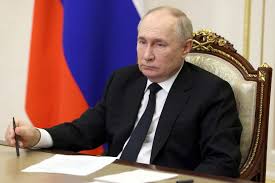
Face-to-face negotiations can take place, but only after a final long-term peace agreement is fully prepared, the Russian president has stressed
9 May, 2026 , https://www.rt.com/russia/639812-putin-names-condition-for-meeting-zelensky/
Russian President Vladimir Putin has stated that a meeting with Ukraine’s Vladimir Zelensky could take place “anywhere,” including in a third country, but only after a final long-term peace agreement is fully prepared and ready for signing.
“The Ukrainian side and Mr. Zelensky, they are ready to have a personal meeting… We have never refused,” Putin said during a press conference after Victory Day celebrations on May 9. “We can meet in the third country as well, but only after there is an ultimate agreement regarding a peace deal that must be a long-term deal.”
He stressed that the meeting should be the “final thing,” the signing ceremony, and not turn into negotiations. Recalling the Minsk Accords experience, Putin noted: “We can speak hours, day and night and it would yield no results. We need specialists to take care of that… then we can meet, we can sign.”
During the same May 9 briefing, Putin declared that the Ukraine conflict “is heading towards the end.”
These remarks came one day after US President Donald Trump expressed hope that the ceasefire declared by Moscow on May 8 could lead to the fighting wrapping up soon.
Last December, Putin reiterated that Russia seeks a peaceful resolution of the Ukraine conflict provided its root causes are eliminated.
Russia’s Threat Of A Massive Retaliatory Strike On Kiev Likely Isn’t A Bluff
Andrew Korybko, May 07, 2026, https://korybko.substack.com/p/russias-threat-of-a-massive-retaliatory
Russia can’t afford to discredit itself abroad, nor can Putin’s ruling United Russia party afford to discredit itself at home four months before the next polls, by threatening overwhelming retaliation against Ukraine if it attacks Moscow’s Victory Day parade only to symbolically retaliate or do nothing at all.
The Russian Defense Ministry warned local civilians and the staff of diplomatic missions in Kiev of their country’s plans to launch a massive retaliatory strike on the city center if Ukraine goes through with Zelensky’s threat to attack Moscow’s Victory Day parade on 9 May. This was followed by Russia announcing ballistic missile tests from Kamchatka from 6-10 May. Shortly afterwards, the Russian Foreign Ministry reiterated the Defense Ministry’s warning, thus ensuring that the world is aware of it.
This threat likely isn’t a bluff for three sequential reasons. The first is that Russia wants to deter Ukraine from attacking Moscow’s Victory Day parade for self-evident reasons, both relating to optics and the security of its VIPs, to which end it threatened overwhelming retaliation if this happens. The second reason is that Russia cannot threaten such a response without actually going through with it if provoked, otherwise it would irredeemably discredit itself, and more audacious attacks would then likely follow.
And third, Russia is finally signaling its willingness to overwhelmingly retaliate against decision-making centers in Kiev per the Foreign Ministry’s additionally specified threat in the event of Ukraine carrying out this high-profile provocation due to its hardline Kremlin faction partially superceding its moderate one. To explain, Putin hitherto restrained his military due his belief in “The Historical Unity of Russians and Ukrainians” as well as his concerns about an uncontrollable escalation spiral sparking World War III.
Once Trump returned and responded positively to Putin’s offer of dialogue for resolving the NATO-Russian proxy war in Ukraine, which Biden rejected, Putin and his fellow moderates dangled a resource-centric strategic partnership for incentivizing compromises. The US was receptive to such a partnership, but Russia rejected its demanded compromises that were presented as a precondition, while the US rejected Russia’s own such demands and didn’t coerce compliance from Ukraine or NATO either.
While Trump declined to escalate the Ukrainian Conflict amid this impasse, he still greenlit the rolling back of Russian influence across the world in a bid to coerce Putin into the US’ demanded compromise, namely freezing the conflict in exchange for sanctions relief without resolving the root issues. Informally known as the “Neo-Reagan Doctrine”, it’s placed Russia under pressure in at least 15 different countries, thus discrediting the moderate faction and prompting some among it like Putin to rethink their views.
The Third Gulf War, in which Iran attacked regional US bases without triggering an uncontrollable escalation spiral, then convinced Putin to finally listen to the hardliners who’ve been urging massive strikes on Ukrainian decision-making centers in Kiev since the get-go. Public opinion, which is important ahead of September’s next Duma elections, has long aligned with the hardliners on this issue. Putin now seems to have assented but only in retaliation to Ukrainian attacks against Moscow’s Victory Day parade.
These factors make it unlikely that Russia is bluffing, in which case the country itself wouldn’t just be discredited abroad, but so too would the ruling United Russia party be discredited in voters’ eyes four months before the next polls. There’s already speculation of a protest vote in support of the communist and nationalist opposition parties, which might prompt various reforms if it happens, but a large-scale one driven by any hypothetical bluff could herald an era of uncertainty that Putin would prefer to avoid.
The story of the cooks of Chernobyl, 40 years later
Vikram Doctor, ET BureauLast May 03, 2026,
https://economictimes.indiatimes.com/magazines/panache/the-story-of-the-cooks-of-chernobyl-40-years-later/articleshow/130728007.cms
Synopsis
Forty years ago, a nuclear disaster struck Chernobyl. Women from Rivne Nuclear Power Plant were sent to cook for clean-up crews. They faced radiation and health problems. Food meant for workers was often wasted or contaminated. Some food was smuggled out. Decades later, these women fight for promised pensions. Their experiences offer insight into the disaster’s lasting impact.
When Raya heard of a nuclear power plant accident, she turned to Ukraine’s Rivne Nuclear Power Plant close by: “We looked at our gherkin barrels — that’s what we call our power plant chimneys — and we could see there was nothing wrong with them.” But then the truth emerged: The accident was at their sister plant in Chernobyl, 180 miles east, and Raya had to go there to cook.
It has been 40 years since the world’s worst nuclear disaster and so much has been written and filmed about Chernobyl. But Polish writer Witold Szablowski found a little-known story for his book What’s Cooking in the Kremlin, a history of Russia through food. Szablowski knew how, even in the worst disasters, those working to save the situation had to eat, so someone had to cook for them. He found seven women alive, out of a group of 15 sent from Rivne after the disaster.
All the women suffered health issues, though not being in the actual plant spared them a bit. Dosimeters, to measure radiation, were placed at the entrance of the canteen, and when clean-up workers came from the plant, their buzzing became frantic and continuous. “It was a dreadful sound,” recalled Valentina, the head of the group.
Finally, the dosimeters were removed. Why remind people about radiation, when nothing could be done? The countryside around Chernobyl was abandoned. Raya recalled cows “mooing pitifully, because the people had been taken away and there was no one to milk them”. The canteen had also been abandoned. An earlier group of cooks were so terrified, they fled through the forest. That act had probably sealed their death warrants since Chernobyl’s forest was one of the worstaffected areas.
Food shortages were the norm in the latter days of the Soviet Union, but a guilty state ensured Chernobyl’s workers were given the best meats, dairy and fruit from across the country. “There was a whole sea of produce there,” Luba, another cook, recalled. “Little cubes of butter, full-fat cream — it sounds funny, but in those days, under Gorbachev, that was a real delicacy.” Workers had to drink glasses of cream, perhaps in the hope that its calcium would counter the depletion in their bones ..
Yet this food, which would normally have been the stuff of fantasies for people, was mostly wasted. Workers just wanted fruit juices and vodka. “They were burning up Witold. Burning up from inside,” Olga said. It was hard for the cooks to see such food disregarded. By habit, Luba would tell workers to take chocolate and give it to a kid, if they didn’t want it for themselves. Then she realised the food was contaminated by just being there, and no kid should have it.
Inevitably, some food was smuggled out. In Nobel Prize winner Svetlana Alexievich’s Voices from Chernobyl , one woman tells her how, in the months of fear afterwards, she only bought the most expensive meats to be safe: “Then we found out it was the expensive salami that they mixed contaminated meat into, thinking, well, since it was expensive, fewer people would buy it.” It is almost grimly comic how quickly the usual compromises and corruptions of life reasserted themselves.
Decades later, Valentina is fighting for the special pensions they were promised. An agent says she’ll arrange it for a thousand dollars — and tells an outraged Valentina that it’s a discount: “She charged those who hadn’t been in Chernobyl several thousand.”
Chernobyl’s 40th anniversary has been marked by articles lamenting how it set back nuclear power for decades. Sam Dumitriu, a British policy analyst, notes with some puzzlement that polls show women are far less likely to support nuc ..
40 years after Chernobyl, Stasi files reveal scale of Soviet misinformation
For decades, researchers, political leaders and advocacy groups have worked to uncover the story of the explosion
Lauren Cassidy The Conversation, Monday 27 April 2026, https://www.independent.co.uk/news/world/europe/chernobyl-disaster-anniversary-secret-stasi-files-b2965335.html
On April 26, 1986, Soviet engineers at the Chernobyl nuclear power plant were conducting a safety test. Doomed by a fatal design flaw and pushed to the limit by human negligence, reactor 4 exploded amid an attempted shutdown during a routine procedure, setting off a chain of events that ultimately released radioactive material hundreds of times greater than that of the atomic bomb dropped on Hiroshima.
Although the accident occurred north of Kyiv, Ukraine, near the border with Belarus, radioactive fallout was soon detected throughout northern and central Europe. Yet the Soviets did what they could to prevent the spread of information that would reveal the true horror of what had occurred.
For decades, researchers, political leaders and advocacy groups have worked to uncover the story of the explosion. While science has allowed us to understand the circumstances of the explosion itself, it has taken much more work to uncover the layers of mismanagement, negligence and misinformation that resulted in human suffering, ecological disaster and economic damage.
One of the problems is that many of the official Soviet records of the event, such as the KGB files, are located in Moscow and are inaccessible to all but a few Russian government agencies.
But there is a partial workaround: Because East Germany was a Soviet satellite state and not a full member of the Soviet Union, official documents remained in the country after the fall of the Berlin Wall. In 1991, after the reunification of Germany, the German government passed a law allowing for the declassification of certain files from the Stasi, East Germany’s secret police and intelligence service. These files can now give us further insight into the mismanagement of Chernobyl, since the East German Stasi and the Soviet KGB were in communication on the matter.
I have spent the past three years reading Stasi files and researching the creation of misinformation in the former Eastern bloc, meeting with Stasi archivists in Berlin and viewing the original archival rooms in the former Stasi headquarters.
Looking at formerly top secret communication between the KGB and Stasi, it is clear that despite publicly insisting everything was under control, both intelligence agencies knew the explosion was absolutely devastating. They kept detailed records of hospitalizations, casualties, damaged crops, contaminated livestock and radiation levels.
But only the very top officials in East Germany and the Soviet Union had access to these numbers. The main fear for both the KGB and Stasi was not the radiation that would harm affected populations but the damage done to their respective countries’ reputations.
Controlling the message
Handling the press was a top priority.
In the Soviet Union, top government officials created their own briefings for the media to be published at precise dates and times. In a set of classified documents that one government official bravely saved and later published, the concreteness with which the lies were devised is apparent. It documents Mikhail Gorbachev, then-leader of the Soviet Union, saying in a Politburo meeting with top government officials: “When we inform the public, we should say that the power plant was being renovated at the time, so it doesn’t reflect badly on our reactor equipment.”
Later in the same meeting, another senior Soviet official, Nikolai Ryzhkov, suggests that the group prepare three different press releases: one for the Soviet people, one for the satellite states and another for Europe, the U.S. and Canada.
In East Germany, the Stasi reports mirrored this messaging. Although top officials are briefed on the presence of radioactive contaminants, the formerly classified Stasi files reiterate that the public is to be told that “absolutely no danger” is present. East German media, controlled by the state, then disseminated this information to the public.
The problem for the East German state was that by the mid-1980s, a lot of people were able to pick up Western TV and radio signals. Many recognized that their own government wasn’t telling them the truth. However, they also knew that Western media would take any chance they got to disparage the Eastern bloc. The result was that many people knew that they weren’t being told the truth, but they weren’t sure exactly what the truth was.
Much of the East German and Soviet propaganda at that time was designed to confuse and cast doubt, not necessarily to fully persuade. The idea was that enough conflicting information would tire people out.
Downplaying economic concerns
One of the Stasi’s major concerns following the disaster was the economic damage that was sure to affect East Germany. Once people began to learn of the radioactive fallout over much of Europe, they grew fearful of their own produce and dairy products.
Children began refusing to drink milk at school, while people frequently asked produce vendors whether their products were grown in a greenhouse or outdoors. On the whole, people stopped buying many of these products.
With an excess of these goods, the East German government needed to devise a plan to continue to make money off potentially contaminated goods. The Stasi’s solution was to increase export of these goods to West Germany.
In the formerly classified files, Stasi officials claim that exports would spread out the consumption of radioactive products, so that no one would consume unsafe levels of contaminated meat and produce.
The problem for the East Germans was that West Germany quickly amended their regulations for border crossings from East to West. Vehicles emitting certain levels of radiation were no longer allowed across the border. As a response, the lower-ranking Stasi workers were required to clean radioactive vehicles themselves. In doing so, the state was knowingly risking the health and safety of its own officials.
The East German food export plan was modeled on a similar one proposed by the Soviet government. The Soviet strategy, however, was not to export contaminated goods abroad but rather to send contaminated meat products to “the majority of regions” in the Soviet Union “except for Moscow.”
How disinformation proved an Achilles’ Heel
When the Stasi was founded in 1950, many of its employees genuinely believed in the East German cause.
Having witnessed the horrors of Nazi Germany, many older Stasi workers saw the East German state as the answer to creating a just and equitable society. By the 1980s, however, this sentiment had grown rare. Instead, many Stasi workers viewed their jobs as means to a decent income and privileged government treatment.
As a result, many Stasi workers had grown disillusioned and dispassionate.
It was little surprise, then, that the Stasi put up little resistance when protesters stormed their headquarters in 1990, months after the Berlin Wall fell. While there are many factors in the demise of the communist bloc, the way the East German and Soviet governments handled the aftermath of Chernobyl contributed greatly to the growing popular sentiment against each regime.
In East Germany, the disinformation campaign after the nuclear disaster only strengthened the message that the state did not have its people’s best interests in mind and that it was willing to sacrifice their health and well-being in order to maintain a certain image.
Horror as Russia ‘plans nuclear weapon in space’ that could cause global chaos
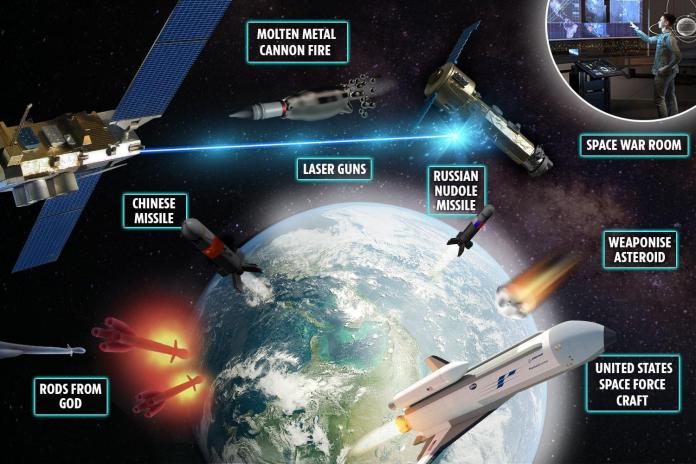
Gen Whiting believes the next major global conflict will “likely be a war that starts in space”. He said rival nations have watched how heavily the US and its allies rely on satellites and space technology for modern warfare
General Stephen Whiting, head of US Space Command, said America was ‘very concerned’ about Russian plans to put a nuclear weapon in space that would target satellites
Tim Hanlon News Reporter and Catherine Mackinlay, 16 Apr 2026
Russia is feared to be planning to put a nuclear weapon in space that is capable of sparking global chaos by targeting satellites.
A United States military chief has warned Moscow is considering using a nuclear anti-satellite weapon which could destroy thousands of satellites and cause communications disruption across the world, dubbing it a “Space Pearl Harbor”.
General Stephen Whiting, head of US Space Command, said America was “very concerned” about the Kremlin’s plans, which he said form part of a wider pattern of Russian aggression in space since the war in Ukraine began.
The four-star general warned Russia has already been carrying out “sustained satellite communication and GPS jamming” on such a scale that it is “putting civilian airliners at risk”.
Speaking on The Times podcast The General & The Journalist, Gen Whiting said: “Russia remains a sophisticated space power and they continue to invest in counter-space weapons. They are thinking about placing in orbit a nuclear anti-satellite weapon that would hold at risk everyone’s satellites in low Earth orbit, and that would be an outcome that we just couldn’t tolerate.”
He said Russia sees the US and NATO as too strong in conventional warfare and believes attacking space systems could “level the battlefield”.
Gen Whiting said: “From a Russian perspective, they look at the United States, they look at NATO and they see an overmatch there of conventional arms.
“And they believe that novel ways of trying to undermine the United States and NATO, such as by neutralising our space capabilities, helps them to level the battlefield. I won’t speak about our intelligence sources and methods, but obviously it’s a report that we’re very concerned about.”
A nuclear weapon in orbit would be a major breach of the Outer Space Treaty, which Russia has signed. The warning is the strongest public intervention yet from a senior US military officer on the threat posed by Moscow.
Russia’s alleged ambitions first emerged in February 2024 when Pentagon officials briefed members of Congress behind closed doors. Since then, the US House intelligence committee has been pressing the White House to declassify information about the project so politicians can discuss the scale of the threat.
Experts fear a nuclear blast in low Earth orbit could destroy up to 10,000 satellites – around 80% of all those currently in space. Military intelligence, communications, internet, mobile phone services and GPS could all be crippled.
Gen Whiting also warned Russia’s GPS jamming is already affecting civilian flights across eastern and southern Europe. He said: “When we put at risk civilian airliners full of citizens just trying to go on business or holiday, that’s incredibly problematic.”
He said both Russia and China are rapidly building space weapons, with Beijing developing jammers, directed energy weapons and anti-satellite rockets. The general urged Sir Keir Starmer’s government to spend far more on Britain’s space defences, with the UK spending less than 1% of its defence budget on space, compared with 4% in Germany and 3% in France.
Gen Whiting believes the next major global conflict will “likely be a war that starts in space”. He said rival nations have watched how heavily the US and its allies rely on satellites and space technology for modern warfare.
Despite the growing space arms race, he insisted a conflict in orbit is “not inevitable”. He added: “Our goal each and every day is to wake up and deter that from happening so that mankind can continue to take advantage of all the benefits of space.”
A good documentary on Chernobyl on SBS available On Demand for the next 3 weeks.

8 April 2026,
https://www.sbs.com.au/ondemand/tv-program/chernobyl-the-lost-tapes/2352741955560
A good documentary on Chernobyl was on SBS tonight, available On Demand for the next 4 weeks.
A lot of original footage and interviews.
So many lies and coverups by the Soviet Union. Doctors were forbidden from diagnosing health issues caused by radiation and said people instead had “radiophobia”.
I remember originally seeing the scenes of the “bio-robot liquidators” – young army men who shoveled radioactive debris off the roof after the German robot failed. 80% of them died. It was heartbreaking.
8.4 million Soviet people were exposed to radiation. It’s unknown how many died, but it’s estimated at 200,000. though the official death toll is 31, which pro-nukers like to shout about.
IDF threatens ‘elimination’ for Russian leaders who ‘wish Israel ill’
Wyatt Reed·March 18, 2026, https://thegrayzone.com/2026/03/18/idf-threatens-elimination-for-russian-leaders-who-wish-israel-ill/
Israel’s veiled threat to Moscow came just after Russian media warned traffic cameras in Moscow were vulnerable to the same exploits that Israel reportedly used to monitor Ayatollah Khamenei’s residence before assassinating him.
Israeli military spokeswoman Anna Ukolova has drawn outrage in Moscow after threatening that Russian authorities who “wish Israel ill” could be subject to “elimination,” while suggesting Israel could hack into Russian closed-circuit television cameras to identify and track targets.
Asked by a journalist with Russian radio broadcaster RBC whether Israel had access to Russian traffic cameras, Ukolova declined to answer directly but warned that “Khamenei’s elimination shows our capabilities are serious” and that “no one who wishes us harm will be left aside.”
She added, ominously, “I hope Moscow does not wish Israel ill right now – I’d like to believe that.”
In response to a post by Russian philosopher Alexander Dugin, who wrote that the IDF spokeswoman threatened that “Russian authorities [will] be killed if they take [an] anti-Israel position,” Ukolova claimed Dugin was spreading “fake news.” But she declined to clarify how her remarks had been incorrectly interpreted.
Ukolova’s statements came just days after it was revealed that a large number of Russian CCTVs were potentially using BriefCam – an Israeli video analysis software that closely matches the description of a program the Netanyahu regime reportedly deployed to track Iranian movements outside the home of Iran’s Supreme Leader before they assassinated him during their February 28 sneak attack.
On March 12, Russian outlet Mash revealed that the Israeli software BriefCam “has been used in Russia by private providers since the 2010s.” Founded at Israel’s Hebrew University in 2007, BriefCam uses AI to let users “review hours of video in minutes” and “make [their] video searchable, actionable and quantifiable.” In 2024, BriefCam was absorbed by a Dutch subsidiary of the Canon Group named Milestone Systems, which publicly pledges to “amplify what organizations of any size can see, do and achieve with video.”
“Our patented VIDEO SYNOPSIS® technology condenses hours of surveillance into a short summary by overlaying multiple events—each tagged with its original timestamp—onto a single frame, letting you filter them by object type and attributes,” the company’s BriefCam page crows. An analysis by Al Jazeera revealed those attributes include “gender, age group, clothing, movement patterns and time spent in a given location.”
Originally deployed by Israel’s Ministry of Housing and Construction to safeguard illegal settlements in occupied East Jerusalem, BriefCam has been used by governments all over the world, including those in the United Kingdom, New Zealand, Pakistan, Israel, Mexico, United Arab Emirates, Canada, Indonesia, Singapore, Thailand, Brazil, Germany, South Africa, Netherlands, Australia, Japan, India, Spain, Taiwan. It’s also been deployed in the US, with police in Hartford, Connecticut adopting the software in 2022. In 2025, a French court found the government’s use of BriefCam was illegal, citing multiple violations of French and European privacy laws.
As of publication, BriefCam appears to be incorporated into dozens of so-called “video monitoring systems,” including Milestone’s own VMS XProtect surveillance system.
According to the Russian outlet Mash, a number of prominent Moscow businesses, institutions, and buildings use VMS XProtect surveillance system, including the Institute of Theoretical and Experimental Biophysics of the Russian Academy of Sciences, a 72-story skyscraper named “Eurasia,” and a huge exhibit space known as the Zotov Center. Though Milestone officially ended operations in Russia in 2022 amid the war in Ukraine, Mash reports that some software distributors in Russia “still offer to install the hacked software and hide this in the documents.”
Russia summons Israeli envoy over missile strike on journalists in Lebanon- Zakharova: “Cannot be called accidental”
Russia has told Israeli envoy Oded Joseph that Moscow wanted an investigation into the attack in southern Lebanon wherein two Russian state TV journalists were injured.
Sharangee Dutta, India Today, Fri, 20 Mar 2026, https://www.sott.net/article/505250-Russia-summons-Israeli-envoy-over-missile-strike-on-journalists-in-Lebanon-Zakharova-Cannot-be-called-accidental
The Russian Foreign Ministry summoned Israeli envoy Oded Joseph on Friday to lodge a formal protest over an Israeli missile strike in southern Lebanon in which two Russian state TV journalists were injured, TASS reported. Moscow has told Joseph that they want an investigation into the attack, which happened on Thursday, and want assurances that such incidents would not be repeated.
A video of the strike, which landed barely 10 metres away from the filming location of RT correspondent Steve Sweeney and his cameraman Ali Rida, was captured on the latter’s camera. Sweeney ducked for cover just in time with the viral clip showing how the strike turned the site into a massive ball of fire.
Both of them survived the attack and received treatment at a local hospital. In one of the videos posted by Rida, doctors are seen removing shrapnel from Sweeney’s arm. The cameraman alleged that Israel intentionally struck the area despite their jackets displaying press credentials.
Russian Foreign Ministry spokesperson, Maria Zakharova, echoed Ali Rida, and condemned the strike. Taking to Telegram, she posted that the attack on the journalists wearing press jackets “cannot be called accidental” considering the killing of 200 correspondents in Gaza.
“Especially since the rocket did not hit a ‘significant strategic military facility’, but rather the location where the report was being filmed,” Zakharova wrote on the social media platform, adding that Moscow was waiting for a response from the international organisation.
Sweeney and Rida were filming near a local military base in southern Lebanon, close to the Al-Qasmiya Bridge. The site is a crucial crossing point over the River Litani, which has faced constant Israeli strikes over the past few days. Israel has claimed that the river crossings are being used by the Iran-supported group Hezbollah to move fighters and weapons amid the war.
In response, Israel said that it had repeatedly given warnings for civilians and residents to move out of the area and that the strike was launched after adequate time had passed. It also stressed that Tel Aviv does not target civilians or journalists and functions in accordance with international law.
Russian hospitals hit, strikes on kindergartens: Does Ukraine think everyone’s distracted by Iran?
At least 23 Russian civilians have been killed in Ukrainian strikes, some using Western-supplied Storm Shadow missiles
13 Mar, 2026 , https://www.rt.com/russia/634854-kiev-strikes-russia-civilians-attention-iran/
On the same day the Ukrainian military used a UK-supplied Storm Shadow missile to attack the city of Bryansk, about 100 kilometers from the Ukrainian border, killing at least seven civilians and wounding at least 42 people. Using such a weapon is impossible without the direct involvement of British military specialists.
On March 8, International Women’s Day and a public holiday in Russia, a family of four, including a six-year-old boy, were killed and twelve others injured by a wave of Ukrainian strikes on the DPR.
On March 6, two people were killed when Ukrainian drone dropped explosives on civilians outside a grocery store in Russia’s Kherson Region. A drone raid on the city of Novorossiysk in southern Russia on March 4 injured seven and caused extensive damage, including to kindergartens.
The DPR, along with the neighboring Lugansk People’s Republic (LPR), seceded from Ukraine following a Western-backed coup in Kiev in 2014. The two territories, along with Zaporozhye Region and Kherson Region, joined Russia following referendums in September 2022.
Civilians in Russia’s border regions have been consistently targeted by Ukrainian drones throughout the conflict, with Moscow accusing Kiev of “terrorism.”
Moscow has insisted that Kiev is attacking civilians because it cannot halt Russian advances on the battlefield. Ukrainian officials claim that inflicting sufficient economic damage will force the Kremlin to abandon its objectives in the four-year conflict.
Beyond civilian casualties, Ukraine has also been attacking energy infrastructure. Pipeline operator Gazprom reported on Wednesday that some of its compressor stations, including one serving the TurkStream pipeline, had been hit. The Russian Defense Ministry has accused Kiev of seeking to disrupt deliveries to European consumers.
Year 4: The Timeline That Tells the Tale
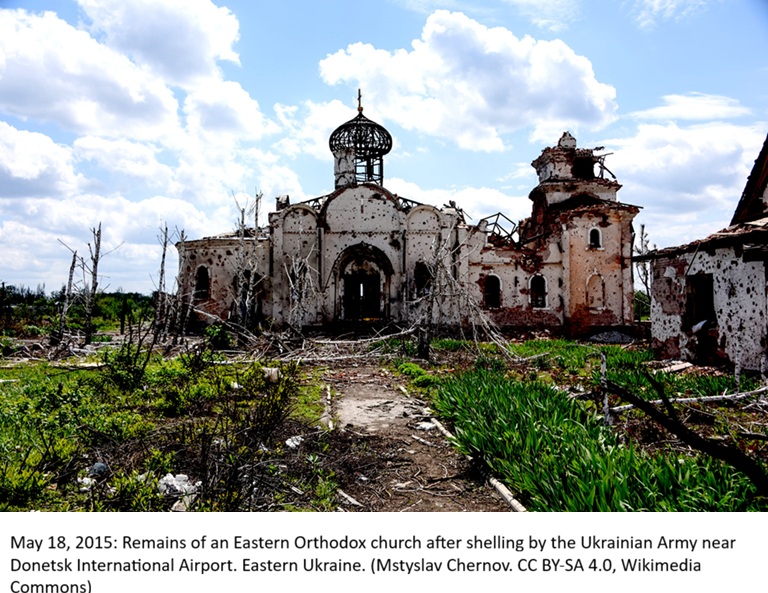
Without historical context, which is buried by corporate media, it’s impossible to understand the war in Ukraine. Historians will tell the story, but journalists are cut short for trying to tell it now.
By Joe Lauria, Consortium News, February 24, 2026
The way to prevent the Ukraine war from being understood is to suppress its history.
A cartoon version has the conflict beginning on Feb. 24, 2022 when Vladimir Putin woke up that morning and decided to invade Ukraine.
There was no other cause, according to this version, other than unprovoked, Russian aggression against an innocent country.
Please use this short, historical guide to share with people who still flip through the funny pages trying to figure out what’s going on in Ukraine.
The mainstream account is like opening a novel in the middle of the book to read a random chapter as though it’s the beginning of the story.
Thirty years from now historians will write about the context of the Ukraine war: the coup, the attack on Donbass, NATO expansion, and the rejection of the Minsk Accords and Russian treaty proposals without being called Putin puppets.
It will be the same way historians today write of the Versailles Treaty as a cause of Nazism and WWII, without being called Nazi-sympathizers.
Providing context is taboo while the war continues in Ukraine, as it would have been during WWII. Context is paramount in journalism.
But journalists have to get with the program of war propaganda while a war goes on. Journalists are clearly not afforded the same liberties as historians. Long after the war, historians are free to sift through the facts.
THE UKRAINE TIMELINE
World War II— Ukrainian national fascists, led by Stepan Bandera, at first allied with the German Nazis, massacre more than a hundred thousands Jews and Poles.
1950s to 1990 – C.I.A. brought Ukrainian fascists to the U.S. and worked with them to undermine the Soviet Union in Ukraine, running sabotage and propaganda operations. Ukrainian fascist leader Mykola Lebed was taken to New York where he worked with the C.I.A. through at least the 1960s and was still useful to the C.I.A. until 1991, the year of Ukraine’s independence. The evidence is in a U.S. government report starting from page 82. Ukraine has thus been a staging ground for the U.S. to weaken and threaten Moscow for nearly 80 years.
November 1990: A year after the fall of the Berlin Wall, the Charter of Paris for a New Europe (also known as the Paris Charter) is adopted by the U.S., Europe and the Soviet Union. The charter is based on the Helsinki Accords and is updated in the 1999 Charter for European Security. These documents are the foundation of the Organization for Security and Co-operation in Europe. The OSCE charter says no country or bloc can preserve its own security at another country’s expense.
Dec. 25, 1991: Soviet Union collapses. Wall Street and Washington carpetbaggers move in during ensuing decade to asset-strip the country of formerly state-owned properties, enrich themselves, help give rise to oligarchs, and impoverish the Russian, Ukrainian and other former Soviet peoples.
1990s: U.S. reneges on promise to last Soviet leader Gorbachev not to expand NATO to Eastern Europe in exchange for a unified Germany. George Kennan, the leading U.S. government expert on the U.S.S.R., opposes expansion. Sen. Joe Biden, who supports NATO enlargement, predicts Russia will react hostilely to it.
1997 :: The only thing that could provoke a “vigorous and hostile” Russian response would be needless NATO Expansion Far East right till the border of Russia – Sen. Joe Biden pic.twitter.com/hRW47hLL5y
— Rishi Bagree (@rishibagree) June 17, 2022
1997: Zbigniew Brzezinski, former U.S. national security adviser, in his 1997 book, The Grand Chessboard: American Primacy and Its Geostrategic Imperatives, writes:
“Ukraine, a new and important space on the Eurasian chessboard, is a geopolitical pivot because its very existence as an independent country helps to transform Russia. Without Ukraine, Russia ceases to be a Eurasian empire. Russia without Ukraine can still strive for imperial status, but it would then become a predominantly Asian imperial state.”
New Year’s Eve 1999: After eight years of U.S. and Wall Street dominance, Vladimir Putin becomes president of Russia. Bill Clinton rebuffs him in 2000 when he asks to join NATO.
Putin begins closing the door on Western interlopers, restoring Russian sovereignty, ultimately angering Washington and Wall Street. This process does not occur in Ukraine, which remains subject to Western exploitation and impoverishment of Ukrainian people.
Feb. 10, 2007: Putin gives his Munich Security Conference speech in which he condemns U.S. aggressive unilateralism, including its illegal 2003 invasion of Iraq and its NATO expansion eastward.
He said: “We have the right to ask: against whom is this [NATO] expansion intended? And what happened to the assurances our western partners made after the dissolution of the Warsaw Pact? Where are those declarations today? No one even remembers them.”
Putin speaks three years after the Baltic States, former Soviet republics bordering on Russia, joined the Western Alliance. The West humiliates Putin and Russia by ignoring its legitimate concerns. A year after his speech, NATO says Ukraine and Georgia will become members. Four other former Warsaw Pact states join in 2009.
2004-5: Orange Revolution. Election results are overturned giving the presidency in a run-off to U.S.-aligned Viktor Yuschenko over Viktor Yanukovich. Yuschenko makes fascist leader Bandera a “hero of Ukraine.”
April 3, 2008: At a NATO conference in Bucharest, a summit declaration “welcomes Ukraine’s and Georgia’s Euro-Atlantic aspirations for membership in NATO. We agreed today that these countries will become members of NATO”. Russia harshly objects. William Burns, then U.S. ambassador to Russia, and presently C.I.A. director, warns in a cable to Washington, revealed by WikiLeaks, that,
“Foreign Minister Lavrov and other senior officials have reiterated strong opposition, stressing that Russia would view further eastward expansion as a potential military threat. NATO enlargement, particularly to Ukraine, remains ‘an emotional and neuralgic’ issue for Russia, but strategic policy considerations also underlie strong opposition to NATO membership for Ukraine and Georgia. In Ukraine, these include fears that the issue could potentially split the country in two, leading to violence or even, some claim, civil war, which would force Russia to decide whether to intervene. … Lavrov stressed that Russia had to view continued eastward expansion of NATO, particularly to Ukraine and Georgia, as a potential military threat.”
A crisis in Georgia erupts four months later leading to a brief war with Russia, which the European Union blames on provocation from Georgia.
November 2009: Russia seeks new security arrangement in Europe. Moscow releases a draft of a proposal for a new European security architecture that the Kremlin says should replace outdated institutions such as NATO and the Organization for Security and Cooperation in Europe (OSCE).
The text, posted on the Kremlin’s website on Nov. 29, comes more than a year after President Dmitry Medvedev first formally raised the issue. Speaking in Berlin in June 2008, Medvedev said the new pact was necessary to finally update Cold War-era arrangements.
“I’m convinced that Europe’s problems won’t be solved until its unity is established, an organic wholeness of all its integral parts, including Russia,” Medvedev said.
2010: Viktor Yanukovich is elected president of Ukraine in a free and fair election, according to the OSCE.
2013: Yanukovich chooses an economic package from Russia rather than an association agreement with the EU. This threatens Western exploiters in Ukraine and Ukrainian comprador political leaders and oligarchs.
February 2014: Yanukovich is overthrown in a violent, U.S.-backed coup (presaged by the Nuland-Pyatt intercept), with Ukrainian fascist groups, like Right Sector, playing a lead role. Ukrainian fascists parade through cities in torch-lit parades with portraits of Bandera.
March 16, 2014: In a rejection of the coup and the unconstitutional installation of an anti-Russian government in Kiev, Crimeans vote by 97 percent to join Russia in a referendum with 89 percent turn out. The Wagner private military organization is created to support Crimea. Virtually no shots are fired and no one was killed in what Western media wrongly portrays as a “Russian invasion of Crimea.”
April 12, 2014: Coup government in Kiev launches war against anti-coup, pro-democracy separatists in Donbass. Openly neo-Nazi Azov Battalion plays a key role in the fighting for Kiev. Wagner forces arrive to support Donbass militias. U.S. again exaggerates this as a Russian “invasion” of Ukraine. “You just don’t in the 21st century behave in 19th century fashion by invading another country on completely trumped up pre-text,” says U.S. Secretary of State John Kerry, who voted as a senator in favor of the U.S. invasion of Iraq in 2003 on a completely trumped up pre-text.
May 2, 2014: Dozens of ethnic Russian protestors are burnt alive in a building in Odessa by neo-Nazi thugs. Eight days later, Luhansk and Donetsk declare independence and vote to leave Ukraine.
Sept. 5, 2014: First Minsk agreement is signed in Minsk, Belarus by Russia, Ukraine, the OSCE, and the leaders of the breakaway Donbass republics, with mediation by Germany and France in a Normandy Format. It fails to resolve the conflict.
Feb. 12, 2015: Minsk II is signed in Belarus, which would end the fighting and grant the republics autonomy while they remain part of Ukraine. The accord was unanimously endorsed by the U.N. Security Council on Feb. 15. In December 2022 former German Chancellor Angela Merkel admits West never had intention of pushing for Minsk implementation and essentially used it as a ruse to give time for NATO to arm and train the Ukraine armed forces.
2016: The hoax known as Russiagate grips the Democratic Party and its allied media in the United States, in which it is falsely alleged that Russia interfered in the 2016 U.S. presidential election to get Donald Trump elected. The phony scandal serves to further demonize Russia in the U.S. and raise tensions between the nuclear-armed powers, conditioning the public for war against Russia.
May 12, 2016: U.S. activates missile system in Romania, angering Russia. U.S. claims it is purely defensive, but Moscow says the system could also be used offensively and would cut the time to deliver a strike on the Russian capital to within 10 to 12 minutes.
June 6, 2016: Symbolically on the anniversary of the Normandy invasion, NATO launches aggressive exercises against Russia. It begins war games with 31,000 troops near Russia’s borders, the largest exercise in Eastern Europe since the Cold War ended. For the first time in 75 years, German troops retrace the steps of the Nazi invasion of the Soviet Union across Poland.
German Foreign Minister Frank Walter-Steinmeier objects. “What we shouldn’t do now is inflame the situation further through saber-rattling and warmongering,” Steinmeier stunningly tells Bild am Sontag newspaper. “Whoever believes that a symbolic tank parade on the alliance’s eastern border will bring security is mistaken.”
Instead Steinmeier calls for dialogue with Moscow. “We are well-advised to not create pretexts to renew an old confrontation,” he warns, adding it would be “fatal to search only for military solutions and a policy of deterrence.”
December 2021: Russia offers draft treaty proposals to the United States and NATO proposing a new security architecture in Europe, reviving the failed Russian attempt to do so in 2009. The treaties propose the removal of the Romanian missile system and the withdrawal of NATO troop deployments from Eastern Europe. Russia says there will be a “technical-military” response if there are not serious negotiations on the treaties. The U.S. and NATO reject them essentially out of hand.
February 2022: Russia begins its military intervention into Donbass in the still ongoing Ukrainian civil war after first recognizing the independence of Luhansk and Donetsk.
Before the intervention, OSCE maps show a significant uptick of shelling from Ukraine into the separatist republics, where more than 10,000 people have been killed since 2014.
March-April 2022: Russia and Ukraine agree on a framework agreement that would end the war, including Ukraine pledging not to join NATO. The U.S. and U.K. object. Prime Minister Boris Johnson flies to Kiev to tell Ukrainian President Volodymyr Zelensky to stop negotiating with Russia. The war continues with Russia seizing much of the Donbass.
March 26, 2022: Biden admits in a speech in Warsaw that the U.S. is seeking through its proxy war against Russia to overthrow the Putin government. Earlier in March he overruled his secretary of state on establishing a no-fly zone against Russian aircraft in Ukraine. Biden opposed the no-fly zone, he said at the time, because “that’s called World War III, okay? Let’s get it straight here, guys. We will not fight the third world war in Ukraine.”
September 2022: Donbass republics vote to join Russian Federation, as well as two other regions: Kherson and Zaporizhzhia.
May 2023: Ukraine begins counter-offensive to try to take back territory controlled by Russia. As seen in leaked documents earlier in the year, U.S. intelligence concludes the offensive will fail before it begins.
June 2023: A 36-hour rebellion by the Wagner group fails, when its leader Yevegny Prigoshzin takes a deal to go into exile in Belarus. The Wagner private army, which was funded and armed by the Russian Ministry of Defense, is absorbed into the Russian army. The Ukrainian offensive ends in failure at the end of November.
September 2024: Biden deferred to the realists in the Pentagon to oppose long-range British Storm Shadow missiles from being fired by Ukraine deep into Russia out of fear it would also lead to a direct NATO-Russia military confrontation with all that that entails.
Putin warned at the time that because British soldiers on the ground in Ukraine would actually launch the British missiles into Russia with U.S. geostrategic support, it “will mean that NATO countries — the United States and European countries — are at war with Russia. And if this is the case, then, bearing in mind the change in the essence of the conflict, we will make appropriate decisions in response to the threats that will be posed to us.”
November 2024: After he was driven from the race and his party lost the White House, a lame duck Biden suddenly switched gears, allowing not only British, but also U.S. long-range ATACMS missiles to be fired into Russia. It’s not clear that the White House ever informed the Pentagon in advance in a move that risked the very World War III that Biden had previously sought to avoid.
February 2025: The first direct contact between senior leadership of the United States and Russia in more than three years takes place, with a phone call between the countries’ presidents, and a meeting of foreign ministers in Saudi Arabia. They agree to begin negotiations to end the war.
August 15, 2025: Donald Trump and Vladimir Putin meet in Anchorage, Alaska for the first face-to-face meeting between U.S. and Russian leaders in more than four years. The Russians left believing Trump had thoroughly understood their position against a ceasefire and instead their desire to reach a comprehensive solution to the war that addressed the “root causes” and Russian security concerns, which have been outlined in this timeline. A series of follow-up diplomatic meetings have failed to advance that goal and the conflict continues to be decided on the battlefield with Russian gains as well as an increase in missiles being fired into each nations territory.
This timeline clearly shows an aggressive Western intent towards Russia, and how the tragedy could have been avoided if NATO would not allow Ukraine to join; if the Minsk accords had been implemented; and if the U.S. and NATO negotiated a new security arrangement in Europe, taking Russian security concerns into account.
Joe Lauria is editor-in-chief of Consortium News and a former U.N. correspondent for The Wall Street Journal, Boston Globe, and numerous other newspapers, including The Montreal Gazette and The Star of Johannesburg. He was an investigative reporter for the Sunday Times of London, a financial reporter for Bloomberg News and began his professional work as a 19-year old stringer for The New York Times. He is the author of two books, A Political Odyssey, with Sen. Mike Gravel, foreword by Daniel Ellsberg; and How I Lost By Hillary Clinton, foreword by Julian Assange. He can be reached at joelauria@consortiumnews.com and followed on Twitter @unjoe
1 This Month
10 June – Assessing Canada’s Investments in Small Modular Nuclear Reactors – https://zoom.us/meeting/register/IiqHA5feRhaEBycOLNTJlA#/registration


Cuba Is Not a Failed State – It Is a Besieged State
PETITION: “Global Appeal to Endorse Palestinian Right of Return of Refugees”
To see nuclear-related stories in greater depth and intensity – go to https://nuclearinformation.wordpress.com
-
Archives
- June 2026 (79)
- May 2026 (306)
- April 2026 (356)
- March 2026 (251)
- February 2026 (268)
- January 2026 (308)
- December 2025 (358)
- November 2025 (359)
- October 2025 (376)
- September 2025 (257)
- August 2025 (319)
- July 2025 (230)
-
Categories
- 1
- 1 NUCLEAR ISSUES
- business and costs
- climate change
- culture and arts
- ENERGY
- environment
- health
- history
- indigenous issues
- Legal
- marketing of nuclear
- media
- opposition to nuclear
- PERSONAL STORIES
- politics
- politics international
- Religion and ethics
- safety
- secrets,lies and civil liberties
- spinbuster
- technology
- Uranium
- wastes
- weapons and war
- Women
- 2 WORLD
- ACTION
- AFRICA
- Atrocities
- AUSTRALIA
- Christina's notes
- Christina's themes
- culture and arts
- Events
- Fuk 2022
- Fuk 2023
- Fukushima 2017
- Fukushima 2018
- fukushima 2019
- Fukushima 2020
- Fukushima 2021
- general
- global warming
- Humour (God we need it)
- Nuclear
- RARE EARTHS
- Reference
- resources – print
- Resources -audiovicual
- Weekly Newsletter
- World
- World Nuclear
- YouTube
-
RSS
Entries RSS
Comments RSS
 nuclear-news