Heatwaves, floods and wildfires pose rising threat to democracy, report finds

Democracy is under mounting threat from the climate crisis, with new
analysis documenting how elections are increasingly shaped not only by
political forces but also by floods, wildfires and extreme weather.
At least 94 elections and referendums across 52 countries have been disrupted
by climate-related impacts over the last two decades, researchers found. As
risks intensify, the pressure on already fragile democratic systems –
particularly in Africa and Asia – is forecast to grow.
The findings, from
the International Institute for Democracy and Electoral Assistance, an
intergovernmental organisation that aims to support democracy around the
world, is the first global analysis of how natural hazards are affecting
elections.
Guardian 22nd April 2026, https://www.theguardian.com/global-development/2026/apr/22/climate-change-extreme-weather-heatwaves-floods-wildfires-threat-democracy-elections
Critical Atlantic current significantly more likely to collapse than thought

The critical Atlantic current system appears significantly more likely to
collapse than previously thought after new research found that climate
models predicting the biggest slowdown are the most realistic.
Scientists called the new finding “very concerning” as a collapse would have
catastrophic consequences for Europe, Africa and the Americas. The Atlantic
meridional overturning circulation (Amoc) is a major part of the global
climate system and was already known to be at its weakest for 1,600 years
as a result of the climate crisis.
Scientists spotted warning signs of a
tipping point in 2021 and know that the Amoc has collapsed in the Earth’s
past. Climate scientists use dozens of different computer models to assess
the future climate. However, for the complex Amoc system, these produce
widely varying results, ranging from some that indicate no further slowdown
by 2100 to those suggesting a huge deceleration of about 65%, even when
carbon emissions from fossil fuel burning are gradually cut to net zero.
The research combined real-world ocean observations with the models to
determine the most reliable, and this hugely reduced the spread of
uncertainty. They found an estimated slowdown of 42% to 58% in 2100, a
level almost certain to end in collapse.
Guardian 15th April 2026, https://www.theguardian.com/environment/2026/apr/15/critical-atlantic-current-significantly-more-likely-to-collapse-than-thought
New Nuclear Is Too Late and Too Costly for the Climate Crisis

14 April 2026, Paul Dorfman, https://bennettinstitutesussex.org/stories/nuclear-is-too-late-and-too-costly-for-the-climate-crisis/
Dr Paul Dorfman, Bennett Scholar, makes a clear and evidence based case: new nuclear power cannot play a meaningful role in addressing the climate or energy crises. It is not simply expensive, it is structurally misaligned with the speed, scale and affordability required for effective climate action.
In the report, ‘Debt, Delays, Dependencies. Why Public Banks
Should Not Support Nuclear Power‘, Dr Dorfman’s contribution makes clear that new nuclear power represents a policy dead end, diverting scarce resources away from climate‑effective solutions. The opportunity cost is enormous: every pound invested in nuclear is a pound not invested in renewables, energy efficiency, storage or grid resilience. New nuclear is already too late. The renewable transition is happening now – and smart policy must move with it.
Key Findings
Dr Dorfman shows that time is the critical constraint. New nuclear projects consistently take 15–20 years from planning to operation, with average construction overruns of more than 60%. In contrast, wind and solar projects move from planning to generation in months to a few years, making them vastly more effective in the decisive decade for emissions reduction. The Intergovernmental Panel on Climate Change (IPCC) has concluded that renewables are now up to ten times more effective at cutting emissions than new nuclear, underscoring the urgency of choosing technologies that can deliver now rather than decades from now.
Cost compounds the problem. Dr Dorfman highlights that new nuclear is the most expensive form of electricity generation. Nuclear projects routinely double their initial cost estimates, while renewable technologies continue to fall rapidly in price due to economies of scale, innovation and fast global deployment.
The chapter also challenges the notion that nuclear complements renewables. Evidence shows that large, inflexible nuclear plants crowd out investment in grids, storage and flexibility – exactly the systems needed to integrate high shares of renewable energy. Meanwhile, renewables already deliver the bulk of new global power capacity, with wind and solar generating significantly more electricity than nuclear worldwide, and expanding at a far faster rate.
Finally, Dr Dorfman highlights a growing but under‑discussed risk: climate change itself threatens nuclear infrastructure. Rising sea levels, heatwaves, floods and water scarcity increasingly disrupt reactor operation, driving up costs and safety risks. Rather than being a climate solution, nuclear power is becoming more vulnerable because of climate impacts, further undermining its viability.
Why this matters for policy and innovation
Dr Dorfman’s chapter, ‘New nuclear: Too late and too costly for the climate and energy crises‘ has a central insight that aligns squarely with the Bennett Institute’s mission to accelerate effective, evidence‑based policy innovation. The persistence of nuclear in policy debates is not driven by outcomes, but by legacy thinking, political inertia and vested interests. Dr Dorfman’s analysis shows that innovation is not about new reactor designs, but about deploying solutions that already work, quickly, affordably and at scale. This research reinforces a core Bennett Institute principle: policy decisions must be grounded in real‑world delivery.
Sea-level rise is a health crisis and we must hold polluters accountable
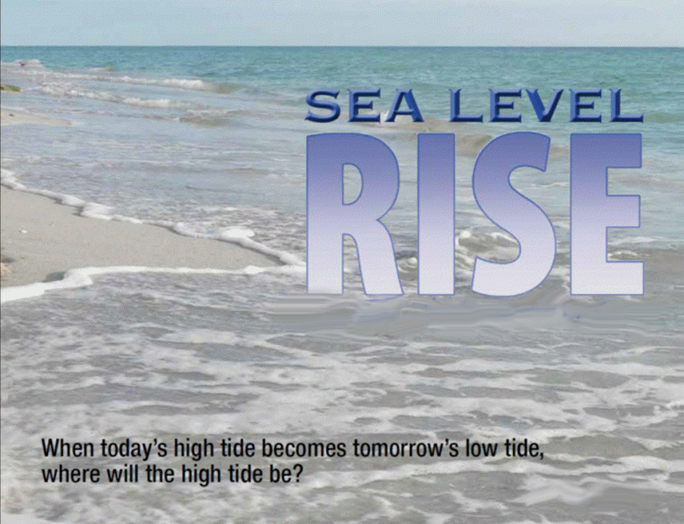
There are moments in history when a crisis long treated as distant reveals
itself to be intimate, immediate and profoundly human. Sea-level rise is
one of those moments.
For years it has been discussed in the abstract
language of centimetres, coastal infrastructure and future projections.
This can make it seem like a technical challenge – something for
engineers and planners to grapple with.
But rising seas are already
damaging bodies, minds, livelihoods and cultures. Sea-level rise is a
present-day health crisis. When saltwater intrudes into freshwater
supplies, health suffers. When floods overwhelm sanitation systems,
diseases spread. When farmland is inundated by king tides, nutrition
deteriorates. And when people are forced to contemplate leaving the land of
their ancestors, they face a painful mix of physical, financial, emotional,
cultural and spiritual harm. The effect of sea-level rise on property lines
and insurance procurement is clear.
But what is being lost goes far deeper
– it’s safety, dignity, continuity and belonging. Across low-lying
coastal regions and small island states, including throughout the Pacific,
communities are living with this reality today. For Indigenous peoples
especially, land is identity, memory, law, kinship, sustenance today and
connection to a shared future.
Guardian 7th April 2026,
https://www.theguardian.com/commentisfree/2026/apr/07/sea-level-rise-health-crisis-christiana-figueres
John Gibbons: I’ve changed my mind on nuclear power — we don’t need it any more

Becoming energy independent is simpler than it’s ever been — wind and solar have the potential to free us from endless energy shocks
Sat, 11 Apr, 2026 , John Gibbons, https://www.irishexaminer.com/opinion/commentanalysis/arid-41825069.html
Nuclear power would, in the future, be “too cheap to meter”. This bold prediction was made by the chair of the US Atomic Energy Commission, Lewis Strauss, in September 1954. This was at the very dawn of the age of nuclear energy and it reflected the Utopian mood of the post-war era.
Fast forward to 2026, and while nuclear is no energy silver bullet, nor has it been an abject failure. Today, just under one tenth of total world electricity production is from nuclear reactors, which have the key environmental advantage of being virtually zero carbon.
Responding to the oil shocks of the early 1970s, France invested heavily in nuclear energy. Its 56 reactors account for about two thirds of total national electrical production, and it regularly exports surplus clean electricity to its European neighbours.
None of these plants are household names, for the good reason that France has managed its fleet of nuclear reactors well and avoided any major incidents over the last half century.
Ireland also looked seriously at the nuclear option, with proposals as far back as 1968 to build four nuclear power stations. These were revived some years later following the oil shocks and in late November 1973, the Irish government approved in principle the construction of a nuclear power station, with an initial budget of £100m. Carnsore Point in Co Wexford was selected as its location.
Growing public opposition to the Carnsore project, including two well-attended protest concerts at the site in 1978 and 1979, saw the government tiptoe away from plans to build a nuclear plant, and the idea was quietly shelved.
The disastrous nuclear accident at the Chernobyl power plant in April 1986 hardened public and political opinion decisively against nuclear energy.
In Ireland, this took the form of the Electricity Regulation Act, 1999, which set out in law a national prohibition on “the use of nuclear fission for the generation of electricity”. That, it seemed, was that.
Opposition to nuclear energy has long been an article of faith among environmentalists. The anti-war movement and the green movement largely coalesced around the idea that nuclear power was both intrinsically dangerous and associated with the proliferation of nuclear weapons. These fears are not totally unfounded. Many countries have indeed developed their civilian and military nuclear programmes in tandem.
In an ideal world, we would have neither nuclear power plants nor nuclear weapons, but that’s not the world we live in. As an environmental commentator, I took the view two decades ago that the unfolding climate emergency was by far the greatest threat we collectively face, and anything that could help in the fight to decarbonise the global economy had to be taken seriously. And yes, that absolutely included nuclear energy.
This was, to put it mildly, not a popular position to adopt. Many people who strongly support climate action are also fervently anti-nuclear. In late 2012, I took part in a green event at Carnsore Point and found myself the odd man out, facing a sceptical audience and an openly hostile fellow panellist, German Green MEP Rebecca Harms.
In 2006, German chancellor Angela Merkel stated: “I will always consider it absurd to shut down technologically safe nuclear power plants that don’t emit CO2.”
Five years later, under pressure from the German Greens in the aftermath of the 2011 nuclear accident at Fukushima, Japan, the government decided to shut down its 17 nuclear power plants, and the absurd became real, as lignite, an ultra-dirty fuel, largely replaced zero carbon nuclear.
Now, the wheel has turned again. In response to the disastrous Iran war, Ireland is now looking to rethink its position on nuclear, with Taoiseach Micheál Martin expressing an open mind on nuclear energy, while noting costs and timescales make it very much a long term option — and this assumes the Irish public would ever tolerate the construction of a nuclear power plant.
Having long supported nuclear power when it was widely opposed in Ireland, I now find myself in the opposite camp. I no longer believe nuclear power can or will play any part in Ireland’s energy future, and here’s why.
First, the cost. In late 2022, Finland’s Olkiluoto 3 nuclear reactor went online, 12 years behind schedule and three times over budget. The final cost exceeded €11bn. This was the first new nuclear power plant built in Europe in over 15 years. At full production, the Olkiluoto plant will supply around 1.6GW of power.
Last year, more than 10 times that amount of wind power was installed across Europe, while 65GW of new solar was deployed in Europe in 2025. In total, some 80GW of new clean renewable energy was added to the European grid last year — the peak equivalent of 50 Olkiluoto nuclear plants.
What changed my mind is that the facts have changed, and changed decisively, over the last decade and more as renewable energy technologies have rapidly matured.
Wind and solar, supported by battery arrays and e-fuels, are now the cheapest, cleanest sources of energy in history. Last year, Ireland alone added 1GW of new solar capacity, meaning we now have at peak a total of 8GW of green electricity, or the equivalent of five Olkiluoto plants.
To grasp the exponential nature of renewable energy roll-out, consider that in 2004, a total of 1GW of solar was deployed globally. Last year, the same amount was added every 12 hours.
Battery storage costs have fallen by an astonishing 90% over the last decade, with no sign as yet of this downward cost curve flattening out. According to the International Energy Agency, renewable power capacity is projected to increase by 4,600GW between 2025-2030.
You would need to build literally thousands of nuclear power plants to keep pace with renewable energy, yet barely 100 have even been commissioned worldwide in the last quarter century, while others, such as in Germany, and Japan, have been shut down.
Ireland has made huge strides in renewable electricity over the last decade in particular, and we need to double down on offshore wind and solar farms to power the electrification of our entire economy and society in the turbulent years ahead. Our continued reliance on fossil fuel imports places us at the mercy of an increasingly volatile global energy marketplace.
While the world’s existing nuclear plants should be maintained, I believe new nuclear power plants have no useful role in decarbonising and achieving energy independence quickly and at scale.
Worse, Irish politicians now dallying with nuclear may only serve to undermine our critical imperative to press ahead with the rapid roll-out of renewable energy.
John Gibbons is an environmental journalist and author of The Lie of the Land: A Game Plan for Ireland in the Climate Crisis
‘Non-survivable’: heatwaves are already breaching human limits, with worse to come, study finds

Analysis of six extreme heatwaves found when
temperature and humidity were accounted for, all were potentially deadly
for older people.
Extreme heat is already creating “non-survivable”
conditions for humans in heatwaves that have killed thousands and likely
many more, according to new research that warns people are more susceptible
to rising temperatures than first thought.
Scientists re-examined six
extreme heatwaves between 2003 and 2024 and found that when temperature,
humidity and the body’s ability to stay cool were accounted for, all were
potentially deadly for older people.
Guardian 8th April 2026, https://www.theguardian.com/environment/2026/apr/08/extreme-weather-heatwaves-breaching-human-survival-limits-study-finds
US scientists are escaping to Norway because of Trump’s anti-climate agenda, minister says.
.At least 23 research scientists have left the US for
Norway in the wake of Trump returning to office, including to six
pioneering climate programmes. In the first year of Trump’s second term,
the US government cut thousands of jobs at federal science agencies,
slashed grant money for universities and effectively ended
government-backed research into the climate crisis, notably with the
announcement last December that the Colorado-based National Center for
Atmospheric Research would close.
More than 10,000 doctorate-level experts
in science and other fields have now left federal government employment,
according to one analysis, leading to fears of a scientific brain drain
from the US. Research minister Sigrun Gjerløw Aasland told The Independent
that several American scientists had joined research institutes in her
country over the past year, many of which are prioritising pioneering
climate research in the Arctic.
Last summer, the centre-left Norwegian
government announced a 100m kroner (£7.8m) programme to attract
international researchers. So far, 27 scientists have come to Norway under
the programme, including 23 from the US.
Independent 1st April 2026, https://www.independent.co.uk/climate-change/trump-climate-arctic-norway-scientists-b2938958.html
Climate change will push venomous snakes towards highly populated coastlines, study finds

Climate change will drive venomous snakes away from arid interiors and
towards densely populated coastlines, increasing the risk of deadly
encounters for millions of people, a new global study says. It notes that
snake populations will broadly move towards higher latitudes and more
heavily populated areas as rising temperatures make their current habitats
less suitable. In Australia, the shift is expected to be especially
pronounced along the east coast where snakes will move from the arid centre
into more heavily populated southern areas.
Independent 2nd April 2026,
https://www.independent.co.uk/climate-change/news/venomous-snakes-climate-change-b2950023.html
Funding gap threatens next round of Intergovernmental Panel on Climate Change (IPCC) climate science reports.
The latest IPCC session in Bangkok was clouded by persistent
differences over when its flagship reports should be published and concern
over cost-cutting proposals. A lack of money is hampering the work of the
Intergovernmental Panel on Climate Change (IPCC) and a substantial funding
boost is needed to ensure its scientists can complete their next set of
flagship reports, the chair of the UN body has warned.
Funding from
governments fell in 2024 and 2025 and the organisation could run out of
money by 2028 unless it receives fresh funds or implements spending cuts,
chair Jim Skea told an official meeting of IPCC scientists in Bangkok last
week, according to the Earth Negotiations Bulletin (ENB), which provides
coverage of UN negotiations. Skea told the IPCC’s 64th session that
without a substantial increase in contributions, the completion of the next
set of reports, known as AR7, would be jeopardised.
Climate Home News 1st April 2026,
https://www.climatechangenews.com/2026/04/01/funding-gap-threatens-next-round-of-ipcc-climate-science-reports-chair-warns/
Oceans take in a lot of heat as Earth’s energy imbalance hits record.
The Earth’s energy imbalance reached record levels last year, as the
rate of solar radiation that entered the planet exceeded the amount leaving
the system at a faster rate, the World Meteorological Organization said.
The measure was included for the first time in the UN agency’s State of
the Climate annual report, as the rate had more than doubled in the past 20
years while greenhouse gases continued to accumulate. Under a balanced
system, incoming heat from the sun is about the same as outgoing energy.
The levels are measured by satellite data, collected since 2000, as well as
a host of land, ice and sea monitors used since 1960. The oceans had
absorbed most of the excess heat, storing about 91 per cent of the energy.
Another 5 per cent had warmed the land, 3 per cent heated the ice and 1 per
cent warmed the air, the report said. The 2015-2025 period was the warmest
11 years since observations started, with ocean heat and acidification at
record levels, and continuing rises in sea levels and the retreat of
glaciers.
FT 23rd March 2026 https://www.ft.com/content/e8390d64-63d3-4d27-9c73-6a59dda2045b
Fears huge nuclear dump buried under concrete dome could be unleashed into the sea
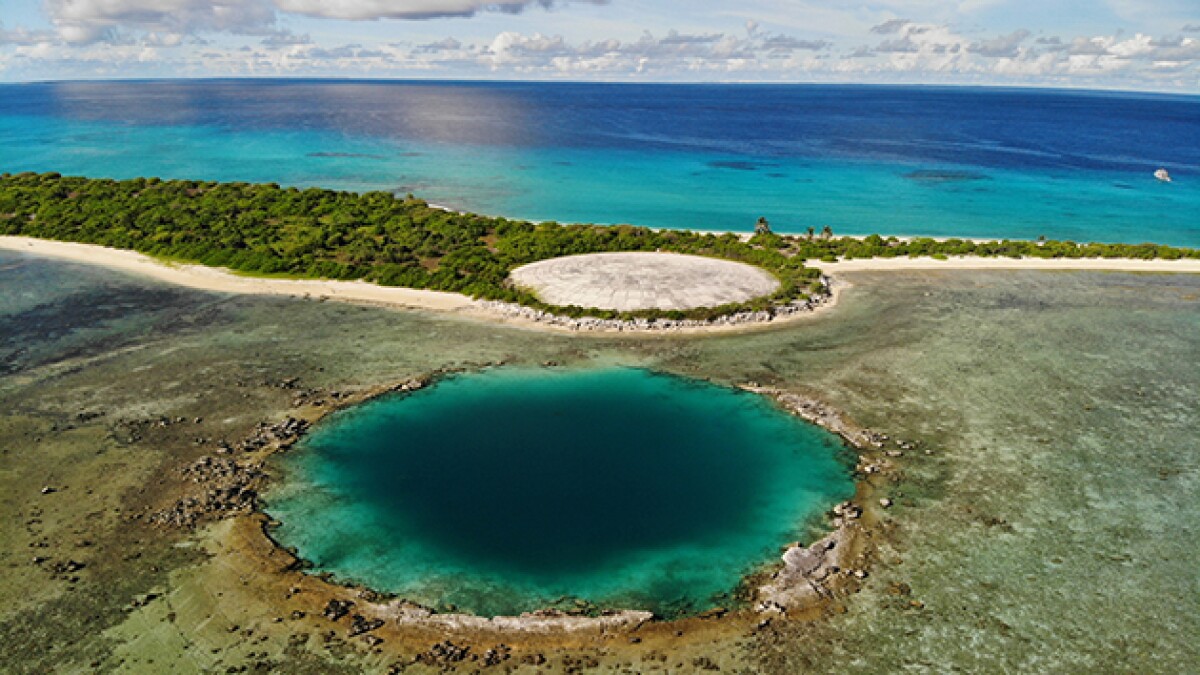
Rory McKeown March 25, 2026,
https://metro.co.uk/2026/03/25/climate-change-unleash-huge-nuclear-dump-buried-concrete-dome-sea-27664599/
A Pacific Island is sitting atop a nuclear time bomb that could pollute the oceans for centuries.
Scientists have discovered that a concrete structure built to contain radioactive waste from Cold War-era testing is showing signs of deterioration.
The site, known as Runit Dome, sits on Runit Island in the Enewetak atoll in the Marshall Islands.
Although Runit itself is uninhabitable, the atoll is home to around 300.
The dome sits close to the ocean’s edge and rising sea levels and shifting groundwater bring seawater into close contact.
It dates back to a period of intensive nuclear testing. Between 1946 and 1958, the United States conducted 67 nuclear tests across Enewetak Atoll and Bikini Atoll, displacing more than 300 Marshallese people.
One test in particular, an 18-kiloton explosion known as “Cactus”, destroyed part of Runit Island and sent a mushroom cloud approximately six kilometres into the sky.
The Crater created by the Cactus explosion on May 5, 1958. It was later used as a burial pit to inter 84, 000 cubic meters of radioactive soil (Picture: US Defense Special Weapons Agency/Cover Media)
In the late 1970s, the 10 metre deep crater left by the blast was used to store more than 120,000 tonnes of radioactive soil and debris collected from across the atoll.
The site was then sealed with an 18-inch (46cm) concrete cap, forming what is now known as the Runit Dome.
More than five decades later, the structure is showing visible signs of ageing. Cracks have appeared across its surface, and groundwater is able to flow beneath it.
Researchers say this water moves in and out with the tides, potentially carrying radioactive material into the surrounding lagoon. Studies have also indicated that the dome is not watertight.
Ivana Nikolic-Hughes, of Columbia University and president of the Nuclear Age Peace Foundation, observed cracks during a visit in 2018 while measuring radiation levels.
‘These results provide further demonstration of the continuing impact of radioactive fallout on the Marshall Islands and will inform future work to understand how the presence of this isotope might affect current inhabitants and potential resettlement,’ she writes.
American officials have said the structure is not at immediate risk of collapse.
But experts have warned that some of the radioactive elements involved pose extremely long-term risks. Plutonium-239, used in nuclear weapons, remains hazardous for more than 24,000 years.
Arjun Makhijani, president of the Institute for Energy and Environmental Research, said no concrete structure could be expected to last even a fraction of that time.
He noted that cracks have already appeared within decades, highlighting the challenge of containing radioactive material over such long timescales.
‘There are already cracks in it in less than 50 years,’ he told Australian broadcaster ABC.
Scientists say the dome illustrates a broader problem. Certain places we regard as being safe spaces to dump toxic waste, may become less so due to climate change. If sea levels rise and rain increases, water and food supplies change.
What a recent court win reveals about the Trump administration’s unlawful attacks on climate science

Bulletin, By Rachel Cleetus | Opinion | March 18, 2026
The second Trump administration is taking its hostility to climate science to new levels. In addition to its rhetoric dismissing climate change as a con or scam, recently released government documents show how the administration is seeking to replace scientific facts with propaganda and disinformation.
The Environmental Defense Fund and the Union of Concerned Scientists recently won a court case against the administration which forced it to release of a trove of government documents related to a secretive “Climate Working Group” illegally convened by Energy Secretary Chris Wright. These documents show that the Trump administration secretly enlisted a handpicked group of climate contrarians to write a biased climate report specifically designed to undermine the EPA’s Endangerment Finding. This science-based finding establishes the known harms to human health and well-being from global warming pollution, facts that were clear in 2009 and even more so today, as affirmed by a recent National Academies report……………………………………………………………………………………………………………………………..
Propaganda and disinformation about climate science are now the official position of the US government. Meanwhile, scientists confirm that the world is on the verge of overshooting 1.5 degrees Celsius of global warming within the next few years. Costly and deadly climate impacts—extreme heatwaves, record-breaking floods, intensified storms, catastrophic wildfires—are worsening, and the risks of irreversible, multi-century harms are growing. And yet this deeply anti-science administration continues to prop up fossil fuel interests rather than protecting people’s safety and the health of the planet.
The successful Federal Advisory Committee Act lawsuit has resulted in some crucial wins, including shining a light on the Trump administration’s deceptive tactics to undermine climate science. . And the administration’s harmful actions will continue to be challenged in court. The Union of Concerned Scientists and the Environmental Defense Fund, together with many other groups, have recently joined a lawsuit challenging the unlawful repeal of the endangerment finding. Try as it might, this administration cannot bury the evidence of climate harms so readily apparent to communities across the nation. The American people deserve genuine solutions to the climate crisis, not more self-serving lies.https://thebulletin.org/2026/03/what-a-recent-court-win-reveals-about-the-trump-administrations-unlawful-attacks-on-climate-science/
Coastal erosion raises questions over protection for £40bn Sizewell C nuclear plant

The accelerating pace of coastal erosion after a damaging winter on the UK’s east coast has raised fresh questions over protection for a new £40bn nuclear plant under construction.
19 March 26, https://www.itv.com/news/anglia/2026-03-19/coastal-erosion-raises-questions-over-protection-for-40bn-nuclear-plant
Sizewell C is being built on the Suffolk coast, near the site of two previous nuclear power plants, with an operational and decomissioning timeline stretching for more than 100 years.
But a bruising winter along the coast, which has seen dozens of homes demolished before they fall into the sea, has led to concerns about the wisdom of building the plant on one of the fastest-eroding coastlines in Europe.
Sizewell C said the plant would be built on a “more stable section of the coast between two hard points” and an offshore bank of sediment known as the the Sizewell-Dunwich Bank.
Prof Sir David King, chair of the Climate Crisis Advisory Group, said a secure future for Sizewell lay in adaptable and robust defences.
“The question is no longer should it be built there, because it is being built; but rather ‘How do we protect it?’”, he said.
“I would be constructing a wall around Sizewell B and Sizewell C, and I would see the foundations for this wall going in quite soon.
“Build the foundations now so that in later years, as sea levels rise, we can build them all up to defend appropriately,” he advised.
The plans are for Sizewell C to be built on a platform approximately 7m above today’s sea level.
It will be protected by a sea defence structure more than 14m above today’s sea level, which will take the form of temporary sheet-pile sea defences during construction and will be replaced by permanent structures throughout the plant’s operational lifetime and decommissioning until 2140.
Sizewell C said the plant would be built on a stretch of coastline which had been shown by data to be “comparatively stable”, while the beach will also be enlarged and maintained to form a soft coastal defence.
It adds that it will all be adaptable, meaning if sea levels rise beyond predictions, so too can the defences.
But communities along the coast complain there is an inequality of defence.
While millions are being pumped into defences at Sizewell, others living elsewhere along the coast are being left to fend for themselves and there is a big debate on whether what happens at Sizewell will have an impact on neighbouring areas further down the line.
The campaign group Together Against Sizewell C believes planning approval should not have been granted without Sizewell C demonstrating it had a viable plan to protect the site from an extreme climate change scenario.
Chris Wilson from the group said: “Why was the modelling for flood-risk in the [development consent order] restricted to a site lifetime of 2140 when it was clearly evident that spent fuel would be on site beyond that date?”
“And why was it allowed to be based on an unchanging coastal geomorphology assuming that the protective sand bars… would remain intact throughout the full lifetime of the project?”
There have also been concerns raised about how the defence work to protect Sizewell C will impact further down the coast.
Local resident Jenny Kirtley said erosion had escalated in the past year “far more than anybody thought it would”.
“A worry will be when they start the work out at sea,” she said.
“There will be two jetties built and huge intake and outfall tunnels built under the seabed. We know what’s happened to Thorpeness already. Is this going to make to make it more difficult for Thorpeness? Will these sea defences cause more problems?”
The answers are inconclusive.
Robert Nicholls, professor of coastal adaptation at the University of East Anglia, has studied the coastline for many years.
“The effects of Sizewell become significant if we are forced to protect it”, he said.
“At the current time, Sizewell doesn’t need much protection. So probably I would argue it’s not having a huge effect on its neighbouring coasts, if it suddenly began to erode and you had to protect it, then it might start to have a big effect both on the coast to the north and the south.”
At the village of Thorpeness, 11 families have already lost their clifftop homes to erosion in the last few months.
Residents have been given permission to take matters into their own hands and are raising hundreds of thousands of pounds to place rock bags at the bottom of what is left of the sandy cliff.
But with millions being pumped into defences for Sizewell C, residents want support from the project to help secure their future too.
Dennis Skinner from the Thorpeness Community Interest Company said: “The scientists can do all the studies but, as we’ve seen in the last two months with the amount of erosion here in Thorpeness, I don’t think anyone can be certain about what impact different things are having up and down the coastline
“Sizewell C have got a budget in excess of £50bn, so contributing to Thorpeness will just be a rounding sort of figure.”
A spokesperson from Sizewell C told ITV News Anglia it was monitoring local coastal processes and the situation at Thorpeness.
“We’ve performed thousands of hours of flood risk modelling using the highest plausible estimates for sea level rise and therefore have the highest level of confidence that Sizewell C is in the right location,” they said.
“It’s located on a more stable section of the coast and […] drones are regularly producing 3D maps of changes, coastal erosion, and accretion […] If there are any unexpected developments, we will take action to address them.
“Our assessments show that the power station will be built to withstand a 1-in-10,000-year storm and 1-in-100,000-year surge”.
Roger Hawkins is desperately trying to save his house at Thorpeness from the inevitable erosion.
“We recognise that it’s impossible to defend the whole coast, and there are some areas where you’ve got areas of dense population like towns and docks and infrastructure like Sizewell C, where you can obviously need to have a hard defence.
“But at what point do you stop providing the hard defence?”
Humanity heating planet faster than ever before, study finds

Humanity is heating the planet faster than ever before, a study has found.
Climate breakdown is occurring more rapidly with the heating rate almost
doubling, according to research that excludes the effect of natural factors
behind the latest scorching temperatures. It found global heating
accelerated from a steady rate of less than 0.2C per decade between 1970
and 2015 to about 0.35C per decade over the past 10 years. The rate is
higher than scientists have seen since they started systematically taking
the Earth’s temperature in 1880.
Guardian 6th March 2026, https://www.theguardian.com/environment/2026/mar/06/humanity-heating-planet-faster-than-ever-before-study-finds
Global sea levels have been underestimated due to poor modelling, research suggests
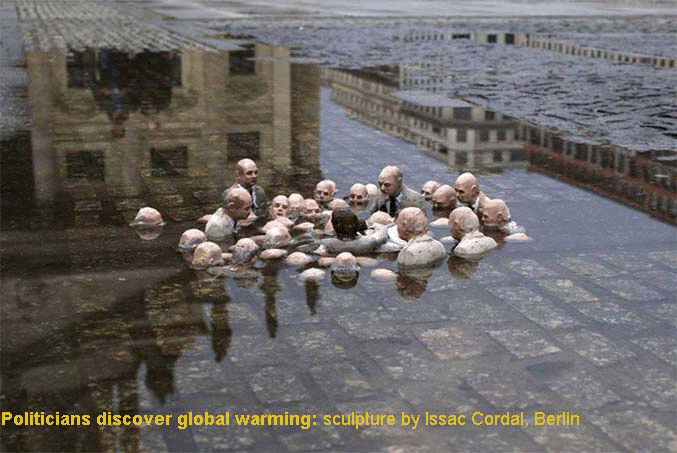
Sea levels around the world have been underestimated due to inaccurate
modelling, with research suggesting ocean levels are far higher than
previously understood. The finding could significantly affect assessments
of the future impacts of global heating and the effects on coastal
settlements.
Globally, the research found ocean levels are an average of
30cm higher than previously believed, but in some areas of the global
south, including south-east Asia and the Indo-Pacific, they may be
100-150cm higher than previously thought.
Rising sea levels are a major
threat to coastal communities across the world, and the UN
Intergovernmental Panel on Climate Change (IPCC) estimates that by 2100
levels may rise by 28-100cm. The latest research, published in Nature,
combined the analysis of 385 pieces of peer-reviewed scientific literature
released between 2009 and 2025 with calculations of the difference between
the commonly assumed and actual measured coastal sea levels.
The new
calculations reveal that following a relative sea level rise of 1 metre, it
is estimated that 37% more coastal areas will fall below sea level,
affecting up to 132 million individuals. “If sea level is higher for your
particular island or coastal city than was previously assumed, the impacts
from sea level rise will happen sooner than projected before,” said
Minderhoud.
Guardian 4th March 2026, https://www.theguardian.com/environment/2026/mar/04/global-sea-levels-underestimated-poor-modelling-research
1 This Month
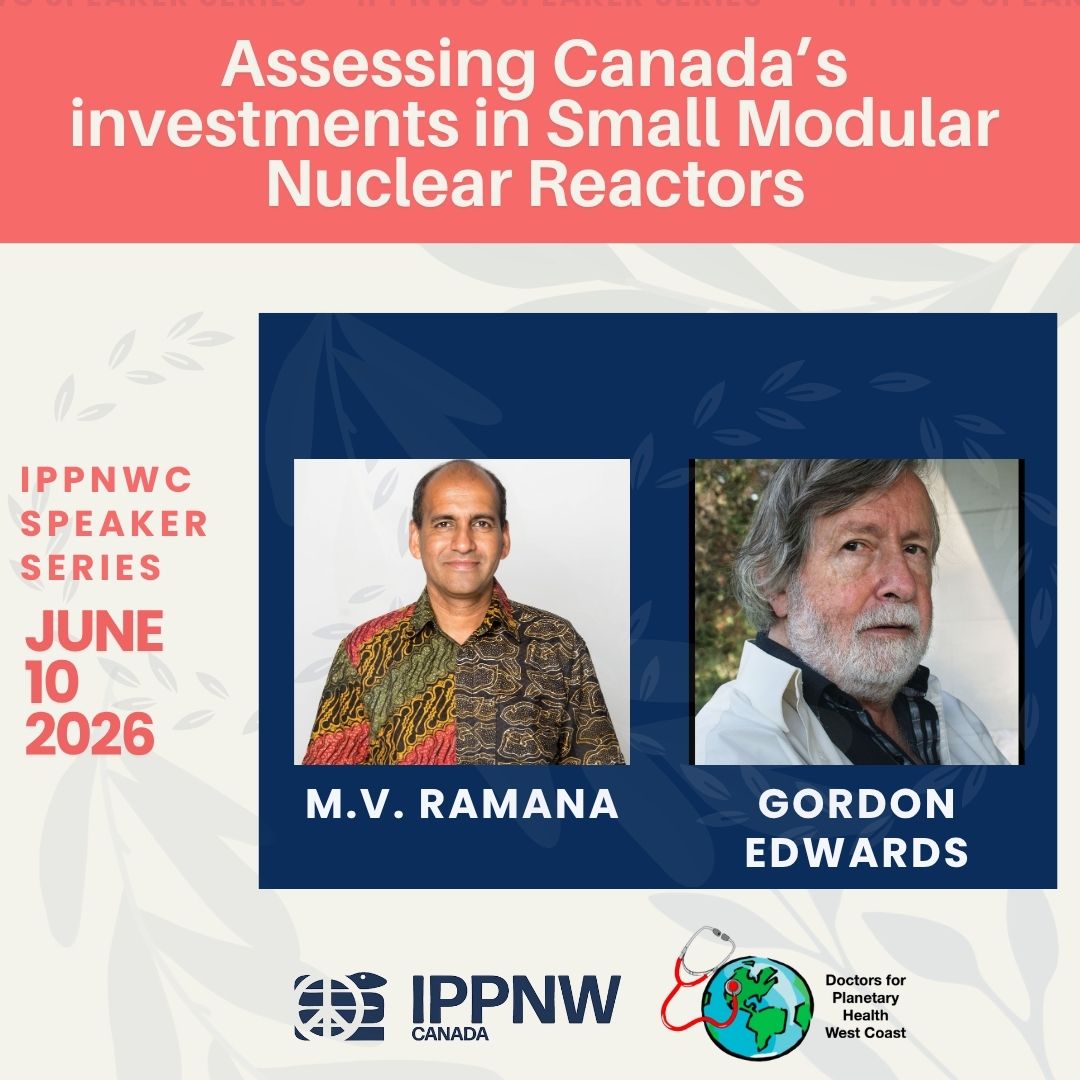
10 June – Assessing Canada’s Investments in Small Modular Nuclear Reactors – https://zoom.us/meeting/register/IiqHA5feRhaEBycOLNTJlA#/registration


Cuba Is Not a Failed State – It Is a Besieged State
PETITION: “Global Appeal to Endorse Palestinian Right of Return of Refugees”
To see nuclear-related stories in greater depth and intensity – go to https://nuclearinformation.wordpress.com
-
Archives
- June 2026 (89)
- May 2026 (306)
- April 2026 (356)
- March 2026 (251)
- February 2026 (268)
- January 2026 (308)
- December 2025 (358)
- November 2025 (359)
- October 2025 (376)
- September 2025 (257)
- August 2025 (319)
- July 2025 (230)
-
Categories
- 1
- 1 NUCLEAR ISSUES
- business and costs
- climate change
- culture and arts
- ENERGY
- environment
- health
- history
- indigenous issues
- Legal
- marketing of nuclear
- media
- opposition to nuclear
- PERSONAL STORIES
- politics
- politics international
- Religion and ethics
- safety
- secrets,lies and civil liberties
- spinbuster
- technology
- Uranium
- wastes
- weapons and war
- Women
- 2 WORLD
- ACTION
- AFRICA
- Atrocities
- AUSTRALIA
- Christina's notes
- Christina's themes
- culture and arts
- Events
- Fuk 2022
- Fuk 2023
- Fukushima 2017
- Fukushima 2018
- fukushima 2019
- Fukushima 2020
- Fukushima 2021
- general
- global warming
- Humour (God we need it)
- Nuclear
- RARE EARTHS
- Reference
- resources – print
- Resources -audiovicual
- Weekly Newsletter
- World
- World Nuclear
- YouTube
-
RSS
Entries RSS
Comments RSS
 nuclear-news